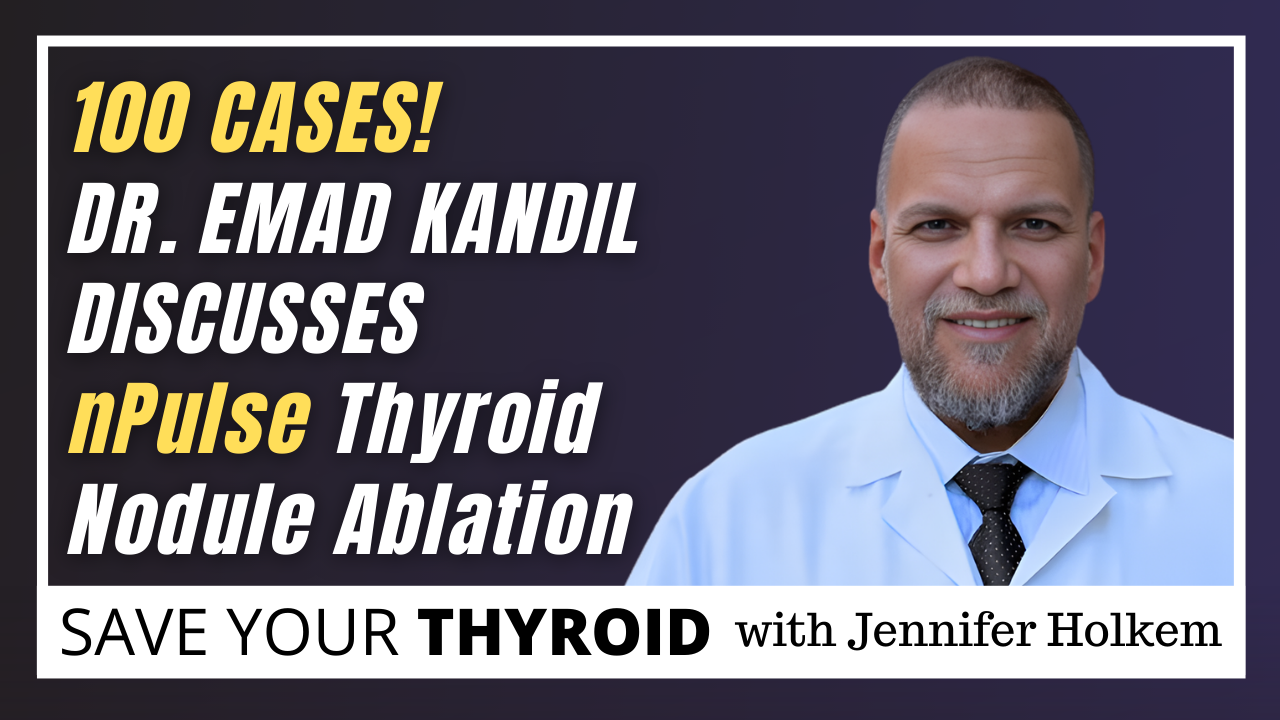
Escaping the "Danger Zone": How nPulse is Changing the Rules of Thyroid Preservation
Imagine sitting in an exam room and being told your thyroid has to come out.
Maybe your nodule has grown too large. Maybe it’s toxic, overproducing hormones and wreaking havoc on your body. Or maybe, like so many patients, you’ve been told the lump is sitting precariously close to the "danger triangle"—right up against your vocal cord nerve or carotid artery. For decades, the medical consensus in these scenarios has been identical: schedule the surgery, accept the lifelong need for synthetic hormones, and hope you aren't one of the many patients who end up with lingering swallowing issues.
Even with the rise of non-surgical ablation technologies, those high-risk locations have remained a massive hurdle.
Then came nPulse.
Recently on the podcast, I sat down with Dr. Emad Kandil, the Chief of Endocrine Surgery at Tulane University. Dr. Kandil has spent his career at the absolute forefront of thyroid preservation, having performed thousands of thermal ablations. But we weren't just catching up. We were celebrating a massive milestone: Dr. Kandil has now completed over 100 cases using nanosecond pulsed field ablation, or nPulse.
What he has learned from those first 100 patients is fundamentally shifting what is possible for thyroid care.
The Problem with Heat
To understand why nPulse is such a breakthrough, you have to understand how we currently treat nodules non-surgically. Technologies like Radiofrequency Ablation (RFA) and Microwave Ablation are incredible. They have saved thousands of thyroids. But they rely on thermal energy—heat—to destroy the nodule tissue.
When a physician is treating a nodule with heat, they have to leave a margin of safety. If a tumor is pressed right up against the recurrent laryngeal nerve, burning too close could cause permanent vocal cord damage. For massive nodules or toxic nodules, leaving even a fraction of that tissue behind means the problem isn't fully solved. The nodule might regrow, or the hyperthyroidism might persist.
nPulse removes the heat entirely.
Changing the Rules of Engagement
Instead of using thermal energy, nPulse relies on precise electrical pulses. These pulses create microscopic pores in the cell membranes, effectively shutting down the cells' internal machinery. It causes regulated cell death, known as apoptosis.
Because there is no heat, there is no thermal spread. The risk of injuring surrounding nerves or causing massive inflammation drops to near zero.
For the patient, this means the "danger zone" essentially disappears. Physicians can safely treat the absolute entirety of the nodule, achieving the kind of complete destruction that used to require a scalpel. Dr. Kandil noted that with this technology, he is finally able to treat toxic nodules completely, allowing patients to get off their thyroid-suppressing medications without losing their gland.
What the Procedure is Actually Like
When a new technology enters the scene, the unknown is always the scariest part for patients. What does an electrical pulse feel like?
Because the pulses can be uncomfortable, Dr. Kandil performs nPulse under light IV sedation. This isn't general anesthesia—there are no breathing tubes, and you aren't put completely under. You are simply placed into a relaxed, comfortable state where you don't feel or remember the discomfort.
For the doctor, sedation means they don't have to stop a treatment early because a patient is anxious or in pain. They can deliver the maximum, most effective dose of energy.
For the patient, the recovery is remarkably easy. Unlike thermal ablation, which often requires a prescription for steroids to manage the subsequent swelling and inflammation, nPulse patients wake up feeling fine. Dr. Kandil shared stories of treating patients who were recovered, discharged, and sitting in a local restaurant eating lunch just 30 minutes later.
And the results? They happen fast. While doctors typically wait three months to check the shrinkage from thermal ablation, nPulse patients are seeing dramatic, life-altering reductions in just one month.
Challenging the Cancer Narrative
Perhaps the most empowering part of Dr. Kandil's experience lies in his approach to thyroid cancer.
When patients hear "cancer," panic sets in. The immediate reflex—often pushed by traditional medical guidelines—is to cut the entire thyroid out. But well-differentiated, small papillary thyroid cancers are generally indolent. They are incredibly slow-growing, with mortality rates sitting near zero. Yet, the surgery to remove them triples a woman's risk for osteoporosis and permanently alters her metabolic health.
Dr. Kandil is using nPulse to challenge this paternalistic approach. If a small cancer can be safely destroyed with a needle, leaving the healthy thyroid tissue intact and returning a cancer-free ultrasound, why wouldn't we offer that to patients?
Stepping Into the Driver's Seat
The biggest obstacle facing nPulse right now isn't clinical; it's bureaucratic. Insurance companies are notoriously slow to catch up, often denying coverage for this emerging technology while happily paying for an invasive surgery.
But the landscape is changing because patients are refusing to accept "we have to cut it out" as the final answer.
If you have been told your nodule is too big, too close to a nerve, or too toxic for non-surgical treatment, it is time to ask better questions. The doctor giving you that advice might be an excellent physician, but if they don't personally perform non-surgical ablations, they cannot adequately advise you on them.
Seek out the experts. Educate yourself on the differences between RFA, Microwave, and nPulse. Bring that knowledge into the consultation room. The patients seeing these incredible, life-changing results didn't just get lucky.
They advocated for themselves.
To hear the full clinical discussion with Dr. Kandil, including his insights on insurance battles and where his practice is expanding next, hit play on this episode. And be sure to join our patient community at SaveYourThyroid.org to connect with others navigating this journey.

From Thyroidectomy to TAE: How One Woman Avoided Surgery and Kept Her Thyroid