
 Amazon Music
 Apple Podcasts
 Audible
 Castbox
 Deezer
 iHeartRadio
 PocketCasts
 RSS Feed
 Spotify
 YouTube
 Youtube Music
  Goodpods
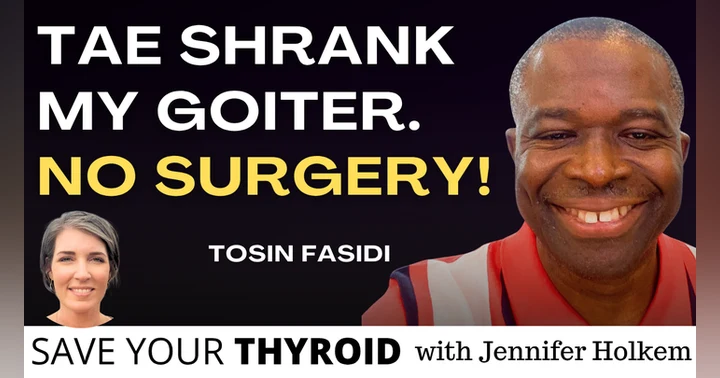
 How to Shrink a Goiter Without Surgery: Tosin’s TAE Success Story
In this episode of Save Your Thyroid, Jennifer sits down with Tosin, a patient whose routine checkup revealed a complex multinodular goiter that had quietly grown down into his chest. Facing a highly invasive sternotomy to remove the mass and the prospect of lifelong medication, Tosin leaned into his curiosity and began searching for alternatives. His journey led him from Houston to Florida to undergo Thyroid Artery Embolization (TAE) with Dr. Juan Camacho. Tosin shares the realities of his diagnosis, what it feels like to undergo TAE, the temporary side effects of recovery, and the incredible news that his goiter shrank by over 80% in just six months—allowing him to keep his thyroid completely intact and fully functional.
Can you shrink a large thyroid goiter without surgery? In today’s episode of Save Your Thyroid, Jennifer Holkem sits down with Tosin, a patient who successfully treated a complex multinodular goiter using an innovative, nonsurgical procedure called Thyroid Arterial Embolization (TAE).
If you’ve been told that a total thyroidectomy is your only option for a large or complex goiter, this conversation is for you. Tosin shares his entire journey—from the stress of the initial diagnosis and the fear of invasive surgery to discovering TAE and experiencing a significant reduction in thyroid size and normalized TSH levels.
In this video, you’ll learn:
What is Thyroid Arterial Embolization (TAE) and how does it work to shrink goiters?
How TAE differs from traditional thyroid surgery and thermal ablation (like RFA).
The reality of the procedure, recovery time, and long-term results.
The importance of seeking second opinions and being a proactive patient advocate.
If TAE is a new term for you, I highly recommend listening to my deep-dive interviews with Dr. Juan Camacho, a pioneer in this field, to understand the science behind this technology:
🔗 https://youtu.be/xqKPESXhEkM?si=c7ZqbRqFfrm6ZTPO
🔗 https://youtu.be/APcl0gqHgv0?si=eOHaaFNNg7oewtIO
TIMESTAMPS:
00:00 Introduction to Thyroid Health and TAE
00:53 Tosin's Diagnosis Journey
04:04 Exploring Treatment Options
07:47 The Decision Against Surgery
09:57 Discovering TAE as an Alternative
12:29 Understanding the TAE Procedure
15:09 Comparing TAE and Traditional Surgery
16:29 The Importance of a Collaborative Medical Team
18:38 Experiencing the Procedure: A Patient's Perspective
22:16 Post-Procedure Recovery and Initial Symptoms
24:50 Understanding the Procedure's Impact on Health
27:56 The Unexpected Success of the Treatment
29:24 The Role of Open-Mindedness in Patient Care
32:38 Empowering Patients: Seeking Alternatives to Surgery
Contact Dr. Juan Camacho: precisionimageguided@gmail.com
Key resources:
-Dr. Juan Camacho on BackTable Podcast:
https://youtu.be/qH-S_8_D4eY?si=A9imME1r7ELJvOAJ
-Clinical Registry (Protect Trial):
https://clinicaltrials.gov/study/NCT06868459?cond=thyroid&intr=embolization&rank=3
-Recent Publication:
https://pmc.ncbi.nlm.nih.gov/articles/PMC12301183/
This paper summarizes follow-up data from the first U.S. and international patients treated using the pressure-enabled technique.
PROTECT Registry PED-TAE Physicians:
https://docs.google.com/spreadsheets/d/1Xzj2PMN8BapM3JzYxbbj-84RT_zX44A852oboYCRP44/edit?usp=sharing
Disclaimer: None of the statements made in this or any other video by Jennifer Holkem or "Its me Jen again" should be considered medical advice.
Support the channel:
PAYPAL👉https://www.paypal.com/paypalme/itsmejenagain
VENMO👉https://account.venmo.com/u/itsme_jenagain
Affiliate links:
TOUPS AND CO👉https://toupsandco.com/jen
RIVERSIDE👉https://www.riverside.fm/?via=itsmejenagain
VAN MAN👉https://vanman.shop/?ref=itsmejenagain
BON CHARGE👉https://us.boncharge.com/?rfsn=7843863.50b9fa&shpxid=4137e8a5-8199-46cb-b71c-0f86d29924ff
Resources:
👉Podcast: https://www.saveyourthyroidwithjen.com/
👉Patient site: https://www.saveyourthyroid.org/
👉Private FB group: https://www.facebook.com/groups/saveyourthyroidnonsurgical
👉Patient Navigation: https://www.saveyourthyroidwithjen.com/p/patient-navigation-services/
#ThyroidHealth #ThyroidTAE #GoiterTreatment #NonSurgical #PatientStory #DrJuanCamacho #SaveYourThyroid #MedicalAdvocacy #ThyroidNodules #HealthJourney
Hosted on Acast. See acast.com/privacy for more information.
Its Me Jen Again (00:00)
You're listening to Save Your Thyroid with Jennifer Holkem your resource for the latest in thyroid preserving non-surgical treatments. My goal is to give you the clarity and confidence you need to make the best decisions for your health. On today's episode, we're diving into thyroid artery embolization, TAE, an innovative non-surgical method for shrinking massive goiters.
Our guest Tosin is here to walk us through his entire experience with the procedure.
we start, please hit that subscribe button and leave a review to help us grow the community. And if you need a primer on the science of TAE, be sure to check out the episodes featuring Dr. Camacho linked below. Today, however, is all about Tosin's journey, his recovery and his success. So let's get started. Welcome to the podcast Tosin.
Tosin Fasidi (00:53)
Thank you. Thanks for having me here.
Its Me Jen Again (00:56)
Well, I love talking with patients. This is one of my favorite things that I do. So I absolutely love that you were willing to join me today. Let's get into your diagnosis. Can you walk us through the moment when you first realized that something wasn't right? You had a complex multinodular goiter extending into an area of the chest that we call the mediastinum. What were your symptoms?
Tosin Fasidi (01:22)
Okay, so to do that I have to go from the beginning. was sometime in 2016. I was
checks and somebody observed that there was a growth around that. So I got my primary physician, got an endocrinologist, they did an ultrasound, a couple of biopsies.
And at that time it was like, okay, you've got multi-nodular thyroid. You know, it was asymptomatic. I didn't feel anything at that time. If they didn't do the CT scan, probably would never have known at that time. So we kept on testing, but the endocrinologist had at that time, he was of the opinion that look, just take it out. know, just take it out, forget about it, leave your life. And I'm like, taking it out means you get to take the pill for the rest of your life. They will probably take the.
Its Me Jen Again (01:57)
wow.
Mm.
Tosin Fasidi (02:16)
thyroid completely. So at that time I was adverse to it. So we kept on playing that. We would do the biopsies, the biopsies turned out negative and so on. So we kept on doing that. Afterwards, they retired. And that was when my primary doctor, Dr. Johnson introduced me to Dr. Shelley Mathur, who was an endocrinologist. So we sat down and talked about it. And she also had the strong opinion of not cutting it off.
Its Me Jen Again (02:43)
Mm.
Tosin Fasidi (02:43)
Then
at that time she introduced me to Dr. Boccalandro who specializes in alcohol ablation, which was another cool technique at that time. So we were talking about it. She looked at said, you need to do it twice. And then we said, okay, I'll go. didn't cover it. So I was like, okay, I would consider doing it at least rather than cutting it off. It looks like a cool technique. Then I had a pain at the left shoulder area.
Its Me Jen Again (02:57)
Mm-hmm.
Mm-hmm.
Tosin Fasidi (03:13)
And it was interesting. So I was like, don't know what's going on with muscle, but let's just do a CT scan. been a while. Then all of a sudden, I realized that this had grown down. So all the while, when you're doing ultrasound, it didn't show because they were looking here.
yeah, but the CT scan of the chest showed everything. I showed that it had gone down, pushing against the windpipe as well as the launch. So at that point, it was like, oh my
Its Me Jen Again (03:36)
Mm.
Tosin Fasidi (03:39)
So at that time, that was when I knew, okay, this is no longer the small little thing I was dealing with anymore. This is now major. And the funny thing was, even my neck wasn't affected because it kept on growing down.
Its Me Jen Again (03:50)
and
Wow, my goodness. I'm starting to have some thoughts of terror run through my mind about the pain I have in my back. That is wild. So was it like behind your shoulder or kind of like in the middle of your back?
Tosin Fasidi (03:57)
Hahaha ⁓
Yeah, behind my shoulder, that was when I felt the pain. was like,
OK, something, you you just feel that something wasn't right. But it could be muscle, but it was a good thing. It may not be totally related to it, but I just felt some that I felt. Let me look at it, because one of the things I understand now is I learn to listen to my body. And once I see something, maybe I'm getting honestly fatigued or so I start checking and say, OK, something is going somewhere.
Its Me Jen Again (04:15)
Thank
Yeah.
that's a good skill to have, very important. And I feel like, if we can temper our tendencies sometimes to get too worried with curiosity instead of worry, I think that's so important because it can lead us to points that we would have never otherwise reached. And I think, I mean, the fact that even your doctor wasn't noticing that there was anything below
Tosin Fasidi (04:48)
Ah-ah.
Its Me Jen Again (04:55)
The neck, that is just wild. You are the first person I've actually heard say that they had pain in their shoulder that was caused by a thyroid goiter. That's crazy. So you were offered surgery. Was the surgery that was offered to you just traditional thyroid surgery or was it something more invasive than that?
Tosin Fasidi (04:56)
Right.
Yeah.
Yeah.
From what I heard later, they said because of the size, was going to be something that would involve some cracking of some ribs to get to it because right now it's gone so big. So it's not the usual, what did they call it? The fire, the normal one that you go remove it. So yeah, exactly. Exactly. This one involves cracking because you have to get to it and remove it. So that was going to be invasive.
Its Me Jen Again (05:23)
Mm-hmm.
that
That's called a sternotomy
and that is a very invasive surgery where they open the chest, crack open the sternum and the ribs and yeah, highly invasive surgery.
Tosin Fasidi (05:50)
Absolutely.
So at that point, of course, for me, a lot of things were going on in my mind at that time. So first, understanding that I have this situation and the situation is such that something is pressing against my windpipe and my lungs. So I stopped all brisk exercises.
Its Me Jen Again (05:56)
Mm.
Tosin Fasidi (06:10)
Now I'm trying to get back to it now. So I stopped out because I didn't want to stress the heart or anything like that because at that point you just have to be careful. Then secondly, going through this surgery, I'm like, okay, what's going to happen? Am I going to handle it? You know, things like that. So it got to the point where a lot of things were crossing my mind. What's current and future.
Its Me Jen Again (06:12)
and
And you know, it's important to consider all of those things. When I speak to patients a lot of times who have been diagnosed with thyroid nodules and they've been offered surgery, there's this sense of panic and they tend to focus on just myopically on just right then what's in front of them, right? Which is, my gosh, I have this thyroid nodule. It's not supposed to be there.
I need to get it out and they're thinking about immediate and not long-term future, other parts of the body, other aspects of their health that are affected by the thyroid. And I see that it's not in all patients, it's in a lot of patients, it's a certain subset of patients where they focus so much on that at the expense of their long-term health that after the surgery, there's this huge regret there.
where they wish that they had taken the time to explore their other options, which is why I do what I do. I'm so passionate about helping people because I've seen that happen to so many people. let's talk about the most overwhelming part about hearing that as your treatment plan. What thoughts were going through your mind about how major of a surgery that that would be?
Tosin Fasidi (07:47)
Yeah, it was, you know, I always had this thing in my mind that I wouldn't do it unless it's life-threatening. Then all of a sudden this became very real. So it was like, okay, what if there was no other way I would have to go through this? So it was very clear. I couldn't leave it like that. So at that point I was like, this is going to take months to recover. Am I going to handle it? And one of the things I must say,
Its Me Jen Again (07:56)
Mm.
Mm-hmm.
Tosin Fasidi (08:15)
that made me very adverse to removing thyroid was I know a father of a friend who had that and he had to take the pills for the rest of his life. And the other time he stayed in Mississippi too, where that was when I was there. And he said during the hurricane Katrina, because all these pharmacies got shot and this medications ended and he couldn't refill. It was a very tense moment at that point. So you hear
Its Me Jen Again (08:36)
Yeah.
Mmm.
Tosin Fasidi (08:45)
those kind of things are like, no, don't want that. Right. So that's part of those things to say, look, we take different medications for different reasons, but they're still opiate, get over it. But when you know there is no hope that this is it, then that governs your decision somewhat. Then it's all it's.
Its Me Jen Again (08:58)
Yeah.
Tosin Fasidi (09:06)
And we'll talk about it later about doing due diligence and research and being open-minded. We'll talk more about it. But I think it's just also good to explore, understand some of these things too. Not just, yeah, the physician is good to validate data with doctors, but you also need to be curious and ask them questions and say, is this the only thing? And so on.
Its Me Jen Again (09:27)
Absolutely.
I love the aspect of curiosity because I think that's how we all grow is what is this? What is this possibly going to lead to? Or what am I possible alternatives or what's the possible cause? These are always that we learn and expand our knowledge. there's, think curiosity is a wonderful thing. So what drove you, was it your curiosity that drove you to seek alternatives beyond this traditional surgery because
⁓ You ended up having TAE performed, is a much less invasive approach. So how did you find out about
Tosin Fasidi (10:05)
So when I found out the new development with my thyroid and the situation, the first thing I did, I talked to Dr. Shirley Martha. said, you might need to this surgery. I said, let me talk to Dr. Boccalandro and see if the alcohol ablation that we talked about will still work. So went to Dr. Boccalandro. She said, no, it wouldn't work. She said.
Its Me Jen Again (10:27)
Yeah.
Tosin Fasidi (10:29)
It's too big for this. So alcohol adlation, ethanol adlation is for the smaller ones. It's a very neat alternative technique, but it's for smaller thyroid. So she now told me that there's somebody though she knows who might be interested in your case. Let me talk to him first and I'll let you know. I said, please talk to him. I said, I'm open.
You know, I'm open now and you know, so it was my openness to seek other things that made them go further. So she came back and said, yes, it seems interesting in your case, but it's in Florida. I said, Florida. I was like, I'm in Houston, the medical capital of the planet, and I have to go to Florida to do something. So initially I was red lost. But one thing she said was I want the best person to do this for you.
Its Me Jen Again (11:14)
Yeah.
Tosin Fasidi (11:22)
just somebody who will use you as an
Its Me Jen Again (11:25)
You know, it's interesting. There are some major cities out there that aren't actually the epicenter of medical innovation that we would think. ⁓ Yeah, so there's definitely innovation happening in places we wouldn't expect. So it's really funny that you say that because, you know, when I had
Tosin Fasidi (11:37)
Yeah.
Its Me Jen Again (11:46)
I had RFA performed on my thyroid in 2019 and in 2020. I ended up in Virginia and I would not have expected to go to Virginia. You know, you would think Houston, New York City, LA, some big major epicenter of medical institutions, but no, it doesn't necessarily work that way. so when you first learned about TAE,
Tosin Fasidi (11:54)
⁓ okay.
Exactly.
Its Me Jen Again (12:15)
which is not like any other technique that I've ever heard of. It's very different. What was your initial impression of that procedure and what details made you kind of consider it?
Tosin Fasidi (12:29)
So when I heard about it, the first thing on my mind was, OK, why has this not gone mainstream? Why is it still hidden? So that was my first thing. The first thing is that why is everybody not using this? Then I started. was curious. Then at that time, I think Dr. Komatsu already sent some of his YouTube. I mean, by the way, that thing is.
or some of the literature he does. He has this way. It's almost like he becomes a teacher and we're all his students. So if the patients are his students, he's the teacher, he's the professor. And he goes through. So he shared those things. The more I read about it, the more I got so engaged with it. Of course, I had guarded optimism, but I said, okay, for something to have taken this long. And also I have friends and family who were like, just check. But I said, this looks good.
Its Me Jen Again (13:03)
Mm-hmm.
Mm-hmm.
Tosin Fasidi (13:23)
I did the research, but the only thing that kept on nagging in my mind then was, why is this not well known? Why is this relatively unknown? So that made me do more research and digging in and everything I saw was positive. So was like, so why not? So it was until when I spoke to Dr. Camacho,
We had a conference and you he talked to everything. So he sealed the deal. He's very good at it. He has a way of, but it would also, he's also blunt. He mentioned about the 4 % chance of stroke because you're dealing with artery, but he mentioned how to mitigate it. So he put everything on the table. It went so far to refer me to his colleague who does a surgery. said he wanted me to be balanced. So that also increased the cut because when somebody's telling you, look,
Its Me Jen Again (14:07)
Mm-hmm.
Tosin Fasidi (14:14)
I wanted to do this, but I wanted to be balanced and not just me saying this. You know, of course, when I talked to his colleague, the doctor who was doing the surgery, he described the whole major procedure as well. And I said, OK, no, sir, I'm doing that. So that made me more determined not to go through that route. So it was objective, gave a lot of data.
Its Me Jen Again (14:30)
Yeah. Yeah.
Tosin Fasidi (14:39)
and information, was very reassuring. I asked a lot of questions. I always said, God, I think the only thing I didn't have to ask was why is it still eating? Because in my mind, I'm like, I'm going to Sarasota for a treatment from Houston. That was interesting.
Its Me Jen Again (14:54)
Mm-hmm.
So when you met with the surgeon, did he go into a deep explanation of the sternotomy and what the recovery would be like and all of the unknowns and issues related to that?
Tosin Fasidi (15:09)
It didn't go too dark on it because I knew that was already on the other side. But I think it gave enough for me to say, OK, we just knew the obvious that I wasn't going to go that route. So he mentioned the complications, the what it involves, the recovery time. We didn't talk too much. I think Dr. Kumach already covered that when he talked through it. and I just had the feeling that that
Its Me Jen Again (15:12)
Yeah.
Mm-hmm.
Mm.
Tosin Fasidi (15:34)
Procedure wasn't going to be the best for me at that time
Its Me Jen Again (15:38)
It's a very invasive surgery. I've met one patient who had that done. She was an elderly woman and had had that done many, many years in the past. And her thyroid had actually grown back on the other side because she had had the, I think the left side removed with the sternotomy and the right side had grown back and it had grown just as
Tosin Fasidi (15:56)
Okay.
Its Me Jen Again (16:02)
far down into her chest that she would have required a second sternotomy and she was no longer a candidate for it because she was elderly.
And she was like, I don't want to go through that again. It was just so significant, such a significant surgery. you know, Dr. Kamato and I actually recorded an episode last night about this procedure and he said, no surgeon is, you know, excited to crack open a patient's chest.
that's a very big surgery and you have to engage the cardiothoracic as well as the thyroid surgeon. So just a lot going on. well, let's get into you choosing TAE. How important was the medical team with Dr. Camacho and your endocrinologist back in Houston in helping you feel more comfortable with this?
Tosin Fasidi (16:29)
Great.
Its Me Jen Again (16:54)
new intervention that you feel was just hidden from everyone.
Tosin Fasidi (16:58)
Yeah, I think sharing of information, transparency. ⁓ When it comes to convincing people to do something, transparency is very important. Being open, risks, benefit, just laid out there. That was very, important for me because every question I asked was answered, they were
Its Me Jen Again (17:02)
Mm-hmm.
Tosin Fasidi (17:20)
it was clear they knew what they were doing. So the question is, even if you go wrong, you want to go wrong with people who understood what they were doing. So from that perspective, transparency, competency, and, you know, I won't say customer service, but I believe to be able to answer questions and being there very quick turnaround was amazing, both from Dr. Bukaladur.
Its Me Jen Again (17:28)
Yes.
Yes.
Tosin Fasidi (17:47)
Dr. Camacho's team, were awesome from that perspective. Because what had to happen was that they both had to work together. All my CT scans in Houston had to be done by Dr. Bokalager, so that I'll send it over to him. there was this kind of little dance. Then Dr. Shelley Mathur, my main endocrinologist, was also aware of everything. So it was kind of like a good dance across.
Its Me Jen Again (18:02)
collaboration.
That's wonderful. That collaboration spirit is so wonderful. When we hear from patients about those situations where you've got a doctor in one city or state collaborating with another one across the country, those are the best outcomes. When it's not, when it's the opposite where, I can't possibly have a conversation with another doctor who has a different opinion for me, that's when the patients end up frustrated and they decide,
this is not a doctor I can work with because they're not willing, like you said, to have an open mind to be curious. ⁓ So what was the experience of this procedure for you actually like?
Tosin Fasidi (18:40)
Exactly.
Exactly.
So the procedure was interesting in the sense that, you know, when I went, it's not, in fact, I tell people it's not surgery. If I, when I feel forms now, I would have to be like, you had surgery before? I'll be like, not really, because it was a less invasive procedure. So it was, you know, from the beginning, he was there, I Dr. Camacho. Then he told me, then he checked my neck. said, you're asymptomatic, you know, so, you know, seeing me face to face, he was like,
Its Me Jen Again (18:59)
Mm-hmm.
I'm
Tosin Fasidi (19:20)
This thing is not ever showing, but we know it's there. Then he told me that I was going to do the bigger one, that the smaller one is of no consequence. What I told him, he said, less is more, you know, in this situation. I said, look at it and I will just make the judgment call. I think it's better to do the two, get them over and done with. if you feel that after looking in detail yourself, then fine.
Then when I got there, they were very prompt, you know, got me reassured. The nurses there were good, very good at what they were doing. Perfect. Then when they got me in there, that place had these screens. It was almost like the Matrix, you know. I think they had a lot of screens. I think doing all the kind of city-guided things. It was like you're looking at the Matrix with all the screens. So I was like, okay.
Its Me Jen Again (20:08)
That's so
cool.
Tosin Fasidi (20:12)
It was cool. I you just see those crates and then you see those diagrams, almost like you're doing a CT scan continuously, right? Because as they were doing it, so you know that they were watching all the things you were doing as they were conducting it, as we're guiding through it. Now, from that perspective, it wasn't a full anesthesia. It was kind of like a twilight thing where I was going in and out. Did sleep much the night before, obviously, for you you know what you were going for. So I was
Its Me Jen Again (20:19)
Mm-hmm.
and
Yeah.
you
Tosin Fasidi (20:41)
going in and out of sleep, seeing everything going on. Then I'll see something that we're referring to the screen. So it was very technical because they were watching what they were doing on the screen while running it through the arteries. So it was smooth. Then when I came back, came to me and said, yeah, we did the two. Then he showed me the pictures. I see, it's all full-amble lies. I saw.
the way they showed the pictorial showing that. it was, and that was it. Got my, got the meds I was supposed to take to help with recovery because he told me, said, now the thyroid will be a little angry because there'll be, so the TSH level will be very low and everything. So he gave me those warnings and then we got all the things I needed. And I came in the morning, afternoon.
Its Me Jen Again (21:26)
Mm-hmm.
Mm-hmm.
Tosin Fasidi (21:41)
Early afternoon I was done. I was ready to go.
Its Me Jen Again (21:44)
Wow. Yes, for the viewers, ⁓ this is an outpatient procedure. So you're not being admitted to the hospital. You're not staying overnight. You're literally in the hospital for a few hours.
Tosin Fasidi (21:53)
No, no,
Yes, a few hours. So it was an outpatient type of thing. So did it and then I was out within a few hours.
Its Me Jen Again (22:06)
And so describe your experience immediately after because you did say the TSH dropped and did you have any symptoms of hyperthyroidism temporarily?
Tosin Fasidi (22:16)
Yes, I did, because what happened was that the heart rate, you know, went up and already they gave me some medication to take care of that, you know. So I had to do that. I had to keep an eye on it. then, Staff Mary, would be called. I was sending emails on a daily basis on, know, my heart rate, my blood pressure, all that. I mean, it was very good because I was always writing all the notes then call at times.
Then there was a time I felt, okay, this was looking unusual. She talked to Dr. Camacho, they decide what to do. So after a few, I think after like a week or two, the heart rate started going down, going down and I didn't need to take the medication anymore. Then things started improving. So the CSH was very low when I did the blood test. I mean, it was like 0.0 or something. I mean, it was really low because
Its Me Jen Again (22:44)
Mm-hmm.
Yeah.
Tosin Fasidi (23:13)
It just went off the chain. Then all of a sudden, then it started getting, then I noted that the heart rate was no longer elevated anymore. It was normalized after a week or two.
Its Me Jen Again (23:25)
And that's a completely normal experience to have after the symbolization because what's happened is the gland when they inject and I'll just give this really quick summary of the procedure. If you want to learn more about this viewers go and watch the interview I did with Dr. Camacho because he gives a very in-depth explanation. But basically the doctor will go in through the wrist feed a catheter up through the artery in the wrist up into the neck.
Tosin Fasidi (23:30)
Bye.
Its Me Jen Again (23:53)
And then in the thyroid, there are four arteries that feed the thyroid gland with blood supply. And so that catheter, he will inject very, very tiny particles into the artery, which closes it off and causes it to have a temporary blockage of the blood supply to the thyroid gland. Well, what that does is it actually causes this excess tissue to die because it's cutting off its blood supply.
which is what you want. You want all of that tissue that's grown down into the chest to die because then the body can reabsorb it and it shrinks. And so when that death of the tissue occurs, all of the thyroid hormone that's inside of that tissue is then suddenly released into the body. And that's why patients have this temporary period of time where they have hyperthyroidism, their TSH will go down.
they may feel some symptoms from that. And so you mentioned he did give you some medication to get you through that transition period. And then once things start to normalize over a period of time, you can taper off of that medicine. So tell us about the changes, even though you really didn't see anything in your neck and you didn't really have a lot of symptoms in your neck, what were the changes? Did you have any noticeable feeling of that shoulder, back pain improving?
Tosin Fasidi (24:58)
Right.
Yeah, it did. it still is. I think it's a muscle thing. It was more of a warning and it went better. Then there was a slip-up near that I did not know this contributed to. And that has changed a whole lot.
Its Me Jen Again (25:25)
Uh-huh.
Mm.
Yeah.
Tosin Fasidi (25:37)
so after a when I did my three months CT scan, in fact, it was so funny. Mary told me that when Dr. Camacho saw the pictures, it was like, holy cow, you know, it was like, it had shrunk by 60 % then within three months. Because what Dr. Camacho told me was that, you know,
maybe within three to six months, will shrink by 30 % and over time. Then within three months for it to have done that, that was like, it was amazing that it had gone that much to that point. The TSH at that time was still low, but it was getting up there. Then the six months, it was over 80 % shrunk. At that time, Dr. Camacho was like, I don't want to see you anymore. Just go. No, he was like, okay, you're discharged whether you like it or not.
Its Me Jen Again (26:22)
Success.
Yes.
Tosin Fasidi (26:24)
So yeah, because at
that time, my TSH had now gone to 0.8 or 0.75. So it has become normal for the first time in a long time. So even before that thing grew out of proportion, the TSH was going down. that was the, so this is the first time TSH would be normal in quite a while.
Its Me Jen Again (26:33)
Mm.
So there was probably
an aspect of that goiter that was hyperactive. Okay. Wow.
Tosin Fasidi (26:50)
Yes, it was. It was all
that well. that happened as well. So that was just amazing how that happened. In fact, it was so funny. After the three months, I was still telling Dr. Camacho that would I still need to do the ablation? Because before the procedure, those were some of the things we discussed that shrink it small enough to do other things to it that are, you know, whether it's the ablation or whichever one it may be.
Its Me Jen Again (27:18)
Mm-hmm.
Tosin Fasidi (27:19)
And he said, you don't need any of that anymore. So you don't need it. I asked Dr. Boccalardo, do I still need to do it? She said, no. So it was like, was a one for all treatment for me.
Its Me Jen Again (27:21)
you
Wow.
Wow, so it exceeded your expectations in that regard. Wow. My goodness.
Tosin Fasidi (27:34)
⁓ by wide margin. By wide margin. mean, it was
like, it was like more than I could ever imagine, you know, how we always thought, okay, we'll go for this and then do other things at the back end. And it was almost like, you don't need to do anything else. don't I don't think anybody want to touch you at this point, you're a fool.
Its Me Jen Again (27:56)
That's incredible. what do you think preserving your thyroid has done and avoiding major surgery has done for your quality of life or your energy or your wellbeing in general?
Tosin Fasidi (28:10)
It's been amazing because first of all, I didn't have to do something that would have taken me months to recover. Maybe I'll just be recovering now from the old effect of it. I was able to recover quickly. I when I did the procedure, I took that day off, went to Florida, did it, back by Monday, I started working remotely. I was back. Then...
Its Me Jen Again (28:30)
Mm-hmm.
Tosin Fasidi (28:32)
you know, being able to know that my thyroid is there, I don't need to take anything for the rest of my life on the thyroid. The thyroid is now fully functional. It's no longer a thyroid disease. It's good. That was, that's awesome too. And you know, just understanding and then understanding that there are other ways to do some of those things. And it's made me start being even more inquisitive than I was before that, okay.
have an open mind, know, think outside the box. But again, respect the physicians, but understand that they are not everywhere. There are certain things they will know and there are certain things they may not have access to. just they're showing the willingness that you're willing to think outside the box. might be more comfortable sharing that with you, because I think the biggest problem with some of the physicians is they think
Its Me Jen Again (29:07)
So.
Mm-hmm.
Tosin Fasidi (29:24)
patients are not interested in those things because of the element of risk. But when you say, I'm open to other techniques, they'll be more open with that. that just, you know, that just gave me that feeling that, okay, medicine has gone a long way from the traditional side and it's good to always keep abreast of what's going on.
Its Me Jen Again (29:45)
You know what I love about these other types of procedures, these non-surgical techniques, is that for people who are interested in wellness, and I mean wellness in the sense of diet, lifestyle, supplements, all of these things that people do to improve their health that are maybe not considered mainstream medical science, but there's a lot of science to support those activities. ⁓
Tosin Fasidi (29:51)
right.
Yes.
Its Me Jen Again (30:13)
I love the fact that when someone has something like what you experienced, that is a very significant thing that needs to be addressed, that is not going to be able to reduce on its own or through lifestyle or diet, there is an intervention that can be done where you are not going to have a lifetime.
Tosin Fasidi (30:34)
Right.
Its Me Jen Again (30:39)
supply of thyroid medicine that you're going to be dependent on, relying on. You're not going to lose a vital organ. You're not going to have this very invasive, surgery with high degree of morbidity associated with it. This is a very complimentary strategy for those of us in the community of holistic health and wellness. And while it is not a holistic type of thing to be talking about a medical intervention,
It's very, very complimentary. so I just like to throw that out there because there are some people who are just like, well, I'm just going to, I'm going to try my lifestyle interventions first. And I think that lifestyle interventions are fantastic. do so many things myself, you know, ⁓ red light therapy, grounding, healthy eating, exercise, supplements, sunlight exposure, all the things that everybody's talking about today on all the podcasts.
Tosin Fasidi (31:06)
Yeah
brain.
Its Me Jen Again (31:34)
at the end of the day, sometimes that's not enough and you need a medical intervention. so I think that that curiosity and that open-mindedness is key. And that being willing to do your own research today is so important so that you can find these alternatives. So I would like to ask you for any of the patients who are watching, who are facing a diagnosis of a large goiter,
Tosin Fasidi (31:39)
That's true.
Its Me Jen Again (32:02)
and they've only been offered surgery, what is the single most important piece of advice that you would give to them?
Tosin Fasidi (32:09)
I would tell them, knowledge is power, right? Knowledge is power. And being open-minded is not a bad thing. Just say, just be open to other possibilities. And it's not an insult on your doctors to seek second opinion. You're not saying you're a doctor. You're not saying you know better than that. All you're doing is looking at all the options because ultimately you're the one who would
Its Me Jen Again (32:19)
Mm-hmm.
Tosin Fasidi (32:38)
have to live with the consequence of the decisions. So go seek other opinions and find out, not like, but go to qualify people to go to do. So my thing is this, this TAE has done wonders and has minimal risks to it. The only reason it didn't come is because of the time it takes to approve certain things here in the United States compared to Europe where it's been there for a while. And it's having applications in other places like, know, Fibroid,
Its Me Jen Again (33:03)
Mm-hmm.
Tosin Fasidi (33:08)
or prostrate and even eventually across the body too. So this is a very good thing and I would encourage people to go for it. I've already told some of my doctors that I went to and friends I said, look, if you have prostrate issues or fibroid issues, don't do surgery, just do this unless there's a particular reason you wanted to use it for. are some cases where it's unavoidable, maybe due to some other things as well.
But when it comes to just that on its own, isolated, go for it. Be open-minded. be open-minded.
Its Me Jen Again (33:46)
I love that. Thank you so much for sharing your experience with us today, Tosin. It's been a pleasure talking with you.
Tosin Fasidi (33:52)
It's an honor. mean, I believe in giving back. When I experience something, I love to share that. And I'm glad to have this opportunity to discuss it and look forward to spreading the good news further.
Its Me Jen Again (34:06)
That wraps up today's episode. If you found this valuable, please like, subscribe, and share it with someone who might benefit.
you can find links to everything we discussed in the show notes below. Find a physician, discover treatment options, and join our patient community at saviourthyroid.org. To stay up to date on new episodes, resources, and expert insights, be sure to subscribe to my mailing list at saviourthyroidwithjen.com. It's the best way to stay connected and informed. There you can also find all podcast episodes,
and book a one-hour patient navigation consult for personalized guidance on your next steps. As always, please remember this podcast is for informational purposes only and is not a substitute for professional medical advice. No endorsement is given or implied for any specific product, treatment, or physician mentioned. As always, consult with a qualified healthcare professional for your individual needs. Thanks for listening and I'll see you next time.