
 Amazon Music
 Apple Podcasts
 Audible
 Castbox
 Deezer
 iHeartRadio
 PocketCasts
 RSS Feed
 Spotify
 YouTube
 Youtube Music
  Goodpods
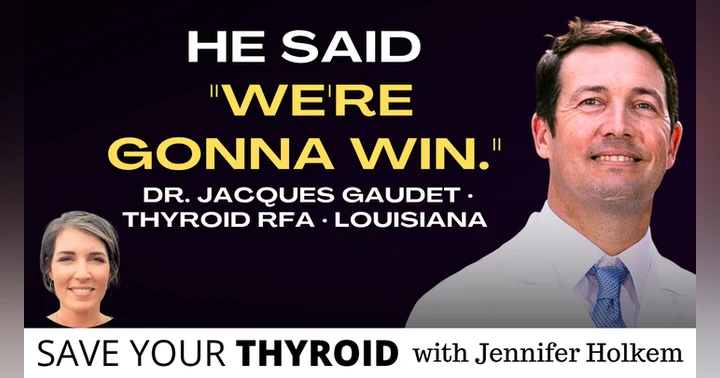
 A Surgeon's Case for Patient Advocacy and RFA | Dr. Jacques Gaudet
What does it take to bring cutting-edge, nonsurgical thyroid care to patients in smaller, underserved communities? In this episode, Jen sits down with Dr. Jacques Gaudet, a board-certified otolaryngologist and head and neck surgeon at Southern ENT Associates in South Louisiana, to find out.
Dr. Gaudet traces his passion for thyroid care and ultrasound back to his medical training in the aftermath of Hurricane Katrina, when resource-scarce conditions pushed him to master diagnostic ultrasound on his own terms. That same persistence eventually led him to become the second physician in the entire state of Louisiana to offer thyroid RFA — not to chase a trend, but to give his patients real options.
In this conversation, Dr. Gaudet and Jen cover:
Why ultrasound expertise is non-negotiable for anyone performing RFA
How he counsels anxious patients newly diagnosed with thyroid nodules
What success actually looks like after RFA — and why symptom relief matters more than perfect numbers
How to know if a total thyroidectomy recommendation is truly warranted
Where thyroid care is headed for the next generation of surgeons
Whether you're newly diagnosed, weighing your treatment options, or just trying to understand what questions to ask your doctor, Dr. Gaudet's grounded, patient-first perspective is exactly what you need to hear.
What happens when a highly trained Head and Neck Surgeon decides that the best tool for a thyroid nodule isn't a scalpel?
In this episode, we sit down with Dr. Jacques Gaudet, a board-certified Otolaryngologist at Southern ENT Associates. Dr. Gaudet shares his journey from training in the resource-scarce aftermath of Hurricane Katrina to becoming the second physician in Louisiana to offer Thyroid Radiofrequency Ablation (RFA). We discuss why he views himself primarily as a patient advocate, the critical role of advanced ultrasound expertise in performing safe RFA, and how he helps patients navigate the anxiety of a new nodule diagnosis.
If you’ve been told to "watch and wait" or that a total thyroidectomy is your only option, this conversation will equip you with the knowledge to advocate for your own thyroid health and explore minimally invasive alternatives.
In This Episode, We Cover:
The Making of an Advocate: How a "trial by fire" medical residency post-Hurricane Katrina shaped Dr. Gaudet's resourceful, patient-first approach to medicine.
The Surgeon-Sonographer Advantage: Why a surgeon's intimate knowledge of neck anatomy combined with expert ultrasound skills is crucial for safe and effective RFA.
Redefining Success: Why complete disappearance of a nodule isn't always the goal, and how RFA dramatically improves cosmetic and compressive symptoms.
Navigating the "Gray Zone": How to manage anxiety when diagnosed with an indeterminate nodule, and why "we're going to win" is the mindset you need.
Accessible Care: How bringing cutting-edge non-surgical options to smaller communities like Thibodaux, Raceland, and Houma is changing the landscape of thyroid care.
Episode Chapters:
0:00 Introduction to Patient Advocacy in Thyroid Care
1:26 Impact of Hurricane Katrina on Medical Practice
5:05 The Role of a Patient Advocate
7:40 Shifting Perspectives on Thyroid Surgery
9:09 Bringing Radiofrequency Ablation to Louisiana
12:47 Quality of Life and Non-Surgical Options
14:35 Importance of Ultrasound Expertise
17:08 Navigating Thyroid Anatomy in Procedures
20:35 Patient Stories and Building Trust
23:15 Comforting Patients with New Procedures
27:07 Measuring Success in Thyroid Treatments
30:04 The Evolution of Thyroid Care
34:57 Advice for Patients with Thyroid Nodules
Connect with Dr. Jacques Gaudet:
🌐 Website: Southern ENT Associates
📍 Locations: Thibodaux, Raceland, and Houma, Louisiana
Support the channel:
Enjoyed this episode? Subscribe to Save Your Thyroid for more interviews with the world’s leading experts in thyroid-saving technology.
PayPal: paypal.me/itsmejenagain
Venmo: @itsme_jenagain
Partner Links & Discounts:
🌿 Toups and Co: toupsandco.com/jen
🎙️ Riverside: riverside.fm/?via=itsmejenagain
🧴 Van Man: vanman.shop/?ref=itsmejenagain
💡 Bon Charge: us.boncharge.com/?rfsn=7843863.50b9fa&shpxid=4137e8a5-8199-46cb-b71c-0f86d29924ff
Patient Resources:
👉 Podcast Website: saveyourthyroidwithjen.com
👉 Patient Education Site: saveyourthyroid.org
👉 Private Facebook Group: Join the Community
👉 Patient Navigation Services: Book a Consult
Disclaimer: The information provided in this podcast is for educational purposes only and is not a substitute for professional medical advice, diagnosis, or treatment. No endorsement is given or implied for any specific product, treatment, or physician mentioned. Always consult with a qualified healthcare professional regarding your individual medical needs.
Hosted on Acast. See acast.com/privacy for more information.
Its Me Jen Again (00:00)
You're listening to Save Your Thyroid with Jennifer Holkem the podcast where we explore the science and decisions behind modern thyroid care.
today we're looking at what it means to be a true advocate for patients in a medical system that often defaults to the way things have always been done. We often assume that doctors adopt new treatments because they like new gadgets.
But more often, the most impactful changes come from a doctor who simply refuses to accept that a major surgery is the only answer for the person sitting in front of them. To guide us today,
I'm talking to Dr. Jacques Gaudet a board certified otolaryngologist and head and neck surgeon at Southern ENT Associates, serving patients in
Thibodeau, Raceland, and Homa. Dr. Gaudet's career is marked by a high standard of excellence. He was the recipient of the George G. Lyons Excellence in Otolaryngology Award and a three-time winner of the LSU ENT Resident Research Award. But beyond the accolades, Dr. Gaudet is a physician driven by persistence. He was the second doctor in the entire state of Louisiana
to bring thyroid RFA to his community. Not because he was chasing a trend, but because he was committed to doing the right thing for the patient in front of him. Dr. Goday, welcome to the show. Let's get started.
Dr Jacques Gaudet (01:26)
Thanks for having
Its Me Jen Again (01:26)
so as I was reading about you, I saw all of your experience with LSU, your training, and then you mentioned to me off camera that you had some experience as a physician in the aftermath of Hurricane Katrina, and that that's a big reason why you're so interested in thyroid care and ultrasound. How did practicing in that high pressure
resource scarce environment, shape your approach to patient care.
Dr Jacques Gaudet (01:54)
So I was a third year medical student when ⁓ Katrina hit in New Orleans and I was a medical student at LSU there. it obviously changed how medical education and medical care was delivered around us. As I progressed and ultimately chose to stay in New Orleans for my residency with the great LSU ENT program, how we delivered our medical care had changed. For years we were at stable, big hospitals centered almost completely in New Orleans with
hospitals that had long-standing ENT care. And we became a regional program because New Orleans was a very different city in the aftermath of Hurricane Katrina. We became a regional program with satellite hospitals in lots of different places, many of which had never had ENT care before us. So we, in a lot of ways, had to reinvent the wheel at a lot of those places. And we did lot of great care. We had great leadership with our chairman, Dr. Nuss, Dr. Poe, Dr. Jalillo, Dr. McWhorter, really
held everything together, but keeping things moving functionally in some of those satellite hospitals was difficult. We all knew that ultrasound guided fine needle aspiration of a thyroid nodule was step one, but getting that was in some ways almost impossible and frequently very difficult. And so talking with patients and counseling them through care was a challenge knowing that step one in diagnostics may not really happen. ⁓
Its Me Jen Again (03:11)
Mm-hmm.
Dr Jacques Gaudet (03:12)
after trying to navigate that for a while, it became pretty clear to me that if I wanted to provide that service for my patient, I was gonna have to learn how to do it myself. I always was interested in thyroid care and thyroid surgery, but learning that next step was important. So I befriended some general surgeons, some radiology tech, some ultrasound tech, some radiologists, all of which had some varying levels of ultrasound experience and kind of learned on my own.
I had some great faculty teachers along the way. One of them, after I had obtained a little bit of experience, gave me the clearance to take the ultrasound to the ENT office. So we started doing ultrasound guided fine needle biopsies in the office there to help our patients. And from then I was hooked. And as I finished, I took the ultrasound course from the American College of Surgeons, like most of us do, and ⁓ started translating that into my practice. And it's become.
one of the most gratifying things of what I do as an ENT.
Its Me Jen Again (04:08)
So I was curious about the size of the communities where you practice. Are they relatively smaller communities?
Dr Jacques Gaudet (04:15)
So several small cities, but a relatively big, patient catch area. we're kind of centered between New Orleans, Baton Rouge, and Lafayette. So the parishes in Louisiana, we don't have counties, we have parishes, that we serve roughly about 300,000 people, but a fairly scattered 300,000.
Its Me Jen Again (04:37)
Gotcha. Yeah. And those patients need care, even though they're not in a major city area. They're scattered all across this wide area and they need care just as much, if not more in some cases than those who live in a major city center. And so I think it's great that you are bringing this next level kind of care to these communities. Let's talk about you being a patient advocate because you mentioned that's something you're really passionate about.
⁓ You mentioned that you see yourself as a persistent patient advocate. Tell us about a time where that persistence really paid off for a patient who was told that they had no other options besides surgery.
Dr Jacques Gaudet (05:19)
So one patient comes to mind, it's not a thyroid case, but I think it speaks to what you're talking about. I had a patient who has since become a friend. He is a father to one of my classmates in high school. He had multiply recurrent, fairly aggressive skin cancers, one of which had spread to a lymph node and a nerve kind of right along his jawline.
We thought it would be a pretty straightforward resection. ⁓ it planned and performed a big cancer surgery, a neck dissection parotidectomy to remove the tumor. In the process of that, we identified very extensive what's called perineural invasion, which is growth of tumor along the nerve. Well, fortunately, it's not something commonly seen in thyroid cancer, and that's kind of the center of what we're talking about today, but it is pretty common. And in the process of removing that tumor, we...
Its Me Jen Again (06:02)
Mm-hmm.
Dr Jacques Gaudet (06:06)
chased this perineural invasion for hours, sending small specimens of normal looking nerve, ultimately ending very close to this patient's spine. ⁓ And intraoperatively, I called about 10 different head and neck surgeons I know to get opinions, and we got everything that we could safely clear out. In the process of figuring out what to do next for him, I think I called every radiation oncologist in the South because I knew
Its Me Jen Again (06:15)
Mmm.
Dr Jacques Gaudet (06:32)
that this was going to be a tough one with presumed microscopic disease next to this patient's spine And luckily, I got in touch with some really good radiation oncologists at MD Anderson who offered him a fairly cutting edge treatment called proton therapy. And he received proton therapy, that was four years ago. He is now 86 and we ran a 5K together about two months ago. So, ⁓
Its Me Jen Again (06:46)
Mm-hmm.
That's crazy! That's fantastic!
Dr Jacques Gaudet (06:59)
He's a rock star and it's a, you know, work hard and sometimes light shines on you the right way. And I'm really happy for how things turned out for him.
Its Me Jen Again (07:10)
Wow, that's incredible. You know, I think every patient wants a doctor that's gonna be rooting for them and pulling for them every way possible, especially in the operating room. So thank you for sharing that really incredible story. Let's go back to your residency days. So if you could go back to your cell and talk to yourself during your residency where you were focused on these really complex surgeries like what you just described, what would that version of you think about
today's version of you where you're doing essentially an operation on a thyroid nodule with a needle.
Dr Jacques Gaudet (07:50)
On its face, most of us in residency are looking to operate a lot. We're looking to learn how to operate. We become surgeons because that's what we want to do. As I learned more and more about thyroid disease, even then, it became pretty clear to me that less is more. Thyroid nodules are very common. You know this better than most. And with something that common, we should always lean towards less aggressive.
Its Me Jen Again (07:55)
Yeah.
Mm-hmm.
You
Dr Jacques Gaudet (08:16)
The difference then was less was biopsy and watch. And one of things we get to talk about today that there's some pretty cool less options now that there weren't then.
Its Me Jen Again (08:20)
Mm-hmm.
Yeah,
that's great. Yeah. I see the tide shifting. I think that, you know, like 10 years ago when I started my diagnostic journey in the world of thyroid nodules, it was very, it was this idea of it's no big deal to just take it out, you know, just take out your thyroid. It's not that important. And now we're starting to see this shift towards like you said, less is more so.
I appreciate that perspective. So you're the second RFA physician in the state of Louisiana. What hurdles did you have to clear to be able to bring this to your practice and make it a reality for patients in Southern Louisiana?
Dr Jacques Gaudet (09:09)
Honestly, the biggest hurdle for me was time and data. At my core, I'm a small town guy, small town doctor. I want to real, complex, heavy duty medicine, but I'm still an ENT doctor in Thibodeau, right? So I want to be cutting edge, but my role here is not to set the trends. My role and my practice is to study from the
Its Me Jen Again (09:16)
Yeah.
Mm-hmm.
Dr Jacques Gaudet (09:35)
guys and gals that are doing the research and once they show that something works, it's my job to learn it, get good at it, and offer it to my patients. So, you know, this was when I finished residency, radiofrequency ablation was kind of talked about in whispers, like in the corner. Nobody really wanted to mention it. A few people were doing it. The first time I really saw it starting to gain a little steam, I went to the World Thyroid Congress in 2019 and
Its Me Jen Again (09:54)
Really?
Dr Jacques Gaudet (10:03)
People were talking about it, it wasn't center stage, but it was happening. The numbers weren't great, meaning there wasn't a lot of patients that had had it yet, or at least that wasn't widely available. So it made sense to me. Like the concept works. Or obviously it works, the concept made a lot of sense, but I wasn't willing to take that risk. So for me, once... Right, right.
Its Me Jen Again (10:26)
Right, yeah. In the beginning, it is a big risk for you
as a physician, especially, you know, when you're taking that risk on yourself as a private practice physician, you own the equipment and the, you know, the business, that's a huge risk. And I have to
Dr Jacques Gaudet (10:41)
You
own the patient, you own the complications, and then you own the outcomes, right? So I wanted real actionable data from physicians and centers that I knew to show me, this is good, you should do it. Once I had that, frankly, the hurdles at that point were pretty easy. I just had to figure out which device I was gonna use, how I was gonna get it set up.
Its Me Jen Again (10:45)
Yeah,
Mm-hmm.
Dr Jacques Gaudet (11:05)
Luckily that roadmap had kind of been laid out already.
Its Me Jen Again (11:08)
The World Congress of Thyroid Cancer is a meeting I haven't yet been able to attend, but I've been interested in potentially going. I've been to the ATA meeting two or three times and have participated virtually in the THYCA conference, but World Congress of Thyroid Cancer is one I hope to make it to at some point.
Dr Jacques Gaudet (11:25)
It was
a fantastic meeting. have been trying to get back to another one. Unfortunately, life and schedules and kids haven't allowed yet, but I'll make it back at some
Its Me Jen Again (11:30)
Mm-hmm.
Right.
I think it's so awesome that you heard about it in 2019, because that's actually the year I had my first RFA procedure. So I was one of those numbers in that. And at that time, was like nobody was doing this for thyroid cancer. It was strictly for benign nodules. And even then, benign nodules were mostly like, you know, the ones that were over a certain size were off the table. Well, I was one of those people also.
I had this 75 ml nodule that was choking me to death. And I don't know how much you know about my particular background situation, but it was just robbing me of my quality of life. And so I feel like super passionate about this topic because that is the number one thing I see patients struggling with is their quality of life is just in the toilet. And you know, when you're, when you're serving a community,
that is more remote, scattered across these smaller communities, sometimes they need something besides surgery. so was it worth your persistence to bring a non-surgery opportunity to those particular patients?
Dr Jacques Gaudet (12:47)
absolutely.
Initially, I had a few patients who came to me, kind of like you described your history in 2019. In the interim between 2019 and 2023, I had a handful of patients come to me and ask me. At the time, I wasn't set up to do it, so I would refer to the only other Dr. Kandil who you've had on your podcast. A other times, I've sent some to ⁓ Dr. Kandil and he's taken great care of.
Its Me Jen Again (13:03)
Yeah.
Dr Jacques Gaudet (13:11)
But it's nice now. I had a patient last week, 26 year old, hyper functioning nodule, no risk factors, benign. Is there any other option in surgery? Yes, there is. And now I can offer those up front. And it's not a complicated offer. I can show them where we're going to do the procedure. It's the same ultrasound machine that they saw me do their biopsy with. There's a level of comfort there.
Its Me Jen Again (13:20)
Mm-hmm.
Dr Jacques Gaudet (13:40)
I think it makes it easier for the patient to grasp the concept of what we're trying to accomplish. And I think it builds a rapport and a trust between myself and the patient and the patient and me.
Its Me Jen Again (13:50)
Absolutely. And that patient you just mentioned, that's a really young woman. You said it was a female, right? That's a young woman. She probably does not want radioactive iodine. She may have children in her future. That's a big deal that we have an alternative to that to offer to those patients. ⁓ Well, you've talked a bit about ultrasound and that's so important for surgeons today. A lot of people don't realize how important it is for surgery.
Dr Jacques Gaudet (13:55)
Yes, yes,
Absolutely.
Its Me Jen Again (14:19)
that you be able to lay out ahead of time where everything is and what you're going to be doing through ultrasound. So can you explain for the viewers why it's so critical for the person performing RFA to be an expert in ultrasound?
Dr Jacques Gaudet (14:35)
So I think of that in kind of three different veins. There's the diagnostic certainty. So ultrasounds come in all shapes and sizes from all sorts of different sources. Some are trustworthy, some aren't. If I'm the person that's going to take care of you, I need to be able to 100 % trust what I see. And I think
Its Me Jen Again (14:50)
Yes, indeed.
Dr Jacques Gaudet (14:59)
there's no better way to do that than to be the one putting the ultrasound probe on your neck and looking at the pictures live. So all of my patients that show up to me for really any head neck pathology, certainly any thyroid pathology, they're getting an ultrasound by me in the office. And I think that that's an incredibly valuable thing for me. In terms of the RFA procedure itself, being able to competently and safely do that procedure, you better be a good sonographer.
You know, you need to see it not just where you think the tip is, you need to see the tip definitively and you need to see everything around the tip of that instrument definitively to be able to safely and effectively perform that procedure. And the third thing, we've kind of alluded to this a few times. Now think it's important for us as proceduralists and thyroid diagnosticians and surgeons, it's really valuable to be able to offer everything.
Its Me Jen Again (15:55)
Mm-hmm.
Dr Jacques Gaudet (15:55)
Like
to say, we can do this, we can do this, or we can do this, and we can do this here. And I think there's some value to having that all in one package for the patient.
Its Me Jen Again (16:01)
Mm-hmm.
The RFA probe actually, use this, pardon my little visual aid, but I just, think it's so cute. Dr. Angela Mazza sent this to me. She's in Florida and she made this and I thought it was just so cute. So I use this for visual aid when I do patient consults to help patients navigate their treatment journey. And then this is like my little makeshift.
RFA probe or whatever kind of probe we're talking about. The tip of the probe, for those of you who are new to this topic, when we're talking about RFA, that's what's delivering heat into the thyroid nodule. They're going to put that probe wherever that nodule is and they go through the middle, which is called the ithsmas, into whatever side of the thyroid the nodule is. The tip of that probe is delivering heat.
Dr Jacques Gaudet (16:35)
Love it.
Its Me Jen Again (16:58)
Dr. Gaudet explained why it's so important to know exactly where your probe is because of that heat and what it could possibly do if you don't know exactly where it is.
Dr Jacques Gaudet (17:08)
So the thyroid is at the crossroads of a lot of important stuff in the neck. So the thyroid sits on top of the windpipe, the trachea, right down the middle. And on either side, there are the great vessels, the carotid artery, which are the closer to the thyroid, and then the jugular vein to the side of that. Behind the thyroid is the esophagus. And in the groove between those two is where the nerve, called the recurrent laryngeal nerve, runs from the chest up to the voice box. That's the nerve that moves our vocal cords in and out.
talk and breathe. Obviously all those things I said are pretty important. In thyroid surgery it's well defined how we find those things, how we protect those things. There's still risks. I tell everybody the same thing. There's still risk to all those things just from being in the neighborhood. But we know what we're doing. That's why we train to do what we do. The same risks all apply and the same anatomy all obviously still applies when you're doing a radio frequency ablation. And knowledge and
Its Me Jen Again (17:42)
Thank
Dr Jacques Gaudet (18:02)
comfort with where things are three dimensionally and being able to definitively see where you're delivering the energy or both paramount to safe RFA. As a surgeon, we're all very comfortable with where the problems are. Like land mines, you see those things in your sleep sometimes. Like you know where the problems are gonna be. The tricky part
Its Me Jen Again (18:14)
and
you
Dr Jacques Gaudet (18:29)
about going from a surgical approach to an ultrasound guided approach, you can always see your knife. Learning to always see the tip of your radio frequency probe, especially as you start burning things, that's where being a really skilled and practiced sonographer becomes important.
Its Me Jen Again (18:48)
Absolutely. You want to know exactly where you're looking at that tip of the probe and on an ultrasound. For those of us who've had the pleasure of actually seeing what this looks like, you know, and thyroid on ultrasound is just a bunch of gray blobs. But when you're ablating that nodule, the tip of the probe where it's hot, it actually gets bright white. And you can see these little tiny bubbles developing on the screen.
and sometimes they'll even pop. And that's such an odd experience when you're in that procedure. But one of the things we always tell patients is that's actually a good sign. That's what my doctor told me. It's a good sign. means it's working. And so we celebrate when we have the pops, right?
Dr Jacques Gaudet (19:26)
I would agree.
I prepare my patients. It might sound like some popcorn in there, but ⁓ like you said, that's a good thing.
Its Me Jen Again (19:37)
Yeah, yeah. So let's talk about when you're doing a procedure, when you've got a patient specifically when you're talking to patients who've just been diagnosed with thyroid nodules and they don't have any kind of awareness of...
the fact that 90 to 95 % of these are benign. They're usually very anxious. I have counseled so many anxious, ⁓ particularly young mothers who saying, you know, I have children, I'm scared they're gonna have their mother taken away from them and I have to reassure them that this is very, very likely just a nuisance and not a death sentence. So how do you help these patients that are anxious about
their thyroid nodules or having a procedure like RFA where the standard of care for years has been surgery, but now we have this newer procedure available. How do you help them not be so anxious about all of that?
Dr Jacques Gaudet (20:35)
I'm gonna have a long answer for that one. So I'm gonna answer it in a few different ways. In general, as you said, 95%, the vast majority of patients who have a thyroid nodule are gonna be just fine. So the first thing is I say, we're gonna get to the bottom of it, but no matter what it is, we're gonna be okay. The second part I'm gonna tell you is a story. So I had a patient,
Its Me Jen Again (20:37)
That's okay.
Dr Jacques Gaudet (20:59)
a gentleman about my age. He was a shrimper and I live on the Gulf Coast so we have a lot of fishermen and such. Super nice guy. He came in and he had just had his first son. He was seeing me. He had several small nodules that weren't particularly high risk but he was nervous. He was pretty worried about them. I said, alright buddy, we're going to do your ultrasound and we're going to take some samples and see what we got.
got suspicious results and had a few little nodes that looked a little funny. Ultimately, it turned out to be a papillary carcinoma with some metastatic adenopathy. And I told him, said, you're going to be okay. I said, this is not news that anybody wants to hear. And he had the normal reaction that everybody does when you talk about a scary diagnosis. worry about themselves and they worry about their kids. doc look, I need to be alive. I just had it.
Its Me Jen Again (21:51)
Right.
Dr Jacques Gaudet (21:56)
just had a son like, we need to get this. And I said, we're gonna win. And for papillary cancer, that doesn't make me some sort of magician, we win. Like this is a cancer that we almost always win on. And I said, we're gonna be okay. And his response, I still chuckle when I say it, he said, as long as I'm alive, you never have to buy shrimp.
Its Me Jen Again (21:58)
Yeah.
Ha ha ha ha ha ha
Dr Jacques Gaudet (22:20)
That was
12 years ago. I haven't bought shrimp. He's doing fine. And so I share that story sometimes with patients that are particularly anxious because he was a relatively high risk scenario and he's completely perfect with no issues at all. So that's kind of how I approach that part. I focus upfront on, look, you have a nodule. Does it meet criteria for biopsy or not? Obviously, I've talked about that on this podcast before.
But once it does, there's really only one answer. We sample it and then we make a decision after that. So I try and get patients comfortable with the idea of, see what you have. I'm not really scared of it, but we need to get an answer so we can make our next determination. Most patients are pretty good with that. And then once we get past that, the next part of your question was, how do you get somebody comfortable with the idea of a kind of new in-office awake procedure?
The in-office stuff, think, as ENTs, we're kind of uniquely qualified for. Most of us are doing balloon sinuplasties and that sort of thing in the office, which frankly is a lot more difficult to get patients numb for sometimes than these thyroid procedures. But what I tell patients is, we've already done the biopsy. You know the first step. I'm going to put the ultrasound on your neck. We're going to inject a little numbing medicine. I typically inject numbing medicine for my FNA, so they've experienced that.
Its Me Jen Again (23:41)
Mm-hmm.
Dr Jacques Gaudet (23:42)
I let that work for a little while, and then we inject some more numbing medicine around the thyroid. And I typically do use preoperative medications. I'll typically use Benzos or pain meds preoperatively for my in-office procedures, for both my nasal procedures or my thyroid procedures. ⁓ That usually makes them a little more comfortable. Tell them it's like having a martini before we make it to the back room. Then we'll inject them, and basically it starts like a biopsy, so it's something they've experienced and are pretty comfortable.
Its Me Jen Again (23:56)
Mm-hmm.
Dr Jacques Gaudet (24:09)
And then one of the most surprising things to me out of my relatively nascent RFA journey is how little pain people have. ⁓ I was frankly, on my first one, I remember being shocked. I thought I gave her pretty good injection around the capsule. mean, there are a lot, know what I'm doing. I injected in a good bit of medicine and I burned a really big nodule and
Its Me Jen Again (24:19)
Yeah.
Dr Jacques Gaudet (24:36)
she didn't feel it at all. I was like, that's pretty cool. And that's been more often than not, that's been my experience. I don't know what your other guests have said, but that's been more often than not what I've seen.
Its Me Jen Again (24:50)
It's really, it's shocking to me how comfortable the procedure can be. You know, I do have patients who have said, I mean, we have 14 and a half thousand patients in our community now. So we do have cases where people are like, I don't think he numbed me enough. You know, I'm a little bit, it was uncomfortable or, you know,
just the location of the nodules in a really sensitive area. And if that's the case, it doesn't matter how much numbing you put, it's gonna be uncomfortable to a certain extent. But the vast majority of patients are just like, I can't believe this was so easy. I mean, the biopsy sometimes is even more uncomfortable than the procedure. The benzos do help, you know, having a patient
have that calmness, I'm sure helps for you as well. And it just, I personally, hearkening back to my experience, I personally did not even know the procedure had started for about half an hour until he asked me, how are you doing? And I said, I'm just waiting on you to get started. So it's, it's amazing that you can do this in the office and, and it's relatively comfortable and relatively quickly recovered from. So.
Dr Jacques Gaudet (25:52)
else.
Its Me Jen Again (26:03)
So, wonderfully, I loved that story you shared about your patient and the shrimp and kind of a little bit jealous to be honest with you. Because shrimp is like one of my favorite foods and I grew up, my grandparents lived in Houston and I would frequently
Dr Jacques Gaudet (26:13)
If you ever doubt it, come check with I Got Plenty.
Its Me Jen Again (26:23)
⁓ ride with them between here, North Alabama and Houston and we would always stop and eat at Landry's and have all the fried seafood. So, love that part of the story. Let's talk about when you've treated someone with RFA and you're trying to gauge success of this procedure because this is a common thing we see with patients who are just learning about the procedure.
Dr Jacques Gaudet (26:30)
Mm-hmm.
Its Me Jen Again (26:51)
They want to know why we don't often see 100 % reduction of the nodule, disappearance of the nodule. Why are we okay with 50 to 80 % reduction of a thyroid nodule? How do you gauge success?
Dr Jacques Gaudet (27:08)
So it depends on timeframe. So the way I kind of think about things is I'm typically going to see patients at a month, then somewhere between three and six, and then somewhere after that. And I'm hoping for 25, 50, 75. 25%, 50%, 75 % reduction in nodule size. If we've done that, I would call that a win. The interesting or funny thing, depending on how you want to word it, there's some patients with pretty big nodules, like cosmetic change kind of nodules that I've done where we've got a
Its Me Jen Again (27:21)
Mm-hmm.
Mm-hmm.
Dr Jacques Gaudet (27:38)
At the first visit, we've got a 15 % decrease and the cosmetic change is gone. And the globus is gone. And it went from, you know, four by two by two to 3.5 by 1.5 by 1.5. Nothing dramatic. You can't see it in their neck and the patient doesn't feel it when they swallow anymore. So we kind of already won. But obviously we want to see the numbers match up with what we expect.
Its Me Jen Again (27:44)
Yeah.
Mm-hmm.
Dr Jacques Gaudet (28:07)
but ⁓ that's kind of how I define it. And for my hyperthyroid patients, which we're doing more and more of those for that indication now, typically I'm telling them, I'm hoping for your blood work to normalize in something like three to six months. That's what I'm telling.
Its Me Jen Again (28:19)
Yeah.
Yeah, I find that the symptom relief and the cosmetic relief, the qualitative things, right? Those are the things that we really ultimately care about the most, even though sometimes we can get fixated on the numbers, right? Like, did it go from an orange to a ping pong ball or a ping pong ball to a kidney bean? I mean, those are really great things too. It's not to diminish that because, I mean, like, for example,
Dr Jacques Gaudet (28:23)
So that's.
Its Me Jen Again (28:51)
went from 75 to six. That's a huge reduction and not common either. I don't know why I was so blessed by God to have that kind of reduction because I know that's not common. But in three months I had a 50 % reduction and like you said, I couldn't see it anymore. I couldn't feel it anymore. I could sleep. I could eat all of those qualitative
Dr Jacques Gaudet (28:55)
impressive.
Its Me Jen Again (29:19)
⁓ measurements of my quality of life were improved. So I love that. I love that so much. well, let's talk about the availability of non-surgical treatment options for thyroid nodules. It's here now. Like it's, I've been talking about this for, this is my seventh year talking about treating thyroid nodules without surgery.
So it's now it's here, it's part of the armamentarium of treatment options for thyroid nodules that's here to stay. How do you think that's going to change things for the new surgical residents coming up at your alma mater? How are they gonna view thyroid care differently than maybe you did or the people who came before you?
Dr Jacques Gaudet (30:04)
I would answer that by looking back to look forward. If we look 50 years ago, spot on your thyroid, spot on my surgery schedule mentality, right? So it would steal whatever, however you want to word that. You saw us, we got better with diagnostics. We started seeing routine ultrasound use. FNA came along, but it was not where it is now. You saw surgical rate for thyroid decrease.
Its Me Jen Again (30:14)
No.
Dr Jacques Gaudet (30:31)
We were operating on less thyroid nodules. Then we'll go to like 20 years ago, everybody's doing ultrasound guide to find needle aspiration. You're starting to hear about molecular diagnostics like Anderson's doing them, Sloan Kettering's doing them, but man, I can't molecular testing. Thibodaux, what? That wasn't happening then. You started hearing about watching weight, active surveillance. They were doing a little bit of that in Asia.
Its Me Jen Again (30:53)
Mm-hmm.
Dr Jacques Gaudet (30:56)
Certainly wasn't happening much in the US at that point. Where we are now, like you said, basically everybody's using not just ultrasound, guided fine needle aspiration with good cytopathology. Almost everybody's using molecular diagnostics. That alone takes a lot of thyroid nodules off the table for surgery. A lot of patients who before would have required it don't require it anymore. We're seeing the push towards non-surgical management.
Its Me Jen Again (31:10)
Mm-hmm.
Right.
Dr Jacques Gaudet (31:24)
and active surveillance now along with non-surgical management are both in the ATA guidelines. That was not the case 20 years ago. they're gonna be by default observing a lot more patients. So a lot more patients will get to keep their thyroid. And I see the role of non-surgical management growing as well. And I think that's gonna be a function of those of us that are doing it, doing it well. We need to continue to get good outcomes like those that set the stage for us.
And so when they look back at the data in 20 years, they're going to say we made a difference and it was a positive one. And if we can do that, that's going to keep happening.
Its Me Jen Again (32:02)
I love that. And I feel like in the future, we're going to look back on the decades of surgery for benign nodules almost as barbaric because now we'll be able to see it's so easy in a lot of cases to preserve the thyroid gland. That's not to say that it was wrong or harmful that they did those surgeries. They were doing the best they could. Right. Right.
Dr Jacques Gaudet (32:26)
It was what we knew. It was what we
could do. it was done in the interest of patient safety because of limited diagnostic information. If you had a two centimeter nodule, you know, maybe it was a cancer, maybe it wasn't. We didn't have a real good way to tell you. ⁓ And so a lot of patients got surgery. And that was one of the things that kind of frustrated me at the beginning of my thyroid journey is when we would do a really awesome, great hemithyrodectomy.
Its Me Jen Again (32:31)
Yes, absolutely.
Mm.
Right?
Yeah.
Dr Jacques Gaudet (32:55)
and you get the path back and it'd be benign. And you're like, all right, we did a great surgery. Did we help the patient? I mean, the patient's good. They don't have a complication. The nodule that we were worried about is out. But what if we hadn't done anything? The patient probably would have been okay too. So, filtering the nodules through the algorithm that we use now, I think is gonna continue to push patients towards...
Its Me Jen Again (32:57)
Right. Yep.
Yeah.
Dr Jacques Gaudet (33:19)
non-surgical intervention, it patients just getting observed or radio frequency ablation or similar technologies.
Its Me Jen Again (33:27)
I love too that we now have, you were talking about, we were talking about how, you know, the patient anxiety can be so high when they're first told they have a thyroid nodule because they're thinking about other cancers. We're thinking about cancers that are deadly in other parts of the body. That's the basis for comparison, right? So now that we're learning all of this and we have all of these testing and treatment modalities,
and we're seeing the safety of leaving these things alone and just looking at them or treating them non-surgically, we can see the proof is in the pudding there that these nodules really are, for the most part, not harmful. And that's so reassuring to be able to see there are different parts of the body that have different issues. And this is the one that we don't have to be quite as concerned about in a lot of cases. are...
Unfortunately, you know, there can be gnarly thyroid cancers out there.
Dr Jacques Gaudet (34:26)
There certainly are.
Usually those are ones that we can pick up. If you're seeing somebody who's done a lot of thyroid work, usually we're gonna pick up one that was pretty quick. Not every time. You get some surprises. But I don't feel bashful telling a patient with a new thyroid nodule that we're gonna win. We just gotta figure out how we win. Like it might be nothing. It might be me sticking an ultrasound on your neck and saying come see me in two years. You're gonna be just fine. And it might be us talking about a pretty big surgery.
Its Me Jen Again (34:34)
Yeah.
Dr Jacques Gaudet (34:57)
Either way, you're be okay. We just gotta figure out how to get you there.
Its Me Jen Again (35:01)
I love that we're going to win. That's the perfect slogan. That's fantastic. So let's then let's kind of wrap this up with what is one thing that you would tell every patient with a thyroid nodule? What's one thing you would want them to know before they agree to a total thyroidectomy? Because a lot of patients, when that's recommended to them, they think that's their only choice.
Dr Jacques Gaudet (35:26)
Can I answer with a few things? So I'm going to suggest that A, be as certain as possible of your diagnosis. So why am I requiring a total thyroidectomy? There are certainly patients that need a total thyroidectomy. Probably, I don't know if I have one on the schedule this week, but there's a pretty decent chance I have one on the schedule.
Its Me Jen Again (35:28)
Of course, of course this is a podcast.
Right.
Mm-hmm.
Dr Jacques Gaudet (35:51)
But why? Do I have nodules on both sides that are both suspicious? Do I have a one-sided cancer that's big enough that it's likely going to require post-operative radioactive iodine? Do I have a lymph node that requires a more aggressive surgery? Do I have compressive symptoms that are pushing enough and really attributable to both nodules? I know that was a really long one thing, but if that's being recommended, make sure we have a really good reason to be doing
Its Me Jen Again (36:21)
Yeah, I think it's really becoming more common these days for patients to educate themselves, to ask for a second opinion, and to not feel like that that is a, know, especially here in the South, we don't want to offend our doctor. We don't want to their feelings.
Dr Jacques Gaudet (36:37)
Right, we're gonna see them at church.
We're gonna see them at church and we're gonna see them at the grocery store so they're worried if they make us mad. I tell all my patients that look, there's nothing wrong with the second opinion especially in the thyroid world because we got time. None of these things go quick. So they want to talk to anybody else by all means. That's always a wonderful thing. In general, if you asked me what would you tell to somebody with a new diagnosis of a thyroid nodule just in general, I would tell you
Its Me Jen Again (36:43)
Exactly!
Yes.
Mm-hmm.
Dr Jacques Gaudet (37:07)
Do your homework. There's wonderful podcasts like this. There's a billion resources out there. It's a little hard to not get overwhelmed, but the basics aren't hard to find. And I think if you read the basics, you'll feel pretty good about where you're at. then don't ignore it. Like get it evaluated. Go talk to a doctor. Find a doctor you trust that does a fair amount of this. Might be a general surgeon, might be an ENT, it might be an endocrinologist, might be your family doctor or OB, but find somebody who's really comfortable
Its Me Jen Again (37:13)
Right.
Totally.
Dr Jacques Gaudet (37:36)
and educated and up to date with thyroid work. And then, like I said, about 16 different ways now, it's going to be okay. You do those two things, you'll end up in some good hands and we'll get it figured out.
Its Me Jen Again (37:50)
Absolutely love it. Okay. How can patients find you if they live in any of those regions where you're located if they want to come see you?
Dr Jacques Gaudet (37:58)
So our website is SouthernENT.com and just contact us through that and we can get you set up for an appointment.
Its Me Jen Again (38:07)
All right, I love it. Well, thank you for joining me today, Dr. Gaudet.
Dr Jacques Gaudet (38:10)
Thank you, Jen. That was great.
Its Me Jen Again (38:12)
That wraps up today's episode. If you found this valuable, please like, subscribe, and share it with someone who might benefit.
you can find links to everything we discussed in the show notes below. Find a physician, discover treatment options, and join our patient community at saviourthyroid.org. To stay up to date on new episodes, resources, and expert insights, be sure to subscribe to my mailing list at saviourthyroidwithjen.com. It's the best way to stay connected and informed. There you can also find all podcast episodes,
and book a one-hour patient navigation consult for personalized guidance on your next steps. As always, please remember this podcast is for informational purposes only and is not a substitute for professional medical advice. No endorsement is given or implied for any specific product, treatment, or physician mentioned. As always, consult with a qualified healthcare professional for your individual needs. Thanks for listening and I'll see you next time.