
 Amazon Music
 Apple Podcasts
 Audible
 Castbox
 Deezer
 iHeartRadio
 PocketCasts
 RSS Feed
 Spotify
 YouTube
 Youtube Music
  Goodpods
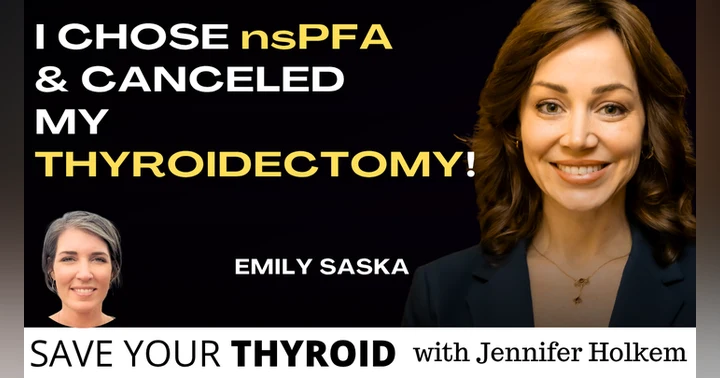
 82% Nodule Reduction Without Surgery: Emily’s nsPFA Success Story
For most thyroid patients, the path from diagnosis to treatment moves fast — sometimes too fast to stop and ask whether there's another way.
Emily Saska's story started with a back scan. An incidental finding. A nodule she had never felt, never thought about, and never seen coming. Within weeks it was growing rapidly, visibly bulging in her neck, and she was sitting in an exam room being referred directly to a general surgeon — with no mention that any other option existed.
Emily went home and Googled. She found the Save Your Thyroid community. She found Dr. Emad Kandil at Tulane University in New Orleans — an hour from her home in Baton Rouge. And she chose nanosecond pulsed field ablation — nsPFA — instead of surgery.
The procedure happened on her 37th birthday. Her last memory before counting backwards from 10 was telling Dr. Kandil: happy birthday to me, hope you had your coffee. Three days later she was in Puerto Rico with her family. All she had was a band-aid.
Six weeks post-procedure: over 65% reduction in nodule volume. Six months: 82%. Thyroid function perfectly intact throughout.
In this episode, Emily shares the full story — from incidental discovery to 82% success — and why she is now on a mission to make sure other patients know this option exists before they end up on a surgical schedule.
In this episode:
How a routine back scan became a life-changing thyroid discovery
Why Emily's nodule grew so rapidly after her biopsies — and what that means
What nsPFA + ethanol ablation combination treatment looks like in practice
What 82% nodule reduction actually feels like
Why you can't expect a doctor who doesn't perform a procedure to assess your candidacy for it
The one piece of advice Emily would give every thyroid patient facing a surgery referral
Procedure performed by: Dr. Emad Kandil, Tulane University, New Orleans
Can you shrink a thyroid nodule by 82% while keeping your thyroid intact? In today’s episode, I am joined by Emily Saska, a patient who refused to accept a total thyroidectomy as her only option. When Emily discovered an "angry," rapidly growing 3.8cm thyroid nodule, she was steered toward the operating room. Instead, she chose a "needle off the record" moment and sought out nsPFA (nanosecond Pulsed Field Ablation).
Join us as Emily walks us through her experience with this cutting-edge, non-thermal technology performed by Dr. Emad Kandil. From a "nothing burger" recovery to stunning clinical results, Emily’s story is a powerful testament to the importance of patient advocacy and the life-changing potential of thyroid-saving technology.
In this episode, we explore:
The Surgery Referral: Why Emily questioned the "standard of care" and how she found the courage to seek a second opinion.
What is nsPFA? An inside look at nanosecond Pulsed Field Ablation—a non-thermal alternative for those who want to avoid the risks of heat-based treatments.
The "Birthday Band-Aid": Emily’s step-by-step account of the procedure day and why her recovery was so incredibly fast.
Proven Results: How Emily achieved a 65% reduction in just six weeks and an 82% reduction by her seven-month follow-up.
Empowering Advice: Why you should never "blindly trust" a surgical referral without exploring the latest nonsurgical tools first.
If you’ve been told that surgery is your only path, this episode is for you. Your thyroid is a vital organ—learn how you can save it.
Connect with Our Guest & Expert:
Dr. Emad Kandil’s Practice: https://kandilablationcenter.com/
Previous episodes on nsPFA (nPulse):
Dr. Tufano: https://youtu.be/ihkp3tmLqXI?si=xGrWeS4OavCM59qF
Dr. Harding: https://youtu.be/1eG6x0W9CW0?si=wl1maW_QS5SEwNP_
Dr. Kandil: https://youtu.be/GWa-xs9iO-s?si=vR_ZRcDN0WuBqK1a
Resources:
👉 Podcast: https://www.saveyourthyroidwithjen.com/
👉 Patient site: https://www.saveyourthyroid.org/
👉 Private FB group: https://www.facebook.com/groups/saveyourthyroidnonsurgical
👉 Patient Navigation: https://www.saveyourthyroidwithjen.com/p/patient-navigation-services/
Support the Show:
Paypal: https://www.paypal.com/paypalme/itsmejenagain
Venmo: https://account.venmo.com/u/itsme_jenagain
⚠️ Disclaimer:
This podcast is for informational purposes only and is not a substitute for professional medical advice. No endorsement is given or implied for any specific product, treatment, or physician mentioned. Always consult with a qualified healthcare professional regarding your individual medical needs.
Keywords: Thyroid Nodule, nsPFA, Nanosecond Pulsed Field Ablation, Thyroid Ablation, Dr. Emad Kandil, Thyroidectomy Alternative, Non-Surgical Thyroid Treatment, Save Your Thyroid, Thyroid Nodule Shrinkage, Patient Advocacy.
Hosted on Acast. See acast.com/privacy for more information.
Its Me Jen Again (00:00)
Welcome to Save Your Thyroid with Jennifer Holkem This is the show where we dive into personal stories, professional expertise, and the latest non-surgical alternatives for thyroid nodule care, helping you navigate your health journey with confidence and keep your thyroid intact. In today's episode, I'm speaking with Emily, a patient who recently chose nanosecond pulse field ablation, nsPFA. This is a cutting edge non-thermal approach
designed to reduce thyroid nodules without the need for traditional surgery. Emily is joining us to share the full story of her experience with this breakthrough technology. If you find these stories helpful, please take a moment to subscribe and leave a review. Your support helps this information reach others who are looking for safe thyroid saving alternatives. If nsPFA is a new concept for you, I encourage you to check out my previous interviews with Dr. Ralph Tifano,
Dr. Richard Harding and Dr. Imad Kandil. These are leaders in this field and explain the specific science of nsPFA, how it differs from thermal methods like RFA, and why it's such a significant development for patients. to those shows, links to those episodes are in the show notes below. Also keep an ear out for my upcoming conversation with Imad Kandil from Tulane on this very topic. Today, however, we are looking at things through the patient's eyes.
Emily is here to give us an inside look at the procedure, her recovery, and her personal results. Let's get started. Welcome to the show, Emily.
Emily Saska (01:26)
Thank you. Thank you for having me.
Its Me Jen Again (01:28)
I always like to start off by asking a patient, when did you first figure out something's not right? I think I have something going on in my neck when you had that realization and diagnosis of the thyroid nodule.
Emily Saska (01:41)
So for me, I actually was made aware of it by having unrelated imaging done. I had a weird back thing. I'm not as young as I used to be and I was having some imaging done and they said, ma'am, are you aware that you've got a pretty significantly large nodule on your thyroid? And I said, no, I did not know that. And they tried to kind of pull me off the ceiling a little bit and they said, well, nodules are not.
terribly uncommon, but we do want to refer you to Endo because it is kind of like a larger nodule. So that's actually how I found out that I had one. I was previously unaware, I mean I know what and where-ish a thyroid is, but I had no idea that I had had a nodule until that time.
Its Me Jen Again (02:12)
Right.
Did you have any signs or symptoms? Once you became aware of it, that's a lot of times when people start to realize, that's what I'm feeling.
Emily Saska (02:30)
exactly yeah well my sister's a dentist and I was telling her kind of the centimeter size they said it was and she said Emily that's like like you should you should feel that like can you you know so I was able kind of to feel it once she gave me some guidance for where I was feeling but ⁓ but actually I became aware of it not only from feeling it but actually kind of started growing in size pretty rapidly
After that, I met with Endo. They did some preliminary biopsies. And it actually grew a little bit larger over the course of the next 30 days or so, where you could physically see it. So I became increasingly aware of it pretty quickly after that time.
Its Me Jen Again (03:05)
Wow.
Do you know how large it was?
Emily Saska (03:11)
I believe when I first met with an endocrinologist, I was living in Baton Rouge at the time and I just met with a local endocrinologist there. The first time they measured it, it was about 3.2 centimeters and they did some preliminary biopsying and we were going to kind of sit tight. But over the course of the next 30 days, I could tell it was growing larger and after about a month, they did another ultrasound and at that time it was about 3.8 centimeters.
So it had grown pretty significantly just in that short amount of time. Again, that was right after I had done that unrelated imaging and found out about
Its Me Jen Again (03:47)
So you went for these consults with the endo. How did you end up from there to deciding you needed to do something about it because you concerned or what were their thoughts about it?
Emily Saska (04:00)
It did the, I met with them preliminarily and they did an ultrasound, took some measurements, did some biopsying because it was not just super tiny. A little on the larger side, they did some biopsying. The first one came back indeterminate or something, so they had to do a repeat fine needle biopsy, send that off to ⁓ California or wherever. It came back benign, so that was good. I was happy to sit tight, but for that it
continued to grow pretty rapidly over the next 30 days, like I said, and it was about 3.8 at the next ultrasound appointment. At that time, because of its size, because of its clearly growing, it wasn't stable, it was clearly growing, at that time, ⁓ the endocrinologist put me in a referral to general surgery for a consultation for a partial or full thyroidectomy at that time.
And then all was like a whirlwind. I I went from like being totally unaware of a nodule to, know, okay, you'll be getting a call within the next seven days from, you know, general surgery scheduling your consult. And so I kind of was like needle off the record. was like, surgery consult, thyroidectomy. And she was like, it's just a consult. It's like, yeah, well, what do you think a general surgeon's gonna consult with me about? It's going to be about surgery.
Its Me Jen Again (05:15)
Right?
Emily Saska (05:16)
there was really no discussion of alternatives at all in that. mean, I'm literally, I'm sitting in the ultrasound room, sitting on the edge of the bed, and was just like, I'll put in your referral to general surgery. That was kind of the beginning and end of that conversation. So I went home and was kind of somewhat spiraling because I'm like, okay, they're going to take out my vital organs. Like that's where we're at now. ⁓ Functioning, fully functioning vital
Its Me Jen Again (05:39)
Yeah.
Emily Saska (05:43)
All of my blood work showed that my thyroid was working, was doing a wonderful job, doing its job. And so I didn't know anything. I'm not medical. I'm a lawyer. I don't do anything medical, but I just started Googling, which can be scary and not recommended. But in my case, I came across, you know, and they weren't even articles that were written for me. It was more like scientific, I don't know, clinical case studies and things.
Its Me Jen Again (06:08)
Mm-hmm.
Emily Saska (06:08)
some content and was finding out information about ablation, thyroid ablation and came across Dr. Kandil's name. Again, at the time I was living in Baton Rouge in South Louisiana and he was based in New Orleans and I was like, I've got to check this guy out. Like, what do I have to lose at this point? I know what the surgeon is going to say, let's do surgery. That's what surgeons like to do. And so of course they're going to want to do that.
So I really didn't have anything to lose. So I just, I read a little bit. It sounded like an interesting and promising option for me, knowing nothing about any of it. I sent a message to the endocrinologist and she said, cause I needed her referral from her. And I basically said, no offense, but I have to check this out. This seems like something that I should at least inquire about, see if I'm a candidate for.
So she willingly put in a referral for me, said keep me posted. And so I scheduled my first appointment with Dr. Kandil after that.
Its Me Jen Again (07:01)
And so when you saw Dr. Kandil did you already know that you were going to ask about nsPFA or were you just wanting to know about ablation technology in general?
Emily Saska (07:12)
I wanted to know about, I guess about Ablation. I didn't know anything about any of it and I was reading and the content that I was reading was not really targeted for me as an audience, for someone much smarter and more medically minded than me. But I was, key words were bouncing her out that I'm like, this seems like something I should check out. So it was more just general.
Its Me Jen Again (07:16)
Mm-hmm.
Emily Saska (07:31)
thyroid ablation, non-surgical. These were all things that I was seeing. I was coming across Facebook pages for Save Your Thyroid and I was seeing a couple of names bouncing around. And again, one of those names, probably in the top five was Dr. Kandil that I kept seeing repeatedly and he was an hour away from me. And so I just, I knew I had to check that out. And when I met with him, I was basically,
I took the position of, is who I am and this is what I have going on. You're smarter than me. Tell me what you think I should do. And I kind of let him make some recommendations for me. Again, knowing that as far as I was concerned, I didn't have anything to lose with trying something alternative. Worst case scenario, I guess we'll take my thyroid out. I can't imagine anything worse than that. So why not try?
try this other option and just see if we have any success with it at all.
Its Me Jen Again (08:22)
That's amazing. you were I just want to touch on your journey like through research momentarily because that was my experience as well. Reading through all this medical literature that is absolutely as you said not intended for patient consumption. It is oriented towards medical They have a working knowledge of all the jargon the terminology.
It is not outside of their wheelhouse, right? But this is completely outside of the average patient's wheelhouse. so that is the entire reason why I started Save Your Thyroid is to put out there some kind of information that was oriented towards patients because I was in the same place looking for content online that was oriented towards me that I could understand and there not being any.
Did you, you said you joined, did you come across Save Your Thyroid and join it? Yeah? Yeah.
Emily Saska (09:13)
Yeah, I've a Facebook group or something like that online,
seeing a few, just reading some stories for other people that have had similar journeys. It's so brand new. And of course, there were some people that were flying to, I don't know, Turkey or all over the place. I've got two young kids. mean, at this time I had, I was still like a breastfeeding mom and I had a three year old and I'm thinking like, I can't go to Turkey. Like, you know, like,
Its Me Jen Again (09:28)
Yeah.
Yeah.
Yeah
Emily Saska (09:39)
Like that's not, you know, realistic for me. And I just thought it was a God thing that Dr. Kandil was right there. And I just, for me, that was like, have to do this. This is what I'm supposed to do. And I still just had to have confidence in myself and be an advocate for myself because I was clueless, but I just knew that there had to be another option for.
Its Me Jen Again (09:51)
That's awesome.
Emily Saska (10:03)
I was a healthy, fit, 37 year old, know, like, I'm just like, why are we talking about, it just seemed bizarre. It seemed absolutely bizarre that we were going to meet with a surgeon about taking out my thyroid. I just, I knew that could not be right. I know that may be the standard of care and that perhaps appropriate medical recommendation based on, don't know.
Its Me Jen Again (10:12)
Mm-hmm.
Mm-hmm.
Emily Saska (10:29)
red tape or whatever they're supposed to recommend, but I couldn't go that way. So I really had to advocate for myself and do some research. You want to walk that line between, of course, trusting your doctors and not Dr. Google, but your actual doctors. But in my case, I was glad that I came across the content that I did come across, the Facebook pages.
the medical jargon that I didn't fully understand, just enough to let me know there is something else out there that we should look into here. it was an enormous success. And so I'm grateful for my own self to be my advocate. I'll toot my own horn a little bit. And I'm so excited to be on your show and to know that people like you exist, to let other people know, wait a minute, look into this before you have your thyroid taken out. They can't just put it back in.
you know, once in a while. So, you know, and I know that as advanced as medicine is with hormone replacements and things like that, it's not ever the same. I mean, I can't, I've never heard of anyone who says, yeah, I'm on thyroid medication, but you know, it's just, I don't feel any different. Like I know it's not gonna do the job that my thyroid is doing for me right now. So I'm very grateful that I've been able to hang on to it.
Its Me Jen Again (11:19)
⁓ Yeah, right.
Absolutely. Well, I'm excited that you were able to find what you needed. Tell us about the conversation you have with Dr. Kandil about what was the motivation for him recommending this particular technology for you because he offers other technologies as well.
Emily Saska (11:59)
So, well I know it's newer and honestly I don't even know if I can answer that question. Dr. Kandil probably could tell you why. I really just trusted him to make the recommendation. Now I know he did, I believe he did, a combination on me of this nanopulse and a little bit of ⁓ chemical ablation as well. Mine had some cystic spaces that I think that means fluid-filled spaces.
Its Me Jen Again (12:19)
Okay.
Mm-hmm.
Emily Saska (12:25)
think there was
Its Me Jen Again (12:25)
Yep.
Emily Saska (12:26)
like a little bit of ethanol perhaps used to kind of target those more fluid filled spaces. then the nanopulse really targeted more of the solid places within the nodule. But yeah, so I don't exactly know why that was the ultimate recommendation that he made. I do know that he is a surgeon, a wonderful surgeon, and he could take it out if it really needed to come out.
So I thought he was a really great resource and I felt very confident in his decision because I knew that if he wanted to do surgery, he could. If he felt that this alternative was a good option, he could do that too. He has no reason to choose one over the other versus what he genuinely believes based on his experience and his knowledge and his research would be the best option for me. So I really just let myself fully trust in him to make a recommendation for me.
because he's smarter than me and I knew I had seen his name a lot. And I could tell just from talking to him in our first meeting, he was very passionate about this as an alternative option just to surgery. could sense his frustration right there along the line as far as seeing me with a healthy, working, wonderful thyroid, that I was just gonna have it taken out and how many people
Its Me Jen Again (13:29)
Yeah.
Emily Saska (13:39)
walk the road and trust their doctors and they get a call in seven days from the appointment lady scheduling their consultation with the general surgeon and they meet with the general surgeon who recommends the surgery and next thing you know it's on the books and so you show up and you have the surgery and then it's gone and you don't really have a chance to stop and take a, to even realize how did I get here? You just, you just foot in front of the other. So again, sometimes my
Its Me Jen Again (14:01)
Yeah.
Emily Saska (14:05)
my spiraling gets me in trouble, but in this case I'm so grateful that it was, that I stopped long enough to go, to look down a different path and follow that path instead. Put one foot in front of the other in that direction because it easily could go a different way and I'm not any better than anybody else because of that. just, I just had a minute to do some Googling and then found myself here. So very grateful.
Its Me Jen Again (14:27)
That's a really
important point though that you make because how many times have patients just been sent for that surgical consult? And then like you said, it's like, well, let's get you on the schedule for surgery. And you don't even, it's like you said, you don't even have time to think about it. You don't even have time to process. You're gonna take out my thyroid. That means for the rest of my life, I need to take thyroid medicine.
Why do I need my thyroid removed? can't you, know, a lot of people want to ask why does the nodule just get, why doesn't that just get removed? And which obviously, you know, we've talked about before on this podcast, that's not really a viable thing that can be done with surgery, but there's just so much happening in those moments where it's, you're just rushed through it. And then, and then there's a lot of regret when patients, when patients don't stop and think and do the research. And so,
you know, kudos to you for doing your research, for getting a second opinion, for taking that extra step towards advocating for yourself because I tell people all the time, no one is going to advocate for you better than you. And so, you know, that's awesome that you did that. So you chose Dr. Kandil as a second opinion. He gave you his insights on treatment.
and he did, you think, a combination of ethanol ablation and nsPFA. What I'm thinking, and this is just my layperson opinion, what I'm thinking happened when you said you had that initial biopsy and then it grew. I think maybe you had a little bit of a cystic, like a portion of the nodule that the cystic component grew after that initial biopsy because solid nodules take a really long time to grow.
but cystic parts, they can grow like immediately. And so that would have been the part he addressed with the ethanol. So that makes sense.
Emily Saska (16:14)
Yeah, it absolutely because for it to go from something I was not even aware of to I met had an ultrasound did a biopsy and all of a sudden it was angry and it was big and it was gross. Yeah, I really think that like you say, I think that it just kind of probably had some bleeding and just some some inflammation within the nodule because of the trauma of the two biopsies really because remember the first
Its Me Jen Again (16:25)
Yeah.
Mm-hmm.
Emily Saska (16:40)
determine it so they had to go in a second and several needle sticks with each biopsy so I think yeah I think it just made it angry and that cystic stuff started expanding because of that for sure.
Its Me Jen Again (16:44)
Yeah.
Yeah,
that definitely can happen. I had a situation where my nodule grew really, really rapidly and it was because the inside of it was filling with blood and the compression and everything. You can feel that in the neck so much more because it's such a small area. And so you're noticing these changes in your anatomy because there's lots of structures in the neck that are so vitally important.
You've got the trachea, the esophagus, all the nerves and blood vessels and veins that run through your neck, plus your spine. So, you know, there's so much going on in this small area, so little changes can really, really add up in terms of your symptoms.
Emily Saska (17:28)
started to be able to feel pressure in that area. It doesn't help that once you're aware of it, at least in my case, I tend to run a little hot and so it would trigger my anxiety and you sometimes when you have anxiety you get that sense already. So you've got that lump in your throat, nervous tightness plus of you know almost four centimeter lump, literal lump in your throat that you're experiencing. So
Its Me Jen Again (17:34)
Yeah.
huh.
Hmm?
Emily Saska (17:52)
So it definitely became uncomfortable, never luckily affected the function of my thyroid, which was good and still has not. Even post procedure, I'm still having really great readings as far as thyroid function. So that's all wonderful.
Its Me Jen Again (17:58)
That's great.
Excellent. Well, take us through the procedure step by step. What was it like? You went in and and like what was your pre procedure and post procedure? Because I know during the procedure, you probably don't remember.
Emily Saska (18:14)
So.
Yes, no, that's right. So when we decided to, or Dr. Kandil made his recommendation, sent me home to think about it. It was definitely not rushed. It was not calendared that day. He sent me home to think about it. And I called back a couple of weeks later and I was just like, I don't know what we're thinking about. Like this, to me, this is a no brainer. I've got this thing that's angry and growing and I didn't want it to grow such that this became a non option for me. I wanted to tackle it.
Its Me Jen Again (18:37)
you
Emily Saska (18:44)
It was large but not so large that it would have to be surgically removed. So I felt like I wanted to strike while the iron was hot. And again, didn't feel like I really had anything to lose. So I calendared. They had an appointment available. It was actually my birthday, my 37th birthday. They had a slot available. I said, well, this will be my birthday present to myself. Unfortunately, in my case, insurance didn't cover everything. So I said, well, whatever. This is my birthday present to myself.
So I got to the hospital early that morning for, I think I had to be there at like 6.30 or something. I made some notes. I got gowned up. They started an IV. I met with Dr. Kandil's nurse, Wendy. She came in to check on me. Of course, the anesthesiologist came in to check on me. And they rolled me back a little after eight and I guess gave me the good medicine that helps you fall asleep. I remember Dr. Kandil popping his head in and I briefly said,
Hey, Dr. Kandil, happy birthday to me. Hope you had your coffee. ⁓ Quick interaction with him, but the last thing, yeah, that I remember was counting backwards from 10. I don't exactly know how long it took, maybe an hour or so, but I remember waking up being groggy, scratchy throat, and I think I left the hospital around 11, so I don't know, maybe.
Its Me Jen Again (19:40)
I'm good.
Emily Saska (19:56)
an hour or so back there and a couple hours in post-op. But I had a band-aid. I had a little band-aid on my throat. I remember I was sore. mean, I don't want to be like, it was nothing, because it really kind of was nothing. But I was sore. But I think it was from my understanding is like the positioning of the procedure. They kind of crank your neck back a little bit. so in your late 30s, you just sleep the wrong way for a few minutes and you're all next day. So anyway, so I was.
Its Me Jen Again (20:09)
Mm-hmm.
Right? Yeah.
Emily Saska (20:23)
I was kind of sore through my neck and chest and had some swelling through my neck and down even into my chest. Had some swelling all through there. Very minimal bruising. And then a tiny bandaid. So I was like, I would complain about it and my husband was like, oh, you just have a bandaid and stuff. was like, hey, I'm sore though. me some slack a little bit. But it was really nothing. In fact, in...
Its Me Jen Again (20:40)
Yeah.
Emily Saska (20:47)
Three or four days later, we flew to Puerto Rico for a family vacation. So I mean, it was not, there's not some lengthy recovery period, know, took the band-aid off and ⁓ I was good to go. I had some, little bit of bruising and of course some localized swelling. Once the extended swelling, which was minimal, you could not tell, I could tell that I could kind of feel it, but no one else could tell that there was any swelling through my neck and chest. But, ⁓
Its Me Jen Again (20:50)
Nice.
Mm-hmm.
Emily Saska (21:13)
that I went down and had some mild swelling in my neck and some mild bruising. I wasn't, I was hoarse probably that day. And that could just be from, I don't know if they intubate you, I don't even know the answer to that.
Its Me Jen Again (21:24)
I
they do. I think it's just all through the IV. But the fact that, you know, all this is happening right near your esophagus, it's not unusual for people to have some of that. Yeah.
Emily Saska (21:32)
This.
So that was a little bit hoarse that day. So don't let that freak you out if you're hoarse. Your voice is not going to sound like that forever. I can still talk and sing and scream at my children, you know, when that happens. But we had a great vacation in Puerto Rico and it was kind of a nothing burger on the back end of it. So it was an easy, easy procedure and happy birthday present to me. The hospital staff put a little printed happy birthday
Its Me Jen Again (21:43)
Thank
Emily Saska (22:01)
copy piece of copy paper on the wall behind my bed. So I got to celebrate there with Dr.
Its Me Jen Again (22:04)
I remember now you sent me the picture and I saw it in the background of the room. That is quite the birthday gift for yourself. Especially if you consider that having had the alternative would not have been a very nice birthday gift. ⁓ my goodness.
Emily Saska (22:07)
Yeah.
Exactly. at all. That ended up
with a of wanted to do it. I thought, you know what? Worst case, I've got a band-aid. I've had a great cocktail today. We're going to figure out. We're just going to see how it goes. And I of rolled the dice on this and it'll be just an expensive cocktail if nothing else, if it doesn't work. But like I said, results actually. So I'm super happy with how
Its Me Jen Again (22:43)
Let's talk
about those results then because that's the part you really that's the gift right there. So tell us what you what you experienced in your follow up.
Emily Saska (22:49)
Absolutely.
So my follow-up was actually a little less than six weeks later. So a pretty quick turnaround as far as follow-up. And at that time, as far as the total volume, there was over a 65 % reduction in total volume in size in six weeks. So couldn't ask for better than that. Of course, you want to try not to get your hopes up, but I probably did have my hopes up because we all want to do that. And I could tell it was gone. mean, when I first met with Dr. Kandil and his nurse, Wendy,
They didn't have to say, no, which side is it on? I mean, you could sit there and you could look at me and you'd say, well, you have a lump in your neck right here. But I could tell it was gone. So when I went in, I knew, said, you're going to have good news for me because this lump is gone. It's gone from my neck. But it was wonderful. The results made me very happy. I think made the whole team over there super happy. And then I went back again, another post-op in November of that year. So my birthday's in April.
my treatment procedure in April. June was my first follow-up with over 65 % reduction in size. And then November I went again for a second follow-up and at that time there was, I think it was 82 % reduction in size. Yeah, and I'll go again in May. We'll check on things again in a couple of months. But obviously 82 % reduction in size is, you know.
Its Me Jen Again (24:08)
It's amazing.
Emily Saska (24:09)
They're that home run, a good birthday present and absolute success.
Its Me Jen Again (24:13)
I'm just curious, did you go back to that endo?
Emily Saska (24:15)
I did follow up with her respectfully just to let her know that it was what my experience had been like. Just to let her know that this is something that I would encourage her to at least mention to other patients that perhaps let me have a functioning thyroid, no other issues or health concerns that would make you need to quickly jump to surgery to mention this as an option. ⁓
Its Me Jen Again (24:22)
Mm-hmm.
Mm-hmm.
Emily Saska (24:40)
So I certainly hope that, I really hope they'll change the standard of care to, I mean, everyone should know this is an option. Let somebody else tell them it's not. If that endocrinologist isn't sure or not, say, go talk to this person and see if it's an option. Because I know there's insurance and medical and money and all the things, but when you think about what are insurance companies paying for thyroid medicine for the rest of your life and all of those.
Its Me Jen Again (24:55)
Right.
Emily Saska (25:06)
And absolutely we need to look at the system here and say, this could be saving everyone money and resources and time and of course quality of life and just enjoyment of life and feeling good. There's not a price tag on that. I definitely did follow up with her.
Its Me Jen Again (25:19)
Absolutely.
Was she receptive to it? Like how is she responding?
Emily Saska (25:25)
Yeah, she was. mean, she had a, she said actually that she had had a couple patients in the past that had mentioned to her about this other alternative option, whatever, and that she had said, yeah, let me know how it goes. And she had not heard back from them. And I told her, you will hear back from me. And she did, you know, and I did follow up with her to let her know how it went. and she seemed happy that I had
gotten good news. Now, much that's actually incorporated into her practice, I don't know. But I certainly hope that this research is going to be continued to be promoted and pushed and the practitioners will absolutely start to incorporate into the practice because it is life-saving, real life-saving. I may not be in critical condition, but I still consider it life-saving when
Its Me Jen Again (26:17)
quality
of life saving. And hopefully you've planted a seed with her, you know, the, the future patients that she'll see, hopefully when they have the same conversation with her, she'll remember that you had this done and, and, know, these other patients that have come to her that went and had other non-surgical techniques applied in their situation. Hopefully she will be,
Emily Saska (26:19)
Absolutely.
Its Me Jen Again (26:42)
willing to share that information and not just, you know, refer to surgery because unfortunately we do see that a lot where if it's not something they offer then they may not mention it. But then, you know, it's I feel like it is a very ⁓ mature thing for physician to do to say, you know, I don't do this, but I know someone who does and I'm going to point you in that direction. And I love that when that happens. So I
think the next question is going to, I think I know the answer to the next question, which is, do you feel like you made the right choice?
Emily Saska (27:15)
Well, yeah, thousand percent.
I told Dr. Kandil, I said, please tell me what I can do. And I'm so glad that he, I guess he gave you my information or whatever contact me to interview, I don't know. But I just said, how can I help you advocate for this? Because it's wonderful. And I know it's medicine that he believes in. He's seen the power of this medicine. And certainly people that have had the procedure have. And so I just.
⁓ don't want to gatekeep it, you know, because it's wonderful and I know there's going to be so many other people with these nodules. They're not uncommon, you know, and I just hate for people to start taking those steps in the other direction when there's an option like this available to them for sure.
Its Me Jen Again (27:52)
Absolutely. They're saying now up to 80%, 70 to 80 % of people have thyroid nodules now, which is unreal when you think about how many people are going in and finding out, know, incidentally, like you did, like I did, that they have a thyroid nodule and then they get sent off for their surgery consult. And, you know, my, my surgery consult was very much a
Emily Saska (27:59)
Mm-hmm.
Its Me Jen Again (28:18)
He was very cavalier about it. He was like, yeah, we can take it out or we can leave it alone. Whatever, you know, it doesn't matter. Thyroid doesn't matter. It matters a lot. It matters a whole lot. And I think that your advocacy for yourself, caring about the advocacy of other patients, that is just a testament to that. It's not a throwaway organ. It's a vitally important organ that interacts with every part of your body. It interacts with your brain.
your heart, your bones, your muscles, your digestion, your thyroid function goes down, your cholesterol goes up. It's like dominoes go knocking down. So I think it's awesome that you feel like you've made the right choice here. that when you make a choice like this, as you said, when you choose a nonsurgical technique, you're not burning the bridge to surgery. You can always have surgery.
but it's worthwhile in my opinion, and I'm assuming in your opinion, to try that first. what are some crucial lessons that you, aside from that, that you feel other patients should know about in this area?
Emily Saska (29:22)
Listen to your doctors. Trust your doctors, but not blindly. know, don't turn your brain off. Use their brain as a resource and use your own brain as a resource and trust your gut too do some of your own research and meet with someone smarter than you and maybe smarter than your first doctor and say, tell me why this is a good option or why it's not. And then you make a choice on what feels right for you. Knowing everything.
you know, seeing other options, then you choose what makes the most sense for you. But I think it's just walking that line between trusting your doctors and your team and looking around. And that's kind of good advice, I think, for all areas of life, you know, is trusting these people, but just looking at the other opinions and other options available to you and then kind of choosing where you think you fall.
Its Me Jen Again (30:10)
Absolutely, I agree 100%. I feel like it is always good to get different perspectives. I do consults with patients where the patient wants to know what doctor should I see, who should I go see? I'm like, well, you could get an opinion from this doctor. He's an endocrinologist. You could get an opinion from this doctor. She's a surgeon. Then this doctor is an interventional radiologist. They all have different perspectives and they all can do some of these nonsurgical techniques.
it's always good to get different perspectives because they're going to have different knowledge and skills that they bring to the table. You know, in your situation with Dr. Kandil he has the surgical background. So it's an option if you need it. And then also the non-surgical options. So they're all tools, right? And so having access to tools is an important thing. So I always tell patients, if you want to have a true assessment of your situation,
You can't expect someone who doesn't do this procedure to be able to give you that. You need to be able to talk to someone who actually does it to know if you truly are or are not a candidate. Because I hear from patients all the time, my endocrinologist says I'm not a candidate. Really? Does your endocrinologist do this procedure? No. Okay. So if you need a doctor, if you need to find a doctor in your area who does one of these procedures, go to saveyourthyroid.org.
And at the top of that screen, click find a physician. We have a list that we constantly update all of the physicians in the world that we know of who do these procedures. That is a free website. It's not sponsored by anyone. No one is paying to get on that website It is a truly free resource for patients only. So I have one more question to ask you about your procedure. And it is, was there anything about it that really surprised you?
What was the most surprising or unexpected part?
Emily Saska (31:59)
I think is that all I got was a band-aid. I don't know why. just, felt like I had the hospital gown. They put me to sleep. I'm at the hospital. Like, you know, I felt like I should be, I don't know, like bandaged up or something. And I just got a band-aid, which is a good thing, because that's how, I guess, non-invasive it is. But anyway, just, I got was a band-aid. I felt like I needed like a t-shirt that said, you know, I've had weeks of, you know, consults and appointments and ultrasounds and
Its Me Jen Again (32:11)
We're good.
Mm-hmm.
Emily Saska (32:27)
biopsies and now you know ablation and all I've got was this band-aid but that was my biggest surprise is that all I got was a band-aid.
Its Me Jen Again (32:32)
that's a fantastic idea.
We
need to make a t-shirt that says that. I love that. my goodness. Thank you so much, Emily. I'm excited for you ⁓ having had such a wonderful outcome. I'm thrilled that you were able to save your thyroid and that you had such a wonderful, wonderful experience. So thank you today for sharing your experience with us.
Emily Saska (32:41)
Thank you.
and thank you for the work that you do and your advocacy in this community. is, like I said, it's life-saving work. You, Dr. Kandil, his whole team, it's all life-saving work. So thank you for the voice that you give the community and the interwebs so people like me can find people like you and help us find people like Dr. Kandil. We appreciate it.
Its Me Jen Again (33:17)
Thank you so much.
Its Me Jen Again (33:18)
That wraps up today's episode. If you found this valuable, please like, subscribe, and share it with someone who might benefit.
you can find links to everything we discussed in the show notes below. Find a physician, discover treatment options, and join our patient community at saviourthyroid.org. To stay up to date on new episodes, resources, and expert insights, be sure to subscribe to my mailing list at saviourthyroidwithjen.com. It's the best way to stay connected and informed. There you can also find all podcast episodes,
and book a one-hour patient navigation consult for personalized guidance on your next steps. As always, please remember this podcast is for informational purposes only and is not a substitute for professional medical advice. No endorsement is given or implied for any specific product, treatment, or physician mentioned. As always, consult with a qualified healthcare professional for your individual needs. Thanks for listening and I'll see you next time.