Amazon Music
 Apple Podcasts
 Audible
 Castbox
 Deezer
 iHeartRadio
 PocketCasts
 RSS Feed
 Spotify
 YouTube
 Youtube Music
  Goodpods
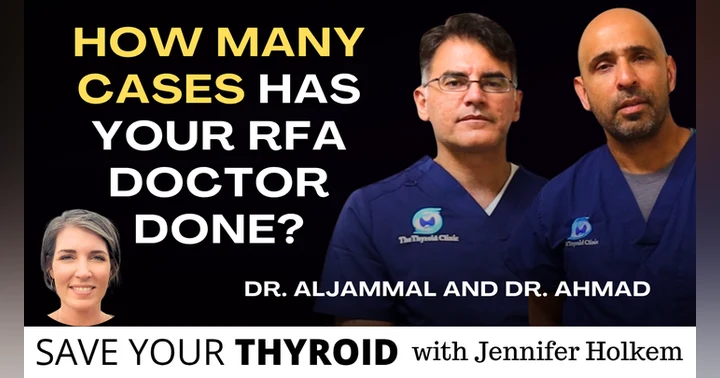
 Is Your RFA Doctor Certified? A New Standard for Thyroid Ablation | Dr. Ahmad & Dr. Aljammal
For seven years, thyroid RFA in the United States has operated without formal standards. Any licensed physician could offer the procedure regardless of their training, case volume, or documented outcomes. That's changing.
Dr. Jules Aljammal was the first endocrinologist in the US to perform thyroid RFA for benign thyroid nodules. Dr. Shahzad Ahmad has since performed the highest number of RFA procedures of any endocrinologist in the country. Together they are the founder and president-elect of NASOIE — the North American Society of Interventional Endocrinology — and the architects of the first formal certification program for RFA providers in the US.
In this episode they break down exactly what that certification requires, what it means for patients, and what questions to ask your provider right now — whether they are certified or not.
In this episode:
Why a medical license alone is not enough to safely perform thyroid RFA
The 50-case minimum and what the certification actually requires
The three questions to ask any RFA doctor before your procedure
Why thyroid cancer ablation requires a different mindset and more experience
Why continuity of care after ablation is non-negotiable
Where to find certified physicians
Find Dr. Ahmad: thyroidradiofrequencyablation.com
Find Dr. Aljammal: The Thyroid Clinic Utah & The Thyroid Clinic Washington
NASOIE: nasoie.com
How do you know if the doctor performing your thyroid RFA is truly qualified?
It's the question every patient asks — and until now, there hasn't been a clear answer. A medical license isn't enough. General board certification isn't enough. And with RFA growing rapidly in the US, the gap between trained specialists and general providers is becoming a real patient safety issue.
That's exactly why two of the most accomplished names in thyroid ablation have spent years building a solution.
Dr. Jules Aljammal is the very first endocrinologist to perform thyroid RFA for benign thyroid nodules in the United States. Dr. Shahzad Ahmad has performed the highest number of RFA procedures of any endocrinologist in the country, achieving multiple North American firsts along the way. Together, they are the founder and president-elect of NASOIE — the North American Society of Interventional Endocrinology — and the architects of the first formal certification program for RFA providers in the US.
In this episode, they break down exactly what that certification requires, what it means for patients, and what questions you should be asking your provider right now — whether they're certified or not.
In this episode:
✅ Why a standard medical license is not enough to safely perform thyroid RFA
✅ What the new NASOIE certification requires — including the 50-case minimum and outcome review
✅ The two certification levels: Certificate of Interventional Endocrinology and Master of Interventional Endocrinology
✅ The three questions to ask any prospective RFA physician before your procedure
✅ Why treating thyroid cancer with ablation requires a different mindset — and significantly more experience
✅ Why continuity of care after ablation is non-negotiable
✅ Where to find certified physicians and how NASOIE is building that map
✅ Where RFA adoption is headed in the next five to ten years
If you are currently searching for an RFA provider — or you want to verify that the one you've already found is truly qualified — this episode is essential listening.
CHAPTERS
00:00 Introduction
01:00 Meet Dr. Ahmad & Dr. Aljammal — The Pioneers Behind US Thyroid RFA
03:38 The Birth of NASOIE & Bringing RFA to the United States
08:05 The Wild West Problem — Why Standardization Is Urgently Needed
09:37 Patient Safety & the Real Risks of Untrained Providers
12:30 The 50-Case Minimum & What Certification Requires
16:08 How New Providers Can Build Toward Certification
17:45 Ongoing Education & What Happens After Certification
20:20 How Patients Can Find Certified Physicians
24:15 Why Anecdotes Aren't Enough — The Case for Verifiable Standards
26:32 Top 3 Questions to Ask Your RFA Doctor Before Your Procedure
31:32 Volume, Published Outcomes & PubMed Transparency
33:09 Treating Thyroid Cancer with Ablation — A Different Mindset
38:45 Knowing When NOT to Perform Ablation
41:50 Continuity of Care — Why Follow-Up Is Non-Negotiable
42:35 Where Is RFA Headed in the Next Five Years?
45:36 How to Find Dr. Ahmad & Dr. Aljammal
🔗 Find Dr. Shahzad Ahmad:
Endocrinology Center of Utah: thyroidradiofrequency.com
🔗 Find Dr. Jules Aljammal:
Thyroid Clinic Utah: thyroidclinicutah.com
Thyroid Clinic Washington: thyroidclinicwashingon.com
🔗 NASOIE — North American Society of Interventional Endocrinology:
nasoie.com
⚠️ Disclaimer:
This podcast is for informational purposes only and is not a substitute for professional medical advice. No endorsement is given or implied for any specific product, treatment, or physician mentioned. Always consult with a qualified healthcare professional regarding your individual medical needs.
🎵 Music:
Y4XYU0XSPNNR5RI3
Hosted on Acast. See acast.com/privacy for more information.
Its Me Jen Again (00:00)
You're listening to Save Your Thyroid with Jennifer Holkem the podcast where we explore the latest non-surgical innovations in thyroid nodule care.
As procedures like radiofrequency ablation, RFA, become more popular in the US, patients are increasingly asking a critical question. How do I know my doctor is truly qualified perform this? Today, we're tackling the need for standardized care and exploring the brand new certification in interventional endocrinology. It's a vital step forward to ensure patient safety.
consistent training, and optimal outcomes as these technologies become mainstream. To guide us through this important shift, we're joined by two true pioneers in the field. Dr. Jules Aljammal is an endocrinologist with practices in Utah and Washington state. He's recognized as the very first endocrinologist to perform thyroid RFA for benign thyroid nodules in the US and has published extensive clinical data on this topic.
Shahzad Ahmad MD, FACE, ECNU (00:48)
. you
Its Me Jen Again (01:00)
Joining him is Dr. Shahzad Ahmad, an endocrinologist based in Utah, who has performed the highest number of radio frequency ablation procedures of any endocrinologist in the US, achieving several remarkable RFA firsts in North America. Together, they're leading the charge for standardization and education. Dr. Aljammal is the founder and first president, and Dr. Ahmad
is the President-elect of the North American Society of Interventional Endocrinology, NASOIE. Here's what you'll learn in today's episode. The necessity of standardization, why a formal certification for RFA providers in the US is crucial for patient safety. Defining the standard, the specific eligibility and rigorous criteria doctors must meet to earn this certification.
The gap in current training. Why a standard medical license or general board certification might not be enough for performing thermal ablation. The role of society. How the newly formed North American Society of Interventional Endocrinology is bridging the gap between traditional and interventional care. Patient empowerment. The top questions you must ask your doctor.
to verify their qualifications before undergoing an RFA procedure. Now let's dive in. Dr. Aljammal and Dr. Ahmad, welcome to the podcast.
Shahzad Ahmad MD, FACE, ECNU (02:24)
Thanks for having us again. I think it's
Its Me Jen Again (02:26)
All
right.
Shahzad Ahmad MD, FACE, ECNU (02:27)
It's been a while since we last spoke, but I think it's always been a fruitful discussion when we get together and talk about things that are influential for saving your thyroid. So thanks again for all the work you do, and we're glad to be a part of this movement to help people save their thyroid. Thank you. Thank you for having us. We're excited to be here and to talk to you and to your audience about ⁓ all the subject that you mentioned.
Its Me Jen Again (02:51)
Well, thank you for coming back. It's always a pleasure to speak with you two. And I've always got to point out the fact that if it wasn't for the work that you two did to bring RFA to the US, I wouldn't be sitting here talking to you right now because your website was the first place where I discovered radiofrequency ablation back in 2019. So I've always had a special place in my heart for the two of you for that very reason. well, before we get into the certification for
RFA physicians. Let's talk a little bit about the evolution and the birth of your organization, NASOIE. Talk about the early days and how you decided to create this organization and the history behind bringing RFA to the United States that even led to that.
Shahzad Ahmad MD, FACE, ECNU (03:38)
So I would let Dr. Ahmad talk about our interest in thermal ablation and technology since we were together since 2014 and even before that. So I will leave him to talk about all the steps we went through
working with the FDA and other part of organization to try to get thermal ablation in general to the US? So yeah, mean, as you said, there had been a need for thermal ablation in the US, an unmet need that we recognized back in 2012, 2013, because we were seeing all these nice papers and the results being published.
from Korea and from Italy. And we were anxious to bring it to the US, but the bureaucratic challenges we faced were pretty formidable. It took us a while dealing with the FDA and trying to get a feasibility study off the ground was a pretty heavy lift for us back then. But by 2018, once FDA approvals came through, that's why we became the first people to do RFA and was done here in Utah.
The idea about our society is very clear. There is a need to have excellence and standards of care and a community where we can support each other, help each other improve. And that was the main reason, rationale for that.
We all wanted a society which could help support endocrinologists and other physicians trying to get into the field to have guidelines, backing, information, a source where they could seek counsel. And that's why we all got together. And this organization has now been around for almost
For seven years. Seven years, yeah. So time to formalize the field a little bit and go from just a support base to an organization which sets the standards for what excellence should mean, what safety should mean, you know, for people doing RFA. So yeah, in 2018, ⁓ there was the first master course for RFA in California by the first company which got
the approval for their antenna for thermal ablation in soft tissue. Both me and Dr. Ahmad attended that meeting. And with that, it becomes reality and possible for us to use thermal technology in treatment of benign nodule in the US. And early on, we recognized the gap between training, physician training and thermal ablation. So the point of our society was
mainly to create a larger awareness between physician to understand where this technology can be used, in what situation this technology offer an excellent choice, replacing more aggressive approaches like surgery, more invasive approaches like surgery, and also at the same time, bridge the gap for patient information.
⁓ making them aware about the existence of this technology. So we thought about our society as a bridge to fill that gap between physician, physician knowledge, and patient and patient knowledge about thermal ablation. So early on I sent an email after meeting with our colleagues who are interested in this field and we thought about
creating the society to bring this support team, support system for physician who finished their training and trying to learn a new technology that is not available easily for people to learn about. And that's how it started as the North American Society of Interventional Endocrinologists with a plan to expand knowledge more to primary care physician, endocrinologist and other specialties.
who are interested into the thermal ablation field. And that's kind of really the main mission of our society, providing guidance, consensus statement, and information, and even paper. And we have published, me and Dr. Ahmad, up till now, many of the first papers in the US in relation of thermal ablation in benign disease, malignancy, recurrent lymph node, and managing complication related to thermal ablation in the best way.
And the hope from all of this, as I mentioned, is to expand knowledge of physician, sharing the technique with them, and then also make it available for patient to be able to get the best treatment option available.
Its Me Jen Again (08:05)
Well, I think it's wonderful to see how much you've done to promote the adoption of this technology beyond your own adoption of it and use of it in your clinic to help patients because I know you've been very active in this activity of ablating thyroid nodules and even thyroid cancers and lymph nodes. And it's just so wonderful when I hear from patients that, you know, I've heard several
over the years, know, several is not the right word, many over the years who have said, I went to Utah and I had my thyroid nodules treated, you know, many who are not local to Utah. And then I've heard many who are local and said, I'm so grateful to have found in my backyard these two wonderful endocrinologists. And of course now Dr. Aljammal, you're located also in Washington state. So you're bringing this wonderful technology to the people of Northwest USA.
So, but unfortunately over the last seven years that we've now had RFA in the US, it's been a little bit of the wild wild west, so to speak, ⁓ because this is new technology that we've adopted here. And there, as you said, you wanted to put out standards, but we didn't have those. And so as this is growing in popularity and prevalence,
Shahzad Ahmad MD, FACE, ECNU (09:10)
you you
Its Me Jen Again (09:23)
What risks do you see for patients if the providers that are performing this procedure aren't really performing them without that standardized training that you're seeking to provide through the certification?
Shahzad Ahmad MD, FACE, ECNU (09:37)
So number one, none of our colleagues and you know, I speak with great degree of respect for all my colleagues. Nobody's trying to intentionally do a procedure that can be harmful to the patient. Overall, this procedure remains rather safe, but there is a wide variation in terms of side effects for people who don't have the... ⁓
the experience and don't have the appropriate training compared to other places where there is a lot more experience. And we also know from different studies that the learning curve leads to much better results when you are at the upper part of that learning curve versus at the beginning. You have better volume reduction and stuff. And so the thought behind starting certification is safety number one. Patient safety remains our number one motivation. And patient comfort and good results are very, very important. And because
Safety for this certification, number one, requires that learning curve to be met. There's a certain volume you have to meet in order to apply for certification. And the benchmark we have set is at least 50 cases. To further expand on the safety, you want those physicians who are going to apply for certification to show us their results also. Simply being able to...
Insert an antenna into a nodule is not enough to get the appropriate results that we're looking for, which is a decent volume reduction and there's different benchmarks we're going to use. And the third, we're going to look at their techniques. They're going to have to submit to us as part of the certification process, sample cases showing cure for toxic nodules, appropriate placement of antenna, observing all safety protocols. So safety is the number one driver why we started this.
and hopefully the safety part will lead to excellence. so those are the basic building points for why the certification is necessary. Yeah, so the certificate is important for us on two aspects. There's many aspects, there's two come mainly to my mind. One is related to improvement of the proficiency of performing the RFA, or the thermal ablation technique.
which is a process that requires following standard of technique that has been published, showing the outcome. And we have, and me and Dr. Ahmad, we have seen this in our own experience. So between me and him, I think we have, before we started doing thermal ablation,
we have combined together done closer to 40,000 fine needle aspiration, if not more. This is maybe the underestimate of the number of biopsies we have done over the years before we started. And we do our own ultrasound in office and our experience combined together kind of equal closer to two decades of ultrasound imaging before we even started working.
on considering the thermal ablation as a technique. So it's important for us to build that proficiency and guide people about those steps that need to do to help them feel comfortable and confident themselves in their own outcome when they perform this procedure, to help guide them about how to lower their complication rate, to bring it closer to what we see in our practice. So we have seen in our practice
a complication related to voice change around two in a thousand. Our complication rate for rupture of a nodule is one in a thousand, which is significantly even lower compared to what has been published around the country and around the world. So our complication rate is around three in a thousand for RFA. So we want the same thing to happen for our patient. And for that, we think the certificate will help physician.
to achieve that proficiency. And we put a standard for 50 based on the guidelines. But I can tell you honestly, every time you do a thermal ablation, you'll learn something new. Even after 100 case, you'll learn something new. Even after 200 case, you'll learn something new. Even after 500 case, you'll learn something new. There's always something new you find because every individual is different.
So that's the first aspect when I think about the certificate. The second aspect from my personal thought is to provide patient with a tool to recognize physician who have been striving to improve and striving to achieve better outcome for their patient. By recognizing those physician by the certificate, it will make it easier for our
a patient and family member to recognize those physicians who are really interested to ⁓ provide the best care. They're working hard on educating themselves, improving their own skills to get the best outcome for their patient. And we see that as a dual-sword benefit for everyone, for both the patient, for both physician at the same time, and hopefully again, increase awareness.
increase understanding of a complication, reducing those complications. So our first step, which is certificate of interventional endocrinology, requires doing the first initial steps that we think is minimal needed to be proficient with RFA. But we know it does not stop here. That's why we have the second step, which is master of interventional
endocrinology, which expand the number of cases, requires physician to provide information about advanced technique and thermal ablation, including hydro dissection and doing other more sophisticated treatment and also crown that whole process by publishing their data, encouraging more physician to put out their outcome.
to increase awareness between physician, other physician, making sure, hey, this has been performed in the US, we have this outcome. So by increasing the output of our research done in the US, also improving everyone access by increasing the knowledge about the outcome of RFA. So we see it as a multi-step process, improving physician proficiency, improving awareness.
and giving patient a simple tool, recognizing physician who have been trying hard to improve themselves, guaranteeing better safety and outcome for them.
Its Me Jen Again (16:08)
I think those are really great guardrails to put in place. And I have a follow-up question to that then for those physicians who are new adopters of this technology and they don't have as many cases as you're recommending, what would you say is the path towards them achieving that milestone of 50 cases to be able to then pursue this certification?
Shahzad Ahmad MD, FACE, ECNU (16:30)
Well, really frequency ablation or thermal ablation is no longer a secret. It's being widely adopted and being offered. As somebody who started anew and there were no guidelines and no resources, it's much easier for these guys who coming after us. That's why we got all bloodied up going through the wall the first time. And so our experience is to help them. So they actually have resources. We had none. And so I don't think their challenge is
light but it's not as hard as it was for us. So they have support and if you can't get to a 50 case threshold after you've been doing this then maybe your practice is more geared towards general endocrinology. To get good at this what we're saying is certain amount of volume and it headings to certain standard is necessary. Without that it's not going to work. If you do a few cases as a thyroid surgeon your complication rates are much higher compared to somebody who does a high volume of thyroid surgery.
The same thing we think is true for radiofrequency ablation also. So the volume part we cannot compromise on. There is plenty of data which suggests that the learning curve really is important after you get to a certain number of cases. So you have to build up the volume if you think that you have a thyroid-only practice and you want to tell the world and your patients that you can safely and efficiently do this.
Its Me Jen Again (17:45)
Excellent.
Why don't we talk about the ongoing education and recertification once you've already been a high volume provider of RFA and you want to continue on in your building of excellence. What are the requirements or mentioning you mentioned earlier reporting of complications to keep your credential active?
Shahzad Ahmad MD, FACE, ECNU (18:01)
So.
So we don't have right now a requirement to keep it active. So after you achieve master when showing your publication, that's basically you are a physician who has been following your outcome to publish. So publishing data require a large sample of patients, require patient in general
Its Me Jen Again (18:14)
Okay.
Shahzad Ahmad MD, FACE, ECNU (18:29)
you want to have at least between 50 to 500 patient. So if you have tracked your outcome over 500 patient, that is a good result over time to tell us about your complication rate. So we don't have a similar to other a certificate where we have continuous monitoring for your capability. We understand that when physician acquire a skill,
and they continue to build up on that skill, they most likely will become more and more proficient over time with that skill. So we don't have that continuity of education that you need to do to improve a technique. After you do, and this is not to simplify it, but after you do any procedure, the old statement in medicine used to say, you...
do one or basically you see one, you do one, you teach one. Now does not mean after you teach one you already became proficient. It's that continuity of practicing that end up leading to the outcome. It's the desire of physician to improve themselves that lead to better outcome. If I do a 50 thyroid surgery only every year, but I have no desire to improve my skill,
I may not be as efficient or proficient than someone who do maybe a little bit less surgery, but always strive to improve themselves by learning new technique, learning a new method, monitoring their outcome better. So it's internal drive that does not get replaced by guaranteeing certificate constantly being given to someone. It's harder sometimes to get that achieved by...
providing a certificate. But we have milestones that we are looking for for people to achieve. And when they achieve that, are hopeful from here forward, they continue to work on improvement on their own selves.
Its Me Jen Again (20:20)
Okay, well that makes complete sense and I think that finding a physician who has done this is probably going to be the question that all the viewers are asking. How do I find someone that has the certification? So where do patients discover that information?
Shahzad Ahmad MD, FACE, ECNU (20:37)
So this is the beginning stages of it. So far, only two people have submitted all the requirements because we have all those requirements listed on the NASOIE website for prospective physicians who want to apply. And as this field takes solid foundation, solid footing in the US, more and more
doctors would have done more than 50 cases. At this point in time, I'm going through the process of submitting all my requirements and to be judged by my peers if I've done the appropriate stuff and there's a few other physicians. We're going to have a map of physicians and a list of physicians who are certified that is going to go up on our website pretty soon. As of now, there's only two three physicians who've been certified and two more pretty soon will be certified, but we expect that with time, hopefully,
Most major metropolitan areas, most states will have certified doctors who've done all the requirements and that give patients a lot more confidence about who they're going to and what type of results to expect because in the end, we have screened that expectation. We would have reviewed all of that. Are they getting the volume reduction? is their side effect profile acceptable? You cannot be doing 70 % volume reduction but doing 3 % nodule rupture versus
you know, causing repeated neck, you know, recurrent nerve injury. So there's a balance between aggression versus safety. So all of those things will be looked at. So this certification will make patients feel a lot more comfortable that other peers have reviewed it. This is how we publish articles also. Peers review our work and they tell us where we're wrong and they give us guidance. And this is also what we're trying to do to try to improve the quality, try to help guide the process where there's trust in this procedure built in to our system. So...
the wild west, we wanted to be the modern west, not the wild west anymore.
So as Dr. Ahmad has mentioned, we will have information on our website to guide patients to where to find those physicians who have completed the certificate. And also reaching out to you and your team and your platform, we're hopeful also we work together and provide you with the name of the physician who have
the certificate so you have it available also for the platform you have of Save Your Thyroid and access directly to the patient too. So we are looking to connect the dots between all available sources of patient information from access on the website of the society, access on Save Your Thyroid and then have it available to everyone to see.
and then they can recognize physician who have been completed this requirement, at least to give them a starting point, where they can go, who they can speak with, and feel comfortable that those provider has completed at least the requirement that qualify them for this certificate.
Its Me Jen Again (24:15)
I think that's great that you're so concerned about the patients feeling more comfortable because that is something we do see quite often in Save Your Thyroid is a patient who is trying to decide where should I go for treatment and they ask the community, what was your experience with this doctor? Did you have any, in this particular scenario, did you have any positive or negative outcomes?
Shahzad Ahmad MD, FACE, ECNU (24:27)
Right.
Its Me Jen Again (24:40)
it's just very, very common that as patients are doing this research, they want confirmation of the things that they're learning about, you know, from these different
Shahzad Ahmad MD, FACE, ECNU (24:50)
That's exactly our intention. We're
not telling people where to go. Obviously, people are smart and there's enough information. can figure out where it's best that you go to. getting advice from one or two people who have been to a place remains anecdotal. We're trying to give you a much more verifiable standard. Like, listen, if I choose this person,
Its Me Jen Again (24:55)
Mm-hmm.
Shahzad Ahmad MD, FACE, ECNU (25:11)
His peers also, his or her peers suggest that this person is excellent, he's striving for excellence and he's tried to meet the criteria that his peers have set up to get to a certain level where you can feel comfortable. mean, patients are smart consumers, they can go wherever they want, but instead of anecdotes, this will give them a lot more evidence-based recommendation about this person being better than, you know, than just a random recommendation. And again, this is always going to be a starting point for patients.
Its Me Jen Again (25:37)
Yeah, I-
Shahzad Ahmad MD, FACE, ECNU (25:38)
And people can start, they meet with a physician, they feel connected or not. That's a very important part of a healing process is to feel you and your doctor are on the same page. So we're not saying this is the doctor you have to go to, but this is a doctor who have completed steps that is required to be proficient in performing this procedure. And then the final choice is always going to be to the patient to decide what they think is the best.
Its Me Jen Again (25:47)
Totally.
Mm-hmm.
Absolutely. I think it's great to have more data, always to have more data on in the decision making process on who is a, you know, what is the bedside manner like? Well, that's what you're going to hear from the patient, right? You know, they're going to be sharing their experience with the doctor, but having the data, as you were saying, behind the outcomes of the doctor's procedures, that's what you're providing largely here through what you're offering. So I think a really good interim
Shahzad Ahmad MD, FACE, ECNU (26:24)
All
Its Me Jen Again (26:32)
question for the patients who are looking and their doctor maybe hasn't had the chance to develop the number of cases or hasn't finished the process of achieving the certification. What maybe are the top three questions that a patient could ask a prospective RFA physician to gauge their competence in the meantime before they receive this
Shahzad Ahmad MD, FACE, ECNU (26:34)
So,
Its Me Jen Again (26:56)
certification?
Shahzad Ahmad MD, FACE, ECNU (26:58)
what would I ask? Let me just suggest in this situation, let's say if I as a physician become a patient and I go to see somebody, what are the questions I would ask? Obviously bedside manner makes a difference, but I would also ask, how long have you been doing this? Is this the gist of what you do? Are you a thyroidologist or this is a small part of what you do? Those things are not that hard to find out because you can tell what type of practice a person has. And not seeing that...
You know, some people cannot do a bunch of everything and they can multitask and stuff. But we have said that this thyroidology interventional thyroidology is its own field requires significant time commitment and that's how you build up your skills. So that's one of the first question I would ask. Secondly, if you've been doing it for a while, have you published your results? Those are very important. And third, you know, what is your complication rate? And that's.
A question that is kind of a hard-hitting question, it's difficult for a lot of people to answer because nobody wants to harm anyone. Things happen when you do procedures. But that's a good metric of finding out where you are and that would give me a lot of peace of mind before I decided to undergo a procedure with somebody. So it is difficult to kind of start a process or a question like this when you are building on something. So one thing I always tell everyone
Its Me Jen Again (28:14)
Mm-hmm.
Shahzad Ahmad MD, FACE, ECNU (28:15)
everyone needs to start at a point. No one comes, I know it all, everyone will build on something. And they get to that certain level. One of the things that comes to our mind when you are trying to answer this type of question, where are you? What access you have? Am I living in a state that is a 300 mile away from a different state where they have one physician who have their certificate and there is someone locally who
Its Me Jen Again (28:18)
Mm-hmm.
Shahzad Ahmad MD, FACE, ECNU (28:39)
I know I worked with for years. I trust as a physician and a provider who has been taking care of me for years. I know this physician not going to try to harm me. And then the question that comes to my mind, if my physician starting new to adapt this type of technology in their practice, have you been doing ultrasound imaging for thyroid for a long period of time? What's your experience in that? Have you doing fine needle aspiration?
of thyroid nodules? Have had any issues and complication with that? Am I your first patient? And remember, everyone start with the first patient. There is no, hey, I have done 100 patient already. No, everyone start with a patient. Have you done some training? Have you done some observation of a technique been done on other patient, how the procedure was done? Was there any proctoring?
Generally every physician when they start a thermal ablation, they have some proctoring where there's another physician come over, observe their ⁓ procedure. And what was your number of cases you have done? It's completely fine to ask that question. Have you had any complications? Keep in your mind, not every physician day one have a success rate 100%. We build and we become better with time. If you ask me, Dr. Aljammal
Its Me Jen Again (29:55)
Mm-hmm.
Shahzad Ahmad MD, FACE, ECNU (30:00)
your experience today versus your experience in 2019. I will tell you, you know, I'm not sure about 2019 guy. I know a lot more, more than 2019 guy. So no one is already reach max level of skill. Everyone build up gradually. As long as they are motivated, they're showing interest, they're putting the effort and have done the steps that we think is reasonable.
have done some proctoring, training, observation, have done cases, and they are working to build on those number of cases, and they're sharing clearly what's their complication rate, then the patient need to decide, do they feel comfortable with a physician they have worked with maybe for five, 10 years, who have been their provider, or do they want to travel 300 mile or 400 mile to do a thermal ablation with someone, have a certificate.
But again, everyone needs to start in a point. Everyone needs to build up on their knowledge. And that's how the process of medicine.
So we have quite a few physicians who've already applied who are candidates and we're hoping that they will have...
gone over and gone through all the requirements that they need to fulfill to become certified by the time the next annual meeting happens in Santa Barbara. And we hope that every annual meeting, another half a dozen to a dozen physicians become certified. And then we have a standard of care of physicians who are certified, spread out throughout the country, where you can confidently go and expect high-level treatment, good-level treatment.
Its Me Jen Again (31:32)
Excellent.
I think your questions to ask the physician were really great. And that's good for patients too. Specifically, I'm thinking of the patients who have thyroid nodules that are not particularly straightforward. We have some patients who have very difficult cases and they're looking for someone who is incredibly experienced.
particularly our patients who are seeking a physician who can treat thyroid cancer. They want someone who has a great deal of experience and is knowledgeable and comfortable with treating a situation like theirs that might not be as easy or simple or straightforward as some nodules can be. And it seems that a lot of times we see in these particular patients, particularly the thyroid cancer patients,
Shahzad Ahmad MD, FACE, ECNU (32:14)
That's it.
Its Me Jen Again (32:21)
papillary thyroid cancers, that their nodules are almost always in a bad location. And that that's why a lot of times they're not candidates, unfortunately. And so if you have that scenario as a patient, that's one thing that's so wonderful about what you're offering is that these patients can find doctors with this high degree of experience.
Shahzad Ahmad MD, FACE, ECNU (32:39)
Yes. So let me clarify this a little bit before Jules
We're not going to specifically
gear this certification towards thyroid cancer. is mainly first of all certificate is about being a good interventional endocrinologist. Unique cases of different locations. This is again about patient physician judgment and the patient's overall health. In certain situations these types of procedures can be risky or life-saving and that's an individual thing. In terms of somebody having a high degree of
Its Me Jen Again (32:53)
Mm-hmm.
Shahzad Ahmad MD, FACE, ECNU (33:09)
experience doing thyroid cancers in the country, that does not really exist all over the country. There's only one paper that came out of the Mayo Clinic with six cases done in the OR and in general anesthesia, which doesn't apply to the regular public. And then there was our paper that we presented at the American Association of Clinical Endocrinology that's still in review and it'll be published soon. But that only has about 24 patients that we've done. So with thyroid cancer, it's not a straightforward answer. And it depends on patient judgment, patient's health, physician judgment.
experience. That's not an easy question to answer about where the right place is, where the right location is. But again, if you have somebody who's done at least a hundred cases before they touch thyroid cancer, is my recommendation. We had come up with seventy or eighty cases before, and there's different studies suggesting that thyroid cancer is harder in certain locations, and sometimes it can be much easier than a benign thyroid nodule, but we still suggest somebody who's really experienced to start doing thyroid cancer.
So thyroid cancer is not in a bad location or always in a hard location. The difference is when you're treating thyroid cancer, you want to ablate the whole thing. When you're treating benign nodule, you're ablating most of it. So you already, when you're dealing with a tumor that is benign, you're dealing with large tumors. So you have a huge cushion of benign tissue.
Its Me Jen Again (34:15)
Right.
Shahzad Ahmad MD, FACE, ECNU (34:28)
that you can leave between your antenna and the structure around the neck. When you're dealing with cancer, you're dealing with a small tumor. And that small tumor is inside a small gland. The gland itself as a size is around 3 cc to 5 cc. 3 to 5 cc as a volume. It's not a huge volume. So if you have a tumor that is around 1 cc or half a cc, and it is a small,
It's not pushing on the capsule. It's not expanding to make it look, I am so large you can't ablate me. So you end up always with that cancer despite being small because the gland is small. It's always sitting and close to the capsule of the thyroid gland, sitting close to the backside, sitting close to the edges. And that's just by the nature of small things. And now you are approaching with an antenna with a goal of a hundred percent.
destruction. You're not shrinking cancer. You want to destroy it 100%, which make it more difficult compared to a big nodule per se, where you have a lot of volume there. So having those extra skill of hydro dissection, separating the thyroid gland and the capsule of the thyroid from surrounding tissue to be able to perform 100 % full ablation,
is essential for someone to do that. And that hydro dissection and skill, like everything else, repeating, repeating, repeating, proficiency, constantly training yourself to improve, doing more cases, improve that skill step by step until you get very proficient in doing that technique. to perform treatment of cancer. So it's not...
Its Me Jen Again (36:03)
Mm-hmm.
Shahzad Ahmad MD, FACE, ECNU (36:16)
The cancer is in a bad location as much you are now dealing with a small tumor and because a small tumor in a small gland, it's always going to be closer to a capsule or an edge, make it very difficult to ablate unless you are really creating this separation. But you do see them occasionally where you have a cancer in the middle of the thyroid. Those are the rare, those are not the common, but they are there.
And yes, they will need a full treatment similar to a cancer sitting on the capsule per se. So personally, would say thyroid cancer is not more difficult. It's just you are aiming for 100 % ablation. So it's a different mindset, different mindset of what you are trying to do compared to a benign nodule where you're trying to reduce the volume as much as you can, causing relief of the pressure symptoms associated with a big nodule.
Its Me Jen Again (37:08)
Thank you for clarifying all of that.
Shahzad Ahmad MD, FACE, ECNU (37:08)
Sorry about that. Sorry about that
people think about like, it's cancer is hard. So I don't think it's harder. You need to be more efficient and profession in the procedure. Which is why, if you look at the total number, why people haven't published studies on thyroid cancer in the US is because finding the right candidate where you can actually ablate all of it, you know, it's, it's not as easy as a nodule that you can trick. And so the most important part, I think,
Its Me Jen Again (37:18)
Thank you.
Mm-hmm.
Shahzad Ahmad MD, FACE, ECNU (37:36)
of being experienced with RFA is not just the technique, it's also learning when to say no. It's not the right thing for the patient. That's also very important. And that also comes from experience and your peers. Yeah, there's an old say medical school to learn how to treat your career to imply how that treatment is done and when to treat and then the rest of your life to learn
when not to do anything. So it's the final step of knowledge is to know when to say, this may not be the best option. So this is a, again, learning curve and it takes years and experience and seeing many cases where you learn different skills and different technique and different approaches. And again, even any physician can say that about any skill they do.
Its Me Jen Again (38:04)
Mmm.
Shahzad Ahmad MD, FACE, ECNU (38:25)
You can ask them, hey, how do you compare yourself 10 years? Is it like, yep, there's things I done when I was 10 years ago, I may not do now, or I may do it completely differently. Cause we are not born, we know everything. We are similar to everyone else, learning and building up on our knowledge over time.
Its Me Jen Again (38:45)
Well, I appreciate you going into all of the detail there, particularly on thyroid cancer, because it is still such a very, very popular topic in our community right now. So many patients don't understand the nuances of when it's appropriate to treat thyroid cancer. And so we see a lot of frustrated patients who say, I don't understand why my thyroid cancer is not appropriate, but then this other patient's is.
Shahzad Ahmad MD, FACE, ECNU (39:11)
And totally we can tell you there's several patients we have said, like, I don't think this is a good idea, you shouldn't do it. And they end up finding somebody who'll do it. And the next time you hear them, you can barely hear them because their voice has been affected negatively. It's a bad outcome. It can happen to anyone. But yeah, knowing when not to do it is very important too. So we have currently standard and it's been published by the American Thyroid Association, the standard of when to consider thermal ablation for cancer present. But there is one point.
Its Me Jen Again (39:12)
Go ahead.
Shahzad Ahmad MD, FACE, ECNU (39:38)
I always emphasize to all my patients, whoever who have benign nodule, a thyroid cancer, or any treatment. One of the most important things to have is a physician who will follow you. Doing a treatment without a follow-up and continuity of care, that is incomplete. If I do a treatment and then I say,
Its Me Jen Again (40:00)
Absolutely.
Shahzad Ahmad MD, FACE, ECNU (40:02)
You go and follow up with your doctor somewhere else who have not enough knowledge of understanding how the nodule will change, the way it will look, what things to look for after some treatment like thermal ablation. What are the important things to decide? We did thermal ablation for a cancer, microscopic or sub-centimeter thyroid cancer, and now it's time to go for surgery. This did not respond the way we wanted to.
That is not, in my opinion, is the right way. The right way, if you are going to do this, is to be monitored, evaluate the outcome, make sure if there is a need, which is based on data, a small need, but it's there. If there is a need for converting this approach from this less invasive approach to a more surgical approach, because we are seeing a progression that is not going in the right direction,
is very important. I do not believe in care that is short or care that isn't complete. This needs to be a complete picture. Continuity of care is a central point when I recommend someone who is interested in thermal ablation. It's very important to find that continuity, not just through the procedure, be able to follow, to monitor, to decide that the outcome we're looking for has been achieved.
And in thyroid cancer, when we deal with cancer, this is long term. We're talking about years of monitoring. We do see thyroid cancer recur. Yes, more commonly in the first five years, but we have evidence of cancer progressing and recurring 15 years, 20 years. So saying that I monitored for a couple of years may not be enough. We are looking for a long term.
Its Me Jen Again (41:50)
I appreciate you taking a little detour with me about thyroid cancer because it is so relevant to our community. But the main point behind that discussion was still with this in mind of this highly experienced physician in thyroid ablation. And I appreciate so very much that you're taking on and calling attention to these physicians who have this experience.
Shahzad Ahmad MD, FACE, ECNU (42:02)
Yes. I agree.
Its Me Jen Again (42:15)
any final thoughts you want to share on where you think, you know, we've made so much progress since 2018, when this first came here, thanks to you two and the work of so many other pioneers in our country. where do think we're headed in the next five years regarding mainstream acceptance of RFA and other ablative techniques?
Shahzad Ahmad MD, FACE, ECNU (42:35)
I mean, I think the barriers and challenges are going to remain financial.
more than everything else. Financial challenges right now still are a problem for lot of patients who cannot get coverage for this. Though the code has been helpful, it's still there are shortfalls in between. But I expect the next five years for this access to improve and results to start improving even more. And I think overall the morbidity that comes from unnecessary thyroid surgery will go down with time. And that's what we're hoping for. That's our vision. And that's hopefully going to turn into reality over the next five, six years.
It's a slow progression, to be honest. it is a process. So we're hopeful ⁓ in the next few years, there will be a shift. And as I mentioned before, the more we publish, the more data come out, the more acceptance of a physician of this technique as a part of standard of care or a medical option for a different...
a situation with thyroid nodules, benign functioning thyroid nodule, I think I'm hopeful with time we're going to see the expansion of this. Again, this does not replace surgery, does not replace other tools we have to treat thyroid nodule or thyroid malignancy. It's additional tool and another step in this process of trying to restore the balance on the homeostasis where people go back to normal. They feel normal.
And this is minimally invasive in general. Yes, it's an antenna we push through the skin, but it's still very limited as an invasive procedure compared to other options. And it's a step before if we need to proceed with something more invasive, per se.
in the next five to ten years, the number of patients who receive treatment with RFA will double or triple. Because right now, compared to the number of surgeries done even for benign disease, we do not represent more than 1 % of the total number of cases that end up doing surgery. I'm hopeful that 1 % in the next five to ten years
will increase from 1 % to hopefully 5%. If 5 % can save their gland, maintain their function normal, and restore homeostasis where the gland is balanced in a toxic nodule, I will be very happy.
And hopefully with time, the 5 % will become even more.
Its Me Jen Again (44:49)
Wonderful.
Exactly, exactly. That's my goal. hope.
Shahzad Ahmad MD, FACE, ECNU (44:51)
And you get a lot of credit for
that too. You've like, I can probably say that a lot of patients who initially were looking for this were influenced by your personal journey and the way you were able to, I mean, it's not easy to put yourself out there, especially when it's something personal and it's health related. And you did all of that for not your own benefit, because you already were getting treated. You did it so that other people could benefit. And you deserve commendation for that. And I think you've also helped
bunch of other people get inspiration from like if she can do it and she's comfortable talking about it and you put yourself out there by visually showing your goiter and all of that. Now other people have benefited from that. So yeah, you get a lot of the credit also.
And we're hoping to see you next year at Santa Barbara. be officially invited and so yeah, you'll be in Santa Barbara next year.
Its Me Jen Again (45:36)
That will be wonderful, I look forward to seeing how much progress we've made by then because I think that right now things are moving faster than they ever have in the seven years that we've had this technology available to us. So it's an exciting time. Both of you please share the information on your practices so patients can find you because I know that after this video they're going to want to.
Shahzad Ahmad MD, FACE, ECNU (45:58)
So yeah, I've been practicing here in Salt Lake City. My practice is called the Endocrinology Center of Utah. You can find us by just Googling thyroidradiofrequencyablation.com. That'll show up or Endocrinology Center of Utah. You know, getting set up with us for radiofrequency ablation is not hard because I only have a thyroid-based practice just for intervention. So our staff knows
all the things that they have to do to make sure you qualify to be a candidate. We have a dedicated ⁓ radio frequency ablation coordinator who works with you and works with insurance companies. And so my practice is just geared towards making your experience really smooth and comfortable. And we take pride in doing that. And so absolutely, we'd be happy to see anyone who needs our help. Yeah, so I have two practices, one in Utah, the Thyroid Clinic, Utah.
and one in Washington, which have a very similar name, the thyroid clinic, Washington. So we perform radiofrequency ablation both here and in Washington. All you need to do is you can look us online if you want on the website or call us by phone. Generally, we are able to take you in as a patient in generally a few days from time you call. We're happy to help. We focus on thyroid disorder, thyroid disorder management.
from benign disease of hypothyroidism, hyperthyroidism, RFA treatment for toxic and benign nodule, and considering treatment for patients with thyroid cancer per se. Again, in both locations, we'll be able to accept you and see you. And probably I'll be talking to you soon, one of our new research endeavors is looking at how radiofrequency ablation works for Graves' disease based on those papers that came out of Asia.
And so, you know, hopefully we'll be talking about that soon. We have a couple of cases that are about to get published in a case series soon. So I think thermal ablation will expand into a certain small segment of ideal candidates with Graves disease who might benefit from it, or at least as a bridge therapy or as another treatment option for people who not entering remission and stuff. Obviously, this is a beginning stage. We're going to have to have a lot more data and research before that is offered to patients with Graves.
That's also another new thing that we'll probably talk to you about in the future. Right now we are working on it, so we'll see how things develop.
Its Me Jen Again (48:07)
It's so exciting to see the expansion of the usage of this technology. So I can't wait to hear more in the future. I look forward to that day. And I just want to thank you two both for joining me today and remind the viewers that if you have not subscribed, please subscribe to this channel to stay in the know about non-surgical treatment options for thyroid nodules. Thanks for joining me today.
Its Me Jen Again (48:27)
That wraps up today's episode. If you found this valuable, please like, subscribe, and share it with someone who might benefit.
you can find links to everything we discussed in the show notes below. Find a physician, discover treatment options, and join our patient community at saveyourthyroid.org. To stay up to date on new episodes, resources, and expert insights, be sure to subscribe to my mailing list at saviourthyroidwithjen.com. It's the best way to stay connected and informed. There you can also find all podcast episodes,
and book a one-hour patient navigation consult for personalized guidance on your next steps. As always, please remember this podcast is for informational purposes only and is not a substitute for professional medical advice. No endorsement is given or implied for any specific product, treatment, or physician mentioned. As always, consult with a qualified healthcare professional for your individual needs. Thanks for listening and I'll see you next time.