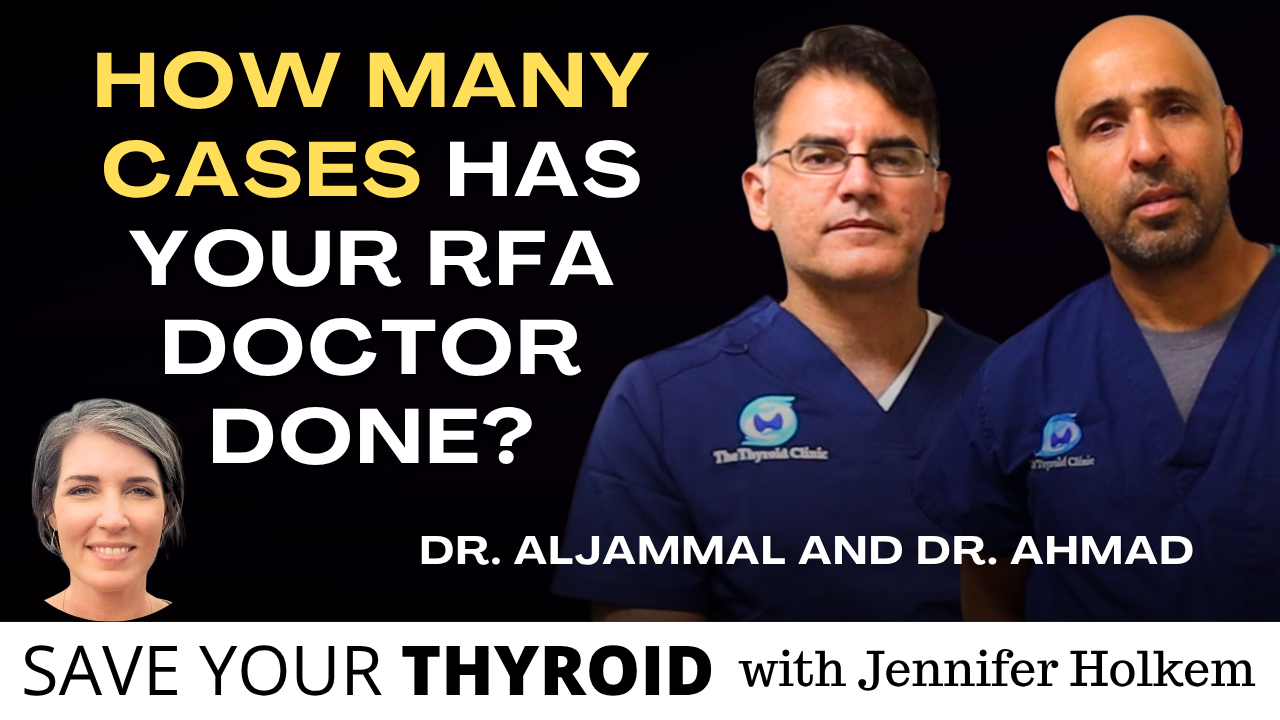
Is Your RFA Doctor Certified? A New Standard for Thyroid Ablation
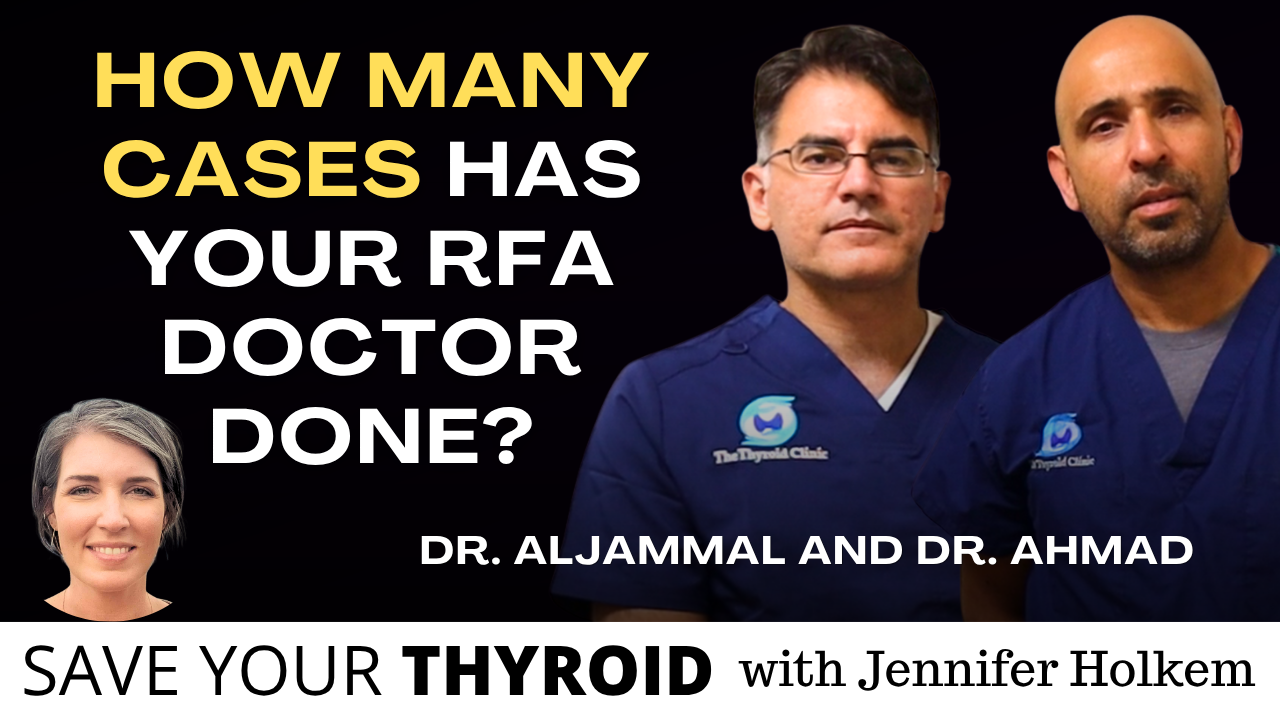
Save Your Thyroid with Jennifer Holkem · Episode 122
As thyroid radiofrequency ablation grows rapidly in the United States, one question is becoming increasingly urgent for patients trying to navigate their options:
How do you actually know if your doctor is qualified to perform this procedure?
It's not a question with an obvious answer. A general medical license doesn't tell you much. Standard board certification doesn't either. And with more physicians adopting RFA every year — some with extensive training and high case volumes, others just starting out — the gap between expert care and early-stage care is real, and it matters for patient safety.
That's exactly what Episode 122 of Save Your Thyroid with Jennifer Holkem addresses. And the two guests who sat down to talk about it are the most qualified people in the country to do so.
Meet the Pioneers
Dr. Jules Aljammal is the very first endocrinologist in the United States to perform thyroid RFA for benign thyroid nodules. Dr. Shahzad Ahmad has since performed the highest number of RFA procedures of any endocrinologist in the country, achieving multiple North American firsts along the way. Together, they began working toward bringing thermal ablation to the US back in 2012 — years before FDA approval came through in 2018 — navigating FDA bureaucracy, publishing the first US clinical data, and building the North American Society of Interventional Endocrinology from the ground up.
Their combined ultrasound experience before they ever performed their first ablation case was close to two decades. Their combined fine needle aspiration volume was upward of 40,000 procedures.
These are not people who picked up a new skill at a weekend course. They built the foundation that everyone who comes after them is now standing on.
And now they're formalized it with a certification program — the first of its kind for RFA providers in the US.
Why Standardization Is Overdue
For seven years, thyroid RFA in the United States has operated without formal standards. Any licensed physician could theoretically offer the procedure regardless of their training volume or outcomes. And while no physician sets out to harm a patient, the data is unambiguous: complication rates and volume reduction results vary significantly depending on provider experience.
Dr. Ahmad and Dr. Aljammal's own practice illustrates what high-volume expertise looks like. Their complication rate is approximately three in a thousand — voice changes around two in a thousand, nodule rupture around one in a thousand. Those numbers are significantly lower than what has been published by centers with less experience.
The learning curve is real. The data supports it. And patients deserve to know where on that curve their provider sits.
As Dr. Ahmad put it: "We wanted to be the modern west. Not the wild west anymore."
What the NASOIE Certification Requires
The new certification from the North American Society of Interventional Endocrinology is built around three non-negotiable pillars: volume, technique, and outcomes.
Volume — the 50-case minimum
Physicians must have performed at least 50 RFA procedures to apply. This threshold is grounded in published data showing that complication rates and clinical outcomes improve meaningfully once a provider reaches a certain volume. Below 50 cases, the learning curve is still steep.
Technique review
Applicants must submit sample cases demonstrating proper antenna placement, adherence to safety protocols, appropriate treatment of toxic nodules, and correct procedural technique. Being able to insert an antenna into a nodule is the beginning, not the standard.
Outcome review
Applicants must show their results — volume reduction benchmarks, complication rates, and clinical follow-up. Peer review of both technique and outcomes is part of the process. The philosophy mirrors how published research works: your peers evaluate whether your work meets the standard.
There is also a Master of Interventional Endocrinology certification for providers who go further — a higher case volume, published data, and demonstrated proficiency in advanced techniques including hydro dissection, which becomes essential when treating nodules in challenging anatomical locations or approaching thyroid cancer cases.
The Three Questions to Ask Your RFA Doctor
For patients evaluating a provider — whether certified or not — Dr. Ahmad and Dr. Aljammal offered three direct questions to ask before undergoing any procedure.
1. How long have you been doing this, and is this the focus of your practice?
A physician who performs RFA as a small part of a general endocrinology practice will build volume more slowly than one whose practice is dedicated to thyroid intervention. Neither is an automatic disqualifier, but the answer gives you important context about where they are on the learning curve.
2. Have you published your results?
Publishing outcomes requires tracking outcomes. A physician who has published their RFA data has been monitoring their patients closely enough to report on them in a peer-reviewed setting. That is a meaningful signal about their commitment to transparency and continued improvement.
3. What is your complication rate?
This is the hardest question to ask — and the most important one. A physician who can answer it clearly, including acknowledging that complications do occasionally occur, is a physician who is following their outcomes. One who doesn't know or deflects is a warning sign.
A Special Note on Thyroid Cancer Ablation
One of the most clarifying moments in this episode was the conversation around treating thyroid cancer with ablation — a topic our community asks about constantly.
Dr. Ahmad's recommendation: at least 100 cases before a provider attempts thyroid cancer treatment.
The reason is counterintuitive. Treating thyroid cancer with ablation is harder not because the cancer is necessarily in a bad location, but because the goal is fundamentally different. With benign nodules, you are reducing volume — shrinking a large nodule enough to relieve symptoms. You have a large buffer of healthy tissue around the treatment zone.
With thyroid cancer, you are aiming for 100% destruction of the entire tumor. A small cancer in a small gland is always going to sit close to the capsule, close to the edges, close to critical structures like the recurrent laryngeal nerve. The margin for error is almost nonexistent.
That's why hydro dissection — creating a fluid separation between the thyroid capsule and surrounding tissue — becomes essential. And that skill takes cases to develop.
"The most important part of being experienced with RFA is not just the technique," Dr. Ahmad said. "It's also learning when to say no."
Knowing when a patient is not a good candidate is itself a form of expertise. And it only comes with experience.
Continuity of Care Is Part of the Standard
Dr. Aljammal made a point in this episode that deserves its own emphasis: performing the procedure is not enough.
Finding a physician who will follow you long-term — monitoring your results, adjusting course if needed, and making the call if a surgical approach eventually becomes necessary — is just as important as finding someone technically capable of the ablation itself.
This is especially true for thyroid cancer cases, where monitoring needs to extend for years. Thyroid cancer can recur up to 15 to 20 years after initial treatment. A physician who performs the ablation and then sends you back to a general provider who isn't familiar with post-ablation imaging changes is providing incomplete care.
"I do not believe in care that is short or care that isn't complete," Dr. Aljammal said. "Continuity of care is a central point when I recommend someone who is interested in thermal ablation."
How to Find a Certified Physician
NASOIE is currently building a searchable map of certified providers that will be available on their website. That list will also be shared with saveyourthyroid.org so that our community can access it directly when searching for a qualified provider.
As of this recording, only a small number of physicians have completed the full certification process. The field is still early. But with each annual NASOIE meeting — the next one coming up in Santa Barbara — more physicians are expected to complete the requirements. The goal is certified providers available in most major metropolitan areas across the country within the next several years.
In the meantime, the three questions above are your best tool. Use them.
Where RFA Is Headed in the Next Five Years
Dr. Ahmad closed with a vision for the future that I found both realistic and hopeful.
Right now, RFA represents less than 1% of thyroid nodule cases that currently end up in surgery. His goal for the next five to ten years: get that number to 5%. If 5% of patients who would otherwise undergo unnecessary thyroid surgery can instead preserve their gland and restore normal function with ablation, the impact on quality of life across the country would be profound.
The barriers are still largely financial — insurance coverage remains inconsistent despite the CPT code going active in January 2025. But the trend line is moving in the right direction. More publications. More physicians getting trained. More guidelines incorporating ablation as a standard option. More patients arriving at appointments already informed and asking the right questions.
That last part — patients arriving informed — is something both Dr. Ahmad and Dr. Aljammal credited directly to this community.
"A lot of patients who initially were looking for this were influenced by your personal journey," Dr. Ahmad said. "You did it so that other people could benefit."
That's you. That's this community. Every time you share an episode, mention saveyourthyroid.org to your doctor, or ask a question that sends a physician back to the research — you're moving the needle.
Keep asking. Keep sharing. Keep speaking up.
To hear the full conversation with Dr. Shahzad Ahmad and Dr. Jules Aljammal, listen to Episode 122 on your favorite podcast platform or watch on YouTube at saveyourthyroidwithjen.com.
Key Takeaways from Episode 122:
1. Standardization protects patients
A medical license alone isn't enough to safely perform thyroid RFA. Volume, technique, and outcomes all matter — and now there's a formal certification to verify them.
2. The 50-case minimum exists for a reason
The learning curve for RFA is real. Complication rates drop significantly as experience builds. Volume is non-negotiable.
3. Two levels of certification
The Certificate of Interventional Endocrinology establishes baseline proficiency. The Master level requires published outcomes and advanced techniques including hydro dissection.
4. Three questions to ask your RFA doctor
How long have you been doing this? Have you published your results? What is your complication rate?
5. Thyroid cancer ablation requires a different mindset
You're aiming for 100% destruction, not volume reduction. At least 100 cases of experience is recommended before attempting thyroid cancer treatment.
6. Continuity of care is non-negotiable
Finding a physician who will follow you long-term is just as important as finding one who can perform the procedure.
7. The certified physician map is coming
NASOIE is building a searchable provider list that will also be available through saveyourthyroid.org.
8. The next five years
RFA adoption is expected to grow from 1% to 5% of thyroid nodule cases — saving thousands from unnecessary surgery.
Connect with Dr. Shahzad Ahmad:
Endocrinology Center of Utah: thyroidradiofrequency.com
Connect with Dr. Jules Aljammal:
The Thyroid Clinic Utah: thyroidclinicutah.com
The Thyroid Clinic Washington: thyroidclinicwashington.com
NASOIE: nasoie.com
To my subscribers, welcome back! If you're new, welcome to Save Your Thyroid with Jennifer Holkem, a podcast and blog all about thyroid nodules. For the past seven years, I have advocated for fellow patients suffering with this very common condition. Thyroid nodules impact 70% of adults in their lifetime, and the standard of care is surgical removal of half or all of the gland. But in recent years, safe and effective non-surgical treatment options have become available. In this podcast and blog, I sit down with patients and physicians to discuss life with thyroid nodules, treatment options, and how to save the thyroid whenever possible.
Find a physician, explore treatment options, and join our patient community:
saveyourthyroid.org
Book a one-on-one patient navigation consult:
saveyourthyroidwithjen.com
Disclaimer: None of the statements made in this or any other blog/video by "Its me Jen again" should be considered medical advice. The goal of this podcast and blog is to provide data, resources, and expert opinions on the topic of thyroid nodules and make it accessible to patients. When I was first looking for thermal ablation treatment, everything that I read was physician-facing material. It was very hard for me to understand. This material is meant to help patients understand what's going on in their thyroid gland and what an important gland it is. If you can keep your thyroid intact, that's going to help you live a longer, healthier life and preserve your quality of life. Thanks for reading this far today! — Jen
When Ablation Isn't the Answer: A Surgeon Who Does Both Explains


 Goodpods