
 Amazon Music
 Apple Podcasts
 Audible
 Castbox
 Deezer
 iHeartRadio
 PocketCasts
 RSS Feed
 Spotify
 YouTube
 Youtube Music
  Goodpods
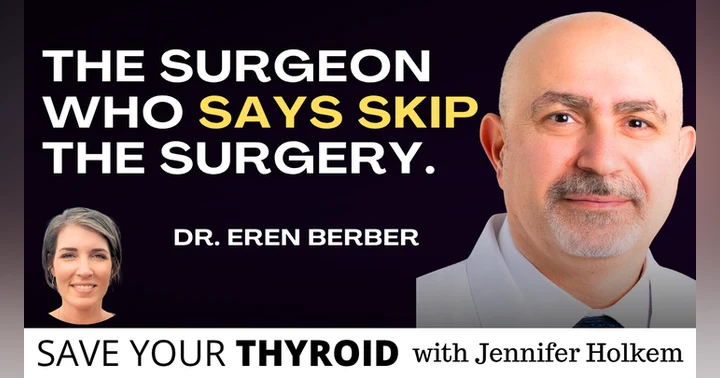
 RFA, Robotic Surgery & the Future of Thyroid Care: Dr. Eren Berber
Dr. Eren Berber is a Professor of Surgery at Cleveland Clinic and Director of Robotic Endocrine Surgery. He performed some of the first robotic thyroid operations in the US, brought thyroid RFA to Ohio, and has authored more than 350 scientific papers.
His honest take on every major thyroid treatment option will surprise you.
On robotic surgery: the only real advantage is avoiding a neck scar. Outcomes are not superior to conventional surgery — and he pioneered it.
On ablation: he was skeptical initially. Four years of following his own patients changed his mind. Over 90% success rate in his first 100 RFA patients. Less than 5% complications.
On the future: a nanopulse ablation trial is launching at Cleveland Clinic. ATA guidelines now formally include ablation as standard of care.
On insurance calling RFA investigational: FDA cleared since 2018. CPT code active since 2025. That excuse is on borrowed time.
Find Dr. Berber: Search his name at clevelandclinic.org and contact his office directly. Telehealth available for out-of-state patients.
What does the future of thyroid care look like when the person describing it helped build the present?
Dr. Eren Berber is a Professor of Surgery and Director of Robotic Endocrine Surgery at Cleveland Clinic. He performed some of the first robotic thyroid operations in the United States, brought thyroid RFA to Ohio, and has authored more than 350 scientific papers. He has spent his entire career at the forefront of thyroid innovation — and in this episode, he gives one of the most candid, comprehensive assessments of the current treatment landscape that Save Your Thyroid with Jennifer Holkem has ever aired.
He's not selling any single approach. He performs conventional thyroidectomy, robotic surgery, and RFA — all at high volume. And his honest take on all three will surprise you.
On robotic surgery: the only real advantage is avoiding a scar in the neck. Outcomes are not superior to conventional surgery. He pioneered it and he'll tell you that himself.
On ablation: he was skeptical initially. Four years of personally following every patient he treated changed his mind entirely. Over 90% success rate in his first 100 patients, less than 5% complications, and hot nodules returning to normal thyroid function within a month.
On the future: ablation technologies are evolving faster than most patients realize. A nanopulse ablation clinical trial is launching. AI is being incorporated into thyroid surgery. And the ATA guidelines now formally include ablation as a standard procedure for appropriate patients.
On insurance calling RFA investigational: FDA cleared since 2018, CPT billing code active since 2025, guidelines updated. That excuse, in his words, is on borrowed time.
In this episode:
- Why robotic thyroid surgery is not necessarily better than conventional surgery — from the surgeon who pioneered it
- How Dr. Berber counsels patients between ablation and surgery
- Why treating nodules earlier — while they're still small — produces dramatically better outcomes
- Cleveland Clinic's outcomes from their first 100 RFA patients
- How to navigate a large institution and get to the right expert
- The nanopulse ablation trial coming to Cleveland Clinic
- Why 98% of thyroid surgeons in the US are not high volume — and why that matters
- How to look up your surgeon's published outcomes on PubMed before your appointment
Find Dr. Berber: clevelandclinic.org — search Dr. Eren Berber and contact his office directly. Telehealth consultations available for out-of-state patients.
Hosted on Acast. See acast.com/privacy for more information.
Its Me Jen Again (00:00)
You're listening to Save Your Thyroid with Jennifer Holkem the podcast where we explore the cutting edge of minimally invasive thyroid care. Today, we're joined by a medical pioneer, Dr. Aaron Berber. As a professor of surgery at the Cleveland Clinic and director of robotic endocrine surgery, Dr. Berber performed some of the first robotic thyroid operations in the US, brought thyroid RFA to Ohio, and continues to lead the world in novel ablation technologies.
authoring more than 350 scientific papers and 30 book chapters along the way. In today's episode, we'll cover the shift to robotic thyroid surgery, how to decide between having a nodule ablated versus surgically removed, and exactly what questions you should be asking to ensure you get the most up-to-date care. Dr. Berber, welcome to the show. It's really nice to meet you, and I've heard your name in our community.
EB (00:48)
Thanks for having me, Jen.
Its Me Jen Again (00:52)
And, you know, I just recently attended a conference last weekend where I had so many, I had the same thing happen where I had so many faces that I put to names. So it's always really nice to be able to do that. So let me just start off by asking you about something I just mentioned in the intro, which is these papers that you've written, 350 papers.
and groundbreaking techniques that you've participated in at Cleveland Clinic. What initially drew you into the highly specialized world of endocrine and thyroid surgery?
EB (01:30)
Yeah, thanks a lot for your compliments, Jen, first of all. You know, I have always been a pioneer interested in new innovative technologies and ⁓ new surgical options for patients so that, these operations could be done through smaller incisions or even without doing surgery for them to have a better recovery after the procedure. So for all throughout my whole career, I have always been in the pursuit of ⁓
newer treatments, better treatments, less invasive options. over time, whatever technological gadgets were available and were cleared by FDA, also being in top institutions like Cleveland Clinic, I had the privilege of being at the forefront of innovation. So one innovation after another followed over time. And now here we are.
Its Me Jen Again (02:21)
Yeah, and today we're gonna talk somewhat about RFA, which is the procedure that you brought to Ohio. before we get into that, we're gonna talk a little bit about surgery. So as someone who is the first to perform robotic thyroid operations in the US, one of the first, how does the robotic approach differ from traditional open surgery for the patient's recovery and outcomes like you just mentioned?
EB (02:45)
So, you I got into robotics end of 2000. And at that time, you know, the robotic procedure were being developed in Korea. And I was one of the first to just go within and learn it. Because at that time, one of the gaps in our care of the patients was that the patients were not happy about the scar. And so at that time, can really spend a lot of time in this robotic procedures and were able to bring back.
Its Me Jen Again (03:03)
Yeah.
EB (03:10)
bring back actually this transaxillary technique where you would make a small incision in the axillary and kind of take the thyroid out. That helped the patients to a degree that, you know, those patients, especially those who were developing keloids and it really, these are like bad wounds after any kind of a scar. And those patients were really happy, but it was still not really very satisfactory to patients because you patients...
you know, still had to recover from that, you know, the surgery. And actually if you do it robotically, just paradoxically, it's actually a more invasive procedure because, you you create all this flap from the axilla to the neck and they have more pain and the longer recovery and they still need the bone thyroid medication. Over time, it came to my realization that actually we were not really 100 %
doing these procedures to the patient's satisfaction. because just losing an organ meant a lot to our patients. And the fact they had to take medication was a big deal. And I agree with you. I mean, we have to take our, you know, like basic vitamins or whatever, you know, we don't wanna take it every night. it's such an inconvenience. And then with the ablation technology is really maturing.
Its Me Jen Again (04:08)
Yeah.
EB (04:25)
I was like, this is actually the best option for the patient, obviously in selected conditions. And actually to the benefit of the patients, the patients, think, ⁓ opened this door because they kind of started asking about it, telling us about it. And it was really a good incentive for me to kind of start learning this. And that's why I started doing it four years ago. And I'm really happy that we're able to offer that to.
a certain percentage of our patients.
Its Me Jen Again (04:52)
love hearing that you mentioned that patients were kind of the driving force behind you adopting this. And you're not the first person to tell me this, not the first physician to tell me this because I've been hearing it for quite a while now. And that's something I always remind our patient community about is that, you you need to speak up about this technology. So many doctors today still don't know about RFA and they're still ⁓
a lot of doctors even who are against it. And so I think it's really important that patients continue to speak up. Audience, you just heard it right here from Dr. Berber that that was a big part of his adoption of this technology. So I appreciate you doing that for your patients. And it's interesting to hear the evolution, you know, from open surgery to robotic surgery, we gained the not having to have a scar.
but we still have the loss of the thyroid hormone. So from robotic surgery to RFA, we then gain the maintenance of the thyroid, the maintaining of the healthy intact thyroid. So that's amazing to hear that story. So tell us then if you're someone who's considering a robotic procedure, who is the candidate for that versus the traditional approach? Because we do know that there's still the loss of the thyroid gland.
So some people who maybe wouldn't be a candidate for RFA would still want to pursue that.
EB (06:16)
Yeah, the best case of patients with smaller nodules, these are nodules less than four centimeter. And if they are diagnosed with cancer, the cancer that's confined to the thyroid that has not spread outside. And then there also body haptis has to be appropriate. There are a couple of different options, like, you know, the transaxillary approach, the distance from the axillary to the neck has to be reasonable. Otherwise the tunnel becomes very complicated, becomes a bigger operation. The newer option where you do the transoral
like was in certain patient anatomies is also relevant. So it's kind of a more kind of a restricted group of patients, especially in our academic practice.
Its Me Jen Again (06:51)
So you wouldn't be removing any larger goiters or nodules maybe over what size threshold would you say?
EB (06:58)
used to use four centimeters.
Its Me Jen Again (07:00)
in light of robotic surgery then, does it help preserve the surrounding structures like the nerves or the vocal cords or the parathyroids?
EB (07:09)
know, in, in contrary to the general belief, I think if you're going to have thyroid surgery, ⁓ unless there's like a really a cosmetic wound healing problem, in my opinion, and again, I'm a big robotic surgeon, a lot of robotic surgery, and I've done a lot of pioneering procedures. I think just that the robotic procedures, although their benefits, like not having a scar in the neck, they're really more complicated procedures. I mean, it requires a lot.
really significant surgeon experience and there are only a handful of surgeons in the country who can do these operations. And if you look at the outcomes, and a lot of patients actually used to ask me, you your robot, can do better. Not necessarily. I mean, it's just, I think just a conventional surgery where, you know, if the patients are okay with having a scar, I think is the best way to do the procedure because whatever.
Its Me Jen Again (07:46)
Right?
EB (07:56)
⁓ anatomical or pathological surprise you might have, can still salvage the situation and come up with the sound plan. Whereas these endoscopic procedures, if the anatomy is not good, you find more advanced disease, then you kind of, don't have a lot of options. And then nowadays, you they are present for very small incisions, you know, wearing surgical loops. So overall, these procedures are not really leading to better outcomes than conventional surgery.
Its Me Jen Again (08:12)
Mm-hmm.
Mm-hmm.
EB (08:24)
I think their only benefit is that you don't have an incision in the neck.
Its Me Jen Again (08:27)
Okay, well, and that makes sense. I did actually one time have an opportunity to
into a robot simulator at Johns Hopkins. when you looked into the
goggles portion, what you could see were like little road cones and you had to put hoops on top of them.
I remember having to maneuver it and do all of those actions and thinking, wow, this is really hard. And, you know, I'm not using my hands. I'm using these tools that are operated by the robot. And I thought, well, I don't know how anyone learns how to do this. But I mean, we do have you yourself and others who have learned how to do these robotic surgeries. And it's really fascinating. But I think at the end of the day, maybe what you're saying is that
your hands and your eyes are doing ⁓ this work in a more facile way. So that's really interesting. So as a highly skilled surgeon and an ablation expert, how do you counsel a patient who's maybe on the fence between having an ablation versus a surgery, either form of surgery?
EB (09:30)
So I feel like with the building experience over the last four years, and actually I follow all my patients myself, I really really interested in does it work or not? And honestly, I was a little bit skeptical initially, but seeing the results in my patients, I'm a big believer. so certain kind of a clinical pathways have emerged. Like if a patient comes in and has a thyroid nodule, which we do a fine needle biopsy in the office and I do my own biopsies.
If it comes back benign, and if the patient is having symptoms from this, definitely they're a candidate for the ablation procedure. And we still bring up the surgical option, but now seeing all the results and really seeing how effective this treatment is, and actually the patient bring it up before I even present the options anyway. But I think...
thyroid ablation is really a good option for them. And the guidelines are including this in the recent editions as well. If the patient has indeterminate nodule or suspicion for cancer, still we don't have a lot of data about the utility of ablation for these situations. for that reason, those patients should still do thyroid surgery. But otherwise,
⁓ benign nodules, if they're symptomatic, definitely. And what we are finding is that the nodules shrink over time, but the most dramatic responses are in those patients with nodules that are smaller. So that brings up to mind that, you know, we always control you, the nodule has to be about a certain size to be eligible for the procedure. But if you have a big nodule, it's gonna get smaller, it's not gonna go away. So maybe, you know, we should think about
even applying of, I think, ablation earlier when the nodules are small. If the patient comes in, is a young patient, is gonna be having a lifelong follow-up, possible multiple biopsies, and then why not even like starting to treat these nodules earlier? I think this is going to, this kind of the fourth process is going to evolve and I think it's gonna be applied eventually because dramatically you just, you know, the nodule disappears and you're done with it.
Its Me Jen Again (11:38)
I completely agree. I think that's probably the direction we're heading. For example, my personal experience with RFA was I had a quite large nodule. It was between 65 and 75 mLs, about four and a half centimeters by I think seven or eight in the longest dimension. It was quite debilitating as far as symptomatically and also it was cosmetically disfiguring. And I went into the procedure having
complete awareness that it would probably not completely go away. And that was six years ago and it has reduced by 90%. And that was a fantastic, phenomenal reduction. However, I still have that remnant in there, which I'm okay with. I'm very happy to have the results that I had. But we do in the Facebook community with our patients do see quite a few people who
You know, they don't have that same dramatic level of reduction because everyone is different, right? And so we do tell people if you're on the fence about having a procedure and your nodules on the smaller side, if you're watching this in year after year, it's growing, why not be proactive and address it before it gets too large and then it doesn't completely go away? I think that's the direction we're heading.
EB (12:55)
I agree.
Its Me Jen Again (12:55)
Yeah, so I think we're going to see more people being proactive in the future, especially now that ablation techniques have been around. We're going on seven years now. People are more aware of this.
as we were just discussing awareness in the community of physicians is growing, adoption is growing. so then let's talk about getting a second opinion, because this is a this is a common question we see from patients about
going and being told by their first physician that they see that they may not be a candidate for an ablative technique, they are being referred to surgery, what specific questions should these patients ask to make sure that they're getting the most up-to-date knowledge on minimally invasive care for their thyroid nodule?
EB (14:29)
What I'm noticing is that despite this ablation technology being available and many centers starting to use it, even in the same institutions that you may be working at, are different levels of awareness and knowledge about this technology. There are naturally, disagreements. And I suggested to patients
if the patient has a benign biopsy, I recommend them to request a second opinion with actually the physician who does these procedures. Because a lot of times the patient come in and I find out the,
the kind of the details about the procedure have not been shared accurately. The outcomes have not been shared accurately indications likewise. So I think that's the most important thing for the patient to see the expert directly without really any.
⁓ opinion or direction from the referring physician. Unfortunately, I mean, we see this for a lot of other procedures that we do, the patients come in and then they kind of start telling you about some details about the procedure that you're planning. But when I tell the patient, actually, what you've been told is not correct, sometimes it becomes inappropriate, but that's kind of the right thing to say to the patients.
Its Me Jen Again (15:45)
100 % agree with you Dr. Berber. I cannot tell you how many patients have been told I'm not a candidate by a doctor who's really not informed on RFA or other techniques. And then when we say to them, you know, in our Facebook community, well actually on our website, saveyourthyroid.org, we have a list of all of the doctors that we know of in the US and abroad who perform non-surgical options for nodules. We tell them,
see one of these doctors and see if you get a different answer. Because if you get the same answer, you may indeed need surgery. But if not, then it could be that the first physician you saw just wasn't up to date on what they knew about these technologies. ⁓
EB (16:29)
Exactly.
But in general, I think like for any procedure, also it's important. Like, I mean, for a lot of procedures now, there's a lot of data showing that the outcomes are better if given procedures done by a surgeon who does a higher volume of that procedure. So I think that's the other question I would recommend the patients to look to some, you know, look at, I mean.
you know, the hospital websites and just a lot of professional websites that give you information about physicians really find out, is the expert I am referred to is really an expert on this field. You how many procedures does he or she does about this every year and what are the outcomes? And so I recommend that to kind of just look into and study their surgeon a little bit ahead of time.
Its Me Jen Again (17:13)
I completely agree. And that's also another reason why I love doing these podcasts and patients also appreciate them because it's a way for them to kind of see their physician ahead of the appointment and kind of see what they're like, hear about them, learn about them. And so with that in mind, why don't you tell us a little bit about your experience with RFA? You started RFA in Ohio back in 2022. So tell us about
the patient demand that you've seen and what has the reception been of the medical community in the time since?
EB (17:45)
So I started doing the procedures about four years ago. And then at the beginning, you have to obviously assemble a team. So assemble the team of endocrinologists and me and increase awareness about the procedure with multiple grand rounds and webinars like this. And then, you know, the volume has been gradually increasing, especially we had a little bit
set back initially when the CPT codes were not available and especially last year the CPT codes being available, the volumes are increasing. a couple of weeks ago, we kind of met our first 100 patient milestone. And then I kind of looked at our patients and so the success rate has been actually over 90%.
Its Me Jen Again (18:29)
Congratulations.
EB (18:37)
So we only had the 5 % of the patients require some additional treatments. Half of them repeated the treatments with the radiofrequency ablation And then a couple of patients, we had to go and do thyroid surgery because we did not get the results that we wanted. The complications were minimal. We had less than 5 % complications.
Mainly one of the kind of specific complication about this condition is this nodular rupture. We experienced that in two patients earlier on. And then adjusting our technique, we haven't seen it subsequently. And then a nerve injury did not happen to anyone else. And two patients had just a transient neck infection. So our complication rate was again, less than 5%. That's just pretty, I think, acceptable. And the patients have been very happy.
Its Me Jen Again (19:20)
Mm-hmm. Yeah, that's great.
Mm-hmm.
EB (19:24)
And
we also started doing it for these hot nodules and almost every nodule, about a month later, we established a eu thyroid condition where the thyroid levels came back to normal. That's been also a big plus and really excitement for us as well.
Its Me Jen Again (19:43)
Yes, and that is exciting for the patients that have been suffering when they have normal thyroid hormone function again after that. That's fantastic. Regarding the conference that you're attending right now, would you like to talk about that at all?
EB (19:57)
Sure, yeah. Now I'm actually currently in DC and attending this ISITES conference, which is actually a group that meets every year to discuss ⁓ innovative technologies and procedures. Thyroid ablation is one of the new technologies that we're talking about. We're also talking about other technologies that help us do the surgeries better. For instance, using special dyes to identify like the parathyroid glands. Actually, this is...
not recognized on a regular basis by the patients. I just maybe with this whole project, I can raise awareness when you're doing thyroid surgery. You know, we always talk about, you know, nerve injuries and kind of voice problems, but you know, another significant problem is that about one percent of the patients in experienced hands and their rate goes up in lower volume centers can have a permanent
hypocalcemia where they have low calcium, they have taken a lot of calcium pills and this can be pretty debilitating. And now there's new technologies that are based on dyes and non-dyes to be able to see these glands in addition to our kind of regular eye view.
And so we're talking about the utilities and the developments in this area for thyroid cancer. you know, additional, you know, AI is being incorporated into thyroid surgery as well. And I think it'll be incorporated into thyroid ablation as well in the future. We're talking about the...
application of these AI technologies into thyroid surgery as well. So it's really good cutting edge society and the meeting.
Its Me Jen Again (21:41)
And just before we got on this call, were you in a thyroid ablation training session?
EB (21:45)
we were actually in a thyroid ablation session where we talk about the recent developments in this area. A couple of new things that we're going to hear about thyroid ablation. One of them is utilizing this technology for small thyroid cancers in appropriate locations.
Some new technologies that do not use heat like nano pulse. The experience with that has been increasing and we're also going to start a trial at the Cleveland Clinic as soon as well.
Its Me Jen Again (22:06)
Mm-hmm.
EB (22:13)
and we also reviewed the literature and some and the Have ablation has appeared in the recent like a TA guidelines for instance. Well, all the guidelines are incorporating ablation more as a kind of the standard procedure for obviously patient was of certain pathologies so
we can review the literature and I'm kind of being was really delightful to hear that. I mean, the data is strong and I think we're gonna hear more about ablation and we're gonna use it more for patients.
Its Me Jen Again (22:46)
Absolutely. think it's so exciting that we do now have guidelines from the ATA. And one of the frustrations we see from a lot of patients, myself included, is just the idea from the insurance companies, the excuse that's given a lot of times on denials is, ⁓ RFA is investigational. This isn't FDA cleared. Well, it's not true. It's been FDA cleared since 2018.
and now we have a CPT code and we have guidelines. So I feel like that excuse is on borrowed time.
EB (23:18)
Exactly, yeah, that's been kind of a big hassle for us and the patients initially, but with after the CPT code, we've been kind of, the patients have been happier.
Its Me Jen Again (23:27)
Yeah, insurance coverage for this has been a long time coming. So I'm really glad we have that now. So you mentioned some of the things that are coming up and coming and that's so exciting to see options expanding for treatment of thyroid nodules and also expanding indications for treatment. And in your bio, it mentioned that you were the first to use several different novel ablation systems globally. ⁓ What emerging ablation technologies
Are you most excited about right now coming up in the future?
EB (23:58)
Sure.
You know, one of the, I think the issues about thyroid ablation is that most of the endocrine surgeons were not really exposed to ablation technology before thyroid RFA. And kind of I function as a surgical oncologist with a kind of minimally invasive background. So I have been exposed to a lot of different ablation technologies for a long time. I also...
treat, for instance, liver tumors with ablation, with radiofrequency ablation, micro ablation.
IRE and then most recently histotripsy, for instance, is the technology that uses ultrasound energy. so transitioning from that experience to the thyroid was really not difficult for me, but also gives me the advantage and ability to actually recognize some new opportunities earlier on to be able to adapt to the thyroid.
So all I can tell is that the ablation technologies are evolving very, very rapidly. every year we're seeing a new device that provides more efficient tissue destruction using these heat-based and non-heat-based energy platforms. I'm sure what we're using now
is not going to be what we'll be using like five years from now. I think all these technologies are evolving and we're going to have like a more ⁓ effective and less harmful, more user friendly ⁓ technologies in the future.
Its Me Jen Again (25:23)
I agree. I think we're moving, we're always moving towards improving for the physician experience and the patient experience and outcomes. You mentioned a clinical trial a moment ago. Would you like to talk about that?
EB (25:34)
yes. So at the Cleveland Clinic, we started the ablation program with radiofrequency ablation, which uses heat-based technology. Most recently, non-heat-based technology using nanopulse energy has been introduced.
We are finalizing the infrastructure to start a trial of nanopulse ablation at the Cleveland Clinic. Hopefully in the next couple of months, we'll be starting that.
Its Me Jen Again (26:01)
Very exciting. So obviously we're going to have patients who want to know about how to get involved with either that or with just you as an ablation specialist. So tell us about the patient experience coming to Cleveland Clinic. I know it's a big institution and I have heard some patients say, I went to the Cleveland Clinic and I asked about RFA and as you said a moment ago, it wasn't offered to me because they didn't go to you, they went to someone else. So how can a patient navigate?
that system at the Cleveland Clinic.
EB (26:31)
Sure. So with my group, we actually recognize the challenges that patients may have and kind of all the anxiety and the fear they may have coming to a big institution. I mean, that starts even in the parking lot to getting to where you have to go. So we really have made a lot of initiatives within our group to really take ownership of the patient and make it as ⁓ convenient as possible. So the best way would be to kind of reach my office directly.
Its Me Jen Again (26:44)
Yeah.
EB (26:56)
And then afterwards, If they can reach to my office, I have very dedicated nursing and secretarial support for this program. And they will immediately arrange to
to gather the patient's records and give the patient a pretty soon appointment to go over the thyroid problem. I think just coming directly to, as we mentioned, to my office kind of will really help a lot for them to have a kind of easier experience within a big hospital system.
Its Me Jen Again (27:26)
Definitely. And what about telehealth? you do any telehealth appointments?
EB (27:30)
Yeah, actually I'm getting a fair number of patients who are not local. And then what I do is I initially, after we gather the records, do a first like a virtual or a phone visit to kind of discuss the eligibility. if it turns out that the patient is really a candidate for the procedure, then they kind of be arranged for a second visit, which will be almost like a
preoperative or like a pre procedural visit where the patient comes in and does all the workup necessary for the procedure. And then the. Yeah.
Its Me Jen Again (28:01)
That's really helpful.
Yeah, because we do, as you said, we do still see a lot of patients traveling long distances for treatment now. We do, although thankfully do now have over 200 different names on our list of physicians in the U.S. I remember when it was two. ⁓ And so it's just, it's so exciting to me to see that there are more options available, but there's still not options in every state and not in every ⁓ locale. So.
EB (28:19)
Yeah.
Its Me Jen Again (28:29)
⁓ We do appreciate you offering that telehealth option for those people who are coming from out of town. There's nothing more frustrating than when we have a patient travel a long distance only to find out they're not a candidate. So that's really helpful. Is there anything else you'd like to share about your practice or your experience that or even at this conference you're at this weekend that might be helpful to the viewers because our viewers are
very savvy and very interested in doing a lot of research and educating themselves on this topic.
EB (29:03)
Sure, what I would like to emphasize that because I do a number of different type of procedures, like for the patients that I see in my practice, I'm proud to say that I'm not biased about any kind of type of procedure. So when the patient comes in, you know, we talk about just a conventional thyroidectomy option, robotic option.
or thyroid ablation and I feel like I'm really providing a custom solution to any given patient without really being biased by just being able to do one procedure. Because sometimes like, somebody does one procedure, it's like a hammer and the nail and then everybody gets that procedure done. So I'm kind of really happy that I'm able to provide a variety of procedure and I do a high volume in each one.
that I think I see in my practice that really optimizes the outcome of the patients and the patients are really happy about it. And we have very dedicated team in my department with the nursing and the secretaries and the trainees as well who are really well trained about this procedure. So overall, our patients are happy about the care they get here.
Its Me Jen Again (30:13)
I like that you mentioned about high volume as well. That's a really critical point that I was made aware not too long ago that most of the thyroid surgeons in the US, believe something like 98 % that are doing most of the thyroid surgery out there are not high volume, which is just unbelievable to think about. So it's really important.
to find a surgeon when you're going to have thyroid surgery or a thyroid procedure of any kind that you go to someone who's got a great deal of experience and does a lot of volume. So I'm glad you mentioned that.
EB (30:47)
And also, like we're very transparent about it. Like any procedure I do, we, you you mentioned the publications that I've had, we published the results. Everything is very transparent. So the patients can actually go online into PubMed and, you know, find these papers and they would know what my outcomes are in the past 10 years on any procedures that I'm doing. I think like, ⁓
In addition to the kind of number of cases you do, like having these outcomes transparently out there is pretty important that you already know what your surgeon is capable of. And I think that is something that has to be acting more widely adopted.
Its Me Jen Again (31:24)
like that too. Would you like to share anything about any particular publications that were really meaningful or really move the needle for your patients in particular?
EB (31:32)
Yeah, mean, like any time we actually look into innovation and actually looked at a lot of innovations, I've been very objective about it. And so we always have some prospective ⁓ study kind of a trial where, you know, the patient comes in and all of the data is recorded and we know what happens to every patient we treat with ablation, for instance. And I was able to give you the...
outcomes and if the outcomes are favorable, then kind of we continue to use the technology with outcomes are not favorable. Like can we move on to another technology really not advertise falsely to the patients about any given procedure. So we published about our thyroid RFA experience. Actually, we're going to present our 100 patient experience at the Center Surgical Association meeting coming in June. So the patient will have access to that as well and it will be published.
And likewise, all our robotic thyroidectomy experience has already been published as well. So all our outcomes are in scientific journals.
Its Me Jen Again (32:30)
So if a patient wants to read one of your ⁓ publications, how's the easiest way for them to find that?
EB (32:37)
They can just Google it, for instance, let's say, know, Eren Berber and thyroid RFA, and it will, you know, pull up anything that
journals and also pull up the papers. Or the medical, really, the more professional side is called PubMed. And then they go in there and they can type in like,
Thyroid RFA and whatever like hot nodules, whatever. And it will pull up all the publication. They can select the publication they wanna review. Some of them will be like available to the public. Some of them they might have to pay a kind of small amount of fee to be able to download.
Its Me Jen Again (33:13)
There's a great deal of open access content out there and I think it's so fantastic that today that the average person can have access to these types of materials online and learn about these things that we're undergoing for our health care. So I think that's wonderful. We live in a day of an age of information today.
So, ⁓ well, Dr. Berber, are, think we've gone through all of our questions. Is there anything else you'd like to talk about before we close this out?
EB (33:41)
Well, first of all, I would like to personally thank you because you being available and creating this kind of environment for the patients where you increased awareness about the procedure has really helped the patients a lot to kind of really know that this treatment exists and also decrease their anxiety and really optimize their expectations about this. ⁓
Pretty much all of the patients I have recently scheduled for the procedure, they mentioned that they've gone through your website. Actually, they recommended me to also be involved with this collaboration. So I really wanna thank you for doing this.
Its Me Jen Again (34:17)
Well, I appreciate the wonderful kind words. Thank you so much. It means a lot to me to know that patients are mentioning our community to you and to their doctors and their consults. So I would encourage patients to keep doing that because as we were saying earlier, patient demand is driving this innovation and so patients need to keep speaking up. So thank you for listening.
Thank you for being ⁓ so receptive to your patients and being so data-driven in the choices that you make in terms of the modalities that you offer. So Dr. Berber, ⁓ what is the best way for patients to find you at the Cleveland Clinic if they wanna reach out to you for a consult for RFA or surgery or robotic surgery?
EB (34:59)
So when they go to the clinical website and they kind of search any physician, including me, and then we'll give them our kind of regular office number and the kind of appointment line. And it's just important for them to request a physician that they would like to see and then they will connect the patient.
Its Me Jen Again (35:16)
well, I appreciate you so much, Dr. Berber. It's been a pleasure getting to know you and I'm sure that you'll be seeing many more of the patients from our community moving forward.
EB (35:25)
Thank you very much, Jen. I appreciate the opportunity. Thanks for having me.
Its Me Jen Again (35:28)
That wraps up today's episode. If you found this valuable, please like, subscribe, and share it with someone who might benefit.
you can find links to everything we discussed in the show notes below. Find a physician, discover treatment options, and join our patient community at saveyourthyroid.org. To stay up to date on new episodes, resources, and expert insights, be sure to subscribe to my mailing list at saviourthyroidwithjen.com. It's the best way to stay connected and informed. There you can also find all podcast episodes,
and book a one-hour patient navigation consult for personalized guidance on your next steps. As always, please remember this podcast is for informational purposes only and is not a substitute for professional medical advice. No endorsement is given or implied for any specific product, treatment, or physician mentioned. As always, consult with a qualified healthcare professional for your individual needs. Thanks for listening and I'll see you next time.