Amazon Music
 Apple Podcasts
 Audible
 Castbox
 Deezer
 iHeartRadio
 PocketCasts
 RSS Feed
 Spotify
 YouTube
 Youtube Music
  Goodpods
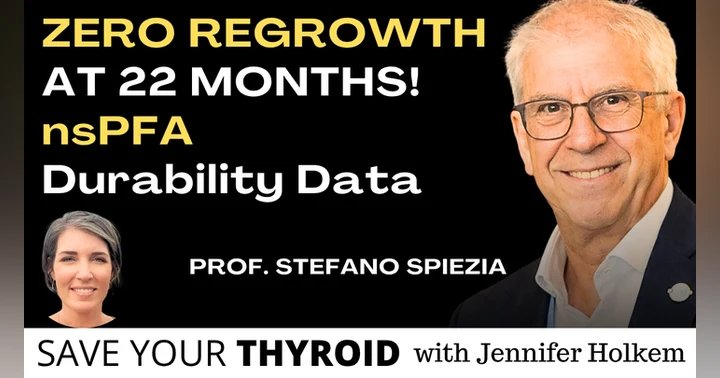
 nsPFA: Zero Regrowth at 22 Months! The Durability Data Thyroid Patients Need | Prof. Stefano Spiezia
Does nsPFA actually last? Until now, that question didn't have a real answer. In this episode, Professor Stefano Spiezia joins Jennifer Holkem to break down the 22-month durability data on nsPFA — non-thermal pulsed field ablation for thyroid nodules — presented at the 2026 NASIT meeting in Portland.
Professor Spiezia is head of the Division of Endocrine and Ultrasound Guided Surgery at the Sea Hospital in Naples, Italy, and conducted the first-in-human feasibility study of nsPFA for thyroid nodules. He's also director of the Save Your Thyroid International School for Interventional Thyroid Procedures.
In this episode, they cover:
✅ The 22-month durability data: zero nodule regrowth, 74% average volume reduction, and no serious adverse events
✅ How nsPFA works differently from RFA and microwave ablation — a non-thermal mechanism that triggers regulated cell death instead of burning tissue
✅ Why nsPFA nodules kept shrinking over time instead of plateauing, unlike thermal ablation
✅ Patient satisfaction results: 100% highly satisfied with cosmetic outcome, 95% highly satisfied overall
✅ Why avoiding fibrosis matters — easier re-treatment if regrowth ever occurs
✅ A real risk of thermal ablation scarring that can be mistaken for cancer on a later ultrasound
✅ Why nsPFA and RFA are complementary technologies, not competitors
✅ What's next for nsPFA in thyroid cancer treatment, including recurrence after surgery, and why multi-center studies are still needed
If you've been waiting to see whether nsPFA's early promise would hold up over time, this episode has the data.
The question this community has been asking since nsPFA first appeared on this podcast has finally been answered.
Does it last?
Professor Stefano Spiezia conducted the first-in-human feasibility study of nsPFA for benign thyroid nodules — and in 2026 he presented the durability data at the NASIT annual meeting in Portland, Oregon. Average 74% volume reduction at up to 22 months. Zero regrowth. Zero serious adverse events. And the nodule continued to shrink throughout the entire follow-up period.
Professor Spiezia is the Head of the Division of Endocrine and Ultrasound Guided Surgery at the Sea Hospital in Naples, Director of the Regional Reference Center for Thyroid Treatment, Adjunct Professor at the University of Turin, and Director of the Save Your Thyroid International School for Interventional Thyroid Procedures.
In this episode:
✅ Why nsPFA is a paradigm shift — not just another energy source
✅ How it works — programming cells to die, not burning them
✅ The 22-month durability data — 74% volume reduction, zero regrowth, zero serious adverse events
✅ Why the nodule kept shrinking throughout the entire follow-up
✅ 100% patient satisfaction with cosmetic appearance, 95% overall
✅ Why the absence of fibrosis and scarring changes everything
✅ Which nodules benefit most — especially those near critical structures
✅ Why nsPFA and RFA are complementary rather than competitive
✅ The regulatory landscape — FDA cleared in the US, CE mark pending in Europe
✅ The Save Your Thyroid International School — training physicians worldwide
If you have been waiting for the durability data on nsPFA before making a decision — this is the episode you have been waiting for.
Chapters
00:00 Introduction to Thyroid Nodule Treatments
01:04 New chapter
01:57 The Evolution of Non-Surgical Options
03:56 Understanding NSPFA: A Paradigm Shift
03:56 The Safety and Efficacy of NSPFA
15:39 Navigating Thyroid Nodule Diagnosis
44:09 Introduction to the Podcast and Resources
44:09 Navigating Thyroid Health and Community Support
🔗 Professor Spiezia & the Save Your Thyroid International School:
www.sytmedical.com
🔗 nsPFA Trial at MD Anderson & Sarasota Memorial (NCT07218315):
clinicaltrials.gov/study/NCT07218315
Contact: (941) 917-2225 or researchinstitute@smh.com
📌 Resources:
👉 Podcast: https://www.saveyourthyroidwithjen.com/
👉 Patient site: https://www.saveyourthyroid.org/
👉 Private FB group: https://www.facebook.com/groups/saveyourthyroidnonsurgical
👉 Patient Navigation: https://www.saveyourthyroidwithjen.com/patient-navigation-services/
⚠️ Disclaimer:
This podcast is for informational purposes only and is not a substitute for professional medical advice. No endorsement is given or implied for any specific product, treatment, or physician mentioned. Always consult with a qualified healthcare professional regarding your individual medical needs.
🎵 Music licensed through Soundstripe:
1G4WWNUWW7H8MYH4
VRP5MQM1YSHICQLR
1NSDN1IASZTIWC21
Hosted on Acast. See acast.com/privacy for more information.
Jennifer Holkem (00:00)
You're listening to Save Your Thyroid with Jennifer Holkem the podcast where we cut through the noise and bring you
Stefano Spiezia (00:05)
you
Jennifer Holkem (00:06)
the real information you need to understand your options when it comes to thyroid nodule treatment, you deserve to make decisions based on facts, not fear. For a long time, the standard answer to a symptomatic thyroid nodule was surgery. Remove the nodule, remove the lobe. Sometimes remove the whole thyroid.
That meant anesthesia, scarring, potential lifelong hormone replacement, all for a nodule that in most cases was completely benign. Then came radiofrequency ablation, RFA, and everything changed. For the first time, patients had a real non-surgical option, a minimally invasive procedure that used heat to shrink nodules,
Stefano Spiezia (00:45)
Thank
Jennifer Holkem (00:46)
preserve thyroid function,
and send people home the same day. It was a revolution, but medicine doesn't stand still. Over the years, new technologies have emerged alongside RFA,
Stefano Spiezia (00:57)
Okay.
Jennifer Holkem (00:58)
Each one has
different use cases,
different benefits depending on what a patient needs.
And then came nsPFA,
nanosecond,
pulse field ablation. non-thermal, no heat, which means no risk of heat related damage to nearby nerves and vessels.
remarkable volume reductions from the early data that appeared to have essentially no downsides except one.
We didn't know how long it would last. That's what we're going to talk about today. Professor Stefano Spiezia is the head of the Division of Endocrine and Ultrasound Guided Surgery at the Sea Hospital in Naples, Italy, and the Director of Regional Reference Center for Thyroid Treatment there. He's an adjunct professor of minimally invasive
percutaneous thyroid treatments in the University of Turin Italy, and a pioneer in thermal ablation of thyroid nodules in Europe. And now he's the one delivering the durability data on nsPFA
that this community has been waiting for, presented at the 2026 NASIT meeting in Portland, Oregon, Beyond his clinical work,
Spiezia is also the director of the Save Your Thyroid International School for Interventional Thyroid Procedures, a training program through Italy's leading ultrasound society, SIUMB, where he's actively working to grow the global community of physicians
skilled in these techniques. He is, in the most literal sense, building the future of this field. Professor Spiezia, welcome back to the podcast.
Stefano Spiezia (02:30)
Hi, Jen and thank you for your kind invitation. I appreciate too much the possibility to join you and your community sharing my experience in the field of thyroid nodule ablation.
Jennifer Holkem (02:42)
It was a pleasure to see you in Portland. It's a pleasure to see you today. And I think that we need
Stefano Spiezia (02:48)
Thank you.
Jennifer Holkem (02:49)
more of these kinds of conversations. So I'm really excited to get into all of what we're going to discuss today. So for the listeners who are
Stefano Spiezia (02:55)
Me too.
Jennifer Holkem (02:58)
newer to learning about these non-surgical procedures, and especially in the thyroid, can you briefly describe the problem that procedures like RFA
and nsPFA are solving, was the patient experience before these solutions existed?
Stefano Spiezia (03:15)
Sure, before minimally invasive treatments, the only real option for symptomatic thyroid nodules was surgery, even when the nodule was benign. That meant general anesthesia, a scarring in the neck, and in many cases, lifelong thyroid treatment replacement for a benign condition that was often an overtreatment.
So what RFA and now nsPFA have done is fundamentally
changed that paradigm. We can treat the nodule effectively while preserving the thyroid and
avoiding surgery. In other terms, we are moving from removing the thyroid to preserving it.
Jennifer Holkem (03:56)
And I know this is a topic you're very passionate about. You've been involved in non-surgical options since the 2000s. And I honestly wanted to ask you this question. I thought about it earlier this morning and it's not in our notes, but why are you so passionate as a surgeon about these non-surgical options? What kind of changed your perspective on surgery to favor something that would save the thyroid?
Stefano Spiezia (04:23)
Yes, because this was an evolution that happened step by step in my life, in my career. You know that I started very early in Europe in 1996 to start with this thermoablative procedure.
that was the first real breakthrough, a minimally invasive alternative that worked. So this was a very big surprise for us all. Then came radiofrequency before laser, then radiofrequency and more recently microwave ablation, each with a specific technical advantages. nsPFA represents today a different kind of evolution.
It's not just another energy source, it introduces a completely different biological mechanism. So if RFA was a revolution, nsPFA nowadays is more a paradigm shift.
Jennifer Holkem (05:18)
Absolutely. And it's so different, even though so many of us in the world of as patients anyway, in the world of non-surgical treatment options, we sort of view all of them through the lens of RFA because that one was really first in our understanding. And so why don't you explain a little bit more about how it's so fundamentally different, the difference between heat based thermal ablations and nsPFA, which is not heat at all.
Stefano Spiezia (05:46)
What immediately stood out when we approached this new technology was the non-thermal mechanism. It was really surprising for us. The idea that you could treat tissue without heating and therefore potentially avoid damage to the critical structures that in a very small space like the neck where the thyroid is located, it's very important to avoid any kind of complication.
because first of all treatment could be safe, very safe. So I think that the real surprise for us was that we could proceed without have in our mind the possibility to create any complication, any issue for the patient. But...
also the possibility to go ahead and do something more. So, for example, to treat areas very close to vital structures, for example, nodes that are very close and attached to the trachea.
or to the laryngeal nerve, to the esophagus, or to the vessel. So these very important structures, anatomical structures, that we need to be very careful when we treat the thyroid nodules to avoid any complication. It was possible without any kind of risk, and this is very useful for us all.
Jennifer Holkem (07:09)
So one of the favorite quotes I have about nsPFA is from Dr. Tufano, where he talks about the safety of nsPFA. And he says, if,
Stefano Spiezia (07:19)
this.
Jennifer Holkem (07:20)
I believe he says something like, safety is what makes all things possible or something along those lines.
Jennifer Holkem (07:26)
So unfortunately we've had these technical issues, but we were talking about
the safety of of nsPFA and the fact that I believe it was quoting Dr. Tufano He said that with safety, all things are possible. And so why don't you kind of expand on that and talk about these very important structures in the neck? Why is it so important that we need to be aware of these and avoid these with the heat? Talk about how would the heat potentially harm these areas?
Stefano Spiezia (07:56)
Yes, very simple terms. Traditional techniques like RFA use heat to destroy the tissue, the nodule. nsPFA works differently because it uses very short electrical pulses that create microscopic pores in the cell membrane. This process triggers a natural regulated cell death. This is fundamental.
and the most important mechanism of action of this new technology. So instead of burning the tissue, we are essentially instructing the cells to die in a controlled way. That's the fundamental difference. We are not burning tissue. We are programming cells to die. And this is the very change, changing the game in this case.
Jennifer Holkem (08:40)
It's so fascinating. And I think that the more we learn about this, the more exciting it becomes.
Stefano Spiezia (08:45)
I agree with you.
Jennifer Holkem (08:46)
So let's talk about in the data. One of the things that showed up early in the data was the absence of fibrosis and scarring. Why does this happen with nsPFA and why is that significant?
Stefano Spiezia (08:59)
Exactly. You know that fibrosis is a typical consequence of a thermal injury. When you use heat, you destroy not only the cells, but also the surrounding structure in the tissue, which leads to scarring. With nsPFA, the extracellular matrix is largely preserved because there is no thermal damage. This results in minimal fibrosis. And clinically, that is very important.
for us. means better healing, preserved anatomy and potentially easier re-treatment if needed. So if you could observe, for example, regrowth of the nodule, it's easier to repeat than more than with typical thermal ablation procedures.
Jennifer Holkem (09:45)
I remember I want to share a little background for the viewers because I remember when you and I first met, I believe it was in 2023, at
American Thyroid Association meeting. And I was so excited to meet you. And Dr. Tufano and you actually talked me through the mechanism of action for nsPFA. We were standing in the exhibit hall in front of this giant poster. And for anyone listening
the exhibit hall will have these new data that are being presented at the meeting on display with giant posters and so we were standing there and you were explaining to me the mechanism of action and I was just speechless because it was so incredible and now that we're sitting here talking about this 22 month durability data it's like we've come full circle so let's get into
the background that kind of started that, which was the first inhuman feasibility study of nsPFA for thyroid nodules that was conducted at your hospital. Can you walk us through that study and what was that study setting out to prove?
Stefano Spiezia (10:52)
Yes, the primary goal in the first study that we presented
the American Thyroid Association was to evaluate safety and feasibility, first of all. We designed a prospective study including 30 carefully selected patients with benign thyroid nodules, with standardized treatment protocols and very well structured follow-up. At that stage, the key question
was not just whether the treatment worked, but whether it was safe and reproducible.
Jennifer Holkem (11:25)
And so what were you able to determine after that initial study? Obviously it worked, right? We're discussing it today.
Stefano Spiezia (11:32)
Yes, yes.
Indeed, the results of this clinical trial were very encouraging for us. We observed sustained volume reduction over time. We continued improvement during the early post-treatment phase. And most importantly, we didn't observe regrowth of the treated nodules within the 15 to 22 months follow-up period. So, this data suggests that the effect is not temporal.
but it's durable over time.
Jennifer Holkem (12:03)
Very exciting. And you presented this at the NASIT meeting in Portland. and the data showed an average 74% volume reduction at the follow-up with no tissue regrowth and no serious adverse events. Did anything about that surprise you?
Stefano Spiezia (12:21)
No, initial efficacy was in line with our expectation. What was most surprising was the stability of the result over time, particularly the absence of regrowth. And this is one of the main differences between nsPFA and thermal ablation treatment. That was the main uncertainty at the beginning and seeing that consistency was very assuring. And this experience was a great one for us.
We were the first in the world to have this impact with this new technology and the effects of this technology.
Jennifer Holkem (12:57)
Excellent. And let's talk about the fact, this was surprising to me actually, that the volume reduction was reported to continue improving up through the 22 months. Can you tell us more about that?
Stefano Spiezia (13:12)
Yes, what was really surprising was to observe that the trend of the curve of the shrinkage of the nodule, differently from RFA or from microwave, this trend was to reduce the volume over time during the follow-up. It didn't reach a stable trend, a flat trend, but was greatly
reducing over time. This was really surprising. And this suggests that the effect of nsPFA is not only immediate and static, but mostly dynamic. After initial treatment, there is a progressive process of cellular clearance and tissue remodeling. And this is the difference. So that the nodule continue to shrink over time rather than reaching a plateau only, like in the...
thermal ablation procedure
Jennifer Holkem (14:04)
And I would love for you to share with the viewers the patient satisfaction statistics because those were quite impressive.
Stefano Spiezia (14:11)
Yeah, that's extremely important. Imagine there's also what we achieved technically with the ultrasound machine, but patient reported outcomes tell us whether we actually improved the patient's quality of life. That is my first goal overall. And indeed, I observed, and Ralph Tufano knows it very well, when we observed the first follow-up of the patient by ultrasound machine,
And I was, my God, I don't see any fibrosis, I don't see any scar. Maybe this is not the nodule I treated. What is the nodule I treated? So it was very strange for us to this big surprise, because really, and this is very important, the tissue replied to the treatment in a very different way. And it's great because in thyroid disease where symptoms and cosmetic concern are sent out, this outcome...
are not secondary. The patient doesn't feel any stiffness in the neck. The thyroid, the neck is soft. And this is the difference. You know very well, because after a radiofrequency treatment, you feel something hard in your neck. That is the scar. Nothing different from a scar that we can have on the skin from the one that's on. So I think that this outcome and the replies of patients
to the treatment of the key measure of the success of this technology.
Jen (15:39)
Are you feeling overwhelmed by your thyroid nodule diagnosis or unsure what your options actually are? That's exactly what I'm here for. For about a year now, I've been doing one-on-one patient navigation consults. I've been through this journey myself and I've spent years learning from the world's leading experts in thyroid nodule treatment. I can't tell you exactly what to do, but I can help you make sense of your choices and know what questions to ask your doctor.
You can book your consult now at saveyourthyroidwithjen.com Links in the show notes too. That's saveyourthyroidwithjen.com Now back to the conversation.
Jennifer Holkem (16:12)
And the numbers were so striking. 100% of patients were highly satisfied with the cosmetic appearance. 95% highly satisfied overall. So these are really impressive patient reported outcomes. Do you have any thoughts about that that you'd like to share?
Stefano Spiezia (16:31)
Yes, what is so very... so surprising for us that when we followed up the patient, they come back to us and they were so happy to demonstrate that they... first of all, they felt nothing during the... the procedure ... and that they were so satisfied because the process of healing and the process of shrinkage
was very fast. Indeed, in our data, we observed that the main shrinkage was observed in two to three weeks after the treatment and was increasing in the first month. So very fast, more than with the thermal ablation procedure. And another thing that was so surprising in the outcome
was that patient that had another nodule in the thyroid, in the other lobe, so doctor, when could be possible to treat also the other nodule? Because we need to do this. We need to do this. This is the difference. OK, I cannot do this now, but in the future, in the future, we could have this possibility. Because during the clinical trial, we cannot do other treatments. But we can do it then. OK.
So, please schedule my treatment as soon as possible. This was crazy. This is really so important for us.
Jennifer Holkem (17:53)
Wow, that's incredible. Thank you for sharing that. My goodness. That's an a testament to their satisfaction and feeling of motivation to come back. Wow. so we've just talked about the durability of the procedure, which is a very important question a lot of patients have had, because as you mentioned before, a lot of patients have had regrowth.
after RFA or microwave ablation. So what does this durability information on nsPFA tell us and what does it not tell us?
Stefano Spiezia (18:28)
This is very important question, Jen, because before this data, the main question was exactly durability, whether the effect would last over time. Now we can see that nsPFA provides a sustained and stable response up to almost two years. That is a very important milestone. However, we still need longer to fully understand the long-term behavior, especially beyond three to five or even 10 years.
We now have strong midterm evidence, but long-term data at the next step to complete all the process to understand this because we have to compare this data with the data of thermal ablation procedure that was, were used from since a long time ago. So it's important to collect so many data.
in order to be really effective from the scientific point of view. Because these are very robust data, but we need to sustain this data
with new information.
Jennifer Holkem (19:27)
how does the durability profile of nsPFA, now that we have this amount of data, how does it compare to the long term outcomes for RFA?
Stefano Spiezia (19:37)
RFA is a well established long-term track record with a durable volume reduction over many years. nsPFA based on current data appears to be moving in the same direction with some differences and with mainly a different biological profile. The difference, the key difference is that nsPFA avoids thermal injury which may translate into
less fibrosis, more predictable healing, potentially easier re-treatment. And at this stage, I would say they are complementary rather than competitive to radiofrequency and microwave. Because I think that for the first time, we are seeing durable results without fibrosis. This is the difference. This is the game changer.
Jennifer Holkem (20:26)
Well, let's talk about regrowth because that is always going to be on the minds of patients. So with nsPFA, you saw no regrowth between fifteen and twenty two months. But if there was regrowth occurring down the road, could nsPFA be repeated safely?
Stefano Spiezia (20:43)
Yes, that was what we observed in this first durability study. And this is one of the advantages of this approach. We didn't observe any regrowth because nsPFA does not induce significant fibrosis. The tissue remains more treatable over time. So if regrowth were to occur, in principle, the procedure could be repeated safely. This gave us
more flexibility in long-term management of the nodules.
Jennifer Holkem (21:14)
So what types of nodules or patient profiles do you see nsPFA having the most advantage over the other treatment options? I have an idea about specifically thyroid cancer patients, but I would love to hear your your ideas before I give mine.
Stefano Spiezia (21:32)
Yes, nsPFA could be used especially in more delicate anatomical situation. When we have cancer in the thyroid, you know that it's not so unusual to see very well-centered nodules located in the middle of the thyroid that can be easily treated by rare deficiency. Most of them are very close to the trachea, the esophagus, to the vasculature
or they are very challenging for us to be treated with thermal potential injuries. So now those close to the nerve are the most important challenge for this treatment and the patients in this case are mostly and particularly concerned about voice preservation.
substitute this case, the non-thermal mechanism offers clear advantages in terms of safety profile. So patient selection will be key in defining where the nsPFA provides the greatest benefits. Mostly in this case, I don't think that nsPFA potentially could substitute
the thermal procedure. I think that they can...
live together and we can tailor the treatment according to the area, the shape, the emergence of the tumor or the nodule, so we can adapt the treatment to the patient and to the nodule itself. This is very important because we have a wider option to give the patient in this case.
Jennifer Holkem (23:07)
Absolutely. I completely agree. I feel that having a customizable treatment option is imperative to making sure that each patient has their specific situation addressed appropriately. And having a use case for each type of technology, people ask me sometimes, which treatment option is the very best?
And and I always say there's a use case for them all. So I can't say this one is the best or this one is not the best because they all have their uses that are so so important. So let's talk about accessibility for the patient.
nsPFA is already FDA cleared and available here in the United States. And I've actually interviewed some of the early US providers and some of their patients here on this podcast, but it was pioneered in Italy where you've been doing this work. So what is the current regulatory and availability status in Italy and the rest of Europe?
Stefano Spiezia (24:05)
Jen this is a very interesting situation, very strange situation because you know that we were the pioneer for this technology in Italy, but now we didn't get the C-mark approval, not yet. So we waiting for us for this C-mark approval very soon. I hope to be, could be realized in the next two months, but I am at the window.
We're waiting for this. You know that in the United States, nsPFA is already FDA cleared and clinical adoption is really growing because there are so many operators doing this. In Europe, the regulatory pathway is more complex and the availability is still limited only for clinical trial. And we are going on to study new procedures and new possible treatment for.
But despite being pioneering in Europe, you told before, access is currently more widespread in the United States. This is likely to change as regulatory processes evolve, I hope, in the next two months.
could add something that was very interesting. You told before when patients ask you what would be the best, should be,
the best treatment. Yes, you should, before choosing the best treatment, choosing the best operator for this because each technique needs a very skilled operator in that technique. And if the operator is very well aware about all the process, all the technologies, the treatment could be safe anyway.
Jennifer Holkem (25:37)
Absolutely. And I'm I'm sure that there are many patients that that are anxiously awaiting availability in Italy and across Europe. I've had several who have reached out to me directly asking where can I access this in Europe? And I've even talked with one who one European patient who's coming to the US to access treatment with nsPFA. So please let us know when you
hopefully obtain that CMARC approval.
Stefano Spiezia (26:06)
Yeah. There was a patient last week asking me to move to United States to treat him. I'm so sorry. I cannot treat him in the United States. I can do only in Italy. So you have to wait if you want. Or go to one of my big friends in the United States doing this.
Jennifer Holkem (26:24)
Well, for the US patients, we have a a number of a small number of providers available. What would you say to a patient who wants this procedure but doesn't have a nearby provider just yet? Do you think that the list of treatment locations is going to grow?
Stefano Spiezia (26:40)
Yeah, you know that the key factors are training and standardization. That's one most important goal of our Save Your Thyroid international school, doing training all over the world to let operator be very skilled and with an appropriate learning code to do the thermal and non-thermal treatment. Any new technology requires proper education of
physicians, clear procedural protocols, careful patient selection. Because don't forget that one of the most important factors leading to the success of the treatment is the careful and correct patient selection. Because if you are wrong on this, all the treatment will be not successful. This is very important. This is exactly
why structured programs like the Save Your Thyroid School are so important to standardize all the protocol for the training and also establish a very well done learning curve. In our experience, we provide a training for the physicians that starts with the knowledge of the ultrasound anatomy of the thyroid that is the most important.
These treatments are quite only in the measured way. They can be used if you know very well the anatomy of the neck. Otherwise, you cannot proceed. You cannot go ahead. These trainings are so important because you can start from the beginning and move from the anatomy, the ultrasound anatomy.
to the fine needle aspiration biopsy that is the mother of all interventional techniques. Then you can move to the treatment, thermal ablation or non-thermal ablation. So we have to observe the skilled operator, then you can move to the percepting and so the trainer will be besides you and will advise you during your first treatment and so that you will be able to do by yourself.
the new patients and so will be hired with your career. But we need to do, if we want to be safe and to spread this procedure all over the world because we need, this is the most important message that I can give you and to the patient to build expertise in a controlled and standardized way. This is very important concept.
Jennifer Holkem (29:11)
I agree. And I'm so appreciative of you and all of the work you've done to help physicians adopt these technologies and be trained in how to use them appropriately and safely. you've been working hard on this for many years now, and I thank you from the bottom of my heart because as we share names, Save Your Thyroid it's very important.
what you're saying is so important and I just want everyone to understand.
that saving the thyroid is more than just finding a procedure. It's about finding a physician who truly knows the technology, has the skills, and has been properly trained. So thinking about that, what does the research roadmap look like moving forward? What studies or data do you want to see?
To continue building the evidence base.
Stefano Spiezia (29:59)
Well, I think that nowadays we are in a very good condition because after durability studies, we collect so many data and we can use that for build something more to give patients more possibility. As I told you before, apart the experience and the research for the tumors, so for the cancer, this is a very wide...
field to explore because for thermal ablation there were some limits to adopt this procedure in critical areas very close to vital structures. We could not have any problem doing this but we need to collect so many data from so many operators and so this data will be more robust than very few data.
that we could collect with a single operator. So we need to build some multi-center prospective studies to be sure that all this first information
this is a very important assessment that this field, this
a technology that we apply is the right way. This is in my mind, what will be the future. So this is a very good pathway to follow and following this pathway, we can have so many possibility to enlarge our view of precision that we can use in our career.
Jennifer Holkem (31:33)
And I wanted to mention, I I mentioned earlier, and you mentioned earlier about treatment of thyroid cancer and how it is very, very common, unfortunately, for these to appear in areas of the thyroid that are just not ideal for treatment with heat based procedures. So I think that it's going to be very important for those patients in particular to find a very well trained nsPFA operator.
to have them avoid surgery because as we know, thyroid cancer often does not spread and does not have mortality associated with it. So I'm very excited to see that data, which is currently right now being studied at MD Anderson and Sarasota Memorial here in the United States. For any viewers who are watching and want to ask about those trials, I'll have information about that in the description below.
Stefano Spiezia (32:27)
I fully agree with you, you are right because thyroid cancer has a very good prognosis, so the mortality is very low. But anyway, we are observing a lot of cases, mostly in very young patients with very small cancers, but they are very aggressive. This was very...
important change in our activities, mainly for surgery, to observe these cases because they present as very small cancer, but they present for the metastasis. So this is very strange and it becomes to be observed in the last five years, mostly in the last five years. And even if the mortality rate is very low, this pathology can affect the quality of life of patient.
What you can observe over time in these patients, that they don't die, but they show during their life some recurrence of the disease. They were previously operated a lot of time. Thyroidectomy, lobectomy, then total thyroidectomy, then lateral cervical neck dissection for lymph, metastasis and so on.
then they will show a new recurrence, new lymph nodes. And we can heal the patient from these recurrence, not doing a new surgery, because we can offer the ablation treatment, thermal or non-thermal. The most important thing is the concept with the possibility to do something without doing surgery.
without removing anything, but doing something that is minimally invasive. And for the patient mentality, for the complaint of the patient, it's so important not to reduce surgery, but to do something that you can do again if the pathology will recur again, because it's one of the most important things. Because the mortality rate is very low, so the life of the patient is so long, and they could have this recurrence.
and you can offer this patient this treatment. We observe often some like the pathology will still remain in the body, okay, but without any manifestation until you don't observe a small lymph node to small lymph node. What would be best to do? Re-operate, redo a surgery? No, we can do ablation.
Jennifer Holkem (34:56)
Right, because that's the quality of life issue you were talking about.
Stefano Spiezia (35:00)
the quality of life.
Jennifer Holkem (35:02)
absolutely at that point, once they've had two, three surgeries, they don't want any more surgery. And there's so many issues that can be associated with more surgery. So I think it's absolutely critical that we always remember the quality of life aspects for the patient. Is there anything about nsPFA or this data that we've talked about today?
that you think the patient community doesn't fully understand yet, something that you wish more people knew.
Stefano Spiezia (35:30)
first thing that I could say is that this new technology could be useful to reduce complication from thermal ablation procedure. So this is a very safe procedure, more than the other, because we don't have any thermal effect, first of all. Thermal effect means that we can work very close to the nerve and also this...
a kind of technology that has to be more aggressive in different ways to completely treat the nodule. Differently from the thermal ablation procedure where we need to leave some tissue very close to the vital structure to avoid any thermal injury. We can very aggressive in the... the term is not correct.
so could be interpreted in a different way, but it means that we can destroy everything, but without destroying, because we lay the tissue through a very regulated death, not with thermal injury, only preserving the structure that will collapse on itself, and everything will still remain as before.
Jennifer Holkem (36:46)
Yeah, aggressive. I understand what you mean when you say the word aggressive, but maybe for someone who's not fully understanding what you mean, I think complete and thorough.
Stefano Spiezia (36:57)
Aggressive could be not correct in this term, but aggressive means to fully treat everything. And this could be also the key of success treating, for example, the hyperfunctioning thyroid nodules The problem was that you know that there is a very high rate of recurrence of the hyperthyroidism after the thermal ablation procedure because
We are not able to fully treat everything. So in this case, to be aggressive, it means to be fully and carefully able to treat also the capsule that lead to the recurrence of the hyperthyroidism. Fully treat the capsule, even if it's very close to the nerve. Doesn't care. OK.
Jennifer Holkem (37:43)
Absolutely. Yeah. I think we as patients don't have the visual benefit of the ultrasound knowledge that you as physicians do. So what I try to explain to people is that when you're treating a nodule, it's almost like you're coloring a circle on a on a coloring sheet, like when we were in school. And inside of the nodule,
is where you're treating. So if you were coloring, you would be coloring inside the lines and you don't go outside of the lines. In fact, you have to stay away from the line when you're using a a heat-based treatment. But with nsPFA, you don't have to worry about the lines. You can color over the lines and it doesn't matter.
Stefano Spiezia (38:24)
Yes, exactly. We don't observe any kind of scar. This is another big problem because after thermal ablation, could happen that if during the follow-up, another doctor will evaluate the patient and is not aware about the results and the ultrasound opinions of the nodule could interpret in a different way the scar. sir, yes, the treatment was...
effective the nodules shrunk a lot, but unfortunately there is this black area, because it's hypoechogenic so it means black, that would be a cancer. This is unbelievable, unbelievable, but it's quite common. It happens because this is also important to consider, to let radiologists, surgeons, ENT surgeons, so that the effect of thermal ablation is like this.
we will have a black scar. But surprisingly, when we will do nsPFA, we cannot be any misunderstanding because we don't have any scar inside. So we completely change everything by this point of view.
Surprising. So surprising.
Jennifer Holkem (39:35)
It's a very common frustration for patients who travel for treatment. They go somewhere and they have their treatment with RFA or microwave and then they come home and their local doctor is terrified of what they see because they don't understand it. So I think hopefully that's changing.
Stefano Spiezia (39:51)
Yeah, that's what happened. Indeed, I always, when I do my trainings, I talk about this patient coming from UK that was a famous actress. in UK, know, it's very difficult to find doctors doing the thermal ablation. And she came to me in Italy. So she received this treatment that was so happy for the treatment. She received microwave, I remember, OK.
And when she went to the UK, I thought, okay, you can be followed up with your doctors, there is no problem, you don't need to come to Italy again. And after six months, the nodule completely disappeared and she was followed up with the radiologist that wrote a letter to me, this is your doctor, okay, I observed, but everything was very good in the treatment, the nodule shrank a lot.
But unfortunately, I observed this hypoechogenic with not well-defined margin, so that I think could be suspicious for a cancer.
Jennifer Holkem (40:55)
Right.
Stefano Spiezia (40:56)
I had to reply, no, don't worry. This is just a scar. Just a scar.
Jennifer Holkem (41:01)
Yeah.
I've had that experience myself. So, you know, it's very important for people to know this information. And that's why we're talking about it. And we won't stop talking about it. So
for the listeners who want to connect with you, whether as a patient or a physician, maybe interested in your training program, what is the best way for them to find you and learn more?
Stefano Spiezia (41:22)
Well, the best way is to link to the website of the Save Your Thyroid School that is www.sytmedical.com. So, this way to this website you can listen about all the possibilities for patients and for doctors to understand what we are doing now.
for patients the possibility to come to Italy or to be connected also because we have a very wide board of operators in the world that join us in this project. And you are one of the participating hosts to this scientific board of our SYT Medical, SYT Medical
school and so they can connect to us or connect to the operators in so many places all over the world where we did training or we have certified certified operators because thanks to our activity and the Save Your Thyroid school we can release certification and this is the only one school in the world doing certificates released by a scientific society in italy we have one of the most important society
in Europe for ultrasound in Medicine and Biology, S-I-U-M-B, Italian Society of Ultrasound in Medicine and Biology. And our school is a branch, is an associated school for the SIUMB to release this certification. So it's a certificate that is released by a scientific society. So all the operators in our school are certified.
by a scientific society. This is a very important difference with other trainings that are mostly focused on the technical and practical aspect, but not to the scientific. That means to follow a standardized protocol to understand the technology mainly and formally, and then to apply the technology to the procedure.
Jennifer Holkem (43:32)
Well, Dr. Spiezia, I really appreciate your tireless efforts in this field. Thank you for all that you've done and for spreading the word in the physician community. We need more physicians in this community.
Stefano Spiezia (43:44)
Thank you, Jen, again for inviting me for this incredible interview. I hope to continue this work with nsPFA as soon as possible, also in my country. But as you know, I continue to cooperate with all the big friends of mine in the United States and collect data together and start new protocols and new treatments very soon.
Its Me Jen Again (44:09)
That wraps up today's episode. If you found this valuable, please like, subscribe, and share it with someone who might benefit.
you can find links to everything we discussed in the show notes below. Find a physician, discover treatment options, and join our patient community at saveyourthyroid.org. To stay up to date on new episodes, resources, and expert insights, be sure to subscribe to my mailing list at saviourthyroidwithjen.com. It's the best way to stay connected and informed. There you can also find all podcast episodes,
and book a one-hour patient navigation consult for personalized guidance on your next steps. As always, please remember this podcast is for informational purposes only and is not a substitute for professional medical advice. No endorsement is given or implied for any specific product, treatment, or physician mentioned. As always, consult with a qualified healthcare professional for your individual needs. Thanks for listening and I'll see you next time.