Amazon Music
 Apple Podcasts
 Audible
 Castbox
 Deezer
 iHeartRadio
 PocketCasts
 RSS Feed
 Spotify
 YouTube
 Youtube Music
  Goodpods
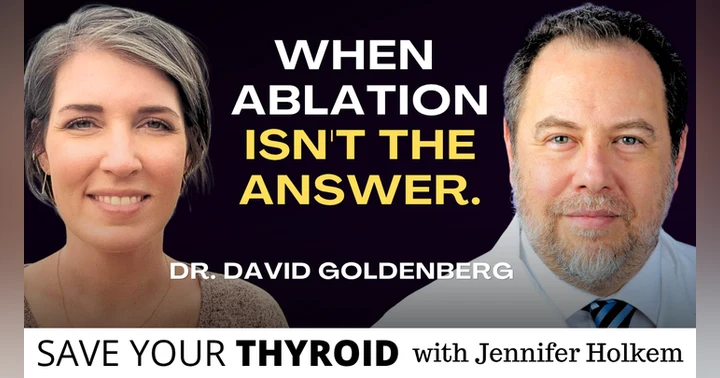
 When Thyroid Ablation Isn't the Answer: A Surgeon Who Does Both Explains | Dr. David Goldenberg
Thyroid ablation vs surgery: how do you know which is right for you? Ablation has transformed care for thyroid nodule patients, but it isn't the answer for everyone.
Dr. David Goldenberg, Professor and Chair of Otolaryngology–Head and Neck Surgery at Penn State Health, performs both thyroid surgery and ablation. He joins Jennifer Holkem to explain when ablation works best, when surgery is still the right call, and why a large thyroid cancer can't simply be ablated. We also cover multinodular goiter, whether a nodule can be "too small" to treat, Hashimoto's, and the one question almost no patient asks their doctor.
"Ablation is a tool. It's not a philosophy." — Dr. David Goldenberg
Connect with Dr. Goldenberg: https://www.pennstatehealth.org/services-treatments/radiofrequency-ablation
Find a physician: https://www.saveyourthyroid.org/
This podcast is for informational purposes only and is not medical advice.
Most of what we cover on this show is the case FOR thyroid nodule ablation. This episode is the other side of that coin — and it's one every patient considering RFA, microwave, or nsPFA needs to hear.
"Just because you have a hammer doesn't mean everything's a nail. Ablation is a tool. It's not a philosophy."
Dr. David Goldenberg is Professor and Chair of the Department of Otolaryngology–Head and Neck Surgery at Penn State Health and Penn State College of Medicine. He is a head and neck surgical oncologist who has written more than 275 journal articles, 40 book chapters, and 8 books, and he leads Penn State's hands-on thyroid RFA training course. He performs thyroid surgery, thermal ablation, and nanosecond pulsed field ablation (nsPFA), so he evaluates every patient with all of those options on the table.
In this episode:
✅ Why ablation has grown so popular, so fast
✅ Where the evidence is strongest, and where it's still limited
✅ When size, location, or growth pattern points to surgery instead
✅ Why ablating a large thyroid cancer would leave cancer behind
✅ Substernal goiters, airway compression, and the "danger triangle"
✅ Multinodular goiter: when one nodule can be treated and when it can't
✅ Is a nodule ever too small, or too big, to ablate?
✅ Why thermal ablation is done awake, and why that isn't cruel
✅ His decision framework, with two real-world case examples
✅ The questions to ask before you commit (including the one no one asks)
✅ A thorough pre-ablation workup: labs, ultrasound, biopsy, and laryngeal exam
✅ Why Hashimoto's is NOT a reason to remove your thyroid
✅ Why "an ultrasound is a movie, not a picture"
If you've been told you're not a candidate for ablation — or you're wondering whether you are — this conversation will help you understand why.
Chapters
00:00 Introduction
01:57 Why ablation has grown so fast
03:24 Where enthusiasm has outpaced the evidence
04:29 Offering both surgery and ablation
05:50 When size, location, and growth mean surgery
11:02 Being awake during ablation and tolerating the procedure
14:53 Multinodular goiter
16:04 Why ablating a large cancer leaves cancer behind
18:45 Dr. Goldenberg's decision framework and case examples
22:09 Is a nodule ever too small or too big?
24:20 Questions to ask before you commit
28:02 The complete pre-ablation workup
29:52 Hashimoto's and the "it's dying anyway" myth
32:00 Advice for referring physicians
35:56 Ablation is a tool, not a philosophy
37:22 Why ultrasound is a movie, not a picture
39:36 Where to find Dr. Goldenberg
🔗 Penn State Health Otolaryngology–Head and Neck Surgery (Hershey, PA) — ask about thyroid nodule ablation:
https://www.pennstatehealth.org/services-treatments/radiofrequency-ablation
📌 Resources:
👉 Podcast: https://www.saveyourthyroidwithjen.com/
👉 Patient site & Find a Physician: https://www.saveyourthyroid.org/
👉 Private FB group: https://www.facebook.com/groups/saveyourthyroidnonsurgical
👉 Patient Navigation: https://www.saveyourthyroidwithjen.com/patient-navigation-services/
💛 Support the channel:
PAYPAL 👉 https://www.paypal.com/paypalme/itsmejenagain
VENMO 👉 https://account.venmo.com/u/itsme_jenagain
🛍️ Affiliate links:
🌿 TOUPS AND CO: https://toupsandco.com/jen
🎙️ RIVERSIDE: https://www.riverside.fm/?via=itsmejenagain
🧴 VAN MAN: https://vanman.shop/?ref=itsmejenagain
💡 BON CHARGE: https://us.boncharge.com/?rfsn=7843863.50b9fa&shpxid=4137e8a5-8199-46cb-b71c-0f86d29324ff
⚠️ Disclaimer:
This podcast is for informational purposes only and is not a substitute for professional medical advice. No endorsement is given or implied for any specific product, treatment, or physician mentioned. Always consult with a qualified healthcare professional regarding your individual medical needs.
🎵 Music licensed through Soundstripe:
GKLLAMF1GLKROGMQ
UDCFUKGJHFQUE3WA
#ThyroidNodule #ThyroidAblation #SaveYourThyroid
Hosted on Acast. See acast.com/privacy for more information.
It's a topic that is going to be different for your folks, because everyone who comes on here lauds ablation. People can like it or not like it, but it is the truth.
Absolutely. And that's what I'm about. Let's make sure they can understand what their options are, and not think that this is a one-size-fits-all kind of thing. They need to know why.
You're listening to Save Your Thyroid with Jennifer Holkem, the podcast dedicated to making sure you actually understand your treatment options before someone puts you on an operating table. Most of what we cover here is the case for thyroid nodule ablation: why it exists, how it works, and who it's helped. RFA, microwave, and other technologies have genuinely changed what's possible for patients who used to have surgery as their only option. But that same enthusiasm has a shadow side. Patients come in having read the success stories, convinced ablation is simply the better choice, and sometimes it isn't. Sometimes surgery is still the right call. That's the conversation today, and there's no one better positioned to have it than my guest.
Dr. David Goldenberg is the professor and chair of the Department of Otolaryngology–Head and Neck Surgery at Penn State Health and Penn State College of Medicine, where he combines a busy surgical practice with teaching and research. He's a head and neck surgical oncologist who has written over 275 journal articles, 40 book chapters, and eight books in the field of head and neck and thyroid surgery. He leads Penn State's hands-on RFA training course, drawing faculty and learners from around the world. He's not speaking from one side of the ablation-versus-surgery divide, but from both. That dual perspective is exactly why this conversation matters. We're going to talk about the honest reasons ablation isn't always the answer. Dr. Goldenberg, welcome back to the show.
Thank you for having me. It's a pleasure to be here again.
I saw you at NASIT back in February, and that was such a great meeting. The excitement was palpable about all of these different technologies that can save the thyroid. So it's so interesting to me that we're now going to turn the coin and look at the other side of it today. You and I were just talking off screen about how important it is for people to really understand this concept that sometimes ablation is just not the right answer. So let's start by talking about the current landscape. Why has ablation grown so popular and so fast in this day and age?
Well, the appeal is really straightforward. Thermal ablation, or any ablation, is performed in an outpatient setting under local or regional anesthesia. It avoids a neck scar, it preserves thyroid function, and it allows for rapid return to normal activities. A study in 2025 showed that over 80% of patients who are offered a choice between surgery or ablation chose ablation. The reasons for that are both clinical and cultural. And as time goes on, there's more and more data out there and more and more support for interventional thyroidology that is not straightforward surgery. So it makes perfect sense.
And the enthusiasm seems well placed most of the time. However, where has it maybe outpaced the evidence, where surgery still needs to be done?
Great question. The evidence is strongest for symptomatic, benign, non-functional nodules attributable to a single or a dominant nodule. That's your sweet spot. For autonomously functioning nodules or toxic nodules, it can be helpful, but it's certainly not as great as the reduction in size. For papillary thyroid cancer, the data is showing comparable five-year recurrence-free survival, but the evidence for that is limited. There's limited follow-up. And right now it's only recommended for patients who refuse surgery or active surveillance for small cancer. So it certainly has areas where it's not as strong, or the data's just not out there quite yet.
Yeah, we're still accumulating that data. So you're doing multiple ablations now. Tell the audience about the different ablations you're offering, what you're seeing in terms of benefits for the patients who qualify for those ablations, and how your vantage point is different because you're doing both ablation and surgery.
One of the advantages of being a thyroid surgeon who offers ablation, as opposed to our non-surgical colleagues, is just that. The patients will come in, we will have a discussion, and I can counsel them without any financial or procedural bias on what the alternatives are, whether it's observation (call it observation, call it active surveillance), radioiodine, surgery, or ablation.
I've been doing thermal ablation for about six years, and the results are excellent. And since October, I was introduced to nanopulse ablation. I've done many of those, with actually wonderful results. Quite remarkable results. A lot of this is new stuff. Five, six years, since October, that's not a long time. A lot of this we're learning as we go along, and I'm very transparent with the patients and I let them know that. But it's exciting.
It is exciting, and I do think we will have a conversation about your experience with pulsed field ablation at a later date. That's something we're getting a lot of questions about. People are very excited to learn about this new technology, and it's very promising. But let's talk about size, location, and growth patterns of thyroid nodules that would indicate a need for surgery. One of the things we were just talking about off camera, that we see often in the Save Your Thyroid patient community, is someone who's new and just learning about ablation, and they have a five-centimeter papillary thyroid cancer, and they want to know, can I have this ablated? Can I save my thyroid? And we have to explain to them, not usually. That's not typically ablatable. So can you tell us why?
Well, there are conditions where ablation is not right. You mentioned a five-centimeter cancer, which is very extreme. I've had people who have had diffuse metastatic disease in both sides of their neck who wanted ablation. There is a thing where patients come looking for what they want, and it's my job to honestly tell them what we can do and what we can't do. The most important thing, and this is from the days of Hippocrates, is first, do no harm.
If I were to try to ablate a five-centimeter cancer, I would leave the patient with cancer, and that would be the wrong thing to do when I could cure them with surgery. It's my job to explain to patients whether they're a candidate. And it's not just the five-centimeter cancer. There are other things that make a patient less likely to have a successful ablation.
First of all, very large nodules. You'll get a reduction in size, but if someone comes in with a ten-centimeter nodule, it will take two or three sessions, with nine months to a year in between each. Do people want to wait three years? Or have surgery, which can be done very safely for half of a gland, and it's gone tomorrow.
Retrosternal extension. If the nodule goes someplace where ablation would be dangerous, if it goes into your chest to the level of your aorta or your heart, it's not safe to ablate that portion of it.
If the patient has significant tracheal compression or airway issues, if they're coming in in respiratory distress, it's not the right thing to try to shrink the nodule over a month or two months. This patient is in mortal danger, and they need to have that removed so that the compression on their airway is gone.
Certain nodules are in a very precarious area when it comes to important structures. Say, for instance, a nodule is sitting right in the danger triangle, right where the recurrent laryngeal nerve is. Especially if you're doing thermal ablation, you can really hurt the patient. You can leave them hoarse forever. So these things have to be evaluated. It's not one-size-fits-all.
Rapid growth. If someone comes to me and says, you know what, this has grown really quickly, then I'm concerned about malignancy. That's not the behavior of a benign nodule.
And then there are other, less common things. A patient who has limited neck extension, who cannot lie there with their neck extended because they have something going on with their cervical spine. A patient who can't tolerate the procedure. I've had that happen. They're anxious, and they cannot tolerate it. Or a patient who either cannot or refuses follow-up.
I follow all of my ablation patients forever, because this is a short window. Six years. We don't know what's going to happen, and we want to make sure. So I ask the patients first to commit to being followed. All of them are actually very happy to be followed. Once a year, nothing onerous.
And then of course there's the question, is it benign or not? We know that there are indeterminate nodules, and this is going to change over time. It also makes a difference where in the world you're having this done. For instance, in Brazil, they don't do molecular testing. In the United States, we are relying more and more on molecular tests. And indeterminate nodules are supposedly not to be ablated, whether or not you have a benign ThyroSeq or Afirma. These are things that are in evolution. Certainly, if someone has a result that's suspicious for malignancy, where there's a 75% chance of it being malignant, ablation is not the right thing to do. Because at the end of the day, it will be a papillary thyroid cancer, and if it's not under a centimeter, it's not the right thing to do at this time. If you and I have this conversation six, seven, ten years from now, things may be different. But right now, we have to proceed with caution so that we don't hurt anyone.
Right. There were a couple of things you said that I wanted to expand on. Let's talk more about patients being anxious and tolerating the procedure. A lot of doctors in the beginning were using conscious sedation to help with that, because for anyone new to this channel, most thermal ablation procedures are done with the patient awake. The one exception is nanopulse, where they do put the patient under mild sedation. But in the beginning, some doctors used conscious sedation, where the patient was still awake but had help from IV drugs to stay calm. In addition to that, or instead of that, some doctors also use oral medications to help with anxiety. So talk more about how the patient has to tolerate the procedure, and why they're awake during it.
Everything you said was correct. Patients typically would do thermal ablation awake. I will do this on an awake patient with an anxiolytic. At first it was voluntary; now it's mandatory. And that usually does it. The patients are pain-free, but it is a very intense procedure, even if it's not painful, because I am sitting at the head of the patient and they are awake. My nurses and PAs have turned our ablation suite into a virtual spa. The patient is offered those eye shields you use when you want to go to sleep, so the light doesn't bother them, if they want it. There's some sweet music in the background and aromatherapy, and it really is calming. But still, I am up around the patient's neck for 45 minutes to an hour, sending a probe into their thyroid, so it can be intense, and some people can't tolerate that.
There are patients who come the day of and we find that they cannot. It's not common. That's happened maybe once or twice in my practice, where they just can't tolerate the procedure. They're too nervous despite everything. And then we reassess. They either go for another technology, or they go for surgery, or they go for observation. It really depends.
Yeah, totally. And the being-awake aspect is something I've actually had some pushback on in YouTube comments, from people who aren't familiar with why this is done awake. I always explain that patients have to be awake to make sure we're ablating in an area where it's not causing issues. And I get pushback from people who say, but that just seems cruel, to work on someone while they're awake.
Well, it's not cruel. One of the reasons it's done awake is that if you're in proximity to the recurrent laryngeal nerve, you can ask the patient to talk and see if they're getting hoarse. That's one of the reasons. With nanopulse, it's less of an issue because there's no thermal energy there. And there are a lot of procedures that are done awake. It's definitely not cruel. We make the patient comfortable. If they're in pain, we move on. We give them more regional anesthetic. The only portion of the thyroid gland that feels pain is the capsule. That's the fibrous material that surrounds it, and that is anesthetized. The thyroid gland itself does not feel pain.
Right. So we've covered the location aspect of it. Now what about someone with a multinodular goiter? This is a question we've seen debated in the medical community, because I think there's not a one-size-fits-all situation here. Can you speak to multinodular disease? Is that something that would rule someone out from ablation?
Not necessarily, but perhaps. For instance, if we can attribute the patient's symptoms to a particular nodule, and that nodule has been proven to be benign, and we can say, this is the nodule that's bothering you, and that's sometimes possible, then we can ablate that nodule and alleviate the patient's symptoms. But if the patient has multiple nodules and they're all huge, almost like a bag of grapes if you think about it, then you say, what am I going to ablate? I can't ablate all of them. If that's the case, thyroidectomy is still the mainstay for a large symptomatic multinodular goiter.
There was also one other thing I wanted to touch on about thyroid cancer. You mentioned that ablating a very large thyroid cancer would leave cancer in the person's neck. Can you explain, especially for newer viewers who aren't as familiar with the difference between ablating a cancerous nodule and a benign nodule, why that would leave cancer behind?
Well, when we ablate a benign thyroid nodule, the idea is to make it shrink as much as possible to alleviate the symptoms, or the cosmetic concerns, or the swallowing issues. However, if we're ablating a cancer, the idea is to destroy, to completely annihilate, that entire cancer. That makes sense to everyone, right? You over-ablate, and then you ablate a little bit more. That's why we do it for up to one centimeter at this point, because that is something we can comfortably eradicate with ablation. With something that's five centimeters, it's just not good enough to say, well, I'll shrink it a little bit. No one would accept that, nor would I. Does that make sense?
Absolutely. A nodule that size isn't going to completely disappear.
No, it shrinks. If we get a 60 to 80% volume reduction rate, then we all should be happy. Now, the good thing is that the patients are typically happy before I'm happy. The patients who come in with a symptom have their symptoms alleviated way before they come in and I do a victory lap: wow, look how much we made it shrink. They feel great, they look great. I have to keep reminding myself it's not about me, it's about how they feel. So yes, the idea is to shrink it and alleviate the symptoms.
I think that's really important. I want viewers to understand that with cancer, we're not just trying to ablate it and shrink it. We're trying to have it completely disintegrate into nothing. And that just can't be done with a large thyroid cancer, or if you have multiple thyroid cancers throughout the gland or on both sides. Unfortunately, we just can't do it yet, and time will tell as things change. So with that in mind, let's talk about your actual decision framework for choosing a procedure, whether it's surgery or ablation. And maybe tell us a case example if you could.
Well, first and foremost, the most important thing: is it benign? Whether it's two benign FNAs, like one accrediting body says, or one, like another says, I, as the treating physician, have to be convinced that it is benign. In my institution, the cytopathologists are excellent, and I've been working with them for 20 years. So I know that if I get a result from Dr. X, I can trust it. Patients come from far and wide, and if people come to me with an outside biopsy that I don't trust, I just have them biopsied again. So first of all, I have to be convinced that it is benign. If I'm not convinced, they're not a candidate.
Are there symptoms attributable to a single or dominant nodule? I'm a head and neck cancer surgeon, and a lot of people come into my office over the age of 40 with some swallowing issues. Unfortunately, that's what happens in life. Sometimes they'll come in with a tiny little nodule, and in their mind, the symptoms are attributable to the thyroid nodule, and I don't buy it. If I'm not convinced that the symptoms they're complaining of have anything to do with the thyroid nodule, then I will not ablate them. I won't operate on them either, because that's not the right thing to do. I can't help them, and then they're distraught: you did the procedure and I'm not better. So I have to be convinced that it is attributable to the thyroid nodule.
Is the nodule accessible, and is it the appropriate size? We discussed this. Most of them are in the right position, but if it's in a very dangerous position, or it's down in the chest near the aorta or the heart, then they're not candidates.
Does the patient accept the trade-off? Because there's no instant gratification. If you come to me as a surgeon, I will remove the lobe and it's gone tomorrow. It costs you a scar and it costs you surgery, but it's done right away. I tell all the patients you have to be able to wait months. Like I said, thankfully, they feel better before I even see them.
Is the patient able and willing to be followed?
That's my decision tree. So if I have a 40-year-old woman with a 15-milliliter solid, benign (I know it's benign) TI-RADS 3 nodule that's causing neck pressure or cosmetic concern, with no other nodules and a normal TSH, she's perfect. She's the perfect candidate. But let's say I have a 55-year-old man with a 35-milliliter dominant nodule as part of a multinodular goiter, in a substernal location, with indeterminate cytology. Well, guess what? This patient needs surgery, and I personally will not do ablation on him, because I don't think it's the right thing to do. I hope that clarifies things a little bit.
Yes, absolutely. You talked about attributing the symptoms to the nodule. Let's go back to that for just a moment. I actually saw a post in the community today from a patient who said they had a very tiny nodule and were seeking ablation for it, and the physician said no, that the nodule was too small to be treated. The first question I had was, how big is the nodule? Because I want to know how small is too small. So how small would you say is too small? And how large is large enough that you might attribute symptoms to that nodule?
When you've been doing this as long as I have, you see a lot of things. In this case, I would actually side with the patient to a certain degree. I have seen nodules that are not that big, but they're in a position where they're pressing right on the esophagus, mostly on the left. I actually did surgery recently on two patients who had tiny little thyroids, but they had nodules no bigger than a centimeter and a half or two centimeters that were in the right place to cause them discomfort. And when they had surgery, they were all better.
So then you ask, why didn't you ablate them? Well, unfortunately, that position is exactly where the recurrent laryngeal nerve runs, in the tracheoesophageal groove. So it's a great question. It's not that I don't believe you because it's too small. There is no too small. If I can stick a needle in it, and if I believe I can help the patient, I'll do it. Same thing on the other end: there is no too big. I have done nine-centimeter nodules. It just takes three times to do it. It works, and if you're willing to do it three times over two years, that's fine. I've had patients like that. There's a judgment aspect. There's no such thing as too small. It really has to do with, can I help you by doing this? If the patient trusts me, then they go with what I say. If not, they can seek care somewhere else, and I'm sure they can find someone to do what they want. We've seen this. But I'm going to try to stay true to what I think is the right thing to do.
Yeah, and I agree with you. I think sometimes what happens is a patient finds out they have an incidentaloma, and now that they know it's there, even if it's two millimeters, it's scary. One thing I always try to make sure patients understand is that a two-millimeter nodule is nothing for you to worry about. You just need to keep having it monitored every year. Obviously, if your doctor says it's something to be concerned about, you should be concerned about it. But go live your life and just continue monitoring it. But I agree with you. I have heard of nodules the size of a pea that were in just the right spot, and unfortunately, those patients were feeling it even though it was so tiny. So I appreciate your perspective on that.
Balancing the patient's autonomy with the clinical steering of the path is so important. What questions should patients be asking before they commit to a path, to know they're truly on the right one? Because this is still so new. Seven years in feels like a long time, but it's not really, in the grand scheme of things. We still have some patients who say, I'm not sure I can trust my doctor's judgment on this, because what if they're so new to it that they just don't have the experience? So what are the right questions to ask to get the confidence they need in their decision about which path to take?
Great points. First of all, it is their decision, not my decision. My job is to counsel them, to try to help them, and to explain things to them. They can either accept it or not accept it.
The first question is, has my nodule been biopsied, and is it benign? What can I expect in terms of volume reduction, and when? How long is it going to take? What are the chances I'll need a second procedure? What does follow-up look like? These are all things you and I just discussed.
Is my nodule causing my symptoms? No one ever asks that. No one ever, ever, ever asks that. I scope every single patient before I do the procedure. I do a laryngoscopy on them, and a lot of them also have reflux, because when you're over 40, you get laryngeal reflux. That's what happens.
How many of these have you done? How long have you been doing this? Those are the questions patients should ask.
What are my alternatives? That's another question they don't typically ask, but guess what, they get told anyway. The answer to the question that's not asked is: you can have observation, and that is fine. I'm happy to watch you, or your endocrinologist or your PCP can. You can have surgery, and this is what it would look like. Or you can have ablation, in two different flavors. Sometimes I don't give them the choice, because there are certain nodules that do better with one ablative technique, and I'm going to do whatever succeeds. But I do tell them about the technologies, depending on the nodule itself.
Okay. So a thorough workup for this patient would definitely include an ultrasound and a biopsy. What about laboratory testing?
I'm fortunate that in my practice, the vast majority of patients have seen or been sent by an endocrinologist, so most of them have it. But if they haven't, they get at least thyroid function tests: TSH, T3, T4. A lot of people, especially women, have subclinical hypothyroidism, and they deserve to know that. I don't want it to be attributed to the procedure. Some of them will get anti-thyroid peroxidase antibodies, because Hashimoto's thyroiditis occurs especially in women of childbearing age.
They need a high-quality neck ultrasound. I had a patient last week whose endocrinologist sent a still image, and I got a still of half a nodule. I said, I'm really sorry, that's not good enough, and she got an ultrasound at our institution that day. I need an ultrasound because I read them myself. I'm the one who's going to be in there, or one of my people, because I have two others who do this with me.
And they need to have a benign biopsy that I trust. Whether it's two benign biopsies or one that I trust, I have to be convinced that it is in fact benign.
If they are hyperthyroid and they're coming in for a toxic nodule or goiter, then I typically get them a thyroid scan, or they usually come in with one already. That's because, and I've seen this, I have patients who have three nodules on one side and only one of them is hot. We don't want to go in there and treat the wrong nodule. So I have the ultrasound and the scan, and I make sure I know which nodule I'm treating and what we're trying to do.
I do a laryngeal exam on every single patient. Every single patient gets a laryngeal exam. That's another thing that, as a head and neck surgeon, I can offer. So it's not just "talk to me." It's "I've seen your vocal folds, and they're working correctly." That's the workup I typically do.
Okay, so you mentioned Hashimoto's disease, but you didn't say it was necessarily a contraindication. I would love to hear you talk more about that, because I've heard some patients say, well, my doctor says there's not really any point, and I might as well just have my thyroid taken out because it's dying anyway.
I've heard the same thing. I've heard the same thing. And I'd be interested in who said that, whether it was a surgeon. I'm very conservative about this, and I've published on it. I'm digressing for a second, but patients who come in with a large goiter that needs to be removed, sometimes a huge goiter, a substernal goiter, I only remove half the thyroid gland, because that's enough to alleviate the symptoms, which is what we're trying to do. And then they have thyroid function from the other side.
Why do I do that? Because it's enough to alleviate the symptoms, and people have to understand that double the thyroid surgery, meaning right and left, is double the risk. If you take out one side, you risk one nerve and two parathyroids. If you take out both sides, you risk two nerves and four parathyroids.
So why are we doing this? We're not doing this because your thyroid is dying anyway. We're doing this because you have a nodule which is symptomatic, and I can help you by shrinking it. That's why we're doing it. It doesn't matter if there's a background of Hashimoto's. It doesn't matter if the patient is hypothyroid. That's not why we're doing it. A lot of this is very old-school thinking, and that's one of the benefits of getting old: I know very old-school thyroidology, because I learned a lot of these things back in the day, and they're just not acceptable any longer. I've been doing this for more than 20 years. A lot of it was, oh, just take it out anyway, it's not working. We don't do that anymore. It's not the right thing to do.
Oh, I 100% agree with you, Dr. Goldenberg. Because if it's a structural problem, you can fix the structural problem with the ablation.
Correct, that's what we're treating. Correct. Whether the house is green or red is immaterial if we're trying to do something inside the house. That's what it is.
We've talked a lot about things that are important for patients to understand. What about referring physicians? We were talking off camera about physicians referring patients to you who really weren't good candidates. Let's talk through that scenario. What would your advice be for those physicians?
Well, first and foremost, you can't blame people for things they don't know. There are a lot of physicians who don't even know about this. I've gone out in my area and educated, and I hold a course, like you said, now a very successful course, every year. I go out and teach. I'm going up to Boston to teach radiofrequency ablation tomorrow. If you get the word out and the doctors are listening, they at least know that the procedure exists.
And then what happens is you go from under-referral, because people didn't know, to over-referral. They refer people who are not appropriate candidates. "I heard about this guy, Goldenberg. He does this procedure. He can magically make whatever go away," which is not true. I understand that. It doesn't upset me. I just counsel the patient on it. I don't say the doctor doesn't know, but in essence, the doctor doesn't really know, because they don't do it, nor have they seen it. It's fairly new, and there are not all that many of us. There's a growing group of us doing this, which is fantastic, but it's still not there.
So to my physicians: all the area physicians know how to reach me. They have my cell phone. If they have a question, they can call me and ask, is this person a candidate? Typically I'll say, send the patient to me and I'll have the conversation. Because guess what? There are patients I can say to, you know what, you don't need anything done. How many patients come to me and say, I have a thyroid nodule, and my doctor sent me for ablation? And I say, is it bothering you? No, I didn't even know it was there. Are you having problems swallowing? Nope. Okay, guess what? Let's just watch it for a while. And they're very happy.
So not everyone leaves with ablation, and not everyone leaves with surgery. And like some of the other examples I gave you, for some of them I've said, I will not do the ablation on you. I will offer you surgery, because it's the right thing to do. That's why it's important to go to someone who can give you all of those options and present them in a non-biased fashion.
Totally agree. I really hope we can continue to get the word out to the primary care physician community about this. I was just talking with a different physician earlier today about how there's still a huge lack of knowledge in the medical community at large about non-surgical techniques. Primary care physicians especially need to know about this, because they're the ones who make these referrals, or who need to know that there's even a referral to be made. Case in point: my own primary care physician had never encountered ablation in all her years of practice until me. So I did my best to tell her about my story and let her know that even if it's not available locally, it's worth knowing where it is available.
And if you're watching this and want to know where it's available, go to saveyourthyroid.org and click Find a Physician at the top. We have a list of all the physicians we know about. It's by no means an exhaustive list, because there are new doctors starting to do ablation and offering different technologies, and we add them as soon as we find out about them. That doesn't mean there aren't people out there doing it that we don't know about. But the key takeaway here is that this is a tool, and not every person needs this particular tool. There's a saying, how does it go, Dr. Goldenberg? Something about, if I have a hammer, everything's a nail?
Just because you have a hammer doesn't mean everything's a nail. Ablation is a tool. It's not a philosophy, nor should it be. It has expanded the landscape of treatment for the symptomatic benign thyroid nodule and for select thyroid cancers. More is happening. I'm going to mention it: we're talking about treating solitary recurrent thyroid cancers in the neck, and others. This is very, very exciting. There are multiple uses that have not yet been explored, or that we're exploring now. I don't want to give away too much.
But it's good for an accessible, ultrasonographically visible, single or dominant nodule, where it allows us to preserve the thyroid and alleviate the patient's symptoms, whether compressive symptoms or cosmetic concerns. People have to understand that. And that's why I think it was so important when we spoke about this back in Portland, I think it was, and you said this was a good idea. It's important that people hear that there are other sides, and that it's not because they're being ignored that a physician doesn't want to do it. Most of us physicians want to do the right thing by our patients. And sometimes ablation is not the right thing.
Absolutely. You said that somebody brought you a still ultrasound image.
Last week. Last week.
I tell patients all the time, one of my favorite quotes from one of my interviews was a doctor who said an ultrasound is not a picture, it's a movie. It's so important to be able to see all the different sides and angles and features on ultrasound to properly diagnose. If you get still images and look at them, there's just so little information there. Do you want to speak to that briefly before we close out?
When I came to Penn State in Hershey 20 years ago, I was already an ultrasound instructor for the College of Surgeons. I'd been doing ultrasound for a while; I started as a fellow under Dr. Tufano, who's a leader in the field. I asked one of my residents, does the patient have imaging? And the answer was, no, just an ultrasound. To this resident, ultrasound didn't count. Since that time, no resident graduates from my program without knowing how to do and read an ultrasound. It is part and parcel of, and an extension of, our physical exam when it comes to thyroidology.
Every now and again, a primary care physician will send someone for an MRI, because an MRI is shiny and expensive. But guess what? Ultrasound is king when it comes to the thyroid and thyroid disease. So yes, it is a movie. It's not enough to just come with a radiologist's read, or a still, or half of it. But it's fine. The Commonwealth of Pennsylvania is huge, and we have people coming from all over the state, hours and hours away, and it's not right to send them back. I've grown accustomed to the fact that some people will come without their imaging. We get them an ultrasound by people we trust, and we look at it. I usually sit with the patient and show them the ultrasound: this is this, this is that. Most of them really appreciate getting a tour of what we're talking about.
Yes, I love it. Okay, Dr. Goldenberg, where can people find you and connect with you to receive this type of care for their thyroid?
Go to Penn State Health Otolaryngology–Head and Neck Surgery. That's in Hershey. Ask about thyroid nodule ablation.
Well, this has been a great conversation. I hope listeners have taken in all of the points you made. If you need more insights on thyroid cancer, or large nodules, or nanopulse, or any of the topics we covered in today's discussion, be sure to check out my playlists on all of those topics. I have multiple interviews on all of those topics and so many more. Thank you so much, Dr. Goldenberg.
Thank you, Jen, for having me. Much appreciated.