
 Amazon Music
 Apple Podcasts
 Audible
 Castbox
 Deezer
 iHeartRadio
 PocketCasts
 RSS Feed
 Spotify
 YouTube
 Youtube Music
  Goodpods
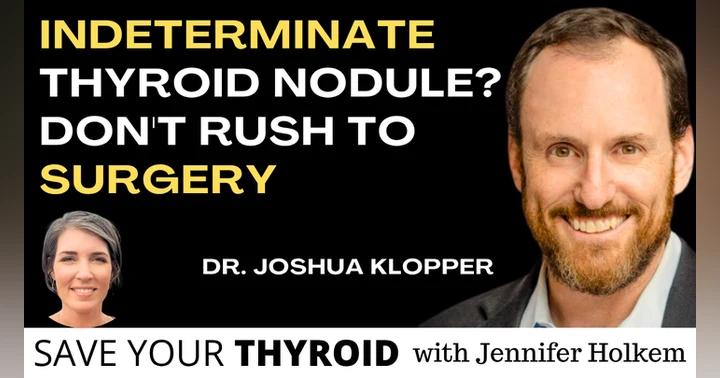
 Indeterminate Thyroid Nodule? Up to 70% of Surgeries Weren't Necessary | Dr. Joshua Klopper
If your thyroid biopsy came back indeterminate — Bethesda 3 or 4 — you may have been told surgery is your only option. For decades, over 70% of those surgeries revealed tissue that was actually benign.
There is a better way. It's called molecular testing. And today's guest helped prove it works.
Dr. Joshua Klopper is the Medical Director for Endocrinology at Veracyte and was an investigator on the original clinical study that validated the Afirma Genomic Sequencing Classifier. He served on the board of the American Thyroid Association and spent over two decades managing thyroid nodules and thyroid cancer.
Disclosure: Dr. Klopper is an employee of Veracyte, maker of the Afirma test discussed in this episode.
In this episode Dr. Klopper breaks down everything a thyroid patient needs to know about molecular testing in plain language. Why the test was designed to find benign tissue rather than cancer. What a benign result actually means. Why a suspicious result doesn't automatically mean surgery. And why it is almost always medically safe to pause before agreeing to anything.
In this episode:
What Bethesda 3 and 4 actually mean
Why two-thirds of indeterminate results come back benign
Why diagnostic risk is not the same as prognostic risk
The 800-patient multicenter study and long-term Afirma performance
Where molecular testing and thyroid ablation are beginning to intersect
Learn more: veracyte.com/tests/afirma-thyroid/providers
Study referenced: pubmed.ncbi.nlm.nih.gov/38415829
If your thyroid biopsy came back inconclusive — Bethesda 3 or 4 — you may have been told surgery is your only option. But for decades, over 70% of those surgeries revealed nodules that were actually benign.
There's a better way. It's called molecular testing. And today's guest literally helped prove it works.
Dr. Joshua Klopper is the Medical Director for Endocrinology at Veracyte and a nationally recognized thyroid specialist with over two decades of experience managing thyroid nodules and thyroid cancer. He was an investigator on the original clinical study that validated the Afirma Genomic Sequencing Classifier — the test that has since helped millions of patients avoid unnecessary thyroid surgery. He served on the board of the American Thyroid Association and previously served as faculty at the University of Colorado School of Medicine.
⚠️ Conflict of Interest Disclosure: Dr. Klopper is an employee of Veracyte, maker of the Afirma Genomic Sequencing Classifier discussed in this episode.
In this episode, Dr. Klopper breaks down everything a patient needs to know about molecular testing — in plain language, without the jargon.
If you or someone you love has been told their thyroid biopsy is inconclusive — this episode could change the conversation with your doctor.
Chapters:
00:00 Introduction — The Indeterminate Thyroid Nodule Problem
01:55 Meet Dr. Joshua Klopper — Medical Director for Endocrinology at Veracyte
02:34 Understanding the Bethesda Classification System
05:38 The Human Cost of Unnecessary Thyroid Surgery
07:37 What Was the Patient Experience Before Molecular Testing?
10:18 What Is the Afirma Genomic Sequencing Classifier?
12:00 Why the Test Was Designed to Find Benign — Not Cancer
14:28 What Is a "Rule Out" Test and Why Does It Matter?
16:04 Oncocytic (Hurthle) Cells — Why They're Challenging
19:00 How Two-Thirds of Indeterminate Nodules Come Back Benign
21:27 Why It's Almost Always Safe to Pause Before Surgery
22:42 The Surgeon Bias Problem — Patients Deserve Options
25:37 How Patients Encounter Molecular Testing on Their Journey
29:43 What Happens to the Sample at Veracyte?
33:52 The 800-Patient Study — Long-Term Afirma Performance
41:24 What Does a Suspicious Afirma Result Actually Mean?
46:17 Risk of Malignancy — What the Numbers Really Mean
48:00 BRAF, RAS and Other Mutations Explained
53:30 The GRID Research Platform and Future Discovery
56:35 Molecular Testing and Ablation — What's Coming
58:33 One Message for Every Indeterminate Thyroid Patient
1:02:38 How to Learn More
1:05:56 Closing
📄 Study referenced in this episode:
Outcomes of Cytologically Indeterminate Thyroid Nodules Managed With Genomic Sequencing Classifier:
https://pubmed.ncbi.nlm.nih.gov/38415829/
🔗 Learn more about Afirma molecular testing:
https://www.veracyte.com/tests/afirma-thyroid/providers/
🔗 American Thyroid Association patient resources:
https://www.thyroid.org
🔗 Clinical Thyroidology for Patients (ATA):
https://www.thyroid.org/patient-thyroid-information/ct-for-patients/
📌 Resources:
👉 Podcast: https://www.saveyourthyroidwithjen.com/
👉 Patient site: https://www.saveyourthyroid.org/
👉 Private FB group: https://www.facebook.com/groups/saveyourthyroidnonsurgical
👉 Patient Navigation: https://www.saveyourthyroidwithjen.com/p/patient-navigation-services/
💛 Support the channel:
PAYPAL 👉 https://www.paypal.com/paypalme/itsmejenagain
VENMO 👉 https://account.venmo.com/u/itsme_jenagain
⚠️ Disclaimer:
This podcast is for informational purposes only and is not a substitute for professional medical advice. No endorsement is given or implied for any specific product, treatment, or physician mentioned. Always consult with a qualified healthcare professional regarding your individual medical needs.
🎵 Music:
Y4XYU0XSPNNR5RI3
Hosted on Acast. See acast.com/privacy for more information.
speaker-0 (00:00)
You're listening to Save Your Thyroid with Jennifer Holkem, the podcast where we explore the science and decisions behind modern thyroid care. Today we're talking about a moment of anxiety for tens of thousands of people every year. You find a lump in your neck, which leads to having a biopsy, a final aspiration, and then the results come back inconclusive. This gray zone is called an indeterminate result, Bethesda 3 or 4.
And for decades, the only safe option was surgery to remove half or all of the thyroid. But all these surgeries led to a staggering discovery. On post surgical pathology, over 70% of those nodules were discovered to, in fact, be benign. But what if you could confidently know it's benign before surgery? Today, we're talking about the technology that aims to do just that. It's called molecular testing.
To guide us in this discussion today, I'm excited to welcome my guest, Dr. Joshua Klopper, the Medical Director for Endocrinology at Varisight. He's a nationally recognized endocrinologist who has specialized in managing thyroid nodules and thyroid cancer for over two decades. Before joining VeriSite, he was a faculty member in the endocrinology division at the University of Colorado School of Medicine.
And served as a regional service chief for Kaiser Permanente in Colorado. Crucially for our conversation today, Dr. Klopper was actually an investigator on the original clinical study that showed how the AFIMATest could reduce unnecessary surgeries. He served on the board of the American Thyroid Association and is truly one of the leading experts in this field. Dr. Klopper, welcome to the show.
speaker-1 (01:52)
Thank you, thanks for having me.
speaker-0 (01:53)
This is a conversation that is very timely. I've had so many conversations with patients where they had an indeterminate nodule. And my first question to them was, Did you have molecular testing? And they say, No, what is that? So today we're going to talk all about that and explain to them basically all of the ins and outs of this testing. So welcome to the show today.
And let's just get started with that indeterminate diagnosis, that Bethesda three or four. Before we had tests like this, what did that diagnosis mean for that patient?
speaker-1 (02:32)
Yeah, well again, thanks so much for having me. Let me just start with kind of some level setting about this Bethesda criteria. So again, if a person shows up as you described with a lump on their thyroid, their thyroid function, in this case, we're going to assume is normal, then we worry about any lump, know, what does that represent? Could that be a cancer? And so the...
after an ultrasound, which is really important because a good neck ultrasound, including the thyroid and the regional lymph nodes, can provide a lot of information to my view, most importantly, whether the nodule should even be biopsied. But again, assuming it's appropriate to biopsy, that fine needle aspiration is a very thin needle and it's designed to collect cells from the nodule, get them on a slide and then hopefully an expert cytopathologist, a physician who's
trained to read these aspirates will give a diagnosis. So then this leads to this diagnostic potential dilemma where it may not be clear. So the Bethesda criteria came out of this meeting in Bethesda, Maryland, where a bunch of pathologists said, we need to standardize the language around what we see because it was sort of a free for all. Looks benign. No other description. Looks cancer, no description. I can't tell. Again, there's just no consensus.
The Bethesda classification really did help to standardize this language and there are six categories, Bethesda 1 through 6. Bethesda 1 means there's not enough cells or it's non-diagnostic, so that needs to be repeated. Bethesda 2 is benign and that's very reassuring. know, again, think about your skin. I mean, we get lots of sort of lumps and spots on our body. Most of them are benign and certainly that can happen on the inside of your body too.
So that's reassuring. I'm going to jump then actually forward to the best of five and six. That's suspicious for cancer or cancer. Those have a risk of cancer of 75 to in Bethesda six, 97%. That's about as good as we can do in medicine. And so if you're Bethesda two or Bethesda five or six, there's at least clarity as to what this lesion is. Then these middle categories that you described and Bethesda three and four are the difficult parts. So.
It's not benign, it's not cancer, it's somewhere in the middle. These are two subcategories of this indeterminate, the those two, three and four. And, you know, if you take sort of all comers, if you look nationally, the risk of cancer ends up being about 25%. Okay. So there's actually wide variability depending on what center you're in, depending on who's reading it. And that's
sort of inherently one of the difficulties is that, you know, there's not great concordance amongst a variety of cytopathologists as to whether it's three or four. And then some other person may say, actually, this Bethesda three looks normal to me, Bethesda two. So there is just sort of this inherent challenge and this is subjectivity and it's just kind of difficult. But in any event, when you have that diagnosis, you know, that risk is kind of a...
tough place to be. 25 % is sort of anxiety provoking for patients and physicians. You know, it's sort of too high to feel comfortable with. But as you described, historically, most patients, because of the uncertainty, would have some sort of surgical procedure to get the truth. And we sort of based this truth on the histopathology. That means once it's taken out, you can slice it up as thin as you want, look at a whole bunch of sections under the slide, and then
get that final diagnosis of benign or cancer. mean, even that can be a little bit challenging, but again, you don't know it preoperatively. So historically, during my training, about 80 % of patients would go for that surgery. And again, if there's a 25 % risk of cancer, well, then 75 % at least are not going to be cancer. So a lot of surgeries trying to get a final diagnosis that this technology was aimed to address.
speaker-0 (06:32)
I've heard so many times, I've heard the story where it's like the patient gets their results and the doctor says, Good news, it was benign. But then the patient's like, But I don't have my thyroid anymore. So it's so it's so good that there's an alternative to that, you know, conversation. So I did not know that Bethesda categories were actually created in Bethesda. That's that's a fun fact to know.
Knowing that 25% of these nodules are cancerous, that is a pretty big number to swallow if you're looking at the the relative risk for that patient. But still thinking three out of four of all of these are benign. And we have to figure out a way to help that group of patients avoid surgery if possible. So what was the human cost when we were thinking about?
these surgeries happening and three out of four patients may not have actually needed them.
speaker-1 (07:34)
Yeah, we want to keep our body parts unless it's absolutely necessary for them to be removed. And, you think about just sort of the inconvenience, appointments, the surgery itself. Back in the day, most patients would spend at least a night in hospital. That's actually shifted now where we know it's safe for most patients to have an outpatient surgery, even with a total thyroidectomy. But beyond...
all the medical appointments and the surgery itself. Certainly people when qualitative studies, meaning you sort of ask patients very specific questions as to how they're feeling, have shown that people postoperatively from thyroid surgery on average do not feel the same. They don't feel as well as they did before. Now, I want to sort of caution just for your audience here. That does not mean that if you need thyroid surgery and it's medically appropriate, you're going to feel bad. I mean, this is again, kind of going to this idea of relative versus absolute risk. So.
on the balance, you know, patients will report not feeling quite as well as they did beforehand. But anecdotally, I've certainly had some patients who said, I got that one bit on my neck, I actually feel better, you know, whatever. there, there is, there is a lot of variability. you know, I think with medical science and medical literature, there is this sort of cautionary note that we're evaluating a population, right? Whereas individuals vary. So it's not guaranteed that, that you will feel bad, but certainly
Again, many studies showing more fatigue, more depression. And then if your thyroid hormone levels are not adequately maintained with half a thyroid, or if you have your whole thyroid removed and you of course need to be on thyroid hormone, we all need thyroid hormone, then a significant minority of patients are not going to feel as well. So.
Most of the data suggests that about 80 % do quite well with thyroid hormone replacement. And so, you know, I think that is again, important to recognize that it's not just guaranteed that you're going to feel poorly, but 20 % is a lot of people. That is a lot of people because there's so many people with thyroid disease.
Hashimoto's or other causes and then of course thyroid surgery. So potentially lifelong thyroid hormone replacement with something that does generally a good job from a medical safety perspective, but is not the same. mean, it is not the same as when you have your own thyroid. Most medical practice errors on the side of caution. Certainly patients obviously drive the decision to have surgery because of that very appropriate fear for a relatively high risk. But to me, this all speaks to this uncertainty. And so.
A lot of uncertainty where you're at this kind of 25 % risk and the data would support that this molecular testing provides a lot more certainty, especially when it's benign.
speaker-0 (10:15)
That's what we're going to get into now is discussing what actually is the ethermogenomic sequencing classifier or GSC. In simple terms, explain to us what problem this is solving and how it's doing that.
speaker-1 (10:30)
Just to step back from the development of this test, very insightful people who started the company, VeriCite, the chief scientific officer and founder, asked the question of why are we taking out all these ultimate leap and eye nodules? Medical training, we are very much trained to find the bad stuff. So first you learn normal, because you have know normal to understand abnormal, but we're trained to look for the bad stuff and deal with the bad stuff.
And they have the insight to say, in this case, should probably be finding the good stuff. I that's the majority of these lesions. And so it really was, was very innovative and I don't want to sort of bypass without kind of acknowledging that, that approach. And so the company then tapped experts. So I was fortunate to be mentored by Dr. Brian Haugen, who was the University of Colorado.
a primary investigator and ultimately the lead investigator for the validation of this study. then Dr. Eric Alexander was the first author out of Brigham and Women's and they sort of took the lead and helped guide that scientific team as to how to collect the right patients, what things to look for and develop the trial. so, you know, again, the goal was to develop a test that was very good at finding what was benign. Okay.
And so how do you do that? Well, the approach that Barisite took with the affirmative test was we looked at RNA expression. So at a very high level, we think about DNA as being sort of the blueprint. We actually, most of our cells, almost all of our cells have the exact same DNA. So why are we not sort of amorphous homogeneous blobs? It's because the way that DNA is transcribed into RNA, the message is different.
ending on different parts of your body. And then that ultimately leads to the final sort of protein or phenotype. And so by looking at RNA, you're kind of closer to the final phenotype for what these lesions may represent. And then the way that this RNA genomic material was assessed was looking at differential expressions. the approach was you take a bunch of people with nodules.
are tested, they're removed. The pathologist who looks at the final pathology does not know anything about the genetic testing and they give the call of benign or cancer. And that is your truth. That's the gold standard. The final histology from what's taken out. That's what is trained. And then you look at all of these RNA expression patterns based on that truth. And so we call it differential expression and you train it in a way that you covet.
being highly sensitive to detect cancer because if your test is really good at detecting the cancer, then when it's negative, you can trust it. So if you're highly sensitive for cancer and it's benign in this case or negative, then you can trust it and that's a high negative predictive value. And so that was the calculus that was made to have a test with a high negative predictive value that when it's benign, you have a very low risk of cancer.
And in this case, it turned out to be about 4%. And that's actually the same risk as if a good cytopathologist says that's benign. So nothing zero, unfortunately, in medicine, almost never zero in a hundred, but less than 5 % is quite good. And so the current test uses RNA sequencing, which is different than the original test that hasn't been available for many years. So it's a little bit irrelevant, but that's sort of the...
The best summation I have of describing this very complex test, but the outcome, the output is quite simple, benign or not. Again, the 96 % negative predictive value is very reassuring, taking you from, again, what's called an average of 25 % risk down to 4 % or less.
speaker-0 (14:26)
So when you say that it's really good at finding cancer, is that what what it means when I when you hear the term rule out test?
speaker-1 (14:34)
It's quite actually confusing, very confusing for physicians too. mean, if I want to find benign, why would I want to make my test really good at detecting cancer? That's the sensitivity. But again, it's this idea that if I'm good at finding the cancer, then when the test is negative, then it's almost certainly benign. So a high sensitivity test is good at ruling out when it's negative. So the downside then for all the molecular tests is that
Because you train the test to be very good at detecting cancer, there are often false positives, meaning that molecularly, the test sees the lesion as not looking benign. It looks suspicious, but ultimately some of those that come out will be benign. And so those are the kinds of things we're working on moving forward. And so it is a little bit of a give and take. If you covet...
high sensitivity and wanting to rule out cancer, you're ultimately going to have some false positives. And we, of course, would love to have the perfect test that's good on both ends. And that's just difficult because training these molecular signals to be that separated is quite challenging.
speaker-0 (15:48)
I'm sure it is. So I would think then that certain cells that you're talking about that look kind of suspicious, even if they are benign, would those be Herthle cells?
speaker-1 (16:01)
So can be, and so hertthal cells and the term by the World Health Organization is now onchocytic cells, because hertthal is a guy's name who actually it turns out did not discover these cells. So onchocytic cells are the current preferred term, although you'll still see hertthal.
quite a bit. Those can be challenging because they are molecularly and even visually different than sort of normal follicular cells. Those are actually fairly rare. When we think about the proportion of sort of onchocytic tumors, it's on average less than 10%. But those are challenging and those are often called indeterminate by cytologists.
speaker-0 (16:45)
I'm just curious, I because I'm not someone who has heard that a lot in my community, what does that really look like when when they're looking at it? Is it very is it highly variable? Is that why it's in this gray zone or does it have a s kind of a standard look to it?
speaker-1 (17:00)
Now, I mean, the cells do have a standard. Look, the difficulty is these onchocytic cells, they fall into a category of cytology that are called neoplasms. So one of the hallmarks of a neoplasm is that you don't see a lot of what's called colloid, which is a proteinaceous material in the thyroid where basically the thyroid hormone is generated.
And so the way I sort of always thought about it is that you have this growth of cells, the neoplasia just means growth, and it's sort of pushing everything else out of the way. And so it's pushing all that colloid out of the way as this lesion develops. Now what converts an adenoma, a benign entity from a carcinoma is invasion. Invasion through that capsule that surrounds this area of growth. And this is where...
we are limited by a fine needle aspiration biopsy because you're just collecting cells, you know, often just kind of out of the middle of this growth and you cannot see the capsule which would provide that sort of final determination of adenoma or carcinoma. And so that's why they were taken out because when you take it out and you slice it up, you can look at the whole rim of that capsule and see if there's invasions. So that's just sort of a limitation of the fine needle aspiration.
And again, the molecular testing should help for when there is actually that invasion at carcinoma, it should be read as suspicious and not benign. Now, again, the problem is that sometimes molecularly, even if it's an adenoma, it looks molecularly suspicious. And, you know, in those cases, it is fortunate that when it's taken out, it's not a carcinoma. you know, the sort of value proposition of the test is that for a pharma,
two thirds of these indeterminate cases come back as benign. Now there may be some reasons for patients to have surgery. It's big and it's bothering them and they were going to kind of have it out anyway, but knowing that it's not very unlikely to be a cancer, that's where you would do only a hemiphyrodectomy instead of the total. You know, that's one reason where even a benign result for a person having surgery still provides value.
But most of the patients and there are studies that show that kind of immediately only about 5 % of patients will have surgery with a benign result. And even with longer term follow up where things may grow or change, it's only somewhere in the 10 to 15%. So you're taking two thirds of patients and only a small proportion of those ultimately have surgery versus again, all converse it used to be much higher.
speaker-0 (19:38)
That's excellent. Think about all the people that that would affect. Yep. In this category. That's so that's so many people. Those are real people with real lives and real consequences that they're avoiding. That's amazing.
speaker-1 (19:52)
I must say, we sort of know this from our business, but when you say you've talked to so many people and they say, no, what's molecular testing? mean, that is sort of shocking because the affirmative test was the first commercially available test and that was rolled out in 2012. mean, that's a long time, but certainly we work with facilities, physicians, health centers that don't use it.
for a variety of reasons, but these are not brand new tests for sure.
speaker-0 (20:23)
Right.
Yeah. Yeah, it's shocking to me too. I and that's why I really wanted to have this conversation because it has come up so many times in my patient consults. For anyone watching this who doesn't know what I mean by that, I will I do patient navigation con consultations where if someone is looking for guidance on their treatment journey, we sit down for an hour and I talk with them about all of their situation and I try to point them in the right direction. I don't give medical advice.
I just try to help them understand their diagnosis and know which direction to go or possibilities of directions. And I have seen, I would say probably two-thirds of the patients that I've consulted with had indeterminate nodules. And the vast majority of them had not been offered molecular testing or didn't know what it was. So this is just such a timely conversation. So let's walk through the patient journey.
How does the patient even get to the point of knowing that they need to have this test?
speaker-1 (21:24)
Yeah, and actually, I just want to make one more point based on what you were just saying. Just for the patients who are listening, know, certainly you have a lump and you get a needle stuck in it and they say, this doesn't look benign. You know, that kind of amps up the anxiety. You want to get things done quickly. It is so rare for this to be a medically urgent issue. So like the bad thyroid cancer that, know, you really need to get taken care of quickly. That is not subtle.
I mean, that is just super obvious. It's almost always cancer. And even then it's not like an emergent type of situation except in exquisitely rare cases. And so the only reason I bring that up is just to say that it is medically safe to take a pause. even if it means having a referral to somewhere else to get this testing, that is almost certainly medically safe.
You know, again, there are so many caveats in our screwy healthcare system with having insurance and having the right facility and not driving six hours. And I mean, there's all kinds of, you know, practical issues that I'm sort of glossing over, but I just do again, want to make the point that there is no emergency. It is medically safe to take a pause and get as much information as you can to, you know, give you the tools to make the right decision. you know, I mean, it is interesting kind of the bias that comes in. So for example, I've spoken with.
surgeons who do not use or don't offer medical testing and sort of say, well, why? And they say, well, I mean, by the time the patient comes to me, they're seeing a surgeon, they want surgery. of course my response is, well, they weren't offered anything else. So yeah, it's like, oh, well, generally we take these out. You should have this out. You guys see a surgeon and they're like, yeah, we should take it out. I mean, that's it. But there are options potentially. So in any event, I just want to make that point.
speaker-0 (23:16)
That's wonderful point. And I'm so glad you brought it up because it's been something that I've been really, really passionate about, particularly recently, because I just feel like that is such a problem today. Where and I love I love our surgeons. I'm so thankful we have good surgeons. But a lot of the times when our patients are seeing a surgeon for a consult, they're on the schedule before they leave the consult for surgery.
And it it's like you said, it's not an urgent emergent situation where they need to get this taken care of immediately. There needs to be space and room for the patient to process what they've been told about their diagnosis, to be able to do their own research, learn about it, figure out what's a good fit for me in my life and my family and what are my values around this and just to make an informed decision and to
Join communities like ours, like Save Your Thyroid, and learn about molecular testing and all of these things before they make a lifelong decision, you know, that's permanent. So sorry I had to get on my soapbox there for a moment, but that's just that's I'm so glad you said that. You're you're not the first person, you're not the first physician on this podcast to say that. And it is something I wanna shout for the roof sometimes. So
speaker-1 (24:35)
Yeah.
mean, I think, you know, again, I mean, you know, the, one of the sort of, sort of cliches or jokes that, you know, a cutter wants to cut. Now that the real experts, they'll argue and, you know, I totally believe them as like, no, I don't want to operate unnecessarily. Like, why would I want to do that? So, you know, the people with expertise in some ways, one of the defining characteristics of an excellent thyroid surgeon, whether that's an endocrine surgeon or a head and neck.
or ENT surgeon is pulling back, knowing when to pull back or do again, it's just important to know that those options exist. And now again, some patients may be like, you know, I kind of want to think about this. I just want it out. And if you have a good, if you have a high quality, high volume surgeon, and we'll talk more about how important it is to have a high volume surgeon, then it's not medically wrong, you know, patients should just be fully informed of all their options.
speaker-0 (25:26)
Totally agree. Totally agree. Well, let's talk about options here. Let's talk about how the patient encounters this test on their journey.
speaker-1 (25:34)
Yeah. So it hit, really depends on where you're being seen and different systems have very different pathways for the patient. I'm an endocrinologist. So, you know, what I can tell you is that I was sort of early on at the, least at the University of Colorado of learning how to do ultrasound guided biopsies. They're pretty much all done under ultrasound guides, which means that there's a probe where they can see the, the nodule and then actually see the needle go into the nodule. You know, you can poke at the.
sort of more concerning parts of the nodule. It's not completely homogeneous, but any, we would just do those in clinic. And of course that's fantastic because we can talk all about what the nodule means, what we're going to do and what are the potential options afterwards. It's always nice to kind of inform the patient of what possible things may happen with the result of the test, whether that's the cytology or the molecular test. In that situation, we had, what we call rapid onsite evaluation.
And so we would have site of the pathologist who would actually come out, look at the slides. And then if they said this looks indeterminate, the patient would just be waiting and we would go back and then draw the molecular test, the sample for the molecular test, which goes in this little tube of what's called RNA detect. So that's one situation. That's in my opinion, like the ideal set up, right? You're not getting poked unnecessarily. You've got a preliminary read, then you can get all the information kind of down at that point.
So then when I went into the Kaiser system, you know, that's a very spread out system across the Denver metro area. That just is not the capacity for someone to come up. So I would just offer and say, look at Kaiser, it was about a 15 to 20 % indeterminate rate. That's how often that result would come back. I'd say about one out of five times it's going to come back as this. I can draw a sample today and you know, it's a couple extra pokes, but then you don't have to come back if it's in that category. We'll send it off. If not, we'll just pitch it.
And, I never had one patient who's like, I would love to come back, you know, if I need to. so, you know, nobody wants to get poked more than is necessary, but a needle is very thin and that convenience is just fantastic. So that's a collect on all, right? So the pros are you're kind of getting everything you may need at once that the cons are getting poked a couple of times. So both of the situations I just described, unfortunately are actually quite rare. And, you know, certainly a lot of patients who.
do not have access to endocrinologists, do not live in major metropolitan areas. know, these primary care docs are like doing all the heavy lifting. don't have the training or skills to do a biopsy. So then they'll go to radiology. You know, in those systems, sometimes we do have a collect on all modality, but oftentimes that may not exist. then again, the patient may have to come back.
And so you can already sort of start envisioning all this ping ponging around of, know, go from the primary care to the radiologist, you get the biopsy, it's indeterminate, but the primary care doesn't have the training. So then you can refer to an endocrinologist. The endocrinologist may or may not do a repeat biopsy. You may have to go back to the radiologist. so it's, you know, it can, it can really be a little bit of a extended journey.
There are some pathologists, it's quite rare, who will actually do a biopsy and that's perfect because they can read it right there. And then some surgeons will do these biopsies as well. So sometimes a primary care will say, you have a lump, just go see my surgical colleague and then you'll get the biopsy and hope for them like you're testing. So unfortunately, I would love to say that there is some like clear, universal, cohesive, you know, path to, getting this done, but, all of those situations can arise.
speaker-0 (29:13)
My word of advice, I think, for patients who are just starting this journey, you know, maybe they've just learned that they have a thyroid nodule and they haven't started all the way down this path like you're discussing, is to consider right off the bat looking for someone who is a thyroid specialist, not, you know.
Just a surgeon, and I I I don't mean to diminish surge surgeons, and not even just just an endocrinologist, but a thyroid focused endocrinologist or a thyroid focused surgeon, ENT surgeon. There there are out there some interventional radiologists who specialize in thyroid.
and cytopathologists that do as well that do procedures. So if you're looking for those types of doctors and maybe think after I have the diagnosis, I might want to have an ablative type procedure without having surgery to deal with this. We actually have a list of those doctors on our website, saveyourthyroid.org. Those are just doctors that we know of in the US and abroad who do these types of procedures and they're all
very adept at doing biopsies because they do these ablative procedures as well. Just wanted to throw that in there.
speaker-1 (30:23)
The American Thyroid Association website has a drop down for members in your area, by state, think they have it by zip code or state. And someone is invested to be a member of the American Thyroid Association, they at least have the interest of having that sort of investment and training. Now that doesn't guarantee that they're going to do the biopsy themselves because there's variety of reasons why people may or may not do.
FNAs in their office, but they're at least going to know about all this stuff. They're going to know where to send you. It will be someone who is an expert. And plenty of excellent thyroid-focused physicians who are not members of the American Thyroid Association, but that one's kind of a slam dunk if you look at their website and there's someone in your region, then that would be a great place to start. And even if they are far away, that office may be able to advise you for someone who...
that focuses on thyroid in your area.
speaker-0 (31:23)
Definitely be an informed patient, informed consumer as you go down this path because it's going to save you a great deal of frustration and anxiety.
speaker-1 (31:30)
Totally.
again, going back to that theme of it's medically safe to wait. If the general surgeon can see you in a month and the endocrinologist can't see you in four months, but you're not going to get all the information, it is safe to wait. Now again, that can be a little anxiety provoking, and I'm not suggesting you need to do that, but it is very unlikely that something bad is going to happen in that period of time.
speaker-0 (31:52)
Hey, just a quick break to share something I'm really excited about. My brand new website, SaveYourThyroidWithGen.com. You can head there to subscribe to my mailing list and stay in the loop about new podcast episodes, videos, and updates in the world of thyroid nodule care. And I'm now offering something new, one-on-one patient navigation services. If you're feeling overwhelmed or unsure about your treatment options, I'm here to help.
As a patient who's been through this myself and spent years learning from some of the world's leading experts in thyroid nodule treatment, I can help you make sense of your choices and feel more confident in your next steps. You can learn more about patient navigation and everything else I'm working on at SaveYourThyroid withGen.com. Now back to the conversation. Okay, so the patient has their biopsy. Hopefully, that biopsy also includes the extra sample.
That's for the molecular testing. And then that sample is sent to Varasite. And then what happens to the sample?
speaker-1 (32:58)
Yeah. So the, so the sample, the RNA is extracted from that sample and it runs through our assay as we call it. And it gets this whole exome sequencing. actually over 21,000 genes are sequenced. And we'll kind of come to that as to how that may provide platform for future discovery. And then there are these, we call machine learning algorithms that look at the differential gene expression and then spit out this result. And hopefully the result is benign, right? And so.
Two thirds of the results, when we look nationally, we've had huge studies of over 50,000 consecutive samples that come through, lots of independent verification. About two thirds will be benign. And then, you know, unless there's some other clinical reason to have that lung taken out, it's bothering you or something else is going on, then you can just safely watch it just as if it was benign on the first biopsy. The cytologists had called it benign. So then for the other third, that comes out as suspicious.
So that doesn't mean it's cancer. That just means that the test cannot confidently rule out cancer with a benign result. The data on the risk of it being cancer, if it is suspicious, the validation study, it was 50 % risk of malignancy. And then in multiple real world studies, we did a meta-analysis. It actually looks like it's closer to 65%. So you've basically doubled the risk of cancer from that indeterminate result.
to where you are now. Now, again, you know, that doesn't mean that you have to have surgery. Certainly I've had plenty of patients who are like, unless you can just guarantee that it's cancer, don't touch me and let's watch it. know, I mean, it's, it's above my risk threshold or it was above my risk threshold. Certainly for a younger patient, I would be like, it's not going to like sort of turn benign. So, you know, maybe we should consider doing something, but again, that's not.
type of terrible thinking to monitor it. But the majority of people are going to want to have surgery. then what we're hoping to do as we move forward is really improve information as to what extent of surgery. Because we would like to have the sort of most efficient surgery, least invasive surgery that is effective, that takes care of the problem. And so basically, that's a lobectomy taking out half the thyroid or a total phyrodactomy.
speaker-0 (35:20)
Yeah. The idea that patients can observe these nodules, I think is still in the physician community a little taboo. As much as I would like to see more doctors doing that, because a lot of the time it's just kind of not even a discussion that I'm at least from my perspective, from my patient population that I see in savor thyroid. I don't see a lot of physicians who are willing.
to observe these indeterminate nodules. I don't know if that's because they've just not been a been willing to do that because they feel like it's too much risk, or if there is some sort of historical data there that shows that, you know, these things as they grow, they can change and get can you speak to that? Like do these n you know, can they change and become more dangerous over time?
speaker-1 (36:14)
Yeah. So I think generally there is just sort of risk aversion, right? if something is missed, that's tragic. But if we over-treat you, even if it's unnecessary, well, you know, we were trying to help you and so it's okay. you know, that's probably, it needs to be reversed, right? The way we think, but I think that is just very, very sort of common and lots of reasons for that. So there is just this risk aversion of missing something. This question of, well, something developed is very interesting.
We talked briefly about this idea of these adenomas, these neoplasms that come out as adenomas. mean, there are people who believe that if you have a neoplasm and it has a mutation that is least associated with cancer, something bad's going to happen. You're kind of capturing it on its progression from benign to some transformation to malignant. And there's certainly sort of a...
biological plausibility to that. mean, we do know that sort of these molecular findings precede the final phenotype, the final event. The problem is that you don't know if that final event is going to happen in one year, 10 years, 50 years, right? And so it does kind of bother me because it sort of sets up this permission structure to be aggressive. You know, it's like, well,
It's a lump, right? mean, even if it's benign, I could say it's not normal. The pathologist said it wasn't benign. The molecular test says it's not benign. All the signs are pointing towards something bad happening, but you know, even as a malignancy, most of these are very low risk. So there's lots of autopsy studies that show that, you know, up to a third of us, if we live long enough, we'll have a little bit of thyroid cancer that we never knew about, never bothers us. There's a very...
well-described event that happened in South Korea where they started adding in thyroid ultrasound as part of their national cancer screening. And the incidence of thyroid cancer just skyrocketed. Absolutely skyrocketed. And they started taking out all of these incredibly low risk little cancers that probably were never going to hurt anybody. And the reason that you know that that is overdiagnosis is because the mortality rate from thyroid cancer did not change.
Right. So if you screen for colon cancer, mortality from colon cancer drops, right. Cause it's usually found at a late stage and it's a much more aggressive disease. So if you are finding a bunch of disease and taking it out and nothing changes in the mortality, that is the definition of overdiagnosis. So in any event, I mean, I would never argue with someone who's like, I have all this abnormal stuff. I want to take it out. Yeah. Very reasonable to take it out, but it is, it is not.
absolutely medically necessary to take it out now for sure. There is some space to, to again, kind of have this information to help guide you. So some of the mutations that can be evaluated when a lesion is not molecularly benign can give some insight into that. So there's mutations that are sort of known to be more aggressive, moderately aggressive or not aggressive over a population. And that can give some.
information as to how you may counsel a patient and how a patient may make their informed decision.
speaker-0 (39:39)
Such important points. I'm so glad you brought that up because yeah, I just think I think that taking a beat to think about this and really consider it in its entirety rather than jumping to conclusions is how we get away from this idea of we just need to take it out all the time and rush to that end conclusion. So let's talk about a study.
That followed 800 patients that confirmed the test performance. Can you tell us more about that?
speaker-1 (40:14)
Yeah. So, um, you know, there's, there's lots of studies that follow patients with cytolactically benign nodules, right? They have a lump, they have a biopsy. It was read as benign and they're followed. So very few of those nodules ultimately are cancer. Very few of them grow. People do great. And so lots of data on that. So because molecular testing is relatively new, there's just, just less on what is the long-term follow-up of a molecularly benign nodule.
So the cytologist said look indeterminate, the molecular test says benign, what happens? Because one of the criticisms to the data is that, well, sure, it's benign now, but is it the same as cytologically benign long term and does something bad happen? So there's actually quite a few studies showing that the growth rate for a firm of benign are the same as cytologically benign. what's good about this study is first of all, it was independent.
parasite had nothing to do with, you know, looking at any data. It was at three medical centers. It was at Brigham and Women's, UCLA and the University of Nebraska. So, nice sort of regional variability, very different cohorts of patients. And they followed the patients. They followed the patients with the Afirma benign to see what happened. actually, that's certainly another thing that they did was they looked at the performance of Afirma.
in those patients with the Bethesda 3 cytology and the Bethesda 4 separately to see if there was any difference because typically Bethesda 4s have a little bit of a higher risk of cancer than Bethesda 3 and maybe the test doesn't work quite as quite the same in each category. So in any event, that's that was the purpose of the study. they patients had ultrasounds following their nodules over time. And what they found was that the majority of patients had no change in their nodule.
In the nodules that drew only a handful had surgery and there were very few malignancies. So you had to have at least one year follow-up. The median follow-up was two years. So, you know, not 10 or 20 years, which, you know, maybe it would be more satisfying. Those studies get very hard to do, but at least two years. And typically if there's going to be a change, something will be seen in that time.
What they found was that the overall malignancy rate, if you assume that the unoperateds are what we call true negatives, would have been benign, was less than 4%. So it was a nice, reassuring, longer-term perspective on the confidence of that benign call in those cases. They had the follow-up like sort of anyone would, and it really looked...
to replicate what you would expect for cytologically benign. And so, you know, those patients may continue to be followed and maybe we'll get a five-year study or something like that. But initially, I believe it's one of the longest follow-up studies and again, very reassuring. So it seems like that benign result has the durability you would expect.
speaker-0 (43:10)
That's exciting. Yeah. I I'm gonna link that in the description below for anyone who wants to take a look at that. And I think that may even be just as a side note, part of why I'm hearing a lot more doctors today who say if it's a firma benign, I'm considering it equal to a biopsy benign. You know, they're not they're not saying, well, it's not as valid or, you anything like that. I used to hear that back in the early days of when I was doing what I do now.
Because we would see people who would go and have the molecular test and then they'd be like, Well, I have a benign result. Can I have an ablasion? And the doctor would be like, Well, no. I don't consider those equal, but I'm seeing more of that now. So Yeah.
speaker-1 (43:52)
So that data is starting to come out and for the ablations, initially the guidance was you had to have two cytological epinines just to even decrease the risk from less than three or 4%. The most recent guidance I'm aware from the American Thyroid Association is at least one cytologically benign as long as there's low risk ultrasound features.
And now there are a couple of studies that have been published and more in the works of looking at molecularly benign. And at least the preliminary data I've seen is it looks similar, you know, which is kind of, kind of what you would expect. So, you know, that may become more of an option, but, know, again, it is a little bit early days to just sort of make a blanket recommendation that this is, yeah, safe.
speaker-0 (44:44)
Well, I think we're getting better and better all the time. Yeah.
speaker-1 (44:48)
But the studies are happening, which is gratifying.
speaker-0 (44:51)
Yeah. Let's go back and talk about the suspicious result. So that's not a hundred percent cancer. And I think you may have said this already, but let's cover the approximate risk of malignancy when they get that result.
speaker-1 (45:07)
Yep. The affirmative test is kind of unique in that there's this core classifier based on that differential gene expression. And that says you're benign. The way I think about it is you're benign or you're not. When you're not, the result we give is suspicious. So historically affirmative used to just give only that information. Benign or suspicious and the validation study showed it was a 50 % chance of pregnancy. Now what we know is that there are
mutations, sometimes they're called canonical mutations, sometimes they're called dragger mutations, but there are mutations that are associated with thyroid cancer. They may be mechanistically part of the pathway that like leads to cancer development, or they actually just may be associated. When a nodule is a firm of suspicious, if any of those mutations are expressed as RNA, then we report those as well. And the value in that is that that can actually shift the risk. And that's based on
literature review and our own studies. So for example, if you have an afirma suspicis and there is a BRAV V600E mutation, that's the most common mutation in classic papillary thyroid cancer, then that's a 95 plus percent, some would argue 99 % risk of cancer. That basically is papillary thyroid cancer. Now, that's a very well described mutation. People will sort of mention that all the time. The problem is that that's actually very rare.
in indeterminate cytology, because BRAF drives classic papillary direct cancer, which can usually be seen. And so those end up being with those two five and six modules. They're only present like five to 10 % of the time in the best of three and four. But there are other, there are other alterations, like some fusions, one's called an n-track fusion that has a similar risk. The majority of mutations that are detected in indeterminate cytology are in a broad family called RAS like mutations.
And some of those will increase the risk from that baseline 50 % up to about 75%. But a lot are just kind of around 50-50. So it is sort of unsatisfying that even when you have this mutational information that doesn't move the needle tremendously. Now the benefit of that is that, you know, there's not a bad mutation, right? So going back to this idea that
you can be more conservative, whether that's only doing a lobectomy or some kind of monitoring protocol. That is valuable information. The other thing I want to say about this risk of malignancy, because even physicians kind of conflate the thing, is that risk of malignancy does not speak to aggressiveness of malignancy. So just because the risk starts getting into those high numbers, which gets us all anxious, that does not mean it's going to be a bad cancer. It just means that it's more likely to be cancer than not.
Sometimes I'll have conversations where people say, well, you know, the risk of cancer is 90 plus percent. So I've got to do a total thyroidectomy. Well, that's not true at all. Most papillary thyroid cancer, even when the cytologist says that's cancer, can be managed with a lobectomy if it's an isolated lesion. So the diagnostic risk is not the same as the prognostic risk. And where we're trying to move is to get better prognostic information.
Mainly to have people feel really confident about pulling back. that conversation speaks to this idea that if you do a lobectomy and there are aggressive features of that cancer, invasion of the blood vessels, surprisingly lymph nodes involved that couldn't be seen, then you need to go back and do a completion of thyroidectomy. So that's painful, right? From second round of anesthesia, surgery, all the costs, missed work, et cetera.
Fortunately, from a surgical perspective, that's actually quite safe. So I do want to reassure your audience that if you have to go back, there's not like some huge complication rate or anything like that. to again, to the point of efficiency, you want the first surgery to be the last surgery. And if we could know with confidence that there is that invasion, then just do the whole thing upfront. I have to worry about going back. If you can say with high confidence, this is going to be low risk.
then don't over-treat because a lot of patients will hear, yeah, we can probably do a lobectomy, but you may have to go back and they're like, forget it. Just take it all. Certainly patients don't want to even think about or deal with that. perhaps there was information that we could say, there's like a 95 % chance that this is not having any invasive features. You can do a lobectomy. Hopefully that can decrease the number of unnecessary total thyroidectomies.
speaker-0 (49:42)
Yeah, and I've I've counseled a lot of patients who are very much more open to the idea of a lobectomy than a total thyroidectomy because there's just benefit to having that remaining lobe there to function. even if they do need a little help from some thyroid medicine to kind of fill in the gaps, at least they've got that part of their gland that's still there functioning. So
speaker-1 (50:05)
Absolutely. mean, they may be able to get away with no thyroid hormone, a small supplement. Having as much of your body intact is great. And the surgical complications are less, for sure.
speaker-0 (50:18)
Mm-hmm. Okay. So I know we just talked about the r the suspicious result and you were talking about the gene expression. Was that the expression atlas that we were talking about?
speaker-1 (50:28)
Yeah.
the name for it. Yeah. So that's the name for a pharma is the expression atlas. And so these mutations generally are single nucleotide variants. So, you know, there's some change in the, in the gene code or a fusion of two genes and they're associated with these pathways that transform, you know, benign to. And so, um, we, we detect those and the way I view that is that they're very good sort of on a
population level, sort of a broad sense of what this cancer may be, if it's a cancer at all. And so it's absolutely helpful. mean, it has, you again, really revolutionized the way that we sort of think about these lesions. The problem is that they're just not that accurate. you know, again, a BRAVV600D mutation, that is going to be papillary thyroid cancer, but it really doesn't speak to how aggressive the thyroid cancer is.
The ultrasound doesn't show a lot of badness. You really can't see vascular invasion, for example, on the ultrasound, but that's a concerning feature. And so BRAF alone does not speak to that. We think that one of the values of our platform is because we sequence all of those genes, there's other molecular data in there that we can carve out to try to risk stratify, for example, patients with BRAF mutated tumor. So yeah, your BRAF, that's going to be papillary.
Is it a bad papillary or not? BRAF alone can't tell you. And so that gets into this research resource we have called the genomic resource for intelligent discovery or grid. And that's our research use only tool. We're collaborating with academic centers or other interested in investigation, just basically handing this molecular data under IRB protocol with all patient information.
safe, there's no disclosure of any patient information that they can help us figure this out because they have the outcomes. As a molecular diagnostic company, we don't have the outcomes for the final pathology for patients. So that's where we're going. So knowing the mutations gives you a general sense of sort of how the tumor may behave, but for an individual, everything's zero or a hundred, right? I mean, like, you so we want to get truly personalized and we have to get beyond, this is a RAS mutation, probably going to be okay. Well, in some cases it's not. This is BRAF.
Some are aggressive, some are very low risk. How can we teach that out? And that's what we're working on now.
speaker-0 (52:55)
Wow. So the grid test that you just mentioned, that's not something that people can go and say, hey, I want to have this done yet, right?
speaker-1 (53:05)
Correct. So there's two versions of it. One is a patient specific research use only report. So if a physician is ordering a firma, there's a check box on the test request form where they can check that box and get some of this data back. Now it is very specific and let me, know, listen to the words coming out of my mouth. This is research use only. This should not be used to determine anything for, you know,
any listeners extensive surgery at this point, we still need to vet all this data. The majority of the data comes out in a database that's bulk data on a whole cohort of patients that are from a certain account. And that is actually much more extensive and that is going to allow for a greater depth of investigation. And that's under an institutional review board or IRB approved protocol. Personal health information is protected.
And then those investigators can look and see signatures or pathways may be helpful. So there is a patient specific research use on one report, but again, I'll reiterate it's research use on me at this time. because not every doc has the infrastructure to do a big research protocol with a huge database of genomic information, but you you could envision a high volume thyroid physician collecting, you know, hundred.
patient RUO reports, research use only reports, and then looking and seeing if there's any patterns that come out of that.
speaker-0 (54:34)
Yeah. And I mean, that's how we're going to get where we need to be in the future is to determine what are the patterns here and how can we interact with it in a way, an intelligent way to drive better outcomes. That's really cool.
speaker-1 (54:47)
Yeah.
I mean, there's certainly opportunities to improve. mean, I think again, the benign call is fantastic. I would love to say we can improve that by 96 % negative particular values. It's pretty darn good. It's going to be hard to beat that. But I think there's a lot of opportunities for when it's not benign, how we can better risk stratify those folks and their lesions.
speaker-0 (55:11)
So where do you think we're heading in the next five years with all of this kind of testing and research and and surgeries, ablations, all of the different possibilities for patients with thyroid nodules that are indeterminate?
speaker-1 (55:25)
Yeah. So I think this, ablation of multiple different technologies is definitely here to stay. There's a huge momentum growing for that technology. mean, some of the barriers now are cost and expertise, but certainly there, think there will be a place for, ablation of, you know, molecularly benign lesions, possibly even, molecularly suspicious lesions that have
very clear data, there's no evidence of invasion. From my perspective, that's a pretty high bar that we want to meet because we don't want to, of course, do no harm, right? So that data sets going to have to be very strong, but I think that that is absolutely within the realm of possibility. So that's on the ablation front. In terms of the surgery, I'm very bullish on the idea that we may be able to say...
You have a indeterminate nodule or even a, at the Thesda five or six, a malignant nodule that has this mutation, but these other molecular features that say with very high confidence greater than 90%, maybe even 95 % that there is not any vascular invasion and you can feel very good about doing.
a low back to me only because, we, in general, think most thyroidologists, thyroid surgeons would agree that there's over-treatment and, know, a lot of that's just erring on the side of caution. Certainly again, I think patients drive that, but I think they drive it because of uncertainty. So if we can go from a place of uncertainties and more certainty, then I think we can get more confident and be more conservative. So I think those are the sort of two areas that we'll able to get to.
10 years sounds like a long time in the medical science realm. That's not too, too long. So five to 10 years though, I mean, I think we will be having many more of those kinds of results and hopefully moving the needle on being more conservative.
speaker-0 (57:22)
What would you say is the single most important message for a patient today who's in this gray zone of indeterminate thyroid nodule and they're facing a big decision? What do I do?
speaker-1 (57:36)
There are certainly advocates who will say that you can learn a lot from the thyroid ultrasound, the stratification. And what I would say is that first of all, the level of expertise to confidently read an ultrasound to provide that clarity is uncommon, very uncommon when you look across the country. And so the molecular testing, and of course, I...
I work for Molecular Testing Company. have a very clear conflict of interest. if anyone wasn't clear, I'm an employee at VeriCite. So my conflict of interest is transparent. But the data is excellent in the tests that have well-performed validation studies that if you get a negative result, which is going to happen two thirds of the time, you can trust it and be very reassured.
that there's nothing bad happening and you can follow it just as if it was benign the first time. So to me, the ultrasound data is really helpful at deciding what to biopsy. Once you put a needle in it though, and you're in that group, the data is overwhelming that molecular testing helps risk stratify you better than any other modality. To my view, the idea of, you
you're on the fence as to someone's even a good surgical candidate, all that should happen before you put a needle in it. But the majority of patients with thyroid nodules are 30 to 60 year old women. so do you really want to tell a 35 year old to just not worry about something? mean, we want more information to make the best informed choice.
speaker-0 (59:10)
Absolutely. And I would just add to what you said with the idea that it's good to find, as I said a moment ago, a thyroid specialist, someone who is looking at your thyroid nodule and knows about the thyroid. So what I mean by that is go to someone who's going to do their own ultrasounds. Because if you get sent to an imaging center, the radiologist is going to interpret that and send a report back to whoever ordered your ultrasound.
And there's just so much more value, I feel, coming from the person who is the thyroid specialist looking through their own eyes at your thyroid on ultrasound and make that determination. Do we need to do a biopsy here? And what do these features mean? And all of that, rather than being sent, like you said, as a ping pong ball back and forth to different practitioners. That's not to say that you can't get a good, you know, diagnostic.
call from a radiologist, it's just that I find that the results always seem to be better when you go directly to that thyroid specialist who does their own ultrasounds.
speaker-1 (1:00:20)
I mean, absolutely in some ways, especially if the surgeon is doing that, that is fantastic. But I mean, by way of example, what the whole ultrasound story is sort of amusing to me, the true national experts, they will make the argument that you can tell a lot of information from the ultrasound and risk stratify people. They will often say in the same talk, you have to read the ultrasound yourself because there are so many ultrasound reports.
that have the wrong interpretation. the ultrasound supposedly can help you risk stratify, but you really shouldn't trust all those ultrasounds out there. You know, I have to look at it myself so I can give the right call. so having someone with that expertise who looks at it is valuable. But when you want to have confident data from really well-done studies and multiple rounds of independent corroboration,
The molecular testing, again, the data set is just very convincing and very easy to interpret. know, if it's benign, you feel great and it's kind of the end of the story.
speaker-0 (1:01:29)
Yeah. Yeah. All right. Well, how can patients learn more if they've watched this podcast and they're like, I'm thirsty to learn more about this topic about molecular testing? But
speaker-1 (1:01:41)
get
sort of unbiased sources of information. mean, the American Thyroid Association is fantastic. The Endocrine Society has good information. American Association of Clinical Endocrinology, all those websites are really good sources. You know, for a firma testing, verisite.com of course is a great resource. And they have, you know, of course, a sort of physician pathway and a patient pathway on that website. And so those, those are all good sources, but I would say that, you know, for sort of the independent
expertise, the American Thyroid Association. You really can't go wrong with getting more information. I did also want to mention that they have a publication called Clinical Thyroidology for Patients. The name may have changed, but I used to write stuff for that. And what that resource is, is people who are on the committee and the American Thyroid Association will take research articles and summarize them in lay language for patients to understand.
And so that's a way that you can, the latest and greatest studies written in a manner that hopefully is digestible for folks, even without a scientific or medical background. So that's also part of the American Thyroid Association. And they do certainly lots of summaries for thyroid nodules, thyroid cancer, molecular testing. So those are really useful. And then, you you can say, I read about this manuscript, take it to your doc and say, what do know about this? And if they don't know anything, then hopefully they'll refer you to someone who does.
Well.
speaker-0 (1:03:09)
I love that there's more patient-facing material out there for the informed patients today because there's so many people who want to know this information and understand it for themselves. And I think that's a really nice paradigm shift that we see today from kind of like our parents and grandparents who were not as informed about things and maybe had some regrets. So that's really great. So for me, the big takeaway from this conversation.
is that the indeterminate result is not a dead end like a lot of people maybe have felt like for a long time. It's actually the start really of this discussion and finding a more detailed answer. So just getting this data and being able to interpret it is helping two-thirds, if you've not heard it yet, two-thirds of the patients who have these tests
avoiding surgery and keeping your thyroid safely. So that is exciting information. I want to thank you, Dr. Klopper, for being with me today. For the viewers, remember this is not medical advice. Talk to your own physician and see what's right for you. But if you need to share this podcast episode with them because this is as we've talked about today, an ever-evolving and growing field. And I'm just so excited to see
how many thyroids could be saved or how many surgeries could be minimized over the coming years with the use of tests like this. So thank you so much for this wonderful conversation today, Dr.
speaker-1 (1:04:46)
Yeah, I really appreciate the opportunity.
speaker-0 (1:04:47)
Thank you. That wraps up today's episode. If you found this valuable, please like, subscribe, and share it with someone who might benefit. You can find links to everything we discussed in the show notes below. Find a physician, discover treatment options, and join our patient community at SaveYourThyroid.org. To stay up to date on new episodes, resources, and expert insights, be sure to subscribe to my mailing list at SaveYourThyroidwithJen.com.
It's the best way to stay connected and informed. There, you can also find all podcast episodes and book a one-hour patient navigation consult for personalized guidance on your next steps. As always, please remember this podcast is for informational purposes only and is not a substitute for professional medical advice. No endorsement is given or implied for any specific product, treatment, or physician mentioned.
As always, consult with a qualified healthcare professional for your individual needs. Thanks for listening, and I'll see you next time.