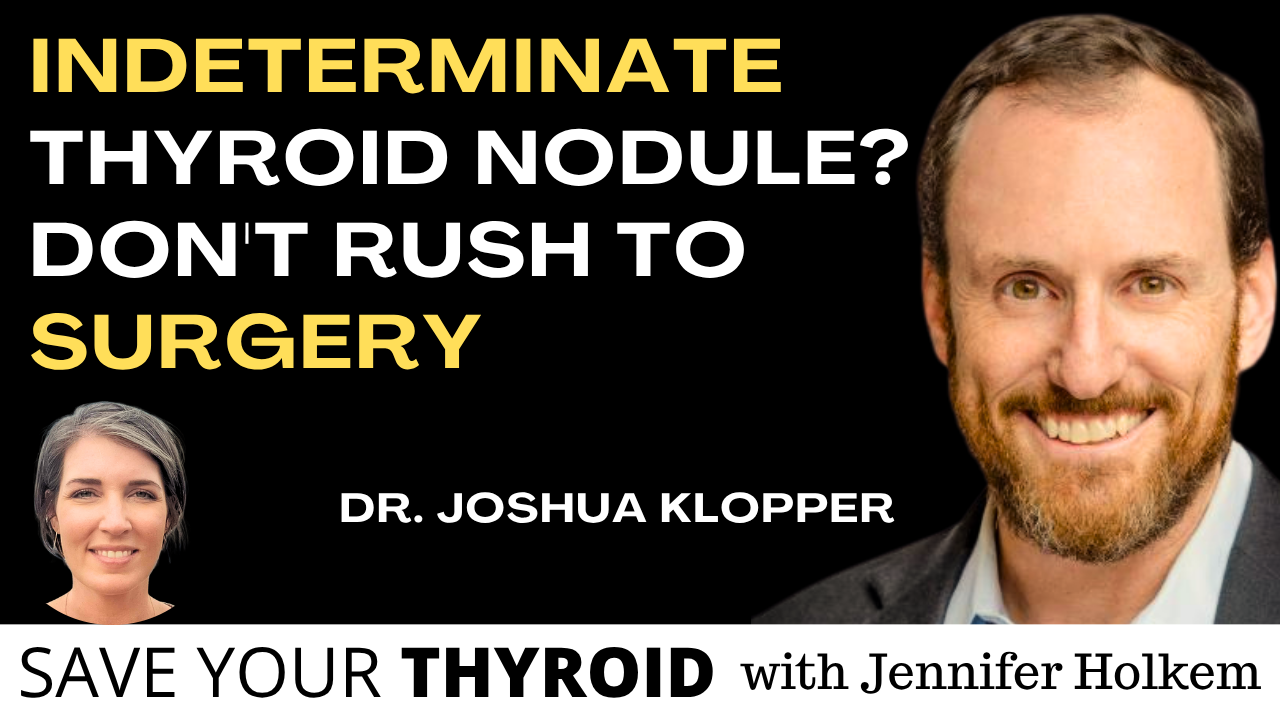
The Indeterminate Thyroid Nodule Doesn't Have to Mean Surgery. Here's the Test That Proves It.
Save Your Thyroid with Jennifer Holkem · Episode 123
If your thyroid biopsy came back inconclusive — Bethesda 3 or 4 — there's a good chance someone told you surgery was your next step.
For decades, that's exactly what happened. A cytopathologist would look at the cells, find themselves unable to confidently classify what they saw as benign or cancerous, and the patient would end up in a surgeon's office. The surgeon would remove half or all of the thyroid. A pathologist would examine the tissue. And when the final result came back, more than 70% of the time the answer was benign.
The good news was benign. But the patient no longer had their thyroid.
That's the problem molecular testing was designed to solve. And in Episode 123 of Save Your Thyroid with Jennifer Holkem, the physician who helped validate the most widely used molecular test in thyroid medicine explains exactly how it works — and what every indeterminate patient needs to know before anyone schedules a surgery.
About Dr. Joshua Klopper
Dr. Joshua Klopper is the Medical Director for Endocrinology at Veracyte, the company that makes the Afirma Genomic Sequencing Classifier. He was an investigator on the original clinical study that validated the test. He served on the board of the American Thyroid Association. He spent over two decades as faculty at the University of Colorado School of Medicine and as a regional service chief for Kaiser Permanente in Colorado, managing thyroid nodules and thyroid cancer.
Disclosure: Dr. Klopper is an employee of Veracyte, maker of the Afirma test discussed in this episode. He disclosed this clearly and upfront in our conversation.
What Does Indeterminate Actually Mean?
When a thyroid biopsy comes back as Bethesda 3 or Bethesda 4, it means the cytopathologist — the physician trained to read cell samples — cannot confidently classify what they see as benign or cancerous. It's not benign. It's not cancer. It's somewhere in the middle.
If you take all indeterminate results nationally, that gray zone carries approximately a 25% risk of cancer. Which means 75% of those nodules are benign.
For decades, most patients in this category went to surgery to get a definitive answer. And when the answer came back, more than 70% of the time the nodule was benign. Those patients didn't need surgery. But by then it didn't matter — the thyroid was already gone.
Why the Test Was Designed to Find Benign — Not Cancer
The founding insight behind Afirma was a question that sounds simple but was genuinely innovative: instead of trying to find the cancer, what if the goal was to find the benign?
Here's why that matters. A test that is extremely good at detecting cancer — meaning highly sensitive — will have a very high negative predictive value. In plain language: if the test is good at catching cancer, you can trust it when it comes back negative. When it says benign, it really means benign.
That's exactly how Afirma was built. RNA from the biopsy sample is extracted and over 21,000 genes are sequenced. Machine learning evaluates the differential gene expression patterns. And the result comes back as one of two things: benign, or suspicious.
Two-thirds of results nationally come back as benign. And when the result is benign, the negative predictive value is 96%. That means if your Afirma result comes back benign, your risk of that nodule actually being cancer is approximately 4% — the same risk as if a cytopathologist had looked at the original biopsy and called it benign the first time.
That is the entire value proposition. You went from a 25% risk of cancer to a 4% risk. Without surgery.
What a Suspicious Result Means — And Doesn't Mean
For the one-third of patients whose Afirma result comes back suspicious, it's important to understand what that actually means.
It doesn't mean cancer. It means the test cannot confidently rule cancer out.
A suspicious Afirma result carries approximately a 50% risk of malignancy — meaningful, but not a definitive diagnosis. And Dr. Klopper made a point in this episode that every patient with a suspicious result needs to hear:
"The diagnostic risk is not the same as the prognostic risk."
A high risk of malignancy means the nodule is more likely to be cancer than not. It does not mean it's going to be a bad cancer. It does not mean it's aggressive. Most papillary thyroid cancers, even when confirmed, can be managed with a lobectomy — not a total thyroidectomy.
Risk of malignancy and risk of aggressiveness are two completely different conversations. Make sure you're having both before you make any decisions.
The 800-Patient Study
One of the most important pieces of evidence in this episode is an independent multicenter study conducted at Brigham and Women's Hospital, UCLA, and the University of Nebraska that followed patients with Afirma benign results over time to see what actually happened.
The study: Outcomes of Cytologically Indeterminate Thyroid Nodules Managed With Genomic Sequencing Classifier
Read it here: pubmed.ncbi.nlm.nih.gov/38415829
The findings were reassuring. The overall malignancy rate — assuming all unoperated nodules were true negatives — was less than 4%. The growth behavior of Afirma benign nodules closely mirrored what you would expect from cytologically benign nodules.
An Afirma benign result isn't just reassuring right now. It appears to behave like a benign result over time.
It Is Almost Always Safe to Take a Pause
Dr. Klopper was direct about this — and it's the message I most want every indeterminate patient to hear.
It is almost never a medically urgent situation when a thyroid biopsy comes back indeterminate. The kind of thyroid cancer that truly requires immediate action is obvious — it's almost always a Bethesda 5 or 6 result. For the indeterminate patient, it is medically safe to take a pause. To get molecular testing. To seek a second opinion. To do research. To make an informed decision.
"It is not absolutely medically necessary to take it out now — for sure."
You don't have to decide in the surgeon's office.
What Patients Don't Know About Life After Thyroid Surgery
Qualitative studies — the kind that ask patients specific questions about how they feel — have consistently shown that patients post-operatively from thyroid surgery on average do not feel the same as they did before. More fatigue. More depression. A quality of life that doesn't fully return to baseline.
Dr. Klopper is careful to note: that doesn't mean you will feel bad. Medicine evaluates populations, not individuals. Some patients feel relief. But the data exists — and every patient deserves to know it before they decide.
The Ultrasound Question
Many patients are told that a good ultrasound read can substitute for molecular testing. Dr. Klopper was candid about the limitations of that approach.
The level of expertise required to confidently read a thyroid ultrasound and provide meaningful risk stratification is uncommon — very uncommon across the country. Ultrasound is essential for deciding what to biopsy. But once you have an indeterminate biopsy result, the data is overwhelming that molecular testing risk-stratifies better than any other modality.
If you've been told your ultrasound looks fine and you don't need molecular testing — it may be worth asking whether the person reading it has the specialized expertise to make that call.
Where This Is All Heading
Dr. Klopper was genuinely optimistic about the next five to ten years. A few things he's watching:
Ablation for molecularly benign nodules is already beginning to happen. Studies evaluating molecularly benign results as equivalent to cytologically benign results for ablation candidacy are underway, and early data looks similar.
Better prognostic tools are coming. The goal is to go from knowing you likely have cancer to knowing whether it's a cancer that needs aggressive treatment or one that can be managed conservatively — with high enough confidence to feel very good about doing a lobectomy only.
"We may be able to say with greater than 90%, maybe even 95% confidence — there is no vascular invasion, and you can feel very good about doing a lobectomy only."
That would be a significant shift. And he believes it's coming.
The Most Important Thing
Dr. Klopper's single most important message for every indeterminate thyroid patient:
Get the molecular test. If it comes back benign — two-thirds of the time it will — you can trust it. You can watch it. You can avoid surgery. You can move on with your life.
And if you don't know where to start, our physician directory at saveyourthyroid.org has a list of every thyroid specialist we know of in the US and abroad who performs nonsurgical thyroid procedures. Find someone who specializes in thyroid — not just any surgeon or endocrinologist — before you make any irreversible decisions.
Resources from this episode:
- Afirma for providers: veracyte.com/tests/afirma-thyroid/providers
- Study referenced: pubmed.ncbi.nlm.nih.gov/38415829
- American Thyroid Association: thyroid.org
- Find a thyroid specialist: saveyourthyroid.org
- Book a patient navigation consult: saveyourthyroidwithjen.com/p/patient-navigation-services
Disclaimer: None of the statements made in this or any other blog or video by "Its me Jen again" should be considered medical advice. The goal of this podcast and blog is to provide data, resources, and expert opinions on the topic of thyroid nodules and make it accessible to patients. Always consult with a qualified healthcare professional regarding your individual medical needs. — Jen
When Ablation Isn't the Answer: A Surgeon Who Does Both Explains


 Goodpods