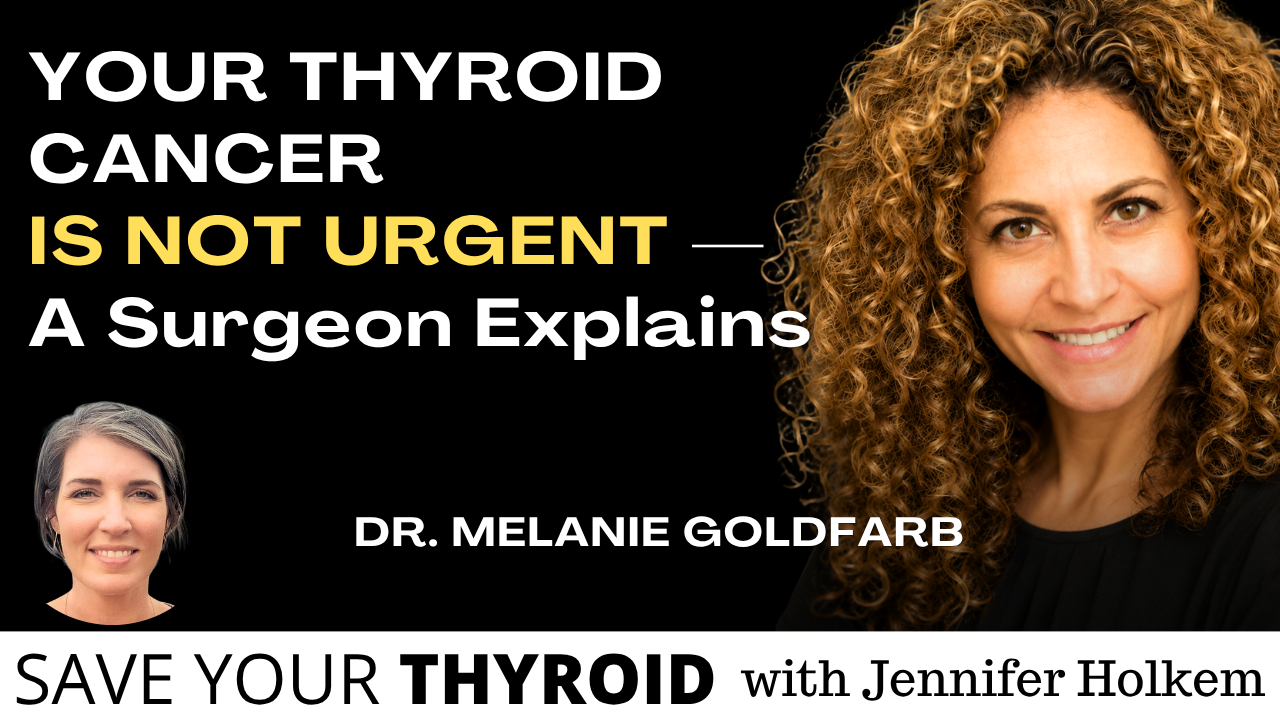
Your Thyroid Cancer Is Not Urgent — An Endocrine Surgeon Explains
Save Your Thyroid with Jennifer Holkem · Episode 125
When an endocrine surgeon who operates on thyroids for a living tells you that thyroid cancer is not urgent — you listen.
Dr. Melanie Goldfarb is a fellowship-trained endocrine surgeon, Professor of Surgery, and Director of the Center for Endocrine Tumors and Disorders at St. John's Cancer Institute in Santa Monica, California. She was one of the first physicians on the West Coast to offer in-office RFA. She performs surgery AND ablation — which means her recommendation is never limited by what she's able to offer. It's driven entirely by what each patient actually needs.
In Episode 125 of Save Your Thyroid with Jennifer Holkem, she joins me to cover everything from benign nodule RFA to thyroid cancer ablation to a combination approach that could save half your thyroid when the other half needs to come out.
🎧 In today's episode, we're covering:
What realistic RFA outcomes look like — and why 50% volume reduction is success but she aims for 70-80%
The goiter vs. nodule distinction that changes your treatment options entirely
Who qualifies for thyroid cancer ablation — and the 120% concept that explains why location is everything
The lobectomy + RFA combination — saving half a thyroid
When proactive treatment makes sense — and where the slippery slope is
Active surveillance — why watching is a treatment, not inaction
Why thyroid cancer is almost never urgent — and what to do when your surgeon books you for surgery before you leave the office
The future of interventional thyroidology — in one word: non-invasive
What Realistic RFA Outcomes Look Like
The published definition of success for RFA is 50% volume reduction. Dr. Goldfarb achieves that 90-95% of the time — but she aims higher. Her personal target is 70-80%, and she gets there most of the time.
Nodule size matters for planning. Under 4 to 4.5 centimeters — one session is usually enough. Over six centimeters — expect more than one. Between those thresholds, it depends on your response and what's bothering you.
Her ground rule for every patient: "I am not getting rid of this. I am making it smaller and I will help your symptoms. But we are not getting rid of it." Setting that expectation honestly from the start is part of what makes her approach work.
Goiter vs. Nodule — Why the Distinction Matters
Dr. Goldfarb has this conversation with every other patient she sees — because someone has given them the wrong information about which one they have.
A goiter is diffuse overgrowth of the entire thyroid gland. Thermal ablation is not designed for goiters. The better tool for large goiters is thyroid artery embolization.
A nodule is a delineated, distinct growth with clear borders on ultrasound. Thermal ablation kills the tissue within it, and the body carries away the dead tissue over time.
Knowing which one you have changes your treatment options entirely. If your ablation consultation went sideways, this distinction may be why.
Thyroid Cancer and Ablation — The 120% Concept
Candidates for thyroid cancer ablation are the same patients who qualify for active surveillance — papillary thyroid microcarcinoma under one centimeter, fully contained within the thyroid, not near the nerve or trachea.
The critical difference between treating benign nodules and cancer: the goal. With benign nodules, the target is volume reduction — 70, 80% smaller. With cancer, you need 120% — the entire tumor plus a surrounding margin.
"You don't just want what's inside. You want the borders and a little bit outside. If we're going to do this correctly."
That's why location is everything. A tiny cancer near a critical structure may make complete ablation impossible. And after ablation for cancer, the treated area may actually look bigger on the first follow-up ultrasound — which alarms local radiologists who don't know what post-ablation tissue is supposed to look like. This is one of the biggest education gaps in the field right now.
The Lobectomy + RFA Combination
For patients with one dominant side that is too large or too symptomatic to address with ablation alone — but who desperately want to preserve something — Dr. Goldfarb has been offering a combination approach for about two years.
Remove the dominant side surgically. Get immediate relief. Then use RFA on the remaining side to address nodules there over time, preserving as much thyroid function as possible.
After a lobectomy, about 30% of patients need some thyroid medication — but not the full replacement dose of a total thyroidectomy. Protecting the remaining lobe matters. And for the many patients I see in navigation who had a lobectomy years ago and now have growing nodules on their one remaining lobe, this approach is directly relevant.
Proactive Treatment — Where the Line Is
Dr. Goldfarb draws her line at 3 to 3.5 centimeters. At that size she'll raise ablation as an option even if the patient isn't yet symptomatic — not pushing, just offering — because if it gets much bigger, the conversation becomes more complicated and outcomes less dramatic.
Her clearest guidance: serial ultrasounds consistently showing growth are an automatic reason to act. The nodule is telling you something. Treating it proactively while it's still manageable is almost always better than waiting.
Active Surveillance Is a Treatment
Active surveillance is not inaction. It is a conscious medical decision made after evaluating all the information — choosing structured observation as the right intervention for this patient at this moment.
And here's the data that should reassure every patient: even if a tiny thyroid cancer grows during the surveillance period, your long-term prognosis is no different than if you had treated it immediately. You have not lost anything. The window for excellent outcomes stays open.
For patients who are genuinely too anxious to watch a cancer — Dr. Goldfarb acknowledges that active surveillance may not be right for them, and that their quality of life is itself a clinical variable worth taking seriously.
This Is Not Urgent
When a surgeon books you for surgery before you leave the consultation, that is not necessarily clinical urgency. It is often simply how surgical practices manage their schedules. Surgeons are busy. Getting on the calendar while you're there is efficient — not an emergency signal.
True urgent thyroid cancer scenarios are genuinely rare. Even cancers that need surgery can wait weeks to months without any change in prognosis. Dr. Goldfarb tells every patient: we have time. Let's do this on your schedule.
"I wish a lot more people told their patients this."
So do I.
Key Takeaways:
Thyroid cancer is almost never urgent — you have time to think, research, and decide
50% volume reduction is success — she aims for 70-80% — nodules under 4.5cm usually need one session
Goiter ≠ nodule — knowing the difference changes your treatment options entirely
Cancer ablation requires 120% — the entire tumor plus a margin — location is everything
The lobectomy + RFA combination can save half a thyroid for the right patient
Serial ultrasounds showing growth are an automatic reason to act proactively
Active surveillance is a treatment — watching is a conscious medical decision
The future of thyroid cancer treatment in one word: non-invasive
Connect with Dr. Melanie Goldfarb:
🔗 stjohnscancer.org/endocrine
Telehealth consultations available via Zoom.
Find a physician near you:
🔗 saveyourthyroid.org
Book a patient navigation consult:
🔗 saveyourthyroidwithjen.com/patient-navigation-services
Disclaimer: None of the statements made in this or any other blog or video by "Its me Jen again" should be considered medical advice. Always consult with a qualified healthcare professional regarding your individual medical needs. — Jen
When Ablation Isn't the Answer: A Surgeon Who Does Both Explains


 Goodpods