
 Amazon Music
 Apple Podcasts
 Audible
 Castbox
 Deezer
 iHeartRadio
 PocketCasts
 RSS Feed
 Spotify
 YouTube
 Youtube Music
  Goodpods
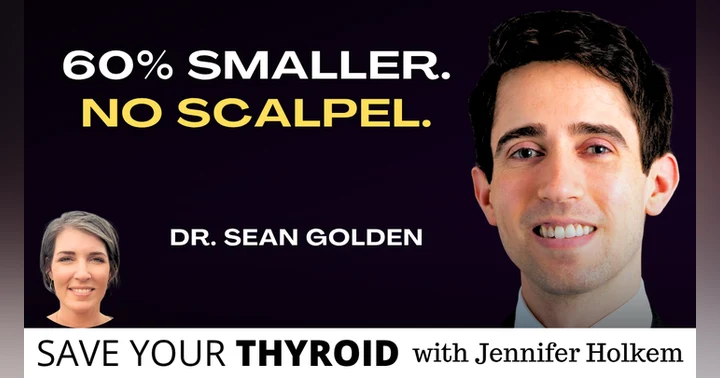
 60% Goiter Reduction Without Surgery or Ablation? An IR Explains TAE | Dr. Sean Golden
Interventional radiologist Dr. Sean Golden joins Jennifer Holkem to break down thyroid artery embolization (TAE) — a minimally invasive treatment that cuts off blood supply to an enlarged thyroid gland instead of removing or ablating it, with patients home the same day.
Dr. Golden, who trained at Yale, the University of Wisconsin, and Johns Hopkins, co-built the TAE program at UW Health alongside Dr. Matthew Niemeyer. He brings a distinct perspective, having come to TAE independently after years performing prostate artery embolization — a procedure he explains shares striking similarities with TAE in technique, patient experience, and risk considerations.
In this episode, Dr. Golden walks through exactly what happens during a TAE procedure, from catheter placement through particle embolization, and what recovery looks like in the days and weeks after. He explains UW Health's hybrid CT angiography suite and GE's EmboAssist technology — tools that help the team navigate precisely to the thyroid arteries while minimizing contrast and radiation exposure.
The conversation also covers UW's ongoing research: whether contrast deposition after the procedure can predict how much a goiter will shrink, expected changes in thyroid hormone levels post-treatment, and reassuring data on parathyroid function. Dr. Golden details who makes a good TAE candidate — including patients with sub-sternal goiters who aren't good surgical candidates — and shares an honest estimate of stroke risk based on current data.
He closes with a message for endocrinologists and ENTs who may not yet be familiar with TAE: what he wishes they knew, and what imaging findings after the procedure can look like so patients aren't unnecessarily alarmed.
If you're researching non-surgical options for an enlarged thyroid or goiter, this episode covers the clinical detail patients are usually not given.
Interventional radiologist Dr. Sean Golden joins the show to talk through thyroid artery embolization (TAE) — a minimally invasive treatment that cuts off blood supply to an enlarged thyroid gland instead of removing or ablating it, with patients home the same day.
Dr. Golden co-built the TAE program at UW Health alongside Dr. Matthew Niemeyer, and brings a distinct perspective as a physician who came to TAE independently rather than through the more established training pathway.
In this episode:
✅ What TAE is and how it compares to surgery and ablation
✅ Step-by-step: what actually happens during the procedure
✅ Recovery — what to expect in the days and weeks after
✅ UW's hybrid CT angiography suite and why it matters
✅ GE's EmboAssist technology, explained
✅ Current research: contrast deposition, shrinkage timelines, and hormone changes post-procedure
✅ Who is (and isn't) a good candidate for TAE
✅ What Dr. Golden wishes every endocrinologist knew
If you've been researching non-surgical options for an enlarged thyroid or goiter, this conversation covers the clinical detail patients are usually not given.
Chapters:
00:00 Introduction to TAE & Dr. Sean Golden
01:29 What Is Interventional Radiology?
04:07 From Prostate to Thyroid: How Dr. Golden Got Into TAE
07:36 Building the UW TAE Program
09:47 Expanding Access in the Midwest
11:30 Walking Through the TAE Procedure Step-by-Step
14:10 How Fluoroscopy & Contrast Guide the Procedure
16:03 Choosing the Right Embolization Particles
19:09 Recovery: What to Expect After TAE
21:11 UW's Hybrid CT Angiography Suite
23:09 What Is GE's EmboAssist Technology?
27:35 Does the Roadmap Change Patient Selection?
28:17 Research: Can Contrast Predict Shrinkage?
29:48 Thyroid & Parathyroid Hormone Changes Post-TAE
31:42 Publishing Research & the PROTECT Trial
32:32 Who Is a Good Candidate for TAE?
34:03 Who Isn't a Candidate (and Stroke Risk)
36:42 The Multidisciplinary Care Team
37:50 Treating Graves' Disease with TAE
38:44 How Patients Find This Program
39:36 Results: 60% Volume Reduction Explained
42:06 Long-Term Follow-Up (5-Year Monitoring)
42:42 Where TAE Is Headed as a Field
43:37 What's Needed for Wider Physician Adoption
44:48 What Dr. Golden Wishes Endocrinologists Knew
46:33 Next Steps for Patients Considering TAE
📌 Resources:
👉 Podcast: https://www.saveyourthyroidwithjen.com/
👉 Patient site: https://www.saveyourthyroid.org/
👉 Private FB group: https://www.facebook.com/groups/saveyourthyroidnonsurgical
👉 Patient Navigation: https://www.saveyourthyroidwithjen.com/patient-navigation-services/
💛 Support the channel:
PAYPAL 👉 https://www.paypal.com/paypalme/itsmejenagain
VENMO 👉 https://account.venmo.com/u/itsme_jenagain
🛍️ Affiliate links:
🌿 TOUPS AND CO: https://toupsandco.com/jen
🎙️ RIVERSIDE: https://www.riverside.fm/?via=itsmejenagain
🧴 VAN MAN: https://vanman.shop/?ref=itsmejenagain
💡 BON CHARGE: https://us.boncharge.com/?rfsn=7843863.50b9fa&shpxid=4137e8a5-8199-46cb-b71c-0f86d29324ff
⚠️ Disclaimer:
This podcast is for informational purposes only and is not a substitute for professional medical advice. No endorsement is given or implied for any specific product, treatment, or physician mentioned. Always consult with a qualified healthcare professional regarding your individual medical needs.
🎵 Music licensed through Soundstripe:
LWEQ1ULKFKSZCJAI
1V2EQXECZBOZ1GND
Hosted on Acast. See acast.com/privacy for more information.
Its Me Jen Again (00:00)
This is Save Your Thyroid with Jennifer Holkem the podcast dedicated to making sure you actually understand your options before anyone puts you on an operating table. Regular listeners know that thyroid artery embolization has been a part of this conversation on the show for a while now. We've covered the procedure from several angles and this community has been paying close attention because the premise is genuinely compelling.
A minimally invasive approach that doesn't touch the nodule at all works by cutting off its blood supply and sends patients home the same day. Today, we're adding another voice to that conversation, and it's one I've been really looking forward to. Dr. Sean Golden is an interventional radiologist at the University of Wisconsin-Madison Yale undergraduate UW
Medical School.
integrated IR residency at Johns Hopkins, who has built a TAE program at UW Health alongside his colleague,
Dr. Matthew Neimeier. His research focus is specifically on making TAE safer and more effective through advanced imaging and embolization techniques, including work with GE's EMBO assist technology.
that I'm especially curious to get into today. This is the kind of episode where we get into the details, the clinical decision making, the research infrastructure, the real questions that are still being worked out. Dr. Golden, thank you so much for being here.
Dr. Sean Golden (01:29)
Well, thanks, Jen, and thanks for having me here. And most importantly, thank you for your advocacy and really raising awareness about some of these non-surgical treatment options for patients with thyroid disease.
Its Me Jen Again (01:39)
it's a labor of love and the more I learn, the more excited I become for patients that they have options now. It's a wonderful time in the field of interventional thyroid procedures.
interventional radiology is one of those fields that oftentimes patients aren't even aware of until they really need it, right? That was my experience personally, because my doctor that did my RFA was an interventional radiologist and I was like, this is such a very unique, interesting and diverse field.
So give us the quick version. What is an IR physician? What do you do and what drew you specifically to this field?
Dr. Sean Golden (02:17)
Yeah, so IR is a really tough specialty to explain even to my own family members because we treat so many different diseases in almost every part of the body. know, for example, on any given day, I could be performing an embolization procedure to stop internal bleeding in someone who's been at car accidents, then turn around and treat someone's kidney cancer using microwave ablation, then suck out a blood clot in someone's lung called a pulmonary embolism. But, you know, even though these procedures, these patients are all very different,
I do think there's a couple threads that kind of tie everything together in IR. And that is one, everything we do is minimally invasive and two, everything is image guided. So by minimally invasive, I mean that almost every procedure that I do is performed through a tiny incision less than one centimeter in size. So this usually means no stitches, quicker recovery and often less risk from the procedure.
And by image guided, I mean that I either use X-ray or ultrasound or CT to see inside the body. And that's how I navigate my tools and instruments without having to make a bit of incision. Now you mentioned what drew me to IR. When I started medical school, I had also never heard of IR. as is the case with most of us. And I was actually planning to become a cancer surgeon. But then by about...
halfway through medical school by good luck. I was introduced to an IR doctor who's actually been a pioneer in microwave ablation and I had the opportunity to work with him and learn from him. And I was blown away by IR's ability to help so many different patients in such a minimally invasive way, as well as the constant innovation and new technology that's really throughout our field. So I switched immediately and I have never looked back.
Its Me Jen Again (04:07)
Yes, the innovation is constantly changing and I imagine you never get bored doing all of these different things and having all of these, you know, expertise in different technologies. It's so interesting. So one of the things about you just mentioned about this that's so cool is you're doing procedures all over the body. What part of your past experience with other parts of the body made you think
Let's do embolization on a thyroid.
Dr. Sean Golden (04:34)
Yeah, great question. So when I first started, I was actually really focused on prostate artery embolization, which
Its Me Jen Again (04:41)
you
Dr. Sean Golden (04:41)
I still do, but that's a treatment for men with BPH or enlarged prostates. And prostate artery embolization is actually one of the hardest IR procedures to perform because the prostate arteries tend to be really small and they're really tortuous, making it really challenging sometimes to get a catheter into the blood vessel and perform the treatment.
So this experience allowed me to really develop my skills in challenging embolization procedures, which was fantastic. Believe it or not, prostate artery embolization is actually really similar to thyroid artery embolization. And there's a few reasons why. The first is, you know, the patient experience. I think too often, you know, patients with enlarged prostates or enlarged thyroid glands are
unfairly dismissed by their healthcare providers because their condition isn't cancer and it's often not life threatening, but it greatly affects their quality of life.
Its Me Jen Again (05:35)
Absolutely.
Dr. Sean Golden (05:36)
Or, and I think a lot of your viewers have experiences, they're told that surgery is the only option, which is also not
Its Me Jen Again (05:41)
Right.
Dr. Sean Golden (05:42)
true. I think the second similarity between these two procedures is that they fundamentally work the same way. In both procedures, we're injecting small beads or particles
into the blood supply to starve the organ of blood and cause it to shrink and that's how you improve the symptoms. And the third similarity is that in both procedures we really have to be careful to avoid non-target embolization when the particles go somewhere other than the glands. So in the prostate, we worry about non-target embolization to the bladder, the penis, the rectum, which have a shared blood supply, and then the thyroid, as your listeners may be aware,
You have to be really careful to avoid non-target embolization to blood vessels like the ascending cervical artery, the vertebral artery, the carotid artery. So after having started with prostates, I read a lot of the studies that were coming out of Turkey and other places and thought this is a great procedure that would really help patients. That's how I got into it.
Its Me Jen Again (06:38)
Yeah, the quality of life is so vastly different for someone who has a mass that's growing either out of their neck, it looks like they have a second head, or it's growing down into their chest and they have issues with breathing and swallowing and just feeling exhausted. And so it's so wonderful that there is now an option for those patients that is not having their chest cracked open for a massive surgery.
for those patients with prostate enlargement as well, men suffer tremendously with those symptoms. And so it's wonderful for all of them to have alternatives that are not so morbid and that can cause so many issues after the fact. So I'm excited, I'm so excited this exists.
You and Dr. Neymeyer spent a lot of time across the country meeting with other IR physicians before you started this program. What was that process like and what did you learn in that process that really surprised you?
Dr. Sean Golden (07:36)
Yeah, so we did do that. you know, IR is a really small world and the group of us performing TAE is even smaller.
Its Me Jen Again (07:44)
Right.
Dr. Sean Golden (07:45)
So Matt and I reached out to a handful of IR docs around the country who were performing TAE, really pick their brain to learn their specific techniques and their experiences in the real world, practicing here in the United States to supplement some of the research that's been published in the literature, largely from outside the United States.
I think what stood out to us was really the heterogeneity in people's techniques. For example, some people were doing femoral approach. Some people were doing radial approach. Some people give all patients steroids. Some don't. Some use slightly larger particles. Some use smaller particles. So Matt and I were able to kind of pick and choose different aspects of what everyone was doing and create our own treatment strategy and philosophy.
And I hope that long-term, this heterogeneity, these differences in practice actually reduce as we start to learn which techniques really work the best and we can start to coalesce around a standardized technique that's based on the research that will be coming out.
Its Me Jen Again (08:49)
Yes, definitely. I had a patient consult yesterday actually with a patient who was concerned about that. She said, I want to know what's the best technique? What's the lowest risk scenario here? And I gave her some pointers on how to research that because she was very concerned about non-target embolization risk. And I think that
Obviously the more research that you guys are doing, the more you're going to refine this technique and it's just going to get better and better. For those viewers who are concerned about what I just said, those risks are very minimal in the hands of a very skilled physician who has refined his technique, his or her technique. We're just getting better and better all the time as we're moving forward in this technique. It's exciting.
Well, you're at UW Health and it is one of the few places that, especially in the Midwest, that's offering this. Did you feel any pressure being early on in this or did it feel more like an opportunity?
Dr. Sean Golden (09:47)
Yeah, you know, I think I was really excited and continue to be excited to be able to offer this procedure to folks in Wisconsin and really the broader Midwest where I grew up. You know, as you mentioned the intro, I had the opportunity to train on the East Coast at Johns Hopkins, where I was exposed to some of the latest and greatest treatments in IR, which was fantastic. And, you know, we're sometimes our patients were senators or celebrities or kings and queens from all over the world.
But you know, not everyone has the means or the time or the desire to travel far distances to get their care. And we have some amazing hospitals and doctors here in Wisconsin and the Midwest. So I am really excited to be able to offer this treatment to my community and to really expand access to care to folks in Wisconsin and neighboring states that are looking for a non-surgical alternative.
Its Me Jen Again (10:36)
I really look forward to the day when every person has access to someone within a hundred miles of their home to do the procedure that they need because it is still very common for patients to travel for treatment. I've even spoken with patients overseas that are coming to the US, patients in the US that are going overseas and it's just like, it would be so nice if we had more hometown providers. So that's wonderful that you brought that to your area.
Let's now talk through the TAE procedure because I'm still learning about this as we were talking about off camera. I've not ever seen one performed and a lot of patients have trouble kind of conceptualizing this because it is so different from the percutaneous ablations that go directly through the skin and the neck into the thyroid gland. So talk to me about this like I'm a patient sitting across from you in a consult. What am I about to experience?
Dr. Sean Golden (11:30)
Sure, so TAE is an outpatient procedure, first of all. So we're gonna have you usually come into the hospital, usually in the morning, we'll have you change into a hospital gown, we'll place an IV in the prep area that we're gonna use for sedation and some basic blood work. I then come up to the prep area, I talk to you, remind you what to expect for that day, answer any last minute questions you may have. We then wheel you over from the prep area to our actual IR suite.
kind of looks like an operating room, but with really fancy monitors and an x-ray machine there. And then in the IR suite, you're going to meet our wonderful team of nurses and x-ray techs who are super friendly and talented and really help me take care of you as I'm performing the procedure. We then start to give you some sedation through your IV. And the sedation tends to make you feel sleepy and relaxed, but it allows you to still breathe on your own.
So you don't need a breathing tube down your throats. We then clean the area that we're going to be working, which is sometimes the wrists right around here and sometimes the groin. We then give you a small injection of lidocaine in the skin in that area where we'll be working, which is a local numbing medicine, kind of like the dentist, which is going to sting and burn for about 10 seconds. And then after that, you really shouldn't feel any pain during the procedure.
We then make a really small skin incision. It's about five millimeters wide or so and small enough that you're not gonna need any stitches at the end. Through that incision, we insert a small tube called a catheter directly into your artery. We then use real time x-ray guidance to navigate that catheter through your network of blood vessels directly to the thyroid arteries.
Once we confirm we're in the thyroid arteries, which we do by injecting some contrast, like x-ray dye to see where we are, we then inject some small particles, which look like tiny little beads that are permanent and clog up the arteries supplying the thyroid gland to reduce its blood supply. And this is what's actually going to cause the thyroid to shrink over time.
In addition, several times during the procedure, we're also performing a CT scan or a modified CT scan called a cone beam CT to confirm that we're actually in the thyroid arteries and that there's no evidence of non-target embolization prior to us delivering our treatments. Once we've treated the thyroid arteries, we then remove the catheters, we place a bandage over the incision site or sites, and the whole procedure takes about an hour and a half to two hours on average.
Then after the procedure, we wheel you back over to the recovery room where we watch you for about two hours, then we send you home.
Its Me Jen Again (14:10)
Wow, that was the most detailed explanation I think I've heard up to this point. So thank you for all of that. I could kind of visualize it in my mind. And I have a few follow-up questions about the imaging part. So you're using something called fluoroscopy to navigate, which is live X-ray imaging. So how, and you mentioned the injection of the contrast. How is that enabling you to see and do things that you wouldn't otherwise be able to see?
Dr. Sean Golden (14:37)
Yeah, so with the real-time x-ray, can see your bones, we can kind of see your soft tissues, but we also see the catheter that we're using and the wire we're using. In addition, we can inject contrast and that's going to outline your blood vessels. And what we're looking for is the thyroid artery, usually the inferior thyroid artery, which is often fairly large in patients with a big thyroid nodule that's going up towards the neck and it's supplying what we call a blush.
The thyroid gland, when it gets big, it gets really vascular, it gets tons of blood supply. So it just soaks up that contrast. And when we inject it, we see this big, it's almost like a puff of smoke. And that's
how we identify the thyroid glands. So that's kind of how we see where we're going. And, I often kind of compare interventional radiologists to like a New York City cab driver that knows every road in the city, like the back of their hands. You know, our job is to just to know which
artery we're in at all times and be able to recognize where we need to go no matter where we are.
Its Me Jen Again (15:41)
Yeah, that makes me think about when percutaneous ablation is happening, the same thing is necessary for the tip of the probe. Every time they've got that probe in the thyroid, you have to see exactly where it is. So there's some similarities there. What about those particles you mentioned that you're injecting? How do you know when you've put in enough and how do you decide what type of particle to use?
Dr. Sean Golden (16:03)
Yeah, so we've, we, terms of type of particles, we usually use something called embospheres, which are trisacral gelatin. They're permanent. They stay there forever, but they also don't cause any problems. They're safe. We've been using them for 30 plus years. there's debate about the size of the particles. That's the biggest thing we have to decide. A lot of the early studies were out of Turkey. We're using slightly larger particles.
We and others like Dr. Camacho have switched over to using slightly smaller particles. So that's what we've been using 100 to 300 size particles. In terms of when to stop. the thyroid artery has branches. And what we want to see is we want to see those branches completely shut down, but we want to see the main trunk of the thyroid artery stay open. initially when we're injecting the particles, we see them flying forward.
and then we see them start to slow down and then we see them stop. So it's a little bit of an art and a little bit of a science to inject just enough where those branches have completely shut down, but the main artery stays open.
Its Me Jen Again (17:10)
That is so interesting. So are you ever concerned when you're doing that, there could be a, I've had this question actually recently, that there could be a recurrence of blood flow through those since you said that they're permanent or is it because you're seeing all of this and you said it is a permanent fixture that stays behind afterwards that it will remain that way?
Dr. Sean Golden (17:34)
Yeah, the honest answer is we don't know because thyroid artery embolization is relatively new. I don't know what the blood vessels will look like 20 years from now. But you know, we can extrapolate from other organs that we've been doing this like the prostate. And we see that the majority of patients that artery does stay shut down. A small percentage, the artery can open back up.
And when that happens, we can always go back in there and retreat. That's one of the reasons why we don't use coils, for example, which is what they initially used in Europe when this procedure was first being developed. They would use coils instead of these small particles. The problem with coils is that they're really hard to get past and retreat just in case things do open back up.
Particles allow us to get a very durable effect and treatment without blocking the potential to retreat 20 years from now if we need to.
Its Me Jen Again (18:33)
interesting. I actually knew someone who had a coil for an, it was for a...
an aneurysm many, many
Dr. Sean Golden (18:40)
Mm-hmm.
Its Me Jen Again (18:40)
years ago. And that was the first time I'd ever heard of anything like that. So that's interesting that it's a retreatment issue that you're trying to be able to continue retreating if needed. So, OK. So we talked about you mentioned that the procedure takes about an hour and half to two hours and that the patient goes home the same day. That's a remarkably short footprint for something so complex.
What about the recovery process after the patient comes home for the first few days?
Dr. Sean Golden (19:09)
Yeah, so the procedure itself, as I mentioned, is essentially pain free. But afterwards, patients can expect some discomfort. So patients will often have mild to moderate neck pain. Sometimes it can radiate to the jaw or even the face area. And that usually lasts about two to four weeks. It's usually mild enough that ibuprofen, Tylenol is enough to really take to manage it.
It's very rare where we have to give anything stronger like a narcotic or an opioid to treat the pain. It's usually not too bad. In addition, patients can feel pretty tired and they can even develop a low grade fever. And all of this is called post embolization syndrome. And it's really the body's response to the treatments and inflammatory response. Other than that, know,
a lot of patients are able to return to work the next day.
They are able to resume most activities as well. The only thing I tell them not to do is depending on where we access the wrist or the groin. I often have them avoid super vigorous activity for the first week or so, but that's about it.
Its Me Jen Again (20:17)
Wow. You mentioned the pain that they experience. Do we know what causes that? That's very interesting to me that they would have like any kind of radiating in the face and neck pain.
Dr. Sean Golden (20:29)
Yeah, you know, I think it's just an inflammatory response.
As the tissue, the thyroid cells are gonna start to die off, which is what we want because we want it to shrink. But as they start to die off, the body can respond with inflammation. It's just like if you accidentally bumped your elbow. so that's usually what causes the symptoms. Some patients tell me, hey, I really didn't have...
any symptoms at all. That was like you weren't even there. Other patients do have more symptoms and feel a little bit more wiped out. And for patients that do have more symptoms, there's things that we can do. We can, for example, give them a short dose of steroids, which often really helps with the inflammation and improves things.
Its Me Jen Again (21:11)
Wonderful.
Well, let's talk about some things that are unique about your specific practice. You have access to something at UW that most programs that do TAE don't have, which is this hybrid CT angiography suite.
Can you explain what that gives you that maybe cone beam CT doesn't or any other things about it that are unique?
Dr. Sean Golden (22:07)
Yeah, so a hybrid CT angiography suite means that we have access to real-time x-ray guidance and a full diagnostic CT scanner in the same room. So the picture quality with the CT scanner is phenomenal. It's just like if you were to get a CT of your neck or a CT of your head, it's the exact same machine. Compared to cone beam, which is
Essentially, when you take that x-ray detector that we use for real-time x-ray guidance and you do a partial rotation around the patient and kind of generate a poor man's CT, but it's not quite the same thing as a real CT. So the benefit of that is just the image quality. So when we're right about to inject our particles, we will sometimes do the CT.
And it allows us to have, be very sensitive for any non-target embolization where we can see all the little branches and make sure that none of those branches are going somewhere where we don't want them to be.
Its Me Jen Again (23:09)
Right, right. Okay, so it's just a better look into all of those very delicate areas. Very cool. Okay, well, let's talk about this EMBO assist. I'm curious to learn what that is. Is it something that is specifically designed for embolization in the thyroid or is it something you've adapted from other embolization procedures?
Dr. Sean Golden (23:29)
Yeah, so this is something that we've adapted from other embolization procedures. I use it and I have used it for a long time in the prostate. And then I've also used it in the knee to treat patients with osteoarthritis and in the colon for patients with hemorrhoids. And it works really well. So we thought, let's try to see if we can use this in the thyroid and it may be really helpful.
Its Me Jen Again (23:52)
What is it exactly?
Dr. Sean Golden (23:54)
I'll give you an analogy. So, you know, let's say you've lost your car keys in your basement, which happens to me more often than I'd like to admit. And you walk down to the basement and all the lights are off and you have no idea where the keys are. You know, one solution would be to flip on the lights and spend 10 minutes looking around until you find the keys. But in this case, in an IR procedure, the lights are X-ray and they're contrast.
Both of which we want to minimize, you know, they're safe in small doses, but we want to be mindful of that. So an alternative would be to turn on the lights in the basement really quickly, take a photo with your phone and turn off the lights. I could then look at that photo on my phone and see, hey, my keys are in that corner. In order to get there, I need to take 10 steps forward and then five steps to the right. And I should be there. But, you know, I know that as I'm walking there, I'm going to need to turn on the lights every once in a while.
make sure I'm on the right path and that I'm not about to stub my toe on a couch. So, another alternative would be what if we turn on the lights really quick, took a photo, turned off the lights, and then my phone took that photo and lit up the exact pathway that I need to take in order to get to my keys. Then I could just follow that pathway without having to turn on the light again until I actually get to the keys. So that's
Basically what EMBO assist is. Now, what does that actually look like? So when we're doing a thyroid procedure, when we are in the subclavian arteries, usually the arteries right before the inferior thyroid arteries, we perform a cone beam CT. The machine takes that cone beam CT and makes a 3D model of the blood vessels. We then identify the thyroid artery in that 3D model. And then the machine
lights up the path to get there. And that path is displayed on our real time x-ray machine. So we know exactly the direction the catheter needs to go. So that means that we can get into the thyroid artery faster with less contrast and less mucking around. We know exactly where we need to go. So we're not accidentally getting into arteries that we don't want to touch like the vertebral artery or the carotid artery.
Its Me Jen Again (26:14)
Wow, that is very, it's almost like a real time map with, gosh, I don't even really know what to compare it to, but that is almost maybe like a GPS for the
Dr. Sean Golden (26:26)
Yeah.
Its Me Jen Again (26:27)
area that you're treating. Yeah.
Dr. Sean Golden (26:29)
Yeah, I think that's a really good analogy.
And then the other thing that we're now messing around with, which kind of takes it one step further is I'm
Its Me Jen Again (26:34)
Mm-hmm.
Dr. Sean Golden (26:37)
going to return to this horrible basement analogy, but imagine you're in your basement and you
Its Me Jen Again (26:39)
Yeah.
Dr. Sean Golden (26:42)
don't even need to turn on the light because you have a photo in your phone of the basement from a week ago and use that photo to light up the path to your keys. So that's what we're trying now. So we, you these patients all have a CTA of the neck from pretty recent.
So we've been uploading that CTA directly into our machine and using that to create a map without even having to do the cone beam sometimes.
Its Me Jen Again (27:07)
Wow. Very cool. Gosh, the technology today is just crazy.
Okay, does having that type of technology really change your patient selection outcomes in ways that you can already measure?
You wouldn't necessarily have that map, that road map.
prepared in advance as far as like in the part of your patient selection process where you're going to rule out if someone is or isn't a candidate, right?
Dr. Sean Golden (27:35)
Yeah, that roadmap doesn't change whether someone's a candidate or not. But once we've determined
that they are a candidate, it's just a really helpful adjunctive tool that we can
use.
Its Me Jen Again (27:46)
I think this is really interesting and I would love if you have some images to share on after you've treated someone in the contrast deposition, after the procedure shows the shrinkage of the the gland, like what parts are alive and what parts are dead.
you're researching whether contrast deposition during or after the procedure can predict how much shrinkage a patient will get. Where did that idea come from and what are you seeing as you're researching that?
Dr. Sean Golden (28:17)
Yeah, so for a long time in the liver, IRs have done a procedure to treat liver cancer. And that procedure is called TASE, where we inject chemotherapy directly into the liver tumor. prior studies have shown that if you do a CT scan immediately after TASE, some of that contrast sticks around in the tumor. And the more contrast that sticks around, usually the more tumor that dies off.
So
we are exploring the same thing in the thyroid gland. know, if after the TAE procedure, we do a cone beam or a CT and we see some of that contrast sticking around in the gland. So we're asking the question whether that predicts how much the thyroid is gonna shrink.
in order to prove a correlation, you need a lot of patients and we're not quite there yet, but I suspect that as we get more patients,
and demonstrate without a doubt that there's this correlation there that it's probably something that we'll be able to confirm.
Its Me Jen Again (29:17)
Interesting. Okay. Well, let's talk about the changes in hormone levels after the procedure. And for the viewers who aren't aware of this, sometimes you experience immediately after the procedure, this massive increase in thyroid hormone as the parts of the thyroid that are not needed are dying. And so you have to track these changes.
post procedure. So what are you looking for and what are you seeing?
Dr. Sean Golden (29:48)
Yeah, so just as you mentioned, so the thyroid cells have already made thyroid hormone and are storing it in their cells. And as they start to die off and that cell breaks down, some of that thyroid hormone is gonna be released. So the vast majority of the time, patients are completely asymptomatic. They do not notice this increase in thyroid hormone, but we still check their blood work.
just to keep an eye on it and to better understand what is expected after this procedure. So what a patient can expect is that after 48 to 72 hours or so, their thyroid labs are gonna start to rise. They then peak around two weeks or so, two weeks after the procedure, and then they start to normalize, they go completely back to their pre-procedure baseline after about
four to eight weeks or so.
Its Me Jen Again (30:44)
Okay.
Dr. Sean Golden (30:45)
So I actually want to see these thyroid hormones spike because that seems to indicate that the patient's gonna have a really nice response. I get
Its Me Jen Again (30:55)
Okay.
Dr. Sean Golden (30:56)
more worried if I don't see those thyroid labs change at all, because then I wonder, you know, did we not treat enough? So I think it's a good thing. In terms of parathyroid hormones, we really don't see any change in those at all.
which is consistent with the prior studies that have shown that there are really no cases out there of permanent hypoparathyroidism after TAE, which is a great part of this procedure. But we still check them just to prove to everyone that we are not causing any issues with the parathyroid hormone, just to put everyone at ease.
Its Me Jen Again (31:32)
Yeah, that's always good to have to cover that base. What about your all your research you've done up to this point? Are you ever planning to publish any of this?
Dr. Sean Golden (31:42)
Yeah, absolutely. So we have written up our technique and also a summary of the procedure and some of the research out there that should be published this spring or this summer in the radiographics journal. We've also presented our work at several national conferences.
We are in the data collection phase at this point to investigate some of the other things that we've talked about, and hopefully we'll be able to publish that in the next year or so. We also are part of the PROTECT trial, which I think you heard about, led by Dr. Camacho, which is investigating pressure-enabled drug delivery for TAE. So we're also participating in that research, and hopefully that will be published.
in the next year or so.
Its Me Jen Again (32:32)
Fantastic. Okay, let's talk about candidacy for this procedure because not everyone with the thyroid nodule or goiter is a candidate. Help me understand what types of patients you're actually looking for.
Dr. Sean Golden (32:45)
Yeah, so the best patient is someone with a really big nodule or a really big goiter. So some numbers that we look for. Usually if your thyroid gland is going to be 80 cc's or 80 milliliters or bigger, you're going to be a good candidate for TAE. Or if you have a single nodule that's bigger than 20, 25 cc's, you also may be a candidate for TAE.
The reason why we choose those specific numbers is that's kind of the point where ablation stops being very effective or requires multiple treatment sessions. The other things that we're look for, if a patient has a sub-sternal goiter, meaning the goiter is extending below their chest bone, they're a really good candidate for TAE. And then of course, these patients are typically not interested in surgery as well and are working to avoid it.
Its Me Jen Again (33:35)
Yeah, I literally had a conversation with the patient about that yesterday about she was kind of wondering, am I more of a candidate for microwave ablation or for TAE? And I think the deciding factor for her is really the sub-sternal component. There's a small sub-sternal component for her.
Let's talk about, who is not a candidate for this? Who is just not the right patient and would really need to have surgery or possibly an ablation?
Dr. Sean Golden (34:03)
Yeah, so part of it's based on anatomy. The best candidates for TAE are usually patients with large inferior thyroid arteries, which come from below, because those are the safest for us to get into and treat. If those arteries are really small, then they may have large superior thyroid arteries, which we can potentially treat, but it may carry slightly higher risk.
So if your arteries aren't big enough for us to get into, TAE is not a good option. The other thing might be sometimes if your goiter is enlarging really quickly, we always do biopsies to make sure that there's no evidence of cancer. But if it's really expanding quickly, it may be a good idea to just get it taken out surgically to make sure that there's no cancer hiding in the glands.
So we've sent one patient to surgery for that reason. And then lastly, know, part of it comes down to patient preference. You know, there is a small but real risk of stroke from TAE. And, you know, patients have to be understanding of that and be accepting of that. And if it makes them feel really uncomfortable, then maybe something like surgery is a better option.
Its Me Jen Again (35:18)
Yeah, that is a concern for patients. But what would you say the statistic is that you've seen on risk for that?
Dr. Sean Golden (35:25)
Yeah. So, you know, there's not a lot of published strokes in the American data or the European data on strokes, but, you know, we know that they happen. and, know, fortunately it's never happened to us, you know, knock on wood, but I would estimate that there's about a 1 % risk of stroke, from TAE And my hope is that as we get better and better at this procedure, we're able to drive that number further down.
Its Me Jen Again (35:53)
Absolutely. That is a super low risk and very comforting for patients that are considering this because I mean, you hear a stroke and you think, wow, that's really scary. But it really puts it into perspective to hear that statistic. So thank you for sharing that.
So we're talking about an area of medicine that is very multidisciplinary where you're working in the thyroid and you are collaborating with endocrine surgery, endocrinology, and then diagnostic radiology. So that's a lot of different specialists and
I think it's really important that everybody understands all of you different specialties bring important things to the table here. How does that work for you day to day? Because I know in a big hospital system, that's a lot of specialists in the room, so to speak.
Dr. Sean Golden (36:42)
Yeah, so you know to be clear during the actual TAE procedure and when you see us in clinic, it's just the IR docs, whether it's me or Dr. Niemeyer or both of us performing the procedure. But
Its Me Jen Again (36:53)
Mm-hmm.
Dr. Sean Golden (36:54)
we do have a really close relationship with these other physicians at our hospital. Endocrine surgery often is the first person to see the patients and discuss the surgical options.
And then if the patient's not interested in surgery or is not a good candidate for surgery, they're often the one that refers the patient to us. Endocrinology often is involved in managing the thyroid medications of the patient. So patients with Graves disease or hyperthyroidism from other causes are often the ones titrating the medications for the patients. And then diagnostic neuroradiology, you know, we get CTAs, a CAT scan for all these patients.
They're the ones that have to issue the report and comment on the goiter. And we look at all the scans ourselves, but we've done a lot of education with them as well, kind of teaching them what we're looking for and what the relevant anatomy is.
Its Me Jen Again (37:46)
You mentioned Graves' disease. Are you treating a lot of Graves' disease with TAE?
Dr. Sean Golden (37:50)
the majority of patients don't have Graves' disease, but we have treated one patient with Graves' disease and they had a really nice response.
Its Me Jen Again (37:58)
great.
Dr. Sean Golden (37:59)
I think that the general consensus is, patients with Graves' disease are potentially at slightly higher risk of needing a second follow-up procedure, of potentially having recurrence just due to the nature of the disease, but they are a candidate for the procedure.
Its Me Jen Again (38:15)
Wonderful, yeah, we're starting to see more patients asking about that because it is such a difficult disease and very challenging disease to live with and to treat. Let's talk about the patient perspective of how a patient can find their way to you because this isn't a procedure that most endocrinologists are even going to bring up. So how's a patient going to find you and how are you kind of, as you mentioned just a second ago?
educating endocrinology about this as an option for their patients.
Dr. Sean Golden (38:44)
Yeah. So, you know, just our story, our first referrals came from endocrine surgery and then we had great results. And then ENT surgeons started sending us patients and then endocrinologists started sending us patients and now patients are self-referring.
Its Me Jen Again (39:00)
Yeah.
Dr. Sean Golden (39:00)
And they are often coming from other states. We've treated patients from, you know, the West coast, the East coast. patients often find us online.
And we do accept patient self-referrals. So patients can just call and request to see us in clinic. We do expect and require that the patient has seen an endocrinologist and seen an endocrine surgeon or an ENT surgeon just so that they learn about all the options. But that can be locally or if they want a second opinion, can help them establish care with one of our surgeons or endocrinologists at UW.
Its Me Jen Again (39:36)
Well, let's talk about the results that patients are seeing. You're reporting around 60 % volume reduction in recent cases. Can you put that into context for the viewers? What does that translate in terms of the patient experience? What are they going to feel?
Dr. Sean Golden (39:52)
Yeah. So yeah, 60 % is about our average, which is pretty consistent with some of the largest studies out there. For example, the Yilmaz et al out of Turkey. So, you know, a lot of patients notice symptom improvement. So we've had patients tell us that after the procedure, they don't feel this, you know, neck tightness. They're able to swallow better. They're able to breathe better. You know, patients that were on medications for hyperthyroidism,
are often able to reduce those medications or stop them completely. So those are the main benefits that patients have been reporting to us.
Its Me Jen Again (40:26)
big quality of life changers, having all of those things improve. And how long are they, how long are typically patients waiting before they see that reduction? Is it more gradual or more defined?
Dr. Sean Golden (40:39)
Yeah, so, you know, some patients will see results pretty quickly as soon as two weeks, but more typical, it takes about three months for most of the gland to shrink. And probably the maximum shrinkage is seen around six months. So
Its Me Jen Again (40:56)
Okay.
Dr. Sean Golden (40:57)
if a patient's going to achieve 60 % reduction by six months, usually at the three month mark, it's shrunk about
50%. So most of the way there, but they do get a little bit of extra shrinkage between three and six months.
Its Me Jen Again (41:10)
Yeah, I always have to remind patients it's important that you understand we're not looking for 100 % reduction here. We're looking for, you know, 50, 60, you know, those numbers are, when we hear them, we think, that's not a very high number. But in reality, in practice, when you have something so massive and you reduce it, even just a small amount, it's life changing. And that was my experience with RFA.
At 50 % reduction, was like, my gosh, I feel so much better. I can't even imagine if you have a very massive goiter what that means in terms of quality of life.
Dr. Sean Golden (41:48)
For sure, and I think it's important to mention too that we follow these patients for five years at UW. So we see them every three months initially and then kind of every year or two. So we're able to catch, if the symptoms do come back for whatever
Its Me Jen Again (42:01)
Okay.
Dr. Sean Golden (42:02)
reason, we're able to jump in and re-intervene if necessary.
Its Me Jen Again (42:06)
Excellent. Yeah, that's a question we've seen a lot is what's the follow-up process like? And I think it's as you said, it's not really standardized yet. So I think that's great that you're following them so closely over that period of time. Well, as we kind of round out this interview, we're just going to touch on a few things about your practice specifically and where we're headed in this field in general. So.
What do you see changing over the next few years in the field of TAE? Do you think it's going to stay kind of in a niche or it's going to just continue to grow in prevalence?
Dr. Sean Golden (42:42)
I think it's definitely gonna grow. think as patients start to hear about it and more and more, IR doctors gain the skill sets and endocrinologists and surgeons learn about this as an option. I think it's gonna gain a lot of popularity. We're already seeing that at some of the IR conferences. TAE was never mentioned a few years ago and now there's
multiple research studies ongoing.
So I think it's just going to continue to expand. It's never going to replace, you know, ablation or surgery. I think all of these treatments are needed in this space,
but I think it's going to find a role for certain patients.
Its Me Jen Again (43:22)
I 100 % agree. What do you think is the most important thing that needs to happen in terms of adoption by physicians? Do you think it's more data, more training, or just awareness across the country for more patients to have access to this?
Dr. Sean Golden (43:37)
I think it's all the above. I think that we need to really clarify what the best technique is. That
Its Me Jen Again (43:43)
Mm.
Dr. Sean Golden (43:44)
means, you know, should we be using, pressure enabled drug delivery, like the protect trial is, is, is studying, or should we do our traditional catheters? What's the best particle size or should we use some completely different embolic like glue or a liquid embolic you know,
when is the optimal time to stop the embolization? How much do we need to get in there? So I think all of that needs to be clarified and proven with data. And then we need to spread that data so that everyone is performing this procedure the way it should be performed in the safest and most effective manner.
Its Me Jen Again (44:20)
I think that more data is always wonderful, but I am excited that what we've seen up to this point has been so positive. Even as this is emerging and new, we're still seeing such positive outcomes. So for all the endocrinologists and ENTs out there who, you know, we're hoping are going to start becoming more aware of this and referring out for this, what do you wish most of them knew that
Right now they don't.
Dr. Sean Golden (44:48)
First of all, I want them to just know that it exists and that it's a really good option, particularly for the most challenging patients with sub-sternal goiters. Number two, I think it'd be helpful for everyone to be aware, including diagnostic radiologists, some of the expected findings after the procedure. For example, you know, we've had a few patients get ultrasounds after TAE of their neck.
And after TAE and after ablation too, some of your nodules can look pretty funny. They can get
Its Me Jen Again (45:20)
Mm-hmm.
Dr. Sean Golden (45:20)
more hypoechoic. And if you just go off of the, you know, the best practices for a normal thyroid, it can be suspicious for cancer. So sometimes patients will get an ultrasound saying you have this new suspicious nodule and they get really concerned, but we reassure them this is completely normal.
So I think raising awareness of that, of some of the imaging findings that one can expect after TAE will really relieve a lot of anxiety of both of our patients and also some of the collaborating physicians.
Its Me Jen Again (45:54)
I want to say it from the rooftops. so important that patients understand that because if they have an ultrasound follow-up with someone locally that maybe didn't perform their procedure and isn't aware, it can be a very scary and stressful conversation where that doctor just thinks something horrible has happened when in reality it's completely normal and it's expected even.
Well, as we close this out for patients who are listening and they think they might be a candidate for TAE, they're considering looking into it, what's the right next step and do patients from outside of Wisconsin reach out to you?
Dr. Sean Golden (46:33)
Yeah. So, certainly talk to, your, you know, endocrinologist or your endocrine surgeon or your ENT surgeon about it. but also talk to an IR directly to learn more about the procedure. and if you, don't have a local IR doc, you know, we're always happy to see patients from outside of Wisconsin. We've taken care of patients from outside of Wisconsin. and we do most of our visits virtual. Really the only time that you have to come to Wisconsin is for the treatment itself.
Its Me Jen Again (47:01)
Well, I have really learned a lot from you today. Thank you so much for this conversation. And for the viewers who are learning more about this procedure, if you are thirsty for more, be sure to watch the TAE playlist that I have saved on Save Your Thyroid with Jen. And with that, we will say goodbye. Thank you so much.
Jen (47:23)
That's it for today. If this helped, follow the show and subscribe so you don't miss the next one, and send this episode to someone who needs it. Everything we discussed is linked in the show notes below, along with the resources and how to book a one-on-one patient navigation consult at Save Your ThyroidwithJen.com.
A quick reminder, this podcast is for information only. It's not medical advice and no endorsement is implied for any product, treatment, or physician mentioned. Please talk through your own situation with your care team. Thanks for listening and I'll see you next time.
MD
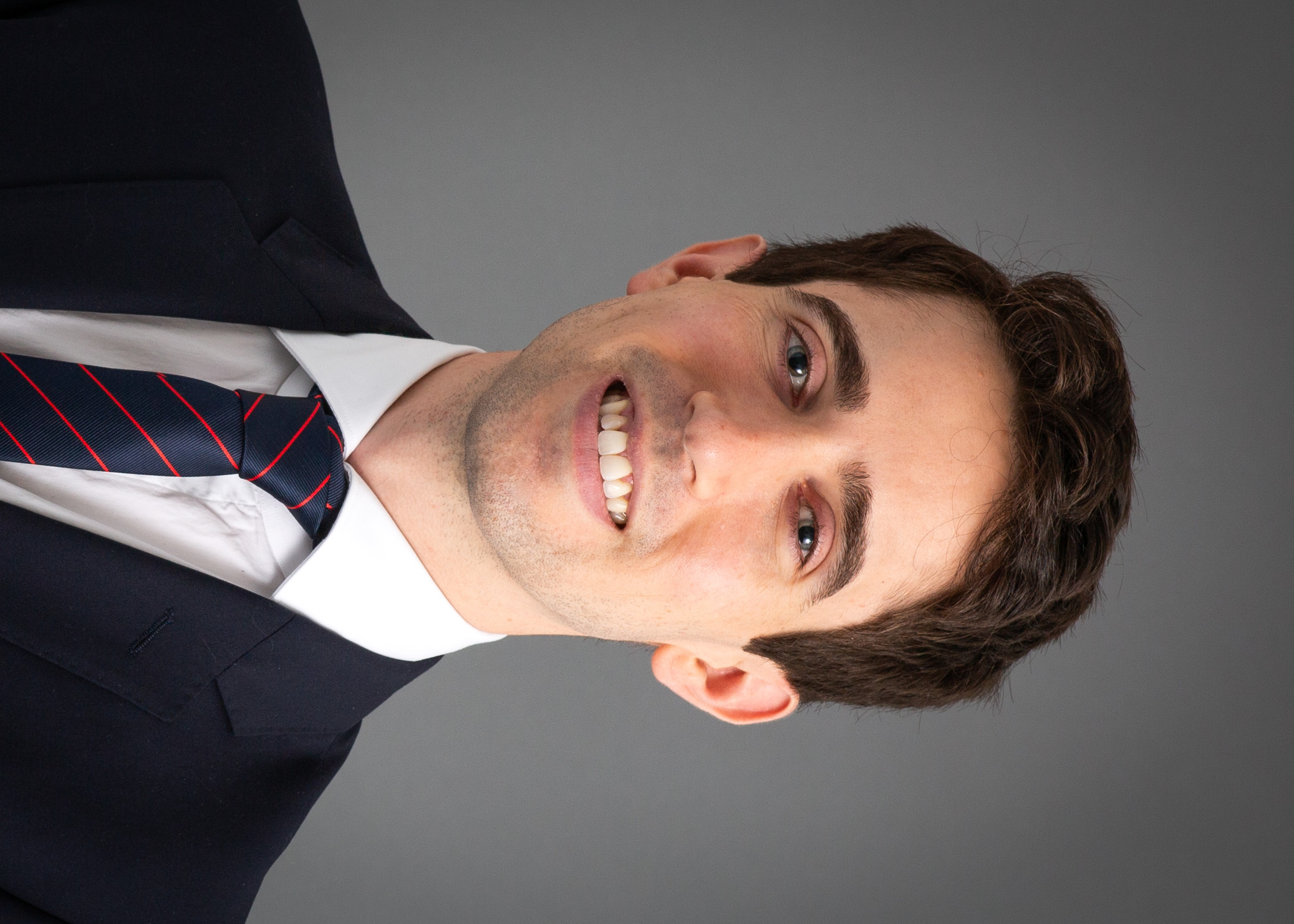
Dr. Sean Golden is an academic interventional radiologist at the University of Wisconsin - Madison specializing in thyroid artery embolization. Dr. Golden completed college at Yale, medical school at the University of Wisconsin, and residency at Johns Hopkins. His research focuses on thyroid artery embolization. Current areas of investigation include: 1) advanced imaging techniques to reduce stroke risk and radiation dose during TAE 2) thyroid hormone levels after TAE 3) patient outcomes after TAE.