
 Amazon Music
 Apple Podcasts
 Audible
 Castbox
 Deezer
 iHeartRadio
 PocketCasts
 RSS Feed
 Spotify
 YouTube
 Youtube Music
  Goodpods
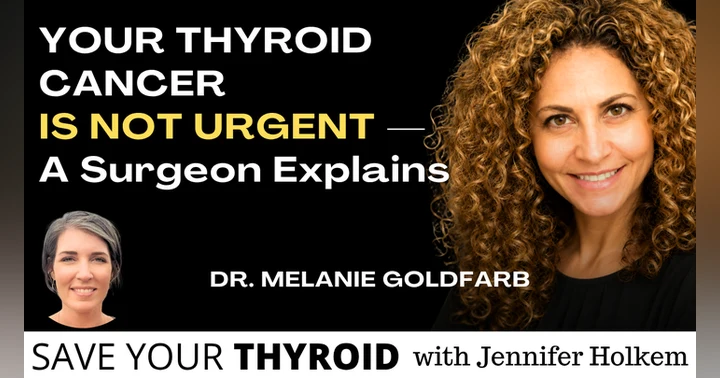
 Your Thyroid Cancer Is Not Urgent — An Endocrine Surgeon Explains | Dr. Melanie Goldfarb
What if the surgeon sitting across from you told you that your thyroid cancer is not urgent — and that you have time to think, research, and explore all your options before committing to anything?
That's exactly what Dr. Melanie Goldfarb tells her patients. And she's an endocrine surgeon.
Dr. Goldfarb is a fellowship-trained endocrine surgeon, Professor of Surgery, and Director of the Center for Endocrine Tumors and Disorders at St. John's Cancer Institute in Santa Monica, California. As one of the first physicians on the West Coast to offer in-office RFA, she performs surgery AND ablation — so her recommendation reflects what's right for each patient, not the limits of what she can offer.
In this episode she covers the full landscape of thyroid nodule and cancer treatment — from realistic RFA expectations to a combination approach that saves half a thyroid.
In this episode:
What realistic RFA volume reduction looks like — 50% is success but she aims for 70-80%
Why goiter and nodule are not the same thing
Who qualifies for thyroid cancer ablation and the 120% concept
The lobectomy + RFA combination — saving half a thyroid
Why active surveillance is a treatment, not inaction
Why thyroid cancer is almost never as urgent as your surgical consult made it feel
Find Dr. Goldfarb: stjohnscancer.org/endocrine — telehealth available.
What if the surgeon sitting across from you told you that your thyroid cancer is not urgent — and that you have time to think, research, and explore all your options before committing to anything?
That's exactly what Dr. Melanie Goldfarb tells her patients. And she's an endocrine surgeon.
Dr. Goldfarb is a fellowship-trained endocrine surgeon, Professor of Surgery, and Director of the Center for Endocrine Tumors and Disorders at St. John's Cancer Institute in Santa Monica, California. As one of the first physicians on the West Coast to offer in-office RFA, she brings a genuinely unbiased perspective — she performs surgery AND ablation, so her recommendation reflects what's right for each patient, not the limits of what she can offer.
In this episode she joins Jennifer Holkem to cover the full landscape of thyroid nodule and cancer treatment — from realistic RFA expectations to a combination approach that could save half your thyroid.
In this episode:
What realistic RFA outcomes look like: The published definition of success is 50% volume reduction — Dr. Goldfarb achieves that 90-95% of the time but personally aims for 70-80%. Nodules under 4 to 4.5 centimeters typically need one session. Larger nodules may need more.
Goiter vs. nodule — why the distinction changes everything: A goiter is diffuse thyroid overgrowth. A nodule is a distinct, delineated growth. Thermal ablation is designed for nodules, not goiters. Getting this wrong leads to the wrong treatment conversation entirely.
Thyroid cancer and the 120% concept: Candidates for cancer ablation are the same patients who qualify for active surveillance — tiny papillary thyroid microcarcinomas under one centimeter, fully contained. The critical difference from benign treatment: you need 120% — the entire tumor plus a surrounding margin. Location is everything.
The lobectomy + RFA combination: For patients with one dominant side that is too large for ablation alone, Dr. Goldfarb removes that side surgically while using RFA to preserve the other. An innovative approach that saves half a thyroid for the right patient.
When proactive treatment makes sense: Her threshold is 3 to 3.5 centimeters. Serial ultrasounds consistently showing growth are an automatic reason to act. But not every nodule that exists needs treatment.
Active surveillance is a treatment: Watching is a conscious medical decision — not inaction. And the data is clear: even if a tiny thyroid cancer grows during surveillance, long-term prognosis is no different than treating it immediately.
Why thyroid cancer is almost never urgent: When a surgeon books you for surgery before you leave the office, that is scheduling efficiency — not a clinical emergency signal. True urgent thyroid cancer scenarios are genuinely rare. You have time.
The future of interventional thyroidology — in one word: non-invasive.
Find Dr. Goldfarb:
stjohnscancer.org/endocrine — telehealth consultations available via Zoom
Resources:
Podcast: saveyourthyroidwithjen.com
Patient site: saveyourthyroid.org
Private FB group: facebook.com/groups/saveyourthyroidnonsurgical
Patient Navigation: saveyourthyroidwithjen.com/patient-navigation-services
Support the channel:
PayPal: paypal.com/paypalme/itsmejenagain
Venmo: account.venmo.com/u/itsme_jenagain
Affiliate links:
TOUPS AND CO: toupsandco.com/jen
RIVERSIDE: riverside.fm/?via=itsmejenagain
VAN MAN: vanman.shop/?ref=itsmejenagain
BON CHARGE: us.boncharge.com/?rfsn=7843863.50b9fa&shpxid=4137e8a5-8199-46cb-b71c-0f86d29824ff
Disclaimer: This podcast is for informational purposes only and is not a substitute for professional medical advice. No endorsement is given or implied for any specific product, treatment, or physician mentioned. Always consult with a qualified healthcare professional regarding your individual medical needs.
Hosted on Acast. See acast.com/privacy for more information.
Its Me Jen Again (00:00)
You're listening to Save Your Thyroid with Jennifer Holkem the podcast where we explore innovative thyroid-sparing treatment options, advocate for patient empowerment, and navigate the journey to improved quality of life. Today, we are joined by someone at the forefront of modern thyroid treatment and preservation. Dr. Melanie Goldfarb is a fellowship-trained endocrine surgeon, professor of surgery,
and the director of the Center for Endocrine Tumors and Disorders at St. John's Cancer Institute in Santa Monica, California. She also serves as their medical director for cancer survivorship. As one of the first physicians on the West Coast to offer in-office radiofrequency ablation, Dr. Goldfarb has been a true pioneer in minimally invasive therapies. Beyond her surgical expertise, she's a leading researcher in clinical outcomes,
secondary malignancies and the unique psychosocial needs of adolescent and young adult thyroid cancer patients. She is a massive advocate for personalized medicine, ensuring every patient gets a tailored approach rather than a one size fits all surgery. Welcome to the show, Dr. Goldfarb.
Melanie Goldfarb (01:05)
Thanks so much for having me, Jen. It's an honor to be honest.
Its Me Jen Again (01:09)
It was kind of crazy the way we ran into each other and we're able to finally meet because I've actually seen you.
present on a few webinars in the past and I've always been so amazed and impressed by your work. So it's really a privilege to get to talk to you today and I would love to hear how you first got involved in endocrine surgery and what drove you to become an early adopter of RFA.
Melanie Goldfarb (01:36)
Sure, Jen. Yeah, was fantastic running into you and I followed you as well. And so I have no idea how we have never crossed paths, but so this was great. I went in, did general surgery and was trying to figure out what I liked. I really liked the idea of multidisciplinary care. So definitely something in oncology. And
This is the area of the body that I just love operating on. It's neat, it's clean, it's precise. I can make it look really pretty when I'm done and it let me do multidisciplinary care. So that's how I got to where I am now.
Its Me Jen Again (02:16)
And then specifically, how did you find this niche in cancer care? Because that's a really big deal to specialize in that area specifically of the thyroid.
Melanie Goldfarb (02:26)
Yeah, I mean, I do do cancer and not cancer, so I do both. I do everything, but within the endocrine surgery field, most of us do a little bit of all the operations, because there's only a couple, but just sort of over time and the patient population that I was seeing and what I've come to enjoy more is the thyroid aspect.
I
Its Me Jen Again (02:50)
Mm-hmm.
Melanie Goldfarb (02:51)
think there's, on one hand it's so easy, on the other hand there's so much that goes into it that I find it interesting. I love the surgery and again I like that multidisciplinary that a lot of times either I'm working with another physician to help coordinate care and we're jointly taking care of the patients or I'm doing a little bit of that that's not just surgery, it's doing all that other stuff too.
Its Me Jen Again (03:17)
And I would imagine that your multidisciplinary collaboration has made you keenly aware of what it's like for endocrinologists and patients after thyroid removal to manage the hormonal aspects of having no thyroid. And so does that play into
Melanie Goldfarb (03:34)
So, thank
Its Me Jen Again (03:35)
why you maybe were drawn to RFA or tell us about that aspect of your treatment toolbox?
Melanie Goldfarb (03:42)
Yeah, so
I am really big on personalized care. I don't think one size fits all. And so I really love the idea of giving people options and letting them figure out what fits best for them. Because there are certain things that there really is only one way to deal with it. But there's a lot of other things that we can approach it in a bunch of different ways. And they all have
pros and cons and risks and benefits and what is the right thing for one patient is not going to be the right thing for another. And so I've always really tried to find things that could, I don't know, make it easier for different patients or just have different things be available, depending on what your personal
beliefs, values, what's important to you and what you're going to worry about later on. And so that's how I got really interested in bringing this as part of my patient care as soon as I really knew about it.
Its Me Jen Again (04:48)
Mm-hmm.
Melanie Goldfarb (04:48)
I think although RFA has been around in other countries for a really long time,
I I'd heard about it, but it wasn't really on my radar until maybe, I don't know, right before COVID.
Its Me Jen Again (05:00)
Mm-hmm.
Melanie Goldfarb (05:01)
And that being on the radar and then we have time to do things during COVID really was like, okay, I'm doing this.
Its Me Jen Again (05:09)
So before you adopted RFA, did you have a lot of patients that were seeing you who you were telling them you really need to have surgery to deal with this? And were they saying things like, well, I don't really want to have surgery. Did you see like a need in the patient population for something in addition to surgery that RFA kind of filled?
Melanie Goldfarb (05:29)
A hundred percent. think that number one, there are patients that just really didn't want surgery from the surgical aspect of it. Number two, patients were really afraid of losing even half of their thyroid, let alone the whole thyroid. And number there are all these also patients in the middle that yeah, we can watch, but then you're,
setting them up to get, you know, yearly ultrasounds or, you know, having this just kind of be a weight over their shoulder for a while. And there had to be something for those patients as well. So I think those are three different things that thermal ablation has really helped out.
Its Me Jen Again (06:12)
Mm-hmm. And I want to talk more about saving one side of the thyroid in a minute. I think that's a really interesting conversation. But before we get
to that point,
Melanie Goldfarb (06:20)
Thank you.
Its Me Jen Again (06:21)
let's talk a little about benign and malignant nodules. Start with benign and talk about how you approach these nodules, particularly the really large ones. What's a realistic expectation for volume reduction and symptom relief for a patient wanting RFA for a benign nodule?
Melanie Goldfarb (06:40)
Thanks Jen. So benign nodules at the moment is the majority of my RFA practice. If it's an actual nodule, and I'm not talking about a goiterous overgrowth, but if it's an actual nodule, there's no patient that we can't approach with RFA. It is all about setting up the expectations and how many times we're going to need to do it over how long of a period of time. So when I see a patient
What I tell them is if it's under four, four and a half centimeters, one session should be enough for you. Every once in a while not, but in general one session should be fine. If it's over six centimeters, you will need more than one session. If it's between four and a half to six, it's kind of a wait and see based on volume reduction and also just.
the physicality and where it is and what's bothering you. And then the really ginormous ones, which I've done a lot of, sometimes you're gonna need three sessions, sometimes you're gonna need four sessions. if it's an actual nodule, there is nothing we can't do, but the thing I always remind patients is we are not getting rid of this. I am making it smaller and I will help your symptoms, but we are not getting rid of it. So that plays to...
what's most important to you. But almost everybody, we can approach it and come up with a plan. When you talk about volume reduction, all the literature states, what is success? Success is 50 % reduction in volume. So I tell them that. And I would say, I get that most of the time, 90, 95 % of the time. But 50 % reduction doesn't.
get rid of symptoms for everybody. And that's where that size goes to as well as where it's located. So everybody can be a little bit different. I would say even though 50 % is success, usually I like 70 to 80 % and I feel like I get that a lot, but not always. And I think it's sometimes a little hard to tell who is gonna have that awesome response, right? 90 plus percent.
and who is
Its Me Jen Again (08:46)
Mm-hmm.
Melanie Goldfarb (08:47)
going to have that lingering around 50%. So I don't think we are perfect at predicting that just yet.
Its Me Jen Again (08:54)
Absolutely, everyone's different and the composition of their nodules probably makes a big impact on that too. Would you say that? if it's more solid versus spongiform versus partially cystic, does that make a big difference in the response?
Melanie Goldfarb (09:08)
I mean, hypothetically, yes, but I've also seen it totally different. I've had amazing response from a solid nodule and I've had a fair response from something that I thought I was gonna have an awesome response from. So
Its Me Jen Again (09:22)
Mm.
Melanie Goldfarb (09:23)
yes, composition is important, but I don't think it's everything and I don't think we have that totally figured out yet.
Its Me Jen Again (09:29)
I would love to see further down the road with data accumulation, what component of that is dependent upon the patient's immune response? The immune system is dealing with this cleanup after the RFA. And so I don't know if there's a way to measure that, but I wonder if that plays a role too.
Melanie Goldfarb (09:47)
Yeah, and you're ready to set up clinical trials. But I
Its Me Jen Again (09:50)
Ha ha ha!
Melanie Goldfarb (09:51)
think that that's a great question. I think that's something we've all wondered. I there are immune markers and inflammatory markers that you can measure. I don't think anybody's really done that yet. There have been a couple studies that have looked at thyroid antibodies, there's some studies that have said,
you know, higher antibodies or the presence of antibodies is going to have better response. Others have said it's going to have not as good a response. So even then, I don't think we're quite there yet in terms of an answer, but that's a question that all, you know, all of us have is
Its Me Jen Again (10:29)
Mm-hmm.
Melanie Goldfarb (10:30)
what are we missing that modulates how well a patient responds? And if we can figure that out,
Is there a way, something we can do to sort of influence that if they are somebody that's not going to respond as well?
Its Me Jen Again (10:45)
Mm-hmm. Yeah, that'll be really interesting if we ever do get that kind of data. And I want to go back and touch really quickly just for the listeners who may not understand the nuance
Melanie Goldfarb (10:54)
Bye.
Its Me Jen Again (10:55)
of terminology here. When we talk about a nodule versus a goiter, some people get really confused there. So if you would just kind of differentiate between those two terms, because sometimes people use them interchangeably and I don't think they fully grasp there's a difference.
Melanie Goldfarb (11:10)
I agree and I feel like I have that conversation with every other patient that comes in because somebody's
Its Me Jen Again (11:16)
Yeah.
Melanie Goldfarb (11:16)
told them they have a goiter and they don't. So a goiter is really just overgrowth of your thyroid. There are not demarcations of growth, nodules, tumors, whatever you want to call them. It is just overgrowth. We thought, we used to think of it as iodine deficiency in the old world and developing countries, but
plenty of people in the US get goiters too. It's not all related to iodine. So thermal ablation doesn't work great for that. There are people that do it, but that's not really what it's meant for. There are some other newer things like thyroid embolization where that's what we want to use for goiters. And I know that's a totally separate conversation, but it's all part of Save Your Thyroid.
that's really the treatment more for these huge goiters that are not nodules. But once you have a nodule doing this thermal ablation that disrupts or kills the tissues within the tumor and then the body deals with it by getting rid of the dead tissue then shrinks that delineated growth.
Its Me Jen Again (12:23)
Mm-hmm. It's an obvious when you're looking at an ultrasound you can see an obvious difference in the where the nodule is versus just the thyroid tissue around it.
Melanie Goldfarb (12:32)
Yes, I mean there are some people where it's they have nodules in the background of a goiter and then that's a little again can be a little bit of a tricky conversation but for the gross majority of patients it's pretty obvious that you either have one or the other or even nodules in a background of goiter. Only every once in a while is it not obvious.
Its Me Jen Again (12:54)
Okay, well now let's talk about malignancies. So using RFA malignancy is something that we
Melanie Goldfarb (13:01)
Okay.
Its Me Jen Again (13:01)
see more and more patients asking about. They're very anxious to know, am I a candidate for treatment with any kind of ablation for a malignancy? And we're constantly having to help people understand the parameters for that. So tell us in your opinion who is the ideal candidate for this and
how you would treat them differently than you would a patient with a benign nodule, and then what their follow-up might be like. How is it different?
Melanie Goldfarb (13:29)
So I think that this is still a very evolving field. I'm going to say that. I do a little bit of it in general. I haven't done as much because I'm able to convince patients to do active surveillance. Okay. And the people that are candidates for ablation right now are the same people that are candidates for active surveillance. So who is that? Anybody that has a
cancer that's under one centimeter that's not, you know, popping out of the thyroid, that's not really near and abutting the trachea, or that's not in a super posterior position where it's going to be right on the nerve. So anybody else is really a candidate for active surveillance, which means they can be a candidate for thermal ablation.
I think either is fine. To me, I feel like a lot of these, we can just watch. And so great, but there are some patients that feel really uncomfortable about that. And this goes to the options, right? So if you feel really uncomfortable with that and you want to be a little bit more proactive, then thermal ablation seems to be a really great option. We've had a lot of data out of Asia mostly.
a little bit out of Europe. think the US data is still very young. It's only about a year follow up. So I really look to the other countries and the data has been great in expert hands that are doing thousands of these. So I think this is where expertise and volume of the person that's doing it actually is even more important than for benign.
And then we're talking about what about the one to two centimeters? So I think that's like the newer thing that people are talking about. And
Its Me Jen Again (15:13)
Mm-hmm.
Melanie Goldfarb (15:14)
I think it's the same thing. So if you are totally within your thyroid that you can get a 20 % margin with ablation without doing anything bad and you are in hands of somebody that does enough of these that they feel like they can get 100 % of the tumor, it may be reasonable.
That's really the difference though between benign and malignant. So benign, I'm not trying to get the whole thing. That's not the goal. I'm trying to get whatever, 70, 80 % and shrink you that much. Whereas with a cancer, I need to get 120%. And so that's where the challenge is. It might sound easy, but it's not as easy as it sounds.
Its Me Jen Again (15:53)
Mm-hmm.
Melanie Goldfarb (15:53)
Somewhere down the road though, there will probably also be a role for, hey, we don't have to get it all because we've like,
typed your tumor and we know that it's not going to do anything bad. So either we
Its Me Jen Again (16:05)
Okay.
Melanie Goldfarb (16:05)
can leave it or we can shrink it some and that's good enough. Whereas, oh, we've typed your tumor, this is going to do stuff. So ablation is probably not for you, it probably needs to come out. So I feel like that's where we'll go eventually. And I think it's appropriate that we're tiptoeing there. But I do think it's part of the armamentarium now. And I think it's something that is
reasonable to if a patient asks you about it or even when you're just offering them what are the options, I think it's there for the really tiny cancers. I also think why are people biopsying things that small either, but that's another question. As a surgeon, usually if something's that tiny, I'm not the one that biopsied it.
Its Me Jen Again (16:51)
Mm-hmm.
Melanie Goldfarb (16:52)
Somebody else.
biopsied it and then they're coming to me saying, okay, what can I do about this? What do I have to do? So
Its Me Jen Again (16:59)
Mm-hmm.
Melanie Goldfarb (16:59)
that's a separate thing, but I don't think this is going away. I think this is here to stay as an option and just figuring out exactly, you know, who may not be appropriate is going to be where we need to do some more research.
Its Me Jen Again (17:14)
think that's so cool, the concept
of typing the tumor and knowing ahead of time, okay, this is a good tumor to treat this way because it's less aggressive. We don't have to be as complete with the treatment. That is a very, very cool concept to think about because in the past it's just been, you have thyroid cancer, we have to take out your thyroid. And now that we have active surveillance as a concept, even a lot of doctors today I think are still very uncomfortable with that.
and are, you know, because it's not taking an action, it's just letting things progress as nature carries them out. And I think that over time we will see, I mean, I think the data probably already shows this, and this is why we have active surveillance, that most of the time it has a positive outcome for the patient to just watch and monitor for size. And then,
I wanted to go back and talk briefly about, said 120 % of the tumor. This is the first time I've heard that number thrown out. And I think that's a really great understanding for patients because we always talk about, okay, when you have a benign nodule, you're treating the nodule inside of its borders, right? When it's
Melanie Goldfarb (18:24)
Great.
Its Me Jen Again (18:26)
malignant, you're going around the outside and getting all of the edges of it.
and then some of the extra healthy tissue that's around it. So that's why it's so important that the tumor be in a location where there's plenty of healthy tissue. So 120
Melanie Goldfarb (18:42)
Exactly.
Its Me Jen Again (18:43)
% is the first numerical value I've
Melanie Goldfarb (18:45)
And I'm to
Its Me Jen Again (18:47)
ever heard assigned to that. So I think that's really helpful. So thank you for mentioning that.
Melanie Goldfarb (18:51)
I
that's how I explain it to patients. I mean, we
Its Me Jen Again (18:53)
Yeah. Yeah.
Melanie Goldfarb (18:56)
talk about getting like a two millimeter margin. And so when
Its Me Jen Again (19:00)
Yeah.
Melanie Goldfarb (19:01)
you think about that in something that's, let's say one centimeter, and sometimes
Its Me Jen Again (19:05)
Mm-hmm.
Melanie Goldfarb (19:05)
it's less, that's why I talk about, that's why I say 120%. So like you said,
Its Me Jen Again (19:10)
Thank
Melanie Goldfarb (19:10)
you're not just want what's inside, you want the borders and a little bit outside.
Its Me Jen Again (19:14)
Mm-hmm.
Melanie Goldfarb (19:15)
If we're going to do this correct.
Its Me Jen Again (19:16)
Mm-hmm. Great. Yeah. So if you've got someone who has done an ablation for a thyroid cancer and you're going to monitor them afterwards, how is that different than for a benign nodule?
Melanie Goldfarb (19:29)
To be honest, for right now, I approach them fairly similarly. Everybody does this a little bit different. I usually like to see patients for benign nodules, so I guess for cancer too, at two months, six months, a year, and once a year afterwards. I think for the cancer patients, some of the ones that I've done, I'm seeing them at like one and half years also and two years, so I think I'm putting in...
a little bit of an extra, just like I would do active surveillance, right? So how
Its Me Jen Again (19:58)
Mm-hmm.
Melanie Goldfarb (19:58)
would I do active surveillance? I see them every six months for the first two years, and then we go to one year. So my plan for when I ablate them for these are going to be the same as for active surveillance with just that extra, I want to see them at two months, just to kind of see how it's looking most of the time. If you do that and you've done that, you know, extra 120%, it may actually look bigger.
when you first see them, because of how peoples are different, and then it should start to go down.
Its Me Jen Again (20:26)
Mm-hmm. And that is something we try to remind patients. Don't freak out if it looks bigger on that first ultrasound after the ablation because it did include that extra 20 % of tissue.
Melanie Goldfarb (20:37)
Exactly.
Its Me Jen Again (20:38)
So it just looks different. The measurements are different. It will eventually catch up. So.
Melanie Goldfarb (20:43)
Exactly.
And I think that's a big thing. You know, when I'm training people, because people come train with me for ablations and when I'm talking to people, I think it's so important that either the person that's doing the ablation is doing the follow up or that you have a dedicated
Its Me Jen Again (20:59)
Yes.
Melanie Goldfarb (20:59)
person that's doing it. So doesn't, know, so one person is actually following along the course. They know what these look like. They know not to freak out because
When I have patients come in from out of town and then let's say they'll do their follow-up with a radiologist wherever they come from, the radiology report is always like, this looks really ugly and they're freaking out, benign or malignant, it doesn't matter. And so that's one of the challenges that we're all going to have going forward is making sure that, know, if you're not doing the follow-ups yourself, which you can't always just based on like location and where patients come from,
that we're teaching the radiologists about what is normal, what things are supposed to look like, and to take that into account when they're reading this.
Its Me Jen Again (21:46)
I agree with you 120
% because it is, we see it all the time. I mean, it's, it was my experience as well, know, having my RFA done at the University of Virginia, then coming home to Huntsville, Alabama, my local ENT took one
Melanie Goldfarb (22:02)
Thank you.
Its Me Jen Again (22:03)
look at my thyroid and absolutely flipped his lid. It's not,
Melanie Goldfarb (22:07)
Exactly!
Its Me Jen Again (22:08)
you know, it's not unusual for that to happen. And so we constantly have to just shout it from the rooftops.
find someone, even if the local person that you're seeing isn't your provider of ablation, find someone who either is open-minded or will collaborate with your long-distance ablation provider or try to find someone closer to home who at least does ablation, who understands what they're looking at if you can't possibly, you know, continue
Melanie Goldfarb (22:33)
Thanks.
Its Me Jen Again (22:36)
following up with that person that
Melanie Goldfarb (22:38)
Right.
Its Me Jen Again (22:39)
did your ablation, which is honestly
the best course of action if it's possible to do that.
Now let's go into saving half of the thyroid because this is a conversation I think is so interesting and I'm seeing it come up more often where the combination of
Melanie Goldfarb (23:45)
Okay.
Its Me Jen Again (23:46)
a surgery, one side of the thyroid removed called a lobectomy and then later using RFA on the remaining side for nodules. I've actually had a few consults with patients that
fall into this category where they had surgery 10, 20 years ago and only have one remaining thyroid lobe and now that one remaining thyroid lobe is very precious to them. So talk with
Melanie Goldfarb (24:07)
Yep.
Its Me Jen Again (24:08)
them about that.
Melanie Goldfarb (24:09)
Yeah. So I started offering this to patients, I don't know, maybe two years ago or so where I, it's the patients that come in that have a zillion nodules, okay? Or
Its Me Jen Again (24:21)
Mm-hmm.
Melanie Goldfarb (24:22)
one that's, you one side is just so much bigger than the other. And that's really who this is for. This is for the people that have one, at least one side, if not both,
that are so huge and I really want them to let me operate on them just because it's so much better for them just because of how huge it is and how much quicker they'll be, it'll be out, it'll be better, great, I'll get the main thing out. But they really wanna save half their thyroid which I think is very legitimate. That's what's important to them. They don't wanna be completely dependent on a full dose of medicine, right? After a lobectomy.
I
usually quote people about 30 % that they need a little bit of meds, but it's not the whole thing, assuming their thyroid was working normally before and many of them don't. But they still have some nodules on the other side that are either a decent size that they really should have RFA or they have one, maybe it hasn't gotten there yet, but it's going to and they want to just deal with it all. So this combination, I've done some of them and it seems to, it's good because I'm getting that
thing out that is like, you know, popping out of their neck that you can see that you just want to rip out, but I'm
Its Me Jen Again (25:31)
Mm-hmm.
Melanie Goldfarb (25:31)
leaving them with their thyroid and we're still dealing with the other nodules on the other side. So it's a thinking outside of the box option, but
Its Me Jen Again (25:41)
Mm-hmm.
Melanie Goldfarb (25:42)
it's there. Or we talked about that goiter nodule thing before, right? So if one side is a big goiter and the other side has some
nodules in the goiter, let's take out that big goiter side, and then maybe we can shrink some of the nodules on the other side and we can get a overall good response, not overnight, but we can get there. So I think this is one of those, I don't know how many people are doing it because I haven't really seen any papers that have published on it, but I would assume that others like me are.
offering this as the option because it just makes sense. Exactly.
Its Me Jen Again (26:21)
Yeah, it does. does. Especially when you consider most of the time, people have one big dominant nodule on one side. Even in the case of a multinodular
goiter, it's very unusual to see just nodules everywhere. You know, it's more common to see one big one and then several other smaller ones. And so, like you said, you can take care of that really big one and improve the patient's
Melanie Goldfarb (26:45)
Thank
Its Me Jen Again (26:45)
quality of life immediately, right? There, you know, if they have a deviated trachea.
Melanie Goldfarb (26:48)
it.
Its Me Jen Again (26:50)
and they're having trouble swallowing or breathing or they can't lie down at night. If that's like ruining their quality of life and they can't wait six months for it to shrink, then yeah, removing just that one side could give them immediate relief, but protect their other side from, you know, it protects the other side and lets it continue to work. And
Melanie Goldfarb (27:10)
Thanks,
Its Me Jen Again (27:11)
then for those other nodules that are on that other side, I think what we're going to see, and tell me if you think that this will happen.
a proactive approach where it's like, we see these nodules here. The tendency is going to be that they're going to grow over time. If we look at the way your other nodules were behaving, why don't we address them before they get too much bigger and become harder to treat and slower to respond? What do you think about that?
Melanie Goldfarb (27:38)
So I think it's a little bit of a slippery slope.
Its Me Jen Again (27:42)
Yeah.
Melanie Goldfarb (27:42)
But I agree. So I say it's a slippery slope because you then get practitioners or places who are just telling everybody that has a nodule they need this from a monetary perspective. And so that's where it's a slippery slope. But if people have
okay size nodules that even if they're not bothering them yet, then I think that's where this really applies to, right? So everybody has a little bit of a different cutoff, whether it's two, three, four centimeters where it's reasonable to offer it to patients even if it's not bothering them.
So I have my cutoff, my cutoff is around three, three and a half centimeters and I'll throw it out there like, hey, I'm not telling you to do this, but it's an option because if it gets much bigger, we are gonna be talking about it. So yes, for those, but I think it's a slippery slope when you start talking about everybody with any little size nodule that we should have laid. That's not
Its Me Jen Again (28:40)
totally.
Melanie Goldfarb (28:40)
what this procedure is for.
Its Me Jen Again (28:43)
Mm-hmm.
Melanie Goldfarb (28:46)
But yes for some.
Its Me Jen Again (28:47)
I agree. And that's what I was getting at is like those nodules that are like two and a half, three, three and a half centimeters. And maybe they're not bothering the patient yet. But if they've been monitoring them for, say, two, three, four years and every single time there's a little bit of an increase, I think it just makes sense to address it before it gets out of control. Because once it gets so big and they're really miserable.
pain or not pain, like discomfort from it. And also just the fact that they don't seem to reduce as much once they reach a certain size. I think it makes sense, but I totally agree with you. Let's not be zapping every single thyroid nodule just because it's there. As Dr. Tufano says, just because it's there doesn't mean we have to treat it. So.
Melanie Goldfarb (29:32)
Exactly.
But I think you brought up a really good point. So when patients come to me that they've had serial ultrasounds that's been growing, that's an automatic reason to do it. So that's an automatic, you meet criteria where this makes sense. It's kind of like that first time ultrasound and, you have a nodule and it's not bothering you and it's not huge. I don't think we should necessarily jump the gun right then.
But yes,
Its Me Jen Again (29:58)
Mm-hmm.
Melanie Goldfarb (29:59)
if something's growing, I 100 % agree about being proactive
Its Me Jen Again (30:04)
Yeah, think being proactive is
Melanie Goldfarb (30:07)
Thank you.
Its Me Jen Again (30:08)
when I look back on my experience, you know, if I had known and if obviously it wasn't available back then, but if RFA was available back then and I had known that I could have had one treatment when
Melanie Goldfarb (30:10)
And I'm to doing a bit bit bit bit bit bit a little a little
Its Me Jen Again (30:20)
my nodule was four centimeters as opposed to having to have two treatments when it was twice as big, you know, all hypothetically speaking here, I would have totally
If I could go back and do it over, I think I would have done that because
Melanie Goldfarb (30:33)
Yeah.
Its Me Jen Again (30:34)
my quality of life was in the garbage at the point when I my RFA. So, yeah, I just encourage people to think like that.
Melanie Goldfarb (30:38)
Yeah.
Its Me Jen Again (30:42)
Think long term. Try not to focus so much on the immediate future. Think about, you know, where's your nodule going to potentially be in two, three, five, ten years?
So we talked a little bit about active surveillance and how that's becoming more accepted and monitoring small cancers rather than intervening can be a very acceptable thing to do. But how do you counsel a patient who's anxious about that? You sort of touched on RFA as a middle ground for that.
But how do you help that patient who maybe doesn't even want to do RFA just to understand that it's okay to monitor a small cancer?
Melanie Goldfarb (31:19)
Yeah, I think that's a really good question. you know, we're always, I'm my other hat, as you'd mentioned at the beginning was, I do a lot of stuff with quality of life and survivorship and all that. all this, plays into that. You know, I think it's just trying to talk it through with them. I do have to say, if somebody is super anxious, they are not the right patient for active surveillance.
at least for long term. And so I sort of also can put it to them of, hey, if you're not ready for surgery yet, that this is really freaking you out, let's look at it again in six months and let's have this conversation again, because nothing is going to change and nothing's going to go bad in six months. That even if it grows, then we know what's going to happen, but you won't have lost anything. So that we know from studies is that even if you fail active surveillance or fail ablation,
you're not going to have any worse prognosis than if we do things six months, two, three years down the road, than if we do it right away. So I think that's a really important point to hammer in.
If somebody is ridiculously anxious that they're going to lose sleep over that they have a cancer, then maybe that's the person that needs surgery, right? And that needs to just do something or needs to do ablation.
But if you can make them understand that this is number one, very treatable. Number two, we don't necessarily have to treat it. And that doing active surveillance is actually, it is a treatment. It is doing something. We are making a conscious decision after looking at everything that this is what we're doing and how we're approaching it. That is how I usually try to phrase it. But it doesn't work for everybody.
That's where the options come in.
Its Me Jen Again (33:03)
I have two follow-ups to that that I want to bring up. So first of all, I think most people when they struggle with this, they don't fully understand that thyroid cancer is not the same in terms of severity and lethal effects as say a colon cancer or a breast cancer can be. And so I think a lot of times patients just don't understand it. They kind of weigh them in the same way.
So I think helping patients understand thyroid cancer is a different beast. So much more survivable and treatable and local usually than these other tend to be more metastatic and more detrimental to everything. I think that's one thing that's super important and I'm sure you bring that up in those discussions. And then
Melanie Goldfarb (33:49)
Yeah.
Its Me Jen Again (33:49)
the other thing I would say is that
I think some of that fear, and I would love to hear your feedback on this as a surgeon, is really increased by the fact that oftentimes when a patient goes to a surgical consult, the doctor wants to book them for surgery before they leave. so when patients reach out to me or to the Save Your Thyroid community, they say, my doctor booked me for surgery.
that must mean that this is serious and it's urgent and I have to deal with it right now. And so when you made the comment about waiting for six months to a year or even longer in some cases to address it, to think about it, to monitor it, I think that's so crucially important for patients to understand that when your surgeon is scheduling you for surgery right away, is that necessarily an indication of the urgency?
of addressing this surgically.
Melanie Goldfarb (34:42)
So all great questions. I'll respond by this. So number one, how else do I counsel the patients? I always tell them this is not urgent. and I think we need to distinguish, are we talking about those micro cancers that we're talking about ablation for, or are we talking about cancer in general, right? So even cancer in general, I tell them we don't need to do this tomorrow. We have to do it, but we don't have to do it tomorrow.
And so usually, unless it's some really nasty thing, I will tell them, I want to do this within the next couple months, but we do it what works for your schedule, because nothing's going to change in that time frame. I think, so that's for regular, for like regular run in the mill cancers that I want to operate on, but that telling them it's not urgent and telling them, my other thing I like to say is,
This isn't the other, like you said, this is not a breast cancer. This is not a colon cancer. Lymph node stuff means something totally different. But also I say, you want to think of yourself as a cancer patient to get your treatment and to do your follow-up, but you need to live your life like you're not a cancer patient. And that's how I want my thyroid patients to approach it. If you go back.
Now we send that six months to a year, let's wait and see, that's what active surveillance is. So that really, that applies to the tiny cancers that I'm offering that as an option. And again, it's the whole point. Are you a candidate for active surveillance? Great, I'm going to look at you in six months. So of course, if you're even thinking about surgery, you're thinking about ablation, you of course can wait at least six months. Nothing is going to change. Nothing should almost...
There is such a rare scenario that surgery is urgent for thyroid cancer that,
Its Me Jen Again (36:26)
Mm-hmm.
Melanie Goldfarb (36:27)
and I feel like you're right, as surgeons should be telling people, like, you need to do this or we need to pick a course of action, but it's not urgent. And I think that's a really important take-home point that I guess I wish a lot more people.
told their patients. I really appreciate it. I'm not sure about this, but it is a good thing that can be a part of this.
Its Me Jen Again (36:44)
I really appreciate you commenting on that because it is confusing for patients to really parse out those two things. Is it urgent
or is the surgery just, you know, is it we're trying to get this on the schedule while I'm there at the doctor's office as a convenience factor, which completely makes sense, you know, that's
Melanie Goldfarb (37:00)
I don't know. Yeah.
Its Me Jen Again (37:04)
not to knock that. But at the same time, we see so many patients who are like, I feel like I have
to figure out if this is really what I wanna do, and I only have two weeks to do that. And so we don't tell patients to cancel surgeries, but we tell them, if you feel like you haven't really had the chance to adequately explore all your options and think them out, get second opinions if you want, and have
Melanie Goldfarb (37:28)
Exactly.
Its Me Jen Again (37:30)
a fully informed decision-making process, and if you're operating from a place of fear, then you might wanna consider
Melanie Goldfarb (37:32)
Exactly.
Its Me Jen Again (37:38)
delaying your surgery. But it's not, you we're not anti-surgery and Save Your Thyroid by any means.
Melanie Goldfarb (37:44)
Yeah.
Its Me Jen Again (37:46)
So I really appreciate your insights on that.
let's talk about advocacy because you're a surgeon who champions personalized medicine. I think that's incredible. What is the one thing you wish that every patient knew or asked before sitting down in an endocrine surgeon's office?
Melanie Goldfarb (38:05)
That's a good question. I wish that they would just be open-minded to listening to all the options. And that also that having surgery and taking out either half or all your thyroid is not the end of the world. It may not be your choice and therefore if you're a candidate, we can talk about all these other things we can do, but even if we have to get there,
It is not the end of the world and there are a lot of things we can do to support you and take care of you so that you live a good, normal, healthy rest of your life. So I think as going into any surgeon's office, no matter what kind of surgeon they are, it's very scary because nobody wants to have surgery, right? Like it's no matter where in the body it is. But ideally you are seeing somebody that
Either it's because you really need to have this done and or we have your best interests in mind. We're going to try to figure out a plan that works best for you that you're comfortable with and
Its Me Jen Again (39:05)
Mm-hmm.
Melanie Goldfarb (39:05)
setting up expectations and that you know what to expect.
Its Me Jen Again (39:08)
I love it. And I think that patients will resonate with what you just said. What is exciting?
What is most exciting to you when you look ahead in the field of interventional thyroidology?
Melanie Goldfarb (39:21)
So I think that there's a lot ahead. We
Its Me Jen Again (39:24)
Mm-hmm.
Melanie Goldfarb (39:25)
touched about one thing that I would love for there to be a way for me to test the tumor to know, and even benign stuff like who's going to grow, who's not going to grow, which
Its Me Jen Again (39:35)
Mm-hmm.
Melanie Goldfarb (39:35)
tumors are going to spread, which are not. So then that will be easier for me to kind of
either push or really say one treatment, yeah, definitely go for that or that's not the right thing. I also think that there are going to be other types of non-surgical treatment. You know, there's one or two new ones on the field already which are supposed to
Its Me Jen Again (39:57)
Mm-hmm.
Melanie Goldfarb (39:58)
be a little bit less nerve damaging but
even that's, you know, it's we've had like one study, right? So theoretically, yes, but we're not really quite sure yet. So we have a lot of work to do with that. That's with the nanopulse stuff. But there are some other technologies out there where we may not even have to stick a needle in somebody and we can get rid of
Its Me Jen Again (40:18)
Hmm.
Melanie Goldfarb (40:19)
tumors and benign stuff. So don't want to talk too much about that yet. But I'm hoping that I'll be able to start a trial for that in the next year or two.
because there are some technologies that are being used for other body parts and types of cancers that I think it's time to try that on the thyroid because why not? I like new toys, I like being innovative and so I think there's more to do and we also briefly touched about or touched on thyroid embolization as another, it's still a procedure, okay, but
Its Me Jen Again (40:51)
Mm-hmm.
Melanie Goldfarb (40:51)
it's a non-surgical procedure.
that I think is really gonna change some of the game with these people that we don't wanna operate on and that are not candidates for thermal ablation. So another tool and option for patients, I've sent some patients to have that done. All this goes also back to multidisciplinary of making sure that either you have
Patients meet with different specialists that do different things that they can really know what's out there. Why I love as a surgeon offering at least the thermal ablations is that I don't really care what they pick. I'm not pushing one thing based on losing a patient. Like, great, I do all this, you tell me what you want to do.
So I think that's a really nice thing for the surgeon to offer, but that's not always the case in a setup.
So, you know, IRs are a great person with a lot of skill to do it, but ideally that patient will have met with a surgeon as well, plus, minus, and endo to really hear about all their options from everybody's
Its Me Jen Again (41:57)
I 1,000 % agree with you on that. Well, before we wrap up and tell people how to find you, I'd love to end with a quick rapid fire round just to help people get to know you a little bit better. So don't think too hard about it. Just the first thing that comes to mind. Are ready?
Melanie Goldfarb (42:12)
I'll try.
Its Me Jen Again (42:13)
What is the biggest
myth that you still hear about thyroid surgery?
Melanie Goldfarb (42:18)
that I'm gonna get fat afterwards.
Its Me Jen Again (42:20)
Yeah, I think that's a big concern for a lot of people. I know it was for me.
Melanie Goldfarb (42:23)
Well,
I think that's a myth, but that is honestly the most common thing I hear from everybody.
Its Me Jen Again (42:30)
If a patient could remember one thing from their consult with you, what would you want it to be?
Melanie Goldfarb (42:36)
I'm gonna give you two. I like that non-urgent thing only because we just talked about. And
Its Me Jen Again (42:41)
Yeah.
Melanie Goldfarb (42:42)
the other is that we're gonna do what's best for you, that personalized approach. I'm not gonna push one thing generally unless there is something super, you you have to do this. But otherwise I'm gonna listen to the timeframe and the choice of how you wanna treat things.
Its Me Jen Again (43:00)
Excellent. Okay, in one word, this is going to be hard I think, in one word, how would you describe the future of thyroid cancer treatment?
Melanie Goldfarb (43:09)
non-invasive.
Its Me Jen Again (43:10)
I like to hear that. Okay. All right. A long day in the operating room as a surgeon. What's your go-to way to decompress in Southern California?
Melanie Goldfarb (43:19)
glass of red wine and walking the dogs.
Its Me Jen Again (43:22)
Yes, I like that. What is your absolute favorite thing about living
Melanie Goldfarb (43:25)
Thank you.
Its Me Jen Again (43:26)
and working in Southern California? If I had to guess, it would be the weather. I've only been to California once, but the weather was amazing.
Melanie Goldfarb (43:33)
You should come. Yeah, I
Its Me Jen Again (43:34)
Thank you.
Melanie Goldfarb (43:35)
grew up in the cold. I lived in the cold till I was in my early 30s. I don't need to do that anymore. So I really love just being able to go outside and not be miserable, 365 days a year. So that makes
Its Me Jen Again (43:52)
Mm-hmm.
Melanie Goldfarb (43:52)
me happy.
Its Me Jen Again (43:53)
Go touch grass. All right, Dr. Goldfarb, how can listeners learn more about your practice and connect with you if they want to come see you?
Melanie Goldfarb (43:59)
Sure, so I practice in Santa Monica, which is on the coastal part of Los Angeles. They can reach me either, there is a website, which is, stjohnscancer.org slash endocrine, which will have all stuff that I've put up, as well as how to reach me.
an assistant that works with me. You can also even put in an inquiry through that website, which will come to myself and my assistant. if you want to set up a consultation, which we can do through Zoom or in person, all that stuff is pretty easy.
Its Me Jen Again (44:34)
How fantastic. Well, it's been a pleasure getting to know you today, Dr. Goldbarb. Thanks so much for joining me.
Melanie Goldfarb (44:39)
Thanks so much for having me. I'm so glad that we finally got to do this.
Its Me Jen Again (44:43)
That wraps up today's episode. If you found this valuable, please like, subscribe, and share it with someone who might benefit.
you can find links to everything we discussed in the show notes below. Find a physician, discover treatment options, and join our patient community at saveyourthyroid.org. To stay up to date on new episodes, resources, and expert insights, be sure to subscribe to my mailing list at saviourthyroidwithjen.com. It's the best way to stay connected and informed. There you can also find all podcast episodes,
and book a one-hour patient navigation consult for personalized guidance on your next steps. As always, please remember this podcast is for informational purposes only and is not a substitute for professional medical advice. No endorsement is given or implied for any specific product, treatment, or physician mentioned. As always, consult with a qualified healthcare professional for your individual needs. Thanks for listening and I'll see you next time.