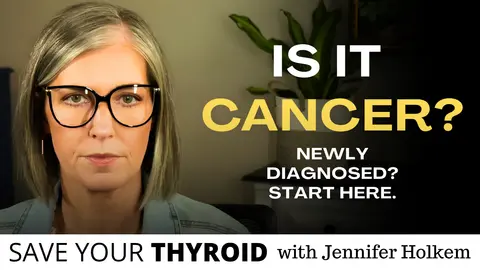
Just Diagnosed With a Thyroid Nodule? What They Don't Tell You on Day One
Save Your Thyroid with Jennifer Holkem · Episode 126
You were told you have a thyroid nodule. Maybe it was found during a routine physical, or on a scan for something else entirely. Now you're home with a referral, a radiology report you can't read, and no idea whether this is serious.
Nobody gave you the numbers. That's the gap this episode closes.
In Episode 126 of Save Your Thyroid with Jennifer Holkem, I'm going solo to walk through exactly what a thyroid nodule diagnosis means, what the odds actually are, and what your treatment options are — including the ones most patients are never told about.
🎧 In today's episode, we're covering:
- The odds nobody hands you — how likely it is that your nodule is benign, according to the American Thyroid Association.
- If it does turn out to be cancer — why papillary thyroid cancer is among the slowest-growing and most treatable that exists.
- The fact that nodules are so common — and why most people who have one never find out.
- What your ultrasound actually measures — risk features and TIRADS categories, not a diagnosis.
- The Bethesda system — what your biopsy result means and how reliable a benign result is.
- Treatment options beyond surgery — active surveillance, radiofrequency ablation, and microwave ablation.
- My own nodule story — the years I spent being told my only options were surgery or nothing.
The Numbers Nobody Gave Me
Here's the question everyone wants answered but is afraid to ask directly: is this going to kill me?
Somewhere between 90 and 95 out of every 100 thyroid nodules found are benign, according to the American Thyroid Association. That's not a hopeful guess — that's the statistical reality for the overwhelming majority of people receiving this diagnosis.
"Nobody in a white coat told me that most thyroid nodules are benign. That's information they should have had."
Takeaway: The most likely outcome, by an enormous margin, is that this is not a threat to your life.
And If It Is Cancer
For the smaller group where it does turn out to be malignant, the most common type by far is papillary thyroid cancer — one of the slowest-growing and most treatable cancers that exists. More than 95% of adults diagnosed are alive at the five-year mark, and that number climbs higher when it's caught while still confined to the thyroid.
"Some doctors will tell you that if you had to choose a cancer diagnosis, this is the one you'd want to pick."
Takeaway: This isn't about minimizing your diagnosis. It's that panic drives fast decisions, and this is a diagnosis that almost always gives you time to make a good one.
How Most Nodules Are Found
By some estimates, more than half of all adults would show a thyroid nodule on a high-resolution ultrasound — some estimates run as high as 80%. Most people never find out, because most nodules never cause symptoms.
That's why so many are discovered by accident: a routine physical, a CT scan for back pain, imaging after a car accident. An incidental finding, sometimes called an incidentaloma.
"It's one sentence buried in a radiology report that suddenly becomes the only sentence you can think about."
Takeaway: Having a nodule is common. Finding out you have one is mostly a matter of whether anyone happened to look.
Understanding Your Ultrasound and Biopsy
Your ultrasound isn't diagnosing cancer. It's assessing risk features — size, shape, borders, and calcifications — and sorting the nodule into a risk category, most commonly using the TIRADS system.
If the features and size warrant it, the next step is a fine needle aspiration biopsy. A pathologist reads the sample and assigns a Bethesda category, numbered one through six. Bethesda II is benign; Bethesda VI is diagnostic of malignancy. A benign result comes back in up to 80% of biopsies, and per the ATA, the chance that result is wrong is generally under 3% — lower still when reviewed by an experienced pathologist at a major medical center.
"That gap between getting the report and actually understanding it is where most of the anxiety lives."
Takeaway: Your report is a risk assessment, not a verdict — and a benign biopsy result is highly reliable.
Surgery Is Not Automatic
A thyroid nodule diagnosis, even certain cancer diagnoses, does not automatically mean surgery. It doesn't mean losing your thyroid, a scar, or a lifetime of hormone replacement.
Depending on size, Bethesda category, symptoms, and how the nodule is behaving, options can include active surveillance — regular ultrasounds and nothing else unless something changes — or minimally invasive treatments like radiofrequency ablation and microwave ablation, where a probe treats the nodule through the skin with no incision, on an outpatient basis, and you go home the same day.
These aren't fringe treatments. The American Thyroid Association has published formal guidance on safe performance and training standards for thyroid ablation, and there's a billing code for insurance.
"A thyroid nodule diagnosis does not automatically mean surgery."
Takeaway: Not everyone qualifies for every option, and your case is your case — but surgery is one option on a longer menu, not the default.
What Happened to Mine
My nodule didn't stay small. It grew through a pregnancy to roughly 4.5 by 7 centimeters. I had daily trouble breathing and swallowing, choked on food, couldn't lie flat at night, woke up choking, got dizzy turning my head, and was exhausted from what turned out to be hypoxia.
After an allergic reaction to antibiotics caused it to hemorrhage internally and nearly double overnight, I finally went looking for something other than "take it out or leave it alone." I found radiofrequency ablation, had the procedure, and went home the same day. Within a week I felt dramatically better. The nodule ultimately shrank by 90%, and my thyroid stayed intact.
"The procedure changed my life. It's the reason that I do this."
Takeaway: "Surgery or nothing" is a false binary — and it cost me years of quality of life before I found out.
Key Takeaways:
- 90 to 95 out of every 100 thyroid nodules are benign, per the American Thyroid Association.
- Papillary thyroid cancer, the most common type, has a five-year survival rate above 95% in adults.
- More than half of adults would show a nodule on high-resolution ultrasound; most never know.
- Your ultrasound assesses risk features and assigns a TIRADS category — it does not diagnose cancer.
- Up to 80% of biopsies return benign, with a false-negative rate generally under 3%.
- Treatment options can include active surveillance, radiofrequency ablation, and microwave ablation — surgery is not automatic.
- Thyroid ablation is recognized care with published ATA guidance on training and safety standards.
Find a physician near you:
🔗 saveyourthyroid.org/find-a-physician/ — specialists in 50+ countries
Join our patient community:
🔗 facebook.com/groups/saveyourthyroidnonsurgical
Book a patient navigation consult:
🔗 saveyourthyroidwithjen.com/patient-navigation-services
Disclaimer: None of the statements made in this or any other blog or video by "Its me Jen again" should be considered medical advice. Always consult with a qualified healthcare professional regarding your individual medical needs. — Jen
Sources:
- Large study confirms the 2015 ATA guidelines for classifying small thyroid nodules on ultrasound — Clinical Thyroidology for the Public, Dec 2017
- Clinical Thyroidology for the Public, December 2017 issue index
- Is it appropriate to refer to thyroid cancer as the "good cancer"?
- General Principles for the Safe Performance, Training, and Adoption of Ablation Techniques for Benign Thyroid Nodules: An ATA Statement — Thyroid 2023
- ATA press release: ablation techniques statement
- ATA ablation statement — free full text (PMC)
- Thyroid nodule — MedlinePlus Medical Encyclopedia
- Fine needle aspiration of the thyroid — MedlinePlus
- Thyroid ultrasound — MedlinePlus
- Thyroid cancer — MedlinePlus
When Ablation Isn't the Answer: A Surgeon Who Does Both Explains


 Goodpods