
 Amazon Music
 Apple Podcasts
 Audible
 Castbox
 Deezer
 iHeartRadio
 PocketCasts
 RSS Feed
 Spotify
 YouTube
 Youtube Music
  Goodpods
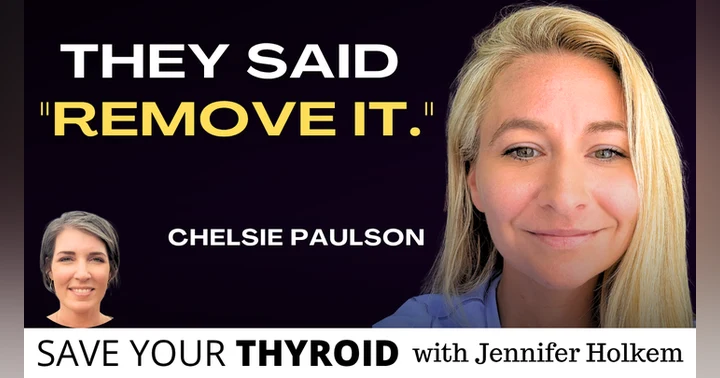
 Canceling Thyroid Surgery: Chelsie’s Journey with Indeterminate Nodules & Dr. Emad Kandil
Here's the episode summary for Episode 120:
For most thyroid patients, an indeterminate biopsy result with a 50% malignancy risk means one thing: surgery. Chelsie Paulson refused to accept that.
Chelsie had two solid thyroid nodules — one on each lobe — when her Afirma molecular testing came back with a 50% risk of malignancy and a suspicion for follicular thyroid cancer. Four ENTs told her the same thing: the protocol is clear, remove the thyroid.
Two nights before her scheduled thyroidectomy, at 2 a.m., she sent an email to Dr. Emad Kandil at Tulane University. She didn't expect much. Instead, Dr. Kandil called her personally the next morning and told her to cancel her surgery. She got on a plane that day.
Chelsie underwent Microwave Ablation on both nodules — combining MWA for the solid tissue with ethanol ablation for the fluid-filled spaces. She paired the procedure with an aggressive integrative health protocol to support her body's healing from the inside out.
The results: 59% reduction on the left nodule, 93% on the right. Her follow-up biopsy came back benign.
In this episode Chelsie shares every step of that journey — from panic attacks and a goiter diagnosis, to five surgical opinions, to a 2 a.m. email that changed everything.
In this episode:
What a 50% Afirma malignancy risk actually means
The 2 a.m. email and the personal phone call that changed everything
What Microwave Ablation feels like from the patient's perspective
Why ablation is not for everyone — and how to know if it's right for you
Chelsie's advice for every patient sitting with an indeterminate result
Procedure performed by: Dr. Emad Kandil, Tulane University, New Orleans
Navigating an Indeterminate Thyroid Nodule Diagnosis with Chelsie Paulson
What do you do when your thyroid biopsy results leave you with more questions than answers? In this episode of Save Your Thyroid, I am joined by Chelsie Paulson, a vocal advocate and active member of our patient community. After an Afirma molecular test came back with a 50/50 inconclusive result, Chelsie was told that removing her thyroid was her only option.
Instead of accepting lifelong thyroid hormone replacement, Chelsie took her health into her own hands. She shares her incredible journey of advocating for herself, canceling her surgery just days before, and traveling to New Orleans for Microwave Ablation with Dr. Emad Kandil. We also discuss how she integrated holistic lifestyle changes with a specialist in California to support her body's natural healing process, ultimately leading to massive nodule shrinkage and a benign pathology result!
If you are sitting in the waiting room of uncertainty with an indeterminate nodule, this episode is here to give you hope and remind you that you have choices.
Learn more about Dr. Emad Kandil and his practice:
🔗 https://kandilablationcenter.com/
⏱️ Episode Chapters:
0:00 - Welcome to Save Your Thyroid
02:05 - Discovering the Nodule: Symptoms & First Biopsy
07:27 - The 50/50 Afirma Result & The Push for Surgery
15:07 - A 2 AM Email: Finding Dr. Kandil & Canceling Surgery
19:19 - Experiencing Microwave Ablation in New Orleans
27:27 - Holistic Healing & Integrative Oncology in California
28:52 - Post-Procedure Nodule Shrinkage & Benign Results
38:59 - How Chelsie is Feeling Today
44:32 - Misconceptions About Ablation & Final Advice for Patients
Enjoyed this episode? Subscribe to Save Your Thyroid for more interviews with the world’s leading experts in thyroid-saving technology.
Resources:
👉 Podcast: https://www.saveyourthyroidwithjen.com/
👉 Patient site: https://www.saveyourthyroid.org/
👉 Private FB group: https://www.facebook.com/groups/saveyourthyroidnonsurgical
👉 Patient Navigation: https://www.saveyourthyroidwithjen.com/p/patient-navigation-services/
Support the channel:
PAYPAL👉 https://www.paypal.com/paypalme/itsmejenagain
VENMO👉 https://account.venmo.com/u/itsme_jenagain
Affiliate links:
🌿 TOUPS AND CO: https://toupsandco.com/jen
🎙️ RIVERSIDE: https://www.riverside.fm/?via=itsmejenagain
🧴 VAN MAN: https://vanman.shop/?ref=itsmejenagain
💡 BON CHARGE: https://us.boncharge.com/?rfsn=7843863.50b9fa&shpxid=4137e8a5-8199-46cb-b71c-0f86d29924ff
⚠️ Disclaimer:
This podcast is for informational purposes only and is not a substitute for professional medical advice. No endorsement is given or implied for any specific product, treatment, or physician mentioned. Always consult with a qualified healthcare professional regarding your individual medical needs.
Hosted on Acast. See acast.com/privacy for more information.
Its Me Jen Again (00:00)
Welcome back to Save Your Thyroid. I'm your host, Jennifer Holkem
might be new to the show, I founded this patient community and podcast after navigating my own journey with a large benign thyroid mass and undergoing RFA treatment This platform is dedicated entirely to patient advocacy and education. My goal is to help you become fully informed so you can make confident treatment decisions
for your own thyroid health. Today we have a very special episode featuring someone many of you might already recognize. Chelsie Paulson is a highly vocal and active member of our Save Your Thyroid patient community. And you might even remember her from when she bravely shared her story at the ThyCa conference last year. She's joining me today for a very specific reason, to pay it forward.
Navigating the world of indeterminate thyroid nodules can be incredibly frustrating and isolating and scary, especially when your test results leave you with more questions than answers. Chelsie experienced this firsthand when her initial Afirma testing came back with a 50-50 inconclusive result. Today, she is here to share her journey of seeking out ablation with Dr. Emad Kandil in New Orleans. Her experience with post-procedure testing
and exploration of holistic therapies in California and how she advocated for herself to finally get a definitive benign answer. Chelsie is here to give hope to anyone currently sitting in the waiting room of uncertainty. Chelsie, welcome to the show.
Chelsie Lee Paulson (01:36)
Thanks for having me on.
Its Me Jen Again (01:38)
going to.
talk about so many things today as we already have mentioned in the introduction. And I can't wait to get into all of it. You I remember the day you called me and told me that you got the benign result and you were just so excited and I was so happy for you. But let's go all the way back to the very beginning. Let's talk about how you even first discovered these thyroid nodules that you have and tell us if you had any symptoms.
Chelsie Lee Paulson (02:05)
Well, I would have told you at the time I didn't have any symptoms, but after post-mortem looking back on this, I had a lot of symptoms. I was two years out from having a baby and I wasn't losing any weight, even though I was working out and dieting like crazy and doing all the things you're supposed to do. I had super bad anxiety and hair loss.
Its Me Jen Again (02:15)
Mm-hmm.
Chelsie Lee Paulson (02:32)
Not significant hair loss, but enough hair loss to notice that my hair was a little bit thinner. But the real reason I actually went to the doctor was because my anxiety was so bad that I was having panic attacks. And so I went to go to my family doctor to finally get to the bottom of this per se. And she said, you have a goiter and I can feel nodules or I can feel something in your throat, which obviously sent my anxiety off even more as you can.
imagine, didn't even really know what the thyroid had done, didn't know what a goiter was. So that was the beginning of the thyroid information that I started to quickly research. I ended up having two nodules, two solid nodules, just under two centimeters and one on each lobe.
which was really unfortunate. One was 1.8 centimeters on the left and the right was around 1.7. So they're roughly the same size. The one on the left was a little bit more suspicious. I think the original TRADS rating was TR5 and the one on the right was a TR3, TR4 depending on the ultrasound tech.
Its Me Jen Again (03:44)
Mm-hmm.
Chelsie Lee Paulson (03:45)
So immediately after that, they sent me down to an endocrinologist and we did a fine needle biopsy and my experience was fine. They only ended up biopsying the left because I think actually the radiologist was like, I don't know, I don't really think this is cancer and I'm sitting here doing all these biopsies all day. And he could tell I was sweating the experience. I was really about.
I don't like needles. And so I, he just, I think he was kind of reading the room and was like, okay, let's get this, let's get this going. Let's just do the left side. That biopsy came back benign. That was actually in 2022. So my endocrinologist and my medical care team were like, you're good. Have a nice life. We'll just, we'll ultrasound this thing every year. That's actually what happened. But
Its Me Jen Again (04:39)
Mm-hmm.
Chelsie Lee Paulson (04:40)
some reason, I was very unsettled by this because I would randomly wake up in the middle of the night and just remember the ultrasound report that said it was highly suspicious in visual nature. And I knew enough about cancer that things can start to form. And so I thought maybe I should look into ablation. So that's...
Its Me Jen Again (04:55)
Mm-hmm.
Chelsie Lee Paulson (05:07)
That's kind of how I started looking into Ablation because I said, okay, well, if they're benign, there's this new thing called Ablation. But at the time in 2022, 2023, 2024, it took me like two years of really researching it, which is how I came across your community. I started to realize that
Its Me Jen Again (05:14)
Mm-hmm.
Chelsie Lee Paulson (05:29)
You know, this is something that I wanted to just take care of. I don't want this thing to get any bigger. I don't want to keep having to do ultrasound if I can take care of it when it's benign. Let's go for it.
so what I did was I got in touch with a doctor in North Carolina and found out that I think it was going to be over $10,000 at the time. I know insurance has worked in for some of these things. It was very new in 2022 and I was like,
And then there's actually a doctor in Australia and I have a connection with Australia and it was a lot more affordable. So I had connected with a doctor in Australia who offered ablation. I happened to be going over there and she said, okay, great, before we do this ablation, we just need another benign biopsy. I guess her protocol was two benign biopsies, even though my biopsy was benign the year before. And I...
I really did not want to get that biopsy. I think I kind of knew in my gut something was going to come up. And I got that result back. And the lab report said it was inconclusive. I think it said there were a lot of the cells were highly clustered together.
and it was flagged as indeterminate and things just moved fast after that. So this was now September, 2024. I started also seeing a functional medicine doctor who also at the same time flagged to me that even though I had a benign biopsy a year ago,
He also said to me that I officially had subclinical hypothyroidism. I had very high reverse T3. Even though my thyroid results were within normal lab range, they weren't optimal. And he was suggesting that that was actually contributing to quite a bit of symptoms. So I got this report back, and I'll read it off to you. It says,
Its Me Jen Again (07:15)
Mm-hmm.
Chelsie Lee Paulson (07:27)
for both of my nodules too, because I had the biopsy on each side, that the classifier was suspicious and I did not have an atlas expression. There was no variant or fusion detected. However, my risk of malignancy was 50%. And my endocrinologist at the time said,
that means they found something. The report's not revealing what they found, but they found something. And what made it a little bit more serious was the associated neoplasm type included follicular thyroid cancer, which is one that can spread to your bones. And no one really wants to touch that cancer because it sits outside of papillary thyroid cancer. So I'm sitting here going, I think I feel I'm very upset, but I'm also
Its Me Jen Again (08:05)
Yeah.
Mm-hmm.
right.
Chelsie Lee Paulson (08:20)
very vindicated because I kind of knew that from even though this first biopsy was benign, I kind of knew something was wrong and clearly something was flagged in this result. So that's how we got to the diagnosis, if we want to call it that.
Its Me Jen Again (08:28)
Okay.
Wow.
So the 50-50 result that you were just reading that was from the Afirma report? wow. So Afirma, for those of you who are watching who might not know what this is, Afirma is a type of molecular testing that when you have a biopsy result that comes back inconclusive, it can't really determine what it is. And I say it, I should say the person, the pathologist who's reviewing your pathology because all of these
Chelsie Lee Paulson (08:42)
Correct.
Its Me Jen Again (09:05)
tests now, biopsies are evaluated by a pathologist's eyes. And in the future, I think we'll have more uses of AI involved in that. But the pathology is inconclusive because they can't recognize what it is. And so at that point, that's when we rely on molecular testing to provide more clarity. unfortunately, and most of the time it does provide clarity.
And in your case, unfortunately, it didn't provide any because you were in this very narrow zone of it could be literally one thing or the opposite, you know, one direction or the other. I know that had to be incredibly scary for you and put even more uncertainty in your mind that even though you said you felt vindicated, you didn't know which way.
you know, which way to lean. And I remember having conversations with you back then where you just weren't sure which direction to go. So how did you end up eventually pursuing the path to ablation from that uncertain place that you were in?
Chelsie Lee Paulson (10:11)
Yeah, the other thing that I learned was I did a lot of deep research into Afirma I called Afirma myself. My endocrinologist called some of the medical doctors, medical directors at Afirma. What I also learned was that the test doesn't usually go up to 100%.
Its Me Jen Again (10:29)
Okay.
Chelsie Lee Paulson (10:30)
So even though they said it was a 50 % risk of malignancy, it could be 75%. So that also was quite terrifying to hear. Those are high numbers. So what happened after that was I think I was just put into the system, right? So I went to, I had a referral to a local ENT. The ENT basically just said, the protocol is when it's at this high percentage, we remove the thyroid.
And I said, well, what percentage is acceptable to live with? And she said, zero. We want 0 % chance of cancer. So if we see any risk of cancer, we want to remove it. And I think that, for me, was the turning point. That, for me, was the minute where I said, I reject this. And I need to be my own advocate and do my own research. And when I had mentioned ablation to her because I was pursuing that path before,
Its Me Jen Again (11:12)
Mm.
Mm-hmm.
Chelsie Lee Paulson (11:26)
You know, she said to me, I'm sorry, she didn't really know much about it. Now the Australian doctor I had been working with, she was excellent, but she just said, for me to be comfortable with doing an ablation, we want to see two benign biopsies. we, know, nothing, no harm there, we just kind of moved on. And she was also in Australia and I was in the US. So.
Its Me Jen Again (11:30)
Mm-hmm.
Mm-hmm.
Chelsie Lee Paulson (11:50)
Anyway, I said, okay, I'm going to get a second opinion. I found a doctor that was recommended by my endocrinologist and he has a lot of experience in this field. And he was also very understanding of my result. He's like, hmm.
This is a tricky one. It's a bit more gray. I don't know. So he was actually really willing to work with me on the recommendation. He said, well, we could just remove one side and see if that's cancer. We could remove the whole thing and we could go in and do both surgeries if the left side is cancer and we can go in the week after. We had this whole plan.
Its Me Jen Again (12:36)
Mm-hmm.
Chelsie Lee Paulson (12:38)
I think because I felt like he was giving me a little bit more choice and was open minded to my results and not putting me into a box, I thought, okay, I'm just going to proceed with surgery with him. But at this point, this was October and the surgery wasn't scheduled until December. So.
Its Me Jen Again (12:55)
Mm-hmm.
Chelsie Lee Paulson (12:57)
I had probably two more months to think about all of this. And I got a third opinion and I went up to a doctor in North Carolina and he had said to me that he would not mess around with this because of the follicular variant suspicion that it could spread through my body and that in two years time, we could be having a totally different conversation. And that
Its Me Jen Again (13:00)
Mm-hmm.
Mm-hmm.
Right.
Chelsie Lee Paulson (13:23)
felt like a kick in the stomach. I felt like I was starting to really question my own decisions and question everything. And that scared me.
Its Me Jen Again (13:35)
Mm-hmm.
Chelsie Lee Paulson (13:35)
So I did ask God to intervene and show me a sign that I was either meant to have the surgery or not have the surgery. And I had heard, you know, obviously I was reading tons of testimonials on the group.
I was also doing my own research. I was going into PubMed. This is also a little bit before AI too. So I was reading the whole articles and I was learning that in China and South Korea and in Europe, they actually were doing ablations on suspicious and low risk cancer nodules. But...
Its Me Jen Again (13:58)
Mm-hmm.
Chelsie Lee Paulson (14:15)
there really weren't anyone, I couldn't find anyone in the US who was really willing to take that risk at the time. And so anyway, I had kind of given up on ablation because I had three to four ENTs tell me, you need to have this thing cut out. Ablation is not something we mess with when it comes to cancer suspicion. And this is just what we're recommending.
So two nights before my planned surgery, I was begging God to show me a sign that I was not meant to have the surgery or that I was meant to have the surgery. I was actually hoping my five-year-old son would give me the stomach bug or something. I was like, if I get sick, I can't have the surgery, then it's not meant to be. And the thing that really shakes me to my core is
Its Me Jen Again (14:52)
Mm-hmm.
Right.
Chelsie Lee Paulson (15:07)
I was two nights, like I said before the surgery, I felt something tugging at my stomach. And I felt like I heard this voice in my head saying, email Dr. Kandil because I had heard of his name a bunch in the group. But I thought, that's a fifth opinion. Do I need a fifth opinion? Probably not. And at this point, you know, I stopped taking my supplements. I was doing surgery prep.
Its Me Jen Again (15:23)
Mm-hmm.
Yeah.
Chelsie Lee Paulson (15:36)
And at 2 a.m., I wrote him an email and said, this is my name. Here are my ultrasound reports. Here's my Afirma testing. What do you make of the situation? And do I qualify for ablation?
Obviously when you email a doctor's office, some receptionist calls you, they put you in the system, you get an appointment with the doctor. These things take a while. The next morning, I got a personal phone call from Dr. Kandil and he said, what are you doing? And he said, cancel your surgery.
Its Me Jen Again (16:08)
Yeah.
Yeah.
Chelsie Lee Paulson (16:19)
And I was tears because I said, God, show me a clear sign. And the doctor called me the next morning saying cancel your surgery. And he said, this is crazy. He said, I have done my own research and I know that heat and ablation and radiofrequency can kill cancer cells. And so,
Its Me Jen Again (16:20)
What?
Chelsie Lee Paulson (16:48)
I thought this is crazy. This is not happening to me. And I got on a plane the next day and flew because I was supposed to have surgery. I think this is a Monday. I was supposed to have surgery on a Wednesday. The next day, I talked to his nurse practitioner after I got off the phone call. She worked me into his schedule.
Its Me Jen Again (16:56)
Wow.
Chelsie Lee Paulson (17:10)
And I flew down there the next day and I think Wednesday or Thursday, I had an ultrasound. We wanted to make sure I didn't have any lymph node metastasis or any lymph node involvement. We needed to look at the size and I think we just concluded that this is us trying. know, we can have surgery if this doesn't work or,
Its Me Jen Again (17:34)
Bye.
Chelsie Lee Paulson (17:35)
And so that was, he was like, you're not doing nothing. You are doing a surgical intervention. It's just a very low risk surgical intervention, if that makes sense. So that's how I ended up with Dr. Kandil and ablation.
Its Me Jen Again (17:46)
Mm-hmm.
My goodness, I got chills when you said that about 2 a.m. writing the email because that is literally the same thing that happened to me when I was looking for RFA in 2019. I sent an email at like two or three in the morning and when my alarm went off the next morning at six o'clock to get my daughter ready for school, I already had a reply in my inbox. So it was the same kind of like
immediate response that, yeah, this is an actual possibility for you. And it's just so cool because I was in the same place as you. was begging God for an answer. I didn't know what to do besides surgery, but I felt in my gut that it was just not the right path for me. That's not to say that no one needs to have surgery, but there are some people out there who
the consequences of surgery could just be so dire. And I believe with all of my heart that finding ablation was a turning point in my life to improvement of my health. And I'm so grateful for that. my goodness. I love, I love, love, love hearing stories like that. So you, you fly down, you decide this is what you're going to do. And then you have the procedure on this trip.
Okay, and tell us about your procedure because you didn't have RFA, you actually had microwave ablation. Tell us about that.
Chelsie Lee Paulson (19:19)
Yes. So I think I was the one of the first hundred people in his practice to have microwave. And he said because of the cancer suspicion, he wanted to try that. And I was warned that it is a little bit more uncomfortable. But I also learned it was a lot quicker. And so I thought, all right, that I'm OK with that. And I was also at the time thinking of
Its Me Jen Again (19:26)
Mm-hmm.
Chelsie Lee Paulson (19:44)
well, a little bit of pain now is worth the long-term gain of still using my thyroid. And, know, Dr. Kandil, I will say he had validated a lot of things that I was seeing and researching. I actually joined a lot of Facebook groups of people who had their thyroid removed and was
Its Me Jen Again (19:49)
Yeah.
Mm-hmm.
Chelsie Lee Paulson (20:07)
all their stories and what they were going through and how your thyroid, a medication sometimes cannot mimic what your thyroid does in real life. And that your thyroid's constantly changing. It's talking to your pituitary gland. It's looking at threats. It's looking at weather and all of these different things. And it's adjusting your levels all the time based on what's going on in your world. And a pool is the same dose. And so I was really struggling with this idea of tinkering with my
Its Me Jen Again (20:32)
Yep.
Chelsie Lee Paulson (20:37)
my
hormones for the rest of my life with a synthetic pill. I think there's also some people who take Synthroid or take thyroid replacement medication and honestly, they're fine. for me, I wanted to avoid that and I had to actually do that.
Its Me Jen Again (20:48)
Right.
Right.
Some people don't
know well, mean, I think all people really don't know until they're in the position of I am now reliant fully on this medication for the rest of my life. They don't know until they're there whether or not they're going to tolerate it well or not. And that that's a point of no return at that point. Once you've had surgery and you're on that medication, there's no going back from that.
Unfortunately, there is a segment of people, I want to say up to 20 to 30 % of people who on thyroid hormone replacement never feel the same. Talk to any endocrinologist who manages a lot of patients after thyroid surgery and you will hear a lot of complaints about, just don't feel well. Then the thyroid Facebook groups, that is where it really gets real because you're reading stories of people who have
Chelsie Lee Paulson (21:33)
Right.
Its Me Jen Again (21:52)
had surgeries, many of the times unnecessary surgeries that could have been done through ablation or they were just rushed into surgery unnecessarily where they are now reliant forever on a drug and they don't feel the same. And I saw so many stories of regret. And so it's just wonderful that we don't have to do that. We don't have to that today. We have alternatives.
I apologize for the tangent, but I just wanted to get that in there because it's so vitally important that people understand that this is not a small thing to remove your thyroid gland. It is a very, very big deal. And if your doctor tells you it's no big deal, just take this little pill, you should probably run.
Chelsie Lee Paulson (22:37)
I think that the endocrinologist I was working with, even though he's told me that he thought I should have surgery, he was very hesitant. He was the one telling me, hold on, let's look into this. Let me call the medical director at a firm. Hold on, let me figure out what's going on here because I have heard that the endocrinologists have to clean up the mess. They're the ones having to medicate people and have to regulate these hormones and have to find...
Its Me Jen Again (22:47)
Mm.
Chelsie Lee Paulson (23:06)
out what works for them. And also it's hard because there are hundreds of different hormones in your body. How do you know if it's the thyroid that's causing you these problems? I already was prone to anxiety. So for me, I was like, ⁓ great, just another thing I'm going to have to figure out. I just didn't want to deal with that unless I absolutely had to.
Its Me Jen Again (23:15)
Right.
Yeah.
Chelsie Lee Paulson (23:29)
So yeah, after, so my procedure was very quick. I did take Valium because I was very, very anxious about having a probe in my neck. I did feel very, very relaxed.
I went in and there were actually doctors who were learning from Dr. Kandil and I loved that. I loved that there were seven doctors in the room while I was having this procedure. They were talking, he was saying exactly what he was doing the whole time. I did find it quite uncomfortable even though I was numbed. And I remember like, you know, there was like a period of like four to five seconds of bad pain.
And remember one of the doctors said, hang in there for a little bit. We're saving your thyroid. And that, still, I don't even know who that doctor was. I don't even think I looked him in the face. And then I got up, I put an ice pack on my neck, went home, went back to the hotel, took some pain medication, and I flew out the next day. And I was back at work, which was also really funny because I told everyone at work that,
I was going to have my thyroid removed and here I just have this tiny dot in my neck. Well, things changed over the last few weeks. I came across some new information which the information basically was I found a doctor who was doing their own research and also had traveled the world and had known that heat can take care of this problem.
Its Me Jen Again (24:42)
Mm-hmm.
I'm going back to
Chelsie Lee Paulson (25:02)
I also realized that I was focusing a little bit on the wrong thing. I just kept focusing on, I have cancer or not? What is this? Do I have cancer or not? And Dr. Candles' approach was, it's not if you have cancer, it's that he will take care of this, whether it's cancer or not, with your specific scenario. So for me, I felt...
Its Me Jen Again (25:13)
Mm-hmm.
Mm-hmm.
Chelsie Lee Paulson (25:29)
really good about my decision. And I didn't really have any problems afterwards. I did have a little bit of hair shedding, but my thyroid probably was just, like I said, it's naturally doing its thing. I have any swelling. I didn't have anything crazy happened. And yeah, that was what happened.
Its Me Jen Again (25:48)
Wow.
Wow, that's incredible. And so you have this procedure. And for those of you out there watching who don't understand the follow-up process, you have to go back every so often and have ultrasounds done. so tell us about when you went back and you had your follow-ups and how everything panned out after the procedure, because you're on this mountain top of, I've had the procedure, I've taken care of this, but then time passes and you have to find out, well,
how did it actually work out? So.
Chelsie Lee Paulson (26:22)
Yeah, so I did see a little bit of shrinkage at the three month mark and it was enough to give me hope because one of the things I had read in one of the PubMed
articles was that if you see fast shrinkage or shrinkage quickly, then you probably have more benign cells because cancer can be more stubborn. So I didn't see, I saw a lot of shrinkage on the right side, but I saw enough shrinkage on the left side to give me hope. And that's what we did.
When I was in the middle of doing all my research on ablation, I also started to say, is there anything I could be eating or is there a lifestyle change that I could make? I'm not going to go into the specifics of those, but I thought it would also be a good idea to supplement my treatment by going out to an integrative practitioner in California who does have an oncology kind of focus. And I wouldn't call her holistic, I'd call her integrative because she really does
mixed the best and I also did a test called an RGCC test which is you know they call it think they call it the Greek blood test and they take your blood and they look for circulating tumor cells in your body that came back
Its Me Jen Again (27:27)
Mm-hmm.
Mm-hmm.
Chelsie Lee Paulson (27:44)
Thank God, negative. So I was saying, doesn't, if cancer has left the station and is circulating in your body, this test would pick it up. If the cancer was still in situ, it might not pick it up. So that was a lot of reassurance. I had that done maybe the three fourth month mark after the ablation.
Its Me Jen Again (27:53)
Mm-hmm.
Chelsie Lee Paulson (28:09)
and I went on a protocol, an anti-inflammatory protocol. I had no grain, I had no sugar. I still didn't eat meat. I was basically cleansing my body and I was doing a lot to help support lymphatic drainage because your body's trying to get rid of those dead cells. So those were some of the things that I had done. I just basically went super clean.
Its Me Jen Again (28:28)
Mm-hmm.
Right.
Chelsie Lee Paulson (28:37)
I lost a ton of weight, but I think it was a natural weight that I think my body was holding on to. And what I realized was maybe six months post procedure, reverse T3 had gone all the way down. It was completely out of range. I also had a high thyroglobin metric, and that went down significantly because I didn't have all that excess tissue anymore.
Its Me Jen Again (28:52)
Mm-hmm.
Chelsie Lee Paulson (29:02)
And I also, all my thyroid numbers just were completely optimal. And so after doing the ablation and all of the cleansing, had, I did start to see the thyroid nodules shrinking. And where I landed as of, you know, this year was my left side has shrunk by 59 % and my right side has shrunk by 93%.
Its Me Jen Again (29:18)
Mm-hmm.
Chelsie Lee Paulson (29:30)
And I followed up with a different endocrinologist who is more in the functional space, but is also very, very aware of ablation and what it can do. I didn't want any judgment passed on me because at this point, all these doctors were telling me not to do ablation. So I, I connected with Dr. Henderson based out of Charleston, South Carolina. And we did.
She did all my follow-up ultrasounds and she also did my repeat biopsy and she said there's not really anything for me to biopsy on the right side, which was, I was crying, I was so joyful. And then the left side, she did the pathology, she sent it off and it came back benign, which was a complete 180 from what I was told. My story started out with,
Its Me Jen Again (30:20)
Mm-hmm.
Chelsie Lee Paulson (30:28)
is very, very likely it's cancer, but we're not really sure to, this could spread to your body, to scaring the crap out of me, to you have to take care of this now, to me doing my research, me finding a doctor who is willing to take the road less traveled, shall we say, and understanding the importance of this.
to having a benign biopsy. I mean, there's not that many cases with my specific criteria because there's not that many people who are really willing to take the chance, patient-wise and doctor-wise. So I think it's important to tell this story because, you know, it's not black and white medicine needs to be personalized. And that's where I've landed.
Its Me Jen Again (31:07)
Right.
Right.
Absolutely.
Wow, you completely came full circle. And it's just, it's absolutely so wonderful that you've shared this because as you said, there aren't that many people and I, I do these patient consults now. I started about a year ago, offering these one-on-one consults. Almost all of my patients that come to me for consultations on which direction do I go for treatment.
are patients with indeterminate thyroid nodules. This is a subset of patients who unfortunately are just kind of not really cleanly in one category or another. in a gray area and we really need more education on indeterminate nodules. I'm actually planning some podcasts on molecular testing because that's a wonderful thing to help a lot of these patients who are in the gray zone.
You know, we just we have a lot of uncertainty in the physician community about do we treat these like cancer? Do we ablate them if they're similar in size and features to cancer? Or do we treat them like benign? Like, how do we treat these? And the answer is we'll see as you know, time will tell and we learn more. But you're kind of a pioneer. And so is that your doctor in this area for treatment of.
of it with an ablative technique. So I think it's fabulous that you were able to come on here and share your story. So what do you think was the biggest needle mover in all of this? Because you've done the ablation and you've done the holistic part. Do you think that one moved the needle more than the other? Do you think that they work together in synergy?
Do you think that things would have been as good with the ablation had you not done the holistic part?
Chelsie Lee Paulson (33:17)
Well, I will say this. I did not find a lot of research out there to support that you can naturally shrink a solid nodule. That I think even in the holistic community was really hard to find. I mean, there were some people who said that it happened, but I couldn't find a lot of studies around what made it happen. So I do believe that
Its Me Jen Again (33:28)
Right.
Mm-hmm.
Chelsie Lee Paulson (33:45)
it would have been an uphill battle for me to have them shrink naturally. just don't think that I would have maybe have to live the cleanest, most purest life and prayed every single day for those things to shrink. So I do think that the microwave ablation did the lion's share, but I really do think that I can't, couldn't give it a split, but I think it did the lion's share. Cause I think it,
killed off whatever was there that was bad, I think it killed it off. And then I think putting my body...
into this really clean eating clean and I'm saying I really did everything. mean, I threw out all my pots and pans. I was looking at every product I put on my hair and my skin. I was cleaning up the air. I was breathing. I was doing mold testing. I was cleaning up my gut. So it wasn't just like didn't have sugar. I was really eating organic. I was filtering all my water. I was looking at my plastic intake.
Its Me Jen Again (34:40)
Right.
Chelsie Lee Paulson (34:47)
So I really think that helped accelerate the shrinkage and improve my lymphatic drainage. I think that those things supported my journey. I was on supplements as well, but I was only taking supplements for the deficiencies that I had. And yeah, so I think that they worked hand in hand. I think that the ablation got it going and then...
Its Me Jen Again (34:47)
Mm-hmm.
Mm-hmm.
Chelsie Lee Paulson (35:17)
think the supplemental, the holistic and the lifestyle change just accelerated it.
Its Me Jen Again (35:25)
I agree with your idea behind the lion's share being done by the ablative technology and then the rest really just enhanced by your lifestyle. And I think that it's important to let the viewers know that, you know, I get a lot of questions about lifestyle and diet and interventions that are within our power, right? Things that we can do with our habits.
and our diet and our supplements. And the fact is that, like you said, there's just not a lot of data on that right now. And I don't know that we will ever get that kind of data because that's almost impossible to really distill down into a research. I mean, think about how research is funded. Who's going to do the research on that?
And think about the fact that the etiology of these thyroid nodules could possibly be different for each individual person, based on your chemical exposures, your endocrine disruptors that are in your environment, the air you're breathing, the water you're drinking. Were you exposed to radioactive materials at some point in your life? And how much of it are you even aware of?
There's so many things we come into contact with that we're not even aware of. The thyroid is kind of a filter for all of that in our body. And so a lifetime of, up to the point when the nodules discovered, all of the time leading up to that was contributing to this development of these nodules. And so where do you go to really determine the cause?
there's just so many variables at play and there's just not really any way to definitively know. So I think until we have the ability to definitively know, there's not gonna be any consistent lifestyle intervention that we can point to that says, this is how you definitively shrink a solid thyroid nodule once it's discovered. I'm sure that there are things that we can do to prevent them from being there or at least to...
help them not become problematic and large. And we do hear anecdotes of people who, I had a thyroid nodule and then when I went back for my ultrasound, it was gone. And those are, I love to hear stories like that, but you just can't like literally genuinely apply that to every single person because it's just not always the same scenario with each person. So I wanna just make sure that point is understood.
Chelsie Lee Paulson (37:51)
Yeah, that's great.
Its Me Jen Again (38:07)
that the lifestyle stuff is very important. But when we're on a trajectory with thyroid nodules, when they're growing and when they're present, it's not usually common to see them be removed through natural means. So I'm again, not to beat a dead horse, but just so, so grateful that we do have interventions now that are minimally invasive, minimally harming to the thyroid gland, preserving
the majority of the thyroid gland and allowing us to do these things, take these things together, the intervention, the medical intervention with the holistic and lifestyle portion of it. So with all of that in mind, you've traveled this road. How are you feeling today? How has all of this culminated in how you're doing today?
Chelsie Lee Paulson (38:59)
It's funny that you asked because I just had all my thyroid numbers checked. Actually, I had a lot of things checked. Apparently, I'm doing great. I feel great. I feel healthy. I have my anxiety feels like it's in check and a manageable and it's a lot more manageable. My thyroid numbers are actually perfect.
Its Me Jen Again (39:05)
Mm-hmm.
Mm-hmm.
Nice.
Chelsie Lee Paulson (39:26)
I think that even though this was one of the scariest things that's ever happened to me, I think it's honestly the best thing that's ever happened to me because I feel awake.
I feel like I could have just gone to the doctor and I could have gotten non-anxiety medication, which I was on previously, by the way, and I didn't feel good on that. And I could have just had my thyroid out, but that wasn't really addressing the root problem. ⁓ And when I actually went out to California, my doctor was Dr. Keneally at Center for New Medicine Center for Healing.
Its Me Jen Again (39:50)
Mm-hmm.
Mm-hmm.
Chelsie Lee Paulson (40:07)
she told me that we really needed to treat the mind, body, and spirit. And there were some things that I needed to work on. Stress management was not something that I saw as part of healthcare. You know, it's, if your arm's broken, you put a cast on it, if, you know, but your brain needs to be healed. And I realized, you know, that I think that's...
Its Me Jen Again (40:11)
Mm-hmm.
Chelsie Lee Paulson (40:30)
like stress is highly connected to your thyroid. And she told me that these nodules are probably growing for years and that cancer takes 10 years to grow, whether mine was cancer or not is not the point. And so I think that once I realized that I need to keep an eye and check on all areas of my health, I think that I've felt more healthy than ever. And I
Its Me Jen Again (40:37)
Right.
Mm-hmm.
Chelsie Lee Paulson (40:57)
more awake than ever, if that makes sense. I feel like I've taken the red pill and I can't go back. I know too much. If I had to leave anyone with anything, it would really be to do your own research. And really, I think doctors are humans. Think about how much they have to do. They have to take care of patients.
Its Me Jen Again (41:04)
Yeah.
Chelsie Lee Paulson (41:18)
and then they've got to deal with admin. If they own their own practice, they're essentially running a business and worried about employees and salaries. And on top of it, the science is changing so much. I remember from the time I started doing research on ablation in 2023 to by the time I had the ablation in 2025, I remember a couple days or a couple months after I had the ablation,
Its Me Jen Again (41:31)
constant.
Chelsie Lee Paulson (41:45)
I saw that Mayo Clinic was doing a clinical trial on small papillary thyroid cancer and ablation. And I thought, I knew I was on to something. If Mayo Clinic is doing it, then that's showing that it's really serious and it's really promising. And even just seeing some of the list of doctors who now treat papillary thyroid cancer, the risk profile is opening up because we're realizing that
Its Me Jen Again (41:55)
Yeah.
Mm-hmm.
Chelsie Lee Paulson (42:15)
the external research from some of these other countries was actually correct. And so yeah, you have to be your own advocate. I hate that word, but it's true. have to your own research because different doctors have different priorities and they might have families, Like the body's changing so much. There's so much about the body that you have to know.
And then there's so much technology out there and there's so much medicine out there. It's hard to keep up with everything. So you have to find the doctors who are actually specializing in this and researching that specific track. I think that's really important. If I had something else happen to me, like I had a knee reconstruction, I would find a doctor who's doing advanced knee constructions and isn't just.
sticking the regular things in there, I would go find someone who's on the bleeding edge. That, I think, is extremely important.
Its Me Jen Again (43:12)
I 100 % agree. having the understanding that for physicians today to stay at the forefront of medicine is like trying to drink from a fire hose because the medicine advancements are changing so rapidly that it's just so much for them to have. I know I've seen this somewhere before and I can't recall where, but the amount of innovation, if you saw it on a graph,
you know, that's happening more and more and more every year. It's like nearly impossible for doctors to stay really at the front of it all because by the time they have adopted a new technology, there's 10 more, you know, waiting to be adopted. So it's just really, really important that if you're looking for someone who's doing these non-surgical techniques, that you are a part of this awareness and this community that we've seen growing over the last seven years now.
of physicians and patients who are at the forefront of understanding all of this and wanting to see it expand and wanting to see patients be able to find it more easily. And so that's the whole point of Save Your Thyroid. So as a member of our community, what would you think is most likely the biggest misconception that you see patients in our community struggling with?
Chelsie Lee Paulson (44:32)
I think that a lot of people have a very wide range of diagnosis and that ablation is not possibly the right call for some people. So I've seen people who have literally a goiter and just nodules that are completely benign and I've seen them say, my doctor told me to take this out, which is like, no, no, stop.
please go find an ablation doctor to people who have, I would say more advanced cancer who think this is right for them. So I think the misconception is that ablation is for everyone and it's not. I think it's for a particular type of patient. think that...
Its Me Jen Again (44:56)
Mm-hmm.
Mm-hmm.
Chelsie Lee Paulson (45:16)
It also comes down to the doctor and the latest research. I think you need to take the situation and apply personalized medicine to it rather than a playbook. And that I think is the biggest thing is like these situations where ablation applies, it's not a one size fits all solution.
Its Me Jen Again (45:37)
Totally agree, totally agree. It takes being an educated patient to really put yourself into this path, this treatment path. Because the traditional medical paradigm of you go to the doctor, the doctor sends you to the specialist, the specialist recommends the treatment, doesn't always fit here. Most of the time it doesn't. It can on occasion, but generally speaking, if you are someone
who is looking for or wanting to save your thyroid with any of these technologies that we talk about today, you're gonna have to insert yourself into that treatment path and into that paradigm. And that takes a lot of tenacity like you have to do the research. It takes the persistence to reach out to doctors. There may not be a doctor in your area.
If you are looking for doctor who uses any of these technologies to treat thyroid nodules without surgery, you can go to saverethorough.org, click at the top where it says find a physician, and there we have a list of all the physicians both in the US and abroad that we know of. There may be doctors that we don't know of yet who are not on those lists, but Chelsie was talking about the doctors that treat cancer on those lists have expanded.
we highlight those doctors in yellow because not every doctor who does ablative technologies will treat cancers. And as she said, it's not for everybody. are patients out there, you know, unfortunately I had one reach out to me recently who had thyroid cancer throughout her neck. She had lymph nodes throughout her neck that were positive for cancer. And that's not a situation where ablation will be appropriate. But for the people that it is appropriate for,
this is a game changer because we have the ability to save the thyroid gland to eliminate the need for lifelong thyroid hormone replacement and all of the consequences that come as a result of non-optimal thyroid hormone function. So Chelsie, it's been wonderful hearing your story and talking through all of this. Do you have any final thoughts for anyone who's in your shoes with an indeterminate?
biopsy result and they don't know what to do, what is one piece of advice that you would give to them?
Chelsie Lee Paulson (47:57)
be tenacious. I think that going into a doctor's office is a very vulnerable experience. And you're very emotional about what information you have. And try not to let the emotion override the rational side of your brain. And do your own research because going in there and going against the grain is not my natural
tendency and I'm not a very rebellious person and so having all these doctors tell me I had to do something and me not doing what they said was actually very difficult for me but I knew, I knew in my gut, I knew that either
Its Me Jen Again (48:38)
Yeah.
Chelsie Lee Paulson (48:45)
Maybe they didn't know what I knew or they haven't read what I had read. And that didn't make them bad people. just made them, you know, they were maybe specialized in surgery or something. And I think that you just have to be very, I think you have to have a lot of courage. I remember Dr. Candles, nurse practitioner who booked me in that week and it was all crazy. She said to me when we were,
when she was doing she was in there doing the ultrasound on my neck with Dr. Candel she said you're very brave you're very brave to have cancelled your surgery which was supposed to be that day you're very brave to have come down here and do this protocol and I don't think she means brave as in you're taking a risk meaning brave you are fighting against the system and you are taking the road less traveled because you feel conviction
and I felt the Lord calling me to do this. I really do.
Its Me Jen Again (49:42)
Well, I appreciate you being so transparent about your faith and your dependence on God for direction in your treatment journey. I always tell patients when they ask me, know, what should I do? I always tell them I'm praying for you because that's so important that we remember that ultimately it's all up to him, right? Where we go and how this all works out. It's he already knows the end answer. So
Thank you so much for joining me today, Chelsie. For anyone watching, don't forget that our community, Save Your Thyroid, is here for you if you want to be a part of this different paradigm. We are here and we've got resources to help you. So thanks for joining me today.
Chelsie Lee Paulson (50:26)
Thanks for having me on and thank you for everything you're doing for the community.
Its Me Jen Again (50:30)
That wraps up today's episode. If you found this valuable, please like, subscribe, and share it with someone who might benefit.
you can find links to everything we discussed in the show notes below. Find a physician, discover treatment options, and join our patient community at saveyourthyroid.org. To stay up to date on new episodes, resources, and expert insights, be sure to subscribe to my mailing list at saviourthyroidwithjen.com. It's the best way to stay connected and informed. There you can also find all podcast episodes,
and book a one-hour patient navigation consult for personalized guidance on your next steps. As always, please remember this podcast is for informational purposes only and is not a substitute for professional medical advice. No endorsement is given or implied for any specific product, treatment, or physician mentioned. As always, consult with a qualified healthcare professional for your individual needs. Thanks for listening and I'll see you next time.