
 Amazon Music
 Apple Podcasts
 Audible
 Castbox
 Deezer
 iHeartRadio
 PocketCasts
 RSS Feed
 Spotify
 YouTube
 Youtube Music
  Goodpods
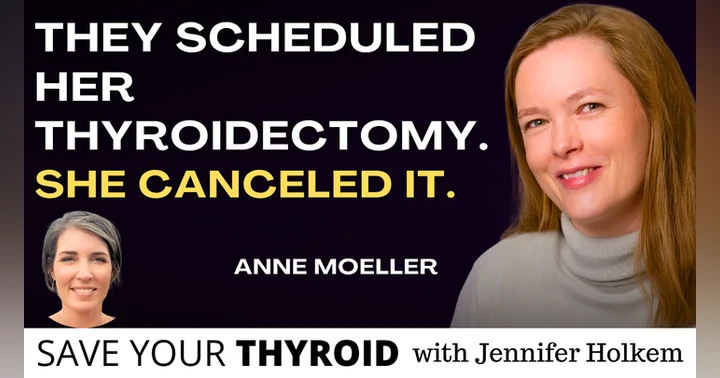
 How Thyroid Artery Embolization (TAE) Saved Anne’s Thyroid from a Total Thyroidectomy
Anne Moeller had a multinodular goiter the size of a grapefruit that had grown significantly after two pregnancies, causing a severely deviated trachea and increasing pressure on her airway. With a thyroidectomy already scheduled, she stumbled across information about non-surgical thyroid treatments just weeks before her surgery date — and everything changed.
In this episode, Anne shares how she went from knowing nothing about alternatives to surgery, to becoming her own most informed advocate. She walks us through her research process, how she found the Save Your Thyroid community, and why she ultimately chose thyroid artery embolization (TAE) with Dr. Juan Camacho over surgery.
Anne also opens up about what the procedure was actually like as a patient, her gradual recovery, and how her thyroid function has remained stable throughout. As someone based in the UK navigating a healthcare system where TAE is only just emerging, her story offers a unique international perspective on what it takes to access cutting-edge thyroid care.
If you've been told your goiter is too large to treat without surgery, this episode is for you.
Can You Shrink a Massive Goiter Without Surgery? Anne’s TAE Success Story
Can a grapefruit-sized goiter be treated without a total thyroidectomy? In this episode of Save Your Thyroid, Jennifer Holkem sits down with Anne Moeller to discuss her transformative journey undergoing Thyroid Artery Embolization (TAE). After being told her large multinodular goiter required major surgery, Anne advocated for an organ-preserving alternative that changed everything.
If you’ve been told your goiter is "too big" for RFA or that surgery is your only option, this episode is for you.
In This Episode, We Cover:
-The "Grapefruit" Goiter: Anne describes the physical pressure, breathing difficulties, and cosmetic concerns of living with a large cervical goiter.
-Canceling the Surgery: Why Anne walked away from a scheduled thyroidectomy to pursue a non-surgical path.
-The Power of TAE: How Thyroid Artery Embolization works to "starve" nodules and shrink massive growths without a neck incision.
-Patient Advocacy: How Anne navigated the UK and US medical systems to find Dr. Juan Camacho.
-Life After TAE: The recovery process and the emotional impact of preserving her thyroid function.
Resources Mentioned:
-Dr. Juan Camacho Interview: https://www.youtube.com/watch?v=xqKPESXhEkM
Timestamps:
0:00 - Introduction: Meet Anne Moeller
03:15 - Growing a massive goiter: The physical & emotional toll
08:45 - The "Surgery Only" ultimatum from doctors
12:30 - Discovering TAE: Finding an organ-preserving alternative
18:50 - Meeting Dr. Juan Camacho & Canceling the Thyroidectomy
25:10 - The TAE Procedure: What does it actually feel like?
32:45 - Recovery & Results: Breathing easier and visible shrinking
41:00 - Jennifer’s Final Thoughts: Why your thyroid is worth saving
Support the channel:
PAYPAL👉https://www.paypal.com/paypalme/itsmejenagain
VENMO👉https://account.venmo.com/u/itsme_jenagain
Affiliate links:
TOUPS AND CO👉https://toupsandco.com/jen
RIVERSIDE👉https://www.riverside.fm/?via=itsmejenagain
Hosted on Acast. See acast.com/privacy for more information.
Its Me Jen Again (00:00)
You're listening to Save Your Thyroid with Jennifer Holkem, your resource for the latest in thyroid preserving non-surgical treatments. My goal is to give you the clarity and confidence you need to make the best decisions for your health. On today's episode, we are continuing our deep dive into thyroid artery embolization or TAE. While we often talk about small nodules,
Today, we're looking at how this innovative non-surgical method can tackle very large cervical goiters that could cause significant physical and emotional distress. Our guest, Anne, is here to share her incredible perspective. Anne was facing a massive goiter that created intense pressure-related symptoms and understandable cosmetic concerns. Like many of you, she wanted to avoid the risks of major surgery and keep her thyroid intact.
Before we jump in, please hit that subscribe button and leave a review to help us grow this community of empowered patients. If you're looking for the technical breakdown of how this procedure works, don't forget to check out my previous interviews with Dr. Juan Camacho linked in the show notes. Today, however, is all about Anne's story from the moment she realized surgery wasn't her only option to the transformative results that she's experiencing today. Let's get started.
and welcome to the show.
Anne Moeller (01:28)
Thank you, Jennifer. It's my
Its Me Jen Again (01:29)
take us back to the very beginning when you first realized that your goiter was becoming a significant issue.
I'm going to share those photos that you sent me on the screen so everyone can see just how much of an issue this was for you. Was it the physical pressure or the cosmetic changes that first kind of clued you in?
Anne Moeller (01:48)
Yes. So I've had a multinodular thyroid goiter for a long time. And actually most of the time the issue has been entirely cosmetic. I think it was back in 2018 that it started to become noticeable on my neck. But for a long time it wasn't that bothersome, but then it became very bothersome after I had two pregnancies in 2020 and 2022, because during my pregnancies and after pregnancies.
Its Me Jen Again (02:03)
Mm-hmm.
Anne Moeller (02:16)
my thyroid grew significantly. So I ended up having after my second pregnancy in 2022, I ended up having basically a thyroid that had grown to the size of a grapefruit and it was sitting right here at the front of my neck. So it was hugely bothersome, but from a cosmetic perspective, because for long time I didn't actually have any other symptoms apart from just being really bothered by the way that I looked.
Its Me Jen Again (02:19)
Yeah.
Anne Moeller (02:41)
At that point in time, I didn't know that I had any options except a full thyroidectomy. So, and I just was not really ready to go down that route.
Its Me Jen Again (02:44)
and
Anne Moeller (02:51)
So I just, you know, covered up my thyroid, my neck with the big scarves and just continued to hope that I could kind of continue like this without having to.
to face surgery, at least not before my kids were older. But I also knew that when seeing scans of my neck, that my trachea, because my thyroid was so large and it was specifically large in the right side.
So I knew that my trachea was very, very deviated to the left and also it was very compressed. So was very clear to me that, you know, it was just a matter of time before I would be experiencing issues.
Its Me Jen Again (03:25)
Hmm.
you know,
having that deviated trachea is something that can be quite, quite distressing once it starts to really become compressed. Did you have symptoms of compression that were becoming apparent as it grew larger?
Anne Moeller (03:46)
Yes. So that started to happen towards the end of 2024. So then I really started to experience issues around breathing. So then it was no longer just a question about cosmetic problems. And at that point in time, it became quite clear to me that, know what, can't continue to live with this massive, massive thyroid goiter and I need to go down the road of treatment.
Its Me Jen Again (03:57)
Hmm.
yeah, I remember feeling very similar to you in my journey as well. In the beginning, it was just this thing I didn't like to see in the mirror. I didn't like to see it when I took photographs with my children or my husband. I deleted so many of those photos from back when I was early on in my diagnosis. But over time, as you were saying, that increase in the swallowing and the breathing difficulties,
it becomes apparent and your body will adapt somewhat over a very gradual period, but it does become apparent eventually. And you mentioned also pregnancy. And this is something I'd just like to touch on briefly because this does also happen not only to me, but it happens to a lot of women. And what we've learned is that it can be related to the hormone changes that we experience during pregnancy. And so
women who have thyroid nodules often complain about, know, my goiter's getting larger. so that's something that obviously in most cases when they're benign doesn't have to be addressed. It's not dangerous or posing any kind of risk during the pregnancy. But it's important to keep an eye on it because as you and I both experienced, there's growth happening. So.
you didn't know about anything besides surgery at this point, how did you find out about alternatives to surgery for thyroid nodules?
Anne Moeller (05:37)
I've been seeing lots of thyroid specialists over the years and I have never heard anybody mention anything about any alternative to surgery. So I was completely certain that thyroid surgery was my only option. And I, be honest, I didn't even question it. So, you know, once I started to experience these problems towards the end of 2024 and I...
kind of became clear to me that I needed to address it now that I also had the breathing issues. I went ahead and booked a thyroidectomy because I thought that's what I had to do. And so it was a complete coincidence that I came across these alternatives to a thyroidectomy. And you know, I'm just so grateful that that coincidence happened because it's really made a massive
difference to how my life is today compared to how it would have been if I had went ahead and got surgery. So I booked the surgery. It was scheduled to happen at the end of April last year. And then one day, one evening, I think in early April, you know, I had a bit of time to myself.
So after the kids were in bed, and usually I don't really have much time to myself because usually I work in evenings, but this particular evening I just had a little bit of time. And so I thought to myself, you know what, I actually, I think I need to prepare myself a bit more for what life after a thyroidectomy is going to be like. Because I'm not sure I really fully know what to expect. And so I went online and I started reading.
Its Me Jen Again (07:06)
I did that too.
Mm-hmm.
Anne Moeller (07:14)
about life after a thyroidectomy. So that was basically what I was looking around for. And I'm in London in the UK. So one of the websites that I found that had a lot of information was the British Thyroid Foundation. I was reading a lot of things on their website and then I came across like a tiny, tiny, tiny section about less invasive thyroid treatments. And so they had a story about
a hospital in London that had just done the first microwave ablation. And there was also a small mention of RFA, but very little information, that obviously that caught my attention. So I was like, okay, I need to, what is this? What is this? I need to, ⁓ to learn more. So I went online and started instead of reading about life after a thyroidectomy, I started reading about less invasive thyroid procedures. And so I.
came across obviously RFA and microwave ablation, but then also came across thyroid artery embolization And so the more I read, the more I kind of, it dawned on me that, know what, there is actually alternatives out there and this might actually be very applicable for my case. So I spent the next few weeks just really intensively researching all these options.
and really understanding what was available out there and what could apply to my case. quite quickly, was quite, quite quickly was obvious that, you know, all the ablation techniques, it didn't work for me because my thyroid was like massive, but thyroid artery embolization was still there. So, you know, I spent a lot of time reading online. I found the Save Your Thyroid YouTube channel, watched a lot of videos, was very, very informative, was fantastic.
I went to, I also found the Facebook page. I reached out to lots of patients on the Facebook page. And there was a lot of people who were actually really willing to share openly their experiences. was, I found a number of people who had been through TAE and kind of helped me understand what it was all about. I scheduled.
Its Me Jen Again (09:17)
Did you by chance talk
to, I'm sorry, I just had to ask this because you're in the UK. Did you by chance talk to Kathy the patient that I interviewed previously? Yeah.
Anne Moeller (09:25)
Of course I did. Yes, of course I did. And
She was again, fantastic offering me so many perspectives.
Its Me Jen Again (09:31)
She's very passionate about saving the thyroid.
Anne Moeller (09:34)
Exactly. also,
she also been seeing the same doctors that I have in London. So there was a lot of like commonality there. So it was the same problem, same doctors, same messages. So that was really nice to talk to her. But yeah, and also, I I scheduled a lot of consultations with both doctors in the US and also doctors in Turkey, because that's where I could find this treatment being accessible.
So really just spend like two, three weeks just really educating myself on less invasive procedures and in particular thyroid embolization. And it just became clear to me that that's what I needed to try. And so I canceled my surgery and then haven't looked back since.
Its Me Jen Again (10:19)
Wow, what an amazing story. And how did you settle on coming to the States to see Dr. Camacho?
Anne Moeller (10:28)
So, you know, I think end of the day, it's a bit of a subjective decision, right? So I spend a lot of time talking to a lot of different providers and I just really like Dr. Camacho. So I thought he was really, really good at explaining everything to me. He was always very responsive. I had a lot of questions. He answered all the questions really well. So I felt really comfortable with him.
And I'm also very fortunate. even though I'm in the UK, actually have through my work, I have health insurance coverage in the US. yes, so it's very, it's very unusual and I'm very privileged to have that. So I was sort of, so that was one reason why it made sense for me to come to the US because I actually have very good health insurance there. So then it was, so it was more a matter of figuring out where in the US to go. And then I landed on Dr. Camacho.
Its Me Jen Again (10:59)
wow.
Wow, what an incredible story. And I wanted to go back and just ask a couple questions about your surgery consult that you had, because you said that you booked the surgery and you thought that was just the way it was gonna have to be. Had any of the surgical consults included a discussion about any part of your goiter that was going down below your collarbone and into the chest and it being a further invasive surgery than a typical thyroidectomy?
Anne Moeller (11:47)
No, so my goiter was very much just here on the neck above the collarbone. There was like a tiny, tiny amount below the collarbone. But so from the surgical perspective, it wasn't such a problematic surgery.
Its Me Jen Again (11:50)
Mm-hmm.
Then why were you persuaded to change your mind from surgery to a minimally invasive approach?
Anne Moeller (12:09)
Well, I think I was really hesitant and very concerned about going down the road of surgery. And it wasn't so much about the procedure itself, because I think the procedure itself, I was seeing a very high volume surgeon here in London and he had explained the procedure really well. I was very clear on risks and mitigants and I thought that was quite well managed, but I was more concerned about what would happen afterwards when I didn't have the thyroid any longer. So I know lots of people.
And the majority, thankfully, the majority of people do well on thyroid medication afterwards. But what if you're one of the unlucky ones who don't? And also I was in, like, I was already juggling two small kids at home, busy job. I just felt like adding at that point in my life, adding the thyroidectomy into the mix. was just too overwhelming, too much to handle. It's a long recovery period, right? Your body needs to adjust.
Its Me Jen Again (12:46)
Yeah.
I can relate to that.
Anne Moeller (13:05)
How do you do that at the same time as having two small kids? So I was kind of, I had accepted that that was what I needed eventually, but I was just hoping that I could wait a bit until my kids were a bit bigger so that I had more time to really, more time and energy to focus on myself and my recovery. In my case, also for the surgery, I was told that it wasn't just one surgery. So I would have the surgery to remove the thyroid, but I also needed an extra surgery.
Its Me Jen Again (13:24)
Yeah, I can-
Anne Moeller (13:34)
because I would have excess skin on my neck. So the thyroid surgery told because my thyroid was so large, the skin on my neck was so stretched that once it took the thyroid out, the skin would actually not recover.
Its Me Jen Again (13:38)
wow.
Wow, that's the first time I've heard that from a patient. That is incredible.
Anne Moeller (13:49)
So that was.
Yeah, so that was it. It just felt like such a big undertaking that I was just not ready at that point to pursue it.
Its Me Jen Again (13:58)
Mm-hmm.
Wow. Yeah, I can totally relate to your experience of feeling like I don't have time to take care of this right now because I have young children and they're my priority. And I think that a lot of women can relate to that as well because the vast majority of women that we see in the Save Your Thyroid patient community are women who are in their childbearing years, in their 30s and 40s. We do have quite a few women above that age bracket, but
Anne Moeller (14:26)
Thank
Its Me Jen Again (14:31)
You know, I don't know as many of them maybe are on social media, but this impacts a lot of women in our demographic. And, you know, that's a difficult thing to juggle your family and your life and recovering from a major surgery and getting yourself adapted to a new source of thyroid hormone, which, as you said, not everyone does well. Some people do. A lot of people do.
but a lot of people also don't and there is no way of knowing until it's too late and there's no going back. And so that's why it's so wonderful to have an option that allows you to not burn the bridge of surgery. You can still have surgery if you end up needing surgery, but to address the shrinking of this massive goiter and preserve the gland and its function and avoid all of that downtime and all of the consequences that come with surgery.
Anne Moeller (15:02)
Exactly. Yeah.
Its Me Jen Again (15:26)
Let's talk about the actual TAE procedure, which is something that a lot of people are still kind of in this community, not really grasping exactly because it's so different from all of the other techniques. know, alcohol ablation is very simple to understand. They're injecting literally alcohol into a cyst and that's causing it to shrink. And then with the other techniques, you're essentially putting a probe into that nodule and treating it.
Anne Moeller (15:40)
Sure.
Its Me Jen Again (15:55)
⁓ with heat or cold or electricity. But with this procedure, we're not putting a probe into the neck. We're actually putting a catheter into an artery that supplies the thyroid gland with blood, which is its life force. so did you have any fears or concerns about going into a procedure that was essentially going to starve your thyroid of its blood supply?
Anne Moeller (16:23)
So I think the fact that the procedure would stop the blood supply, I thought I wasn't so concerned about that because I felt like that had been explained really well by the various doctors that I had talked to. I think the one thing that I was quite concerned about, and I think that's probably the case for anyone who goes into having the embolization procedure done on the thyroid, is the risk of non-target embolization.
So basically non-target embolization means that the particles that they use to close your blood vessels to your thyroid, they go the wrong place in your body. And because the thyroid is so close to your brain, there is a risk that these particles could go to your brain and cause a stroke. And so that's quite a scary thought that that could potentially happen. So I did spend a lot of time discussing this with Dr. Camacho
just so I wanted to be really 100 % sure that I fully understand what the risks were and what potentially could happen and what he was doing to try to mitigate those risks. So I had a really good understanding of the risks and decided that I was willing to take that risk. But it is a scary thought that that could potentially happen.
Its Me Jen Again (17:24)
Mm-hmm.
It is.
It is. mean, no one wants to consider, you know, the possibility of having a stroke. And I definitely think if I were in your shoes, I would be concerned about that as well. That was one of the main focuses of my conversation with Dr. Camacho when we did our podcast interview recently. And he talked about the percentages of risk of stroke being as high as 10 percent in older
Anne Moeller (17:47)
now.
Its Me Jen Again (18:06)
cases that have been done. And as they've refined the technique and they've improved it with different types of catheters, they've been able to bring that risk down significantly. And then most recently, Dr. Camacho published a paper about the results that they've seen with embolizations of the thyroid and they had a hundred patients that were treated and zero neurovascular complications. And I thought that was incredible. So,
So yes, it is a risk that can happen potentially, but it is very minimal risk. And obviously you felt like you were prepared and that it was worthwhile to pursue this even in of that. So can you walk us through the procedure day itself? I know from our discussion that you did not actually have the radial access for your procedure, which is more often what Dr. Camacho does.
Anne Moeller (18:58)
So I actually had the procedure done twice. So I had the procedure the first time I had the two inferior thyroid arteries embolized. So that's Dr. Camacho's procedure where he goes through the wrists. And the second time I had the superior and inferior thyroid embolized on my right side. And in order to access the superior thyroid artery, he needs to go through the groin. So I've experienced the procedure both with
Its Me Jen Again (19:01)
Mm-hmm.
Mm-hmm.
Anne Moeller (19:26)
access for the wrist and access for the groin. And even though the procedure was different because the access sites were different, the experience for me as a patient was quite similar in both cases. So how does the procedure work? Obviously it's a procedure under sedation. So you have to stop eating and drinking at midnight before the day of the procedure. And then you come in in the morning.
The nurses prepare you for the procedure. So what does that preparation involves? It involves you have blood taken. If you are a woman below a certain age, you need to have a urine sample because they need to make sure that you're not pregnant. I think that's quite standard whenever you're having any medical procedure. And you get an IV into your arm. And also in both cases, even when I have the wrist access, they also prepare your groin area.
Just because I think that sometimes even though they want to go through the wrist, they can't, and then they have to kind of resort to the groin. So they always want the groin area to be ready. And this may be a bit too much information, but just the preparation of the groin area, that's sort of a small intimate shave. So that's really the preparation that happens. And obviously you talk to the doctor beforehand. He explains the procedure. You can ask any questions.
Its Me Jen Again (20:28)
That makes sense.
Anne Moeller (20:47)
And then once everybody's ready, you're up to the operating room. And so you come to the operating room. It's quite a standard operating room. There's a table in the middle. You lie on the table. I think the only thing that is different, if you've ever seen an operating room before, is all the screens that are in the room, because it's obviously an image-guided procedure. So it looks a bit different than what you would typically expect an operating room to look like.
But apart from that, so you lie on the table and then you get a very, very strong medication. So basically the sedation. So you are very heavily medicated during the procedure, but you are awake. So I understand. I believe that you are actually awake and communicating with them, but you really don't know what's going on because it's all a blur. So I can sort of remember bits and pieces of what happened, but all in all, it's a blur.
Its Me Jen Again (21:31)
in
Anne Moeller (21:41)
And I don't know if I fell asleep, but I think I was awake for the full procedure. But it's a very, very quick procedure. So I think Dr. Camacho said the procedure itself is only about 10 minutes, so it's super quick.
Its Me Jen Again (21:55)
I didn't realize it was that quick.
Anne Moeller (21:55)
And
no, it is. And what takes time is just all the preparation before and after, but the procedure itself is really, really quick. there was absolutely both times when I had the procedure done, I didn't have any discomfort at all. So from the patient perspective, it's actually, I was surprised how easy it was to get the procedure done.
Its Me Jen Again (22:15)
Wow, that's wonderful that you didn't have any pain. What about afterwards? you have to tell us about the recovery process when you were in the hospital?
Anne Moeller (22:15)
And yeah, no pain at all.
Yeah. So once
the procedure is done, you come back into the recovery room. And when you have had the access through the groin, you basically, I had to lie flat, completely flat for about two hours. And then after those two hours, I was, I could get up and, ⁓ you know, eat and drink when the wrist access. I basically, as soon as I was back in the recovery room and they had checked that I was okay, I could move around, go to the toilet.
have something to eat, have something to drink. When you have had the access through the wrists, they put on this inflatable wristbands around your wrists to keep pressure on the incision site And so what happens is basically every half hour, the nurse will take a little bit of air out of the wristband just to make sure that bleeding is controlled. And then once the air is completely out, you're basically free to leave.
Its Me Jen Again (23:14)
interesting.
Okay. Wow.
Anne Moeller (23:19)
So
it's about, I think I spent about, in both times, I spent about half a day in the hospital and that was it.
Its Me Jen Again (23:25)
Okay, well it's not an immediate reduction in size with the nodule, so how long did you wait before you saw those initial signs that something's changing in there with that thyroid?
Anne Moeller (23:38)
So I think for me, it was a very, very gradual process. of the other patients I spoke to, their experience was that it happened much more quicker. me, that was definitely not the case. It was very, very gradual. So I think in terms of like the pressure, breathing, improving.
that just kind of just improved gradually. So there wasn't, can really, I couldn't really say after a week I could breathe again. It was just very gradually improving. In terms of the cosmetic side, I think by three months I could kind of, I could see the lump that I had on the neck being smaller, but it was still very lumpy. And then by sort of four five months I could see it has started to flatten. And then obviously when I was five months,
first the first procedure I had the same procedure done. And that's now a month ago. But to be honest, I don't think I can see much difference now between five and six months. So I hope still, I still have a bit of a lump here, which I obviously hope that the second procedure will resolve more, more shrinkage in this lump will flatten more.
Its Me Jen Again (24:48)
Yeah, I think that you're definitely still several months from seeing the full realization of this procedure. I interviewed a patient a couple of years ago, about a month after her procedure. And she's like, I can't really tell a difference yet. But then about three months later, Dr. Camacho reached out to me and he showed me the before and after images on her CT scan. It was unreal the difference in how
far her gland had, you it was way down in her chest and had pulled up and shrunk down. And I could see when you look at a CT scan of a person's body, you know, it's it's taking slices, right? So you can see it's like starting at the top of the head and it's working its way down slice by slice. And when it gets to here, you can see the trachea and it's this black circle, or at least it's supposed to be right.
Anne Moeller (25:40)
Hell yeah.
Its Me Jen Again (25:41)
But on those
of us who have compression from one side, sometimes it looks kind of like a kidney bean. And hers not only looked like a kidney bean, but it was pushed way, way over to the side, which I imagine yours was as you were describing it. And so you could see a huge difference. It had moved back towards the center. It had rounded out and wasn't compressed any longer.
Anne Moeller (25:53)
very similar, yes.
Its Me Jen Again (26:03)
So we talked about avoiding surgery and preserving the thyroid gland because of the vital importance of the gland.
How have your thyroid labs been since having this procedure? Have you noticed any changes in your labs or has everything stayed pretty stable?
Anne Moeller (26:18)
So very stable. I've always had a state like a normal thyroid function. Even when I had this huge, huge goiter, my thyroid numbers were normal and they are still normal. Obviously now, right now, at this point in time, just because it's only a month ago that I had the second procedure done, they're a bit funny, but I would definitely anticipate that to normalize again. And to be honest, if anything, they have improved slightly because when you have this like massive goiters, and I think that's very common when you have these massive goiters.
Its Me Jen Again (26:28)
That's fine.
Anne Moeller (26:48)
The goiter just produces a lot of thyroid hormone So you tend to have TSH levels that are at the very lower end of the normal range, or maybe even slightly below. And that was the same for me. But now when the goiter has shrunk, actually my TSH has moved up. So it's a bit more comfortably inside the range.
Its Me Jen Again (27:00)
Mm.
That's great. Yeah, I think that it's interesting how some of us with these bigger goiters experience what you just described. And then some of us have the opposite where it's almost like a roadblock where patients experience like their TSH isn't high, but it's higher than maybe would be ideal. And then after their nodule is treated, it's like kind of like when you have a road...
Anne Moeller (27:32)
.
Its Me Jen Again (27:40)
road that's under construction and they've had to put barriers up and move all the traffic and it has to be slowed down. It's like all that gets removed and everything is just normally flowing again. And I noticed that when I had RFA was that my thyroid function just got better. So I think it's great that for those of us who have it on the under functioning side can have an improvement and those with the
Anne Moeller (27:51)
then.
Its Me Jen Again (28:06)
with the over-functioning can kind of have an improvement as well. The vast majority of people don't lose their thyroid function at all. The one exception to that tends to be sometimes we see in Hashimoto's patients that unfortunately that is a destruction of the gland that's a process that's happening. And so sometimes when that's already in play.
Anne Moeller (28:09)
Absolutely, yeah. That's amazing.
Its Me Jen Again (28:28)
they're going to have that loss of function over time, but they can still reduce their nodules and improve, know, structurally speaking. So that's wonderful. Let's talk about how, you know, this is a big deal. You stepped outside of the traditional medical model, which is very much in the UK, you know, I understand that you have a different healthcare system than we do here in the US.
And so typically patients are going to the NHS and let's, if you could kind of fill me in on this a little bit, I would love to hear about it, how difficult it can be to step outside of that and go into a private model to obtain the care that you're really looking for that maybe isn't provided by the government funded healthcare system. And then from that,
to go outside of your own country even for access to what you're looking for.
Anne Moeller (29:27)
Yes. So I think the UK is a little bit of a hybrid model because we have a state run system, but we also have private healthcare very similar to the US. But when it comes to sort of newer treatments that is typically not provided privately, it always gets provided by the NHS to the same state system first. And so when I was looking just a year ago, trying to kind of search for
thyroid embolization, it wasn't really offered by the NHS back then. But I believe that they are now doing thyroid embolization, but it's very, very early days. So I did read, I think it was in April last year, that was one of the hospitals in London that did their first thyroid embolization. And I know there's another hospital just outside of London who's currently in the process of doing a trial with
Its Me Jen Again (30:06)
Mm.
Anne Moeller (30:18)
with thyroid embolization. So it is coming. But the thing with the state system is that it's a long waiting list. So you have to wait a long time to see the right.
Its Me Jen Again (30:20)
That's good.
Anne Moeller (30:30)
⁓ the doctor. And it can also be difficult, right? Because you have to get like, you go to your primary health, like what you call your GP, so your primary physician, and they need to refer you and you need to, it's difficult, it's very difficult to navigate, to know how you get to the right people. So it's not straightforward. But you know, end of the day, is a great, like there is a lot of benefits to the...
Its Me Jen Again (30:31)
Mm-hmm.
Mm-hmm.
Anne Moeller (30:52)
the system here because it's, you know, end of the day, it's available to everybody. don't have, like, you don't need to be privileged to access the care. So, but when it comes to new treatments, you know, it takes a lot longer for them to be readily available to everybody. And that's still the case here in the UK that I think they are starting to do these thyroid embolizations but it's still sort of more trial stage. And I was actually trying to figure out if I could get it.
Its Me Jen Again (30:59)
Yeah.
Anne Moeller (31:19)
if I could, how to get them basically connected to the right doctors. And this is very, very difficult. And I just, I gave up. And as I mentioned earlier, I'm just fortunate to have options that I can go abroad, which obviously not, and especially going to the U.S. is prohibited for most people in the UK.
Its Me Jen Again (31:38)
How wonderful that you had that available to you. I would love it if you could, if you know of the doctors that are doing TAE in the UK, if you could send me, you know, a website link or name that I could maybe find out who they are, because I wasn't aware that anyone was doing it in Europe. And I would love to put that on.
Anne Moeller (31:53)
Yes, do.
Its Me Jen Again (32:01)
the Save Your Thyroid website for other people who are looking for that. That would be amazing if you could at least just kind of point me in the right direction.
Anne Moeller (32:09)
No, absolutely I will. So I, because I've obviously done a lot of research myself. So I think I've kind of gotten an understanding of where it is provided.
Its Me Jen Again (32:10)
Thank you.
Yeah.
Thank you so much. Tell me beyond the physical changes that you've experienced, how has this experience changed you on your perspective of being an empowered patient who stepped outside the traditional medical model?
Anne Moeller (32:33)
So, you know, I think it's been a very eye-opening experience and at the of the day, you know, it has changed my life because I can, I'm sitting here a year later. A year ago, I thought I was going, I got decided on a thyroidectomy and now I'm sitting a year later having a resolved my thyroid issues, at least for now, without having to go through that major surgery. But it was been very eye-opening because after those,
two, three weeks that I spent in April really researching these options. I suddenly knew much more about thyroid embolization and all the other non-surgical options than the thyroid specialist that I was seeing here in London. So suddenly I was the one in the driver's seat deciding what needed to happen and basically just telling my doctors here what I needed from them. So the tables had turned completely. So that was a very powerful...
Its Me Jen Again (33:14)
Mm-hmm.
Anne Moeller (33:28)
experience. And it just like it's definitely something that I will remember going forward, like the importance of educating yourself and just question things. And there's so much knowledge out there these days with what you can find online. So really take advantage of it. Because you tend to just kind of take for granted what your doctors are telling you because they are the experts. So I've never really had been a situation before where I
had to question what they were telling me was the right thing.
Its Me Jen Again (34:02)
It's a brand new frontier. And, you know, it's wonderful that I'm seeing a paradigm shift in patients, you know, in their comfort level with advocating for themselves, because I was discussing this with someone literally yesterday about how our parents' generation, our grandparents' generation, they didn't question what the doctor said. They followed the doctor's orders.
Anne Moeller (34:04)
Yeah.
Its Me Jen Again (34:29)
Today, with information, technology is constantly changing and updating and improving. There's no way that every doctor can know possibly every new technological advance that's out there. And so we have to be in the driver's seat if there's something we really want and our doctor doesn't know about it. We've got to be comfortable with taking control of that conversation and saying, hey, I want to
ask you about this and if the doctor doesn't know, don't let them be, you know, lot of doctors say paternalistic. That's their word, not mine. Where, you know, the doctor's kind of like, well, I don't offer that so it's bad. Which I'm seeing that shift as well with doctors. They're starting to become more comfortable with the patients being
more of a self-advocate. So I just think it's wonderful to hear stories from patients who have done this. It's encouraging to other patients who are kind of, you know, feeling discomfort about that. So thank you for sharing that. ⁓
Anne Moeller (35:37)
definitely my experience was that actually, even the doctors, they were actually once I presented to them what I wanted to do, they were actually really supportive, even though they hadn't talked about it or ever mentioned it to me or actually didn't really know about it. But so I think some of the doctors that I'm seeing, I think it's been a learning experience to them as well. And then hopefully, you know, when they see other patients with similar
Its Me Jen Again (35:47)
That's great.
Anne Moeller (36:03)
thyroid representations of I had Maybe they will mention that as well to them. So that could, you could hope that that would encourage them to also present more options to patients going forward.
Its Me Jen Again (36:19)
So do you think that the doctors you were speaking with that weren't aware of these options had a bit of curiosity or open-mindedness about these options?
Anne Moeller (36:27)
So,
yes, I think it's definitely to the endocrinologist that I've been seeing and I've been following, he's been following me since 2018. He really has been very curious and he's, think feel he's really been educating himself and learning about these. asked, whenever I see him, he asked a lot of questions and really wants to, he's really keen to learn. So I think that's been wonderful to see.
Its Me Jen Again (36:49)
That's amazing. Really amazing. Yeah. I hear this way less often than I hear, ⁓ the doctor was cynical and dismissive of, you know, anything besides what they offer. So I absolutely love to hear stories like that from patients about their encounters with doctors.
Anne Moeller (36:52)
Yeah.
Yeah, so I've only had positive experiences,
even with the doctors here in the UK who were telling me that thyroidectomy was my only option. They have been very supportive when I told them that what I'm not doing is thyroidectomy, I'm doing something else. But I've just received support from them, so that's been fantastic.
Its Me Jen Again (37:29)
Incredible, incredible. Well, for anyone listening right now who's in a similar situation, they've been told your goiter's too big to address with anything but surgery. What would you say to those patients?
Anne Moeller (37:44)
So I think it's really important to know that even if the doctors you're seeing are thyroid specialists, and even if they are, you know, some of the top doctors in your country or state or region or wherever you are, their knowledge about all these new emerging non-surgical options for thyroid treatment may not be very strong, or they may not know very much. And so if they don't know about all these treatments, then I think that
That's when you want to educate yourself about what options available are out there. And so that you can really make, once you have all these possible treatments in front of you, you can make really informed decisions, whatever that may be. But just even, you know, in my case, right, I've been speaking to some of the top thyroid doctors in London and their knowledge just wasn't up
Like they just wasn't aware that this was an option. And also because it wasn't offered in the UK, so they couldn't really... The UK is behind compared to US, for example. But they have been telling me thyroidectomy is my only option because I think that's what they generally thought themselves.
Its Me Jen Again (38:58)
It's funny to hear someone say that our country's ahead of theirs in terms of medical innovation, because honestly, a lot of Americans complain that we're behind when it comes to medical innovations. I guess we can't all be first. I think Asia's really leading the charge there in terms of medical technology and thyroid treatment. But ⁓ Italy and Brazil,
Anne Moeller (39:03)
Cool.
Ha ha ha.
many of them.
Its Me Jen Again (39:23)
And then of course there's Turkey too, but there's so much innovation happening today. So it's wonderful to hear your story and to hear how something outside of the box of what was offered to you was able to preserve your thyroid. Any final thoughts before we wrap up this conversation?
Anne Moeller (39:42)
it's just been life changing. So it's been an amazing experience going through this. And I'm just so incredibly lucky that I discovered it out of coincidence and didn't just before going down the road of having my thyroid removed.
Its Me Jen Again (39:59)
That's wonderful. I'm so happy for you. Well, thank you for joining me today and it's been an absolute pleasure speaking with you.
Anne Moeller (40:06)
Thank you for having me.
Its Me Jen Again (40:07)
That wraps up today's episode. If you found this valuable, please like, subscribe, and share it with someone who might benefit.
you can find links to everything we discussed in the show notes below. Find a physician, discover treatment options, and join our patient community at saviourthyroid.org. To stay up to date on new episodes, resources, and expert insights, be sure to subscribe to my mailing list at saviourthyroidwithjen.com. It's the best way to stay connected and informed. There you can also find all podcast episodes,
and book a one-hour patient navigation consult for personalized guidance on your next steps. As always, please remember this podcast is for informational purposes only and is not a substitute for professional medical advice. No endorsement is given or implied for any specific product, treatment, or physician mentioned. As always, consult with a qualified healthcare professional for your individual needs. Thanks for listening and I'll see you next time.