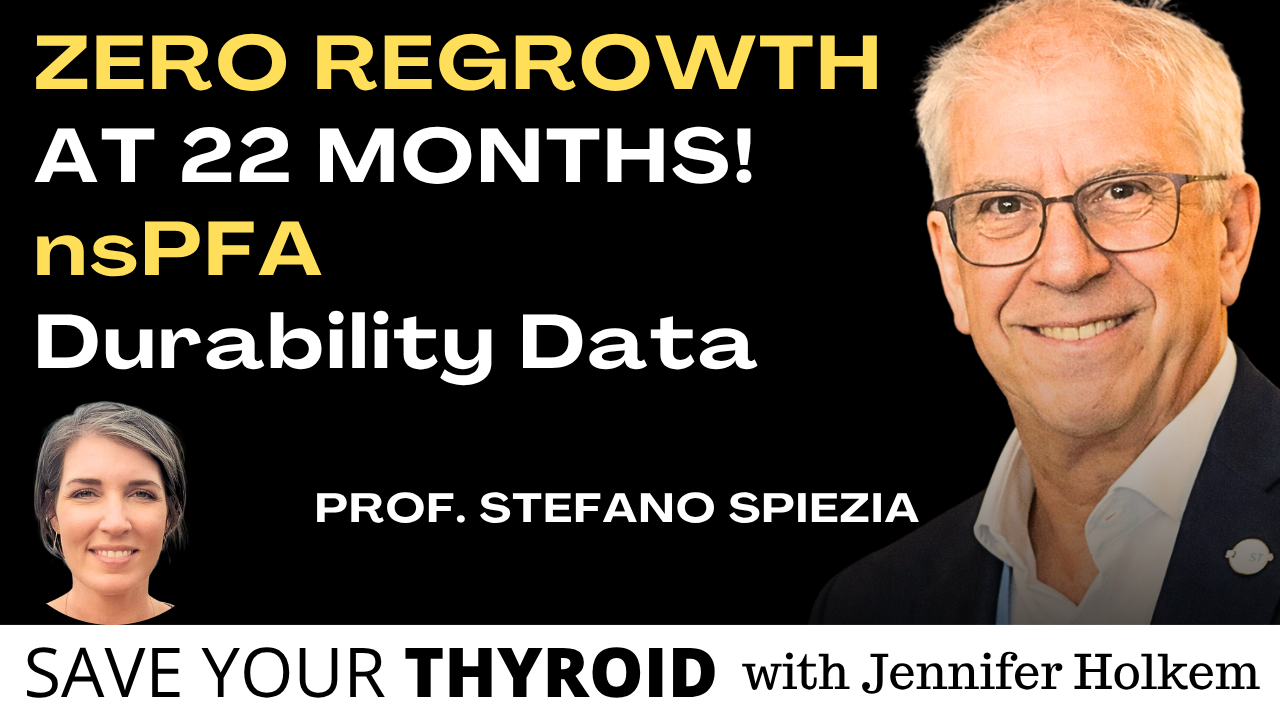
nsPFA: Zero Regrowth at 22 Months! The Durability Data Thyroid Patients Need
Save Your Thyroid with Jennifer Holkem · Episode 127
If you've been waiting to see whether nsPFA's early results would hold up over time, the wait is over. New durability data shows this non-thermal ablation technology delivering zero nodule regrowth and sustained volume reduction for up to 22 months post-treatment.
Professor Stefano Spiezia is head of the Division of Endocrine and Ultrasound Guided Surgery at the Sea Hospital in Naples, Italy, and conducted the first-in-human feasibility study of nsPFA for thyroid nodules.
In Episode 127 of Save Your Thyroid with Jennifer Holkem, Professor Spiezia joins me to break down the 22-month durability data presented at the 2026 NASIT meeting, and what it means for anyone considering this treatment.
🎧 In today's episode, we're covering:
The 22-month durability data — zero regrowth, 74% average volume reduction
How nsPFA works — a non-thermal mechanism that avoids burning tissue entirely
Why the shrinkage keeps going instead of plateauing
Patient satisfaction results — 100% cosmetic, 95% overall
Why no fibrosis means easier re-treatment if regrowth ever occurs
A real risk of thermal ablation scarring that gets mistaken for cancer
What's next for nsPFA and thyroid cancer
The Data Everyone's Been Waiting For
The durability question finally has an answer. "Now we can see that nsPFA provides a sustained and stable response up to almost two years," Professor Spiezia explains. Across 15 to 22 months of follow-up, the study showed zero nodule regrowth, an average volume reduction of 74%, and no serious adverse events.
Takeaway: This is real follow-up data, not early enthusiasm — though longer-term data out to 5 and 10 years is still needed.
A Different Way of Destroying Tissue
nsPFA doesn't use heat at all. "We are not burning tissue. We are programming cells to die," says Professor Spiezia. Short electrical pulses create microscopic pores in the cell membrane, triggering a natural, regulated form of cell death instead of thermal injury.
Takeaway: Because there's no heat, there's no need for the same safety margin thermal treatments require near nerves or other sensitive structures.
Why the Nodules Keep Shrinking
Unlike RFA or microwave ablation, which tend to plateau after the first several months, nsPFA nodules kept shrinking. "The effect of nsPFA is not only immediate and static — it's dynamic. The nodule keeps shrinking over time."
Takeaway: A treatment that keeps working over time is worth asking your physician about directly when comparing options.
No Scar Means No Confusion Later
Thermal ablation leaves a scar that can appear dark, or hypoechogenic, on ultrasound — and a physician unfamiliar with your history might mistake it for cancer. Professor Spiezia calls it "unbelievable, but quite common." With nsPFA, "we don't have any scar inside. So we completely change everything from this point of view."
Takeaway: If you've had thermal ablation, make sure any new physician reviewing your scans knows your treatment history first.
Not a Replacement for RFA — a Complement
Professor Spiezia doesn't see nsPFA as competing with RFA. "At this stage, I would say they are complementary rather than competitive to radiofrequency and microwave, because for the first time, we are seeing durable results without fibrosis. This is the game changer."
Takeaway: More tools means more ways to match the right treatment to your specific nodule — not one option replacing another.
The Next Frontier: Thyroid Cancer
Because nsPFA avoids the safety limits of heat near critical structures, Professor Spiezia sees real potential for thyroid cancer treatment — including recurrence after surgery. "We can heal the patient from these recurrences, not doing a new surgery... something that you can do again if the pathology will recur again." But he's clear that "we need to build some multi-center prospective studies" before this becomes established practice.
Takeaway: Promising early data is a starting point, not a green light — rigorous multi-site research is the necessary next step.
Key Takeaways:
Zero nodule regrowth was observed across 15 to 22 months of follow-up.
Average volume reduction was 74%, with no serious adverse events reported.
The shrinkage was dynamic, continuing well past the one-year mark instead of plateauing early.
100% of patients were highly satisfied with their cosmetic outcome; 95% were highly satisfied overall.
No thermal injury means minimal fibrosis, which keeps tissue easier to re-treat if regrowth ever occurs.
A thermal ablation scar can sometimes be mistaken for cancer on a later ultrasound — nsPFA avoids that risk entirely.
Multi-center studies are still needed before nsPFA becomes standard of care for thyroid cancer.
Connect with Professor Stefano Spiezia: 🔗 Save Your Thyroid International School: sytmedical.com
Find a physician near you: 🔗 saveyourthyroid.org
Book a patient navigation consult: 🔗 saveyourthyroidwithjen.com/patient-navigation-services
Disclaimer: None of the statements made in this or any other blog or video by Jennifer Holkem should be considered medical advice. Always consult with a qualified healthcare professional regarding your individual medical needs. — Jen
Just Diagnosed With a Thyroid Nodule? What They Don't Tell You on Day One


 Goodpods