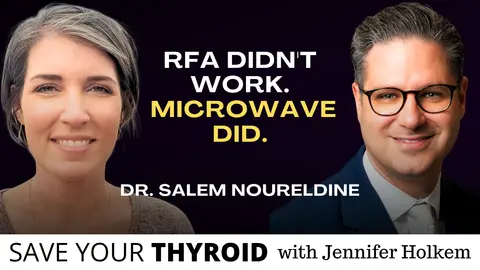
Why RFA Sometimes Fails on Toxic Thyroid Nodules — And What Works Instead | Dr. Salem Noureldine
SAVE YOUR THYROID with Jennifer Holkem, episode 130
Most patients who hear the phrase “toxic thyroid nodule” assume it means something ominous. It doesn’t — toxic nodules are almost always benign. But they’re not harmless either. A toxic nodule stops listening to the brain’s signals and starts producing thyroid hormone on its own, and the result shows up everywhere but the neck: a racing heartbeat, tremors, weight loss, anxiety, trouble sleeping. For a long time, the only real options were radioactive iodine or surgery. Ablation has entered that conversation — but as this episode makes clear, not every ablation technology handles a toxic nodule the same way.
In Episode 130 of Save Your Thyroid with Jennifer Holkem, I sit down with Dr. Salem Noureldine, a fellowship-trained endocrine surgeon and assistant professor of surgery at George Washington University, to talk through what makes toxic nodules different, why radiofrequency ablation (RFA) sometimes isn’t enough to fully treat them, and what changes — at a physics level — when microwave ablation is used instead.
Welcome back to Save Your Thyroid with Jennifer Holkem. This is the space where we bridge the gap between the standard of care and the future of medicine. My mission is to empower you with the knowledge you need to avoid unnecessary surgery and keep your thyroid intact for the long haul.
🎧 In today’s episode, we’re covering:
-
What actually makes a nodule “toxic” and why it’s a whole-body problem, not just a lump in the neck
-
Why toxic nodules are frequently missed as the cause of AFib in older patients
-
RFA vs. microwave ablation: What’s actually different at a physics level, not just a marketing level
-
The “heat sink effect” and why vascular nodules fight back against treatment, and how that shows up specifically in toxic nodules
-
Why RFA requires grounding pads and microwave doesn’t, and what that means for patients with pacemakers
-
Dr. Noureldine’s “shape sorter” philosophy for matching technology to the patient in front of him
-
A real patient case: a toxic nodule that came back after RFA, and what changed with microwave
-
The questions Dr. Noureldine thinks patients should be asking before choosing anyone to perform their ablation
Whether you’ve just been told you have a toxic nodule, you’re trying to understand why your first ablation didn’t fully resolve your hyperthyroidism, or you simply want to understand what’s actually different between these technologies, this episode gives you the physics behind the decision.
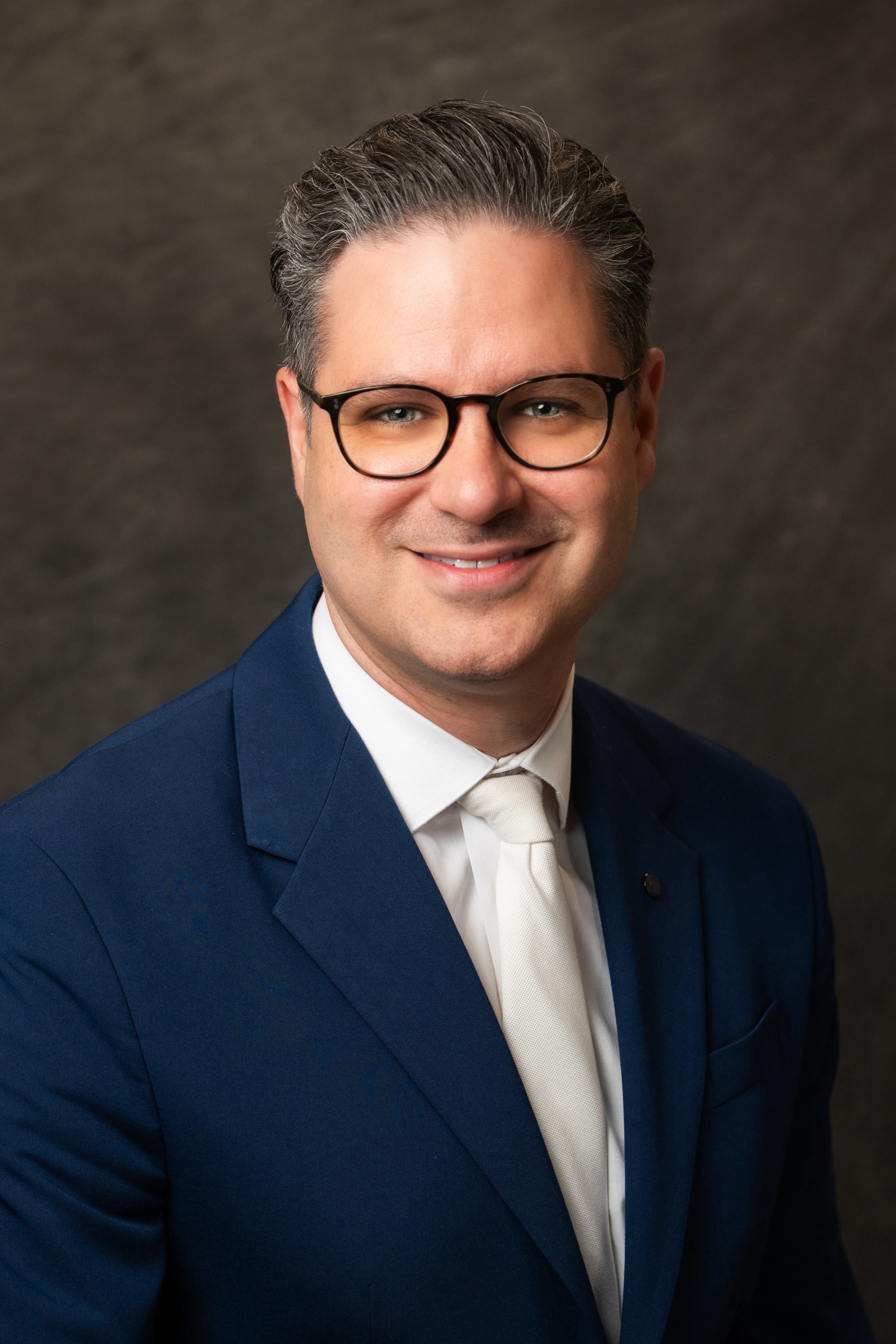
From the Lab to the OR: How Dr. Noureldine Found Ablation
Dr. Noureldine’s path to ablation didn’t start in practice. It started in medical school, watching Dr. Emad Kandil operate at Tulane in 2008. That early exposure led him to a research fellowship in Dr. Ralph Tufano’s lab at Johns Hopkins, where he worked on an idea that felt, at the time, almost theoretical.
“At that time it felt very futuristic, but we genuinely believed that some sort of ablation was going to become part of the future of thyroid care.”
By the time he reached his endocrine surgery fellowship at Cleveland Clinic — training under Dr. Eren Berber, who was beginning to perform RFA on thyroid nodules — the idea he’d worked on in a lab years earlier was being used to treat real patients. He’s now been performing RFA for about three years and microwave ablation for about a year, with an eye toward nanopulse technology next.
What Makes a Nodule “Toxic”
A toxic nodule isn’t defined by size or appearance on an ultrasound. It’s defined by behavior. Instead of waiting for signals from the brain, the nodule starts producing thyroid hormone independently.
“We’re no longer treating just a lump in the thyroid. We’re treating a lump that is actually affecting the whole body.”
That distinction changes the entire treatment conversation. With a typical benign nodule, the decision is often about size or symptoms. With a toxic nodule, Dr. Noureldine is working toward two goals at once: controlling the excess hormone and treating the nodule causing it.
One detail patients don’t always expect: toxic nodules are almost always benign. The danger isn’t cancer — it’s what unchecked excess hormone does to the heart and bones over time, especially in younger patients worried about long-term bone health and older patients at risk for atrial fibrillation.
The AFib Connection Nobody’s Screening For
One of the more sobering parts of this conversation was about how often a toxic nodule is overlooked as the actual cause of a patient’s AFib.
“I have seen over the years many patients that realize that they’re hyperthyroid after they’ve had complications from having AFib, been on a blood thinner for many years, and getting an ablation of the heart to try to control the AFib — but it doesn’t work, because that’s not where the problem is.”
Patients can spend years on blood thinners and beta blockers, and go through a cardiac ablation that doesn’t resolve anything, before anyone checks thyroid function. If you or someone you love has AFib with no clear explanation, this is worth bringing up directly with a physician.
RFA vs. Microwave: The Physics Difference That Actually Matters
From the outside, RFA and microwave ablation look nearly identical. To a layperson, they appear to have the same setup, same needle, same sound. The difference is how each one generates heat.
With RFA, an electrical current passes through the tissue, and that current has to exit the body through grounding pads — which is why patients wear them on their thighs and why jewelry and underwire bras have to come off before the procedure. With microwave ablation, heat is generated directly at the tip of the antenna through friction, with no current traveling through the body at all. No grounding pads, no clothing changes, no jewelry restrictions.
That difference in mechanism translates into a difference in results — heat is generated faster, to a higher temperature, across a wider zone (roughly 5–8mm with microwave versus 2–3mm of active ablation with RFA). Dr. Noureldine put the practical upshot simply:
“What really matters is whether it changes what I can offer the patient or make the procedure better for them.”
The Heat Sink Effect and Why Toxic Nodules Are the Hardest to Fully Treat
This is the piece that connects everything back to toxic nodules specifically. Toxic nodules are inherently vascular. That blood supply feeding the nodule is exactly what allows them to overproduce hormone in the first place. But that same blood flow works against ablation, constantly pulling heat away from the treatment zone before it can do permanent damage. Dr. Noureldine calls this the heat sink effect.
“We tend to need to treat it multiple times to really treat those areas, because we realize that sometimes we’re not able to achieve that irreversible damage.”
Because microwave ablation generates higher, more consistent heat that’s less affected by blood flow pulling it away, Dr. Noureldine has found it can achieve normal thyroid function in a single treatment for some toxic nodules where RFA required a second round. He was careful to note this isn’t a universal claim — he’s still gathering comparative data, and one session isn’t guaranteed for every patient.
A New Option for Patients with Pacemakers
Because microwave ablation doesn’t rely on an electrical current moving through the body, it opens up a group of patients who’ve historically needed extra precautions, or been steered away from ablation altogether: people with pacemakers or other implantable cardiac devices.
“There’s no risk of damaging those electrodes, the wires that go down to the heart, the device itself. You don’t have to do these procedures in the operating room. You don’t have to interrogate them, have an anesthesiologist... I’m still able to do these procedures in the office without needing or worrying about the pacemaker with microwave ablation.”
He noted that RFA can be done safely in pacemaker patients too, with the right protocol. He and Dr. Kandil published an algorithm for it. But it requires more coordination. Microwave simply removes that layer of complexity.
The Shape Sorter: Matching the Technology to the Patient
Dr. Noureldine’s framework for choosing between technologies came from an unexpected place: A photo of his toddler son playing with a children’s shape-sorter toy.
“The patient is the shape sorter box, and my job is to find the shape — the technique or the technology — that fits that particular patient and that particular nodule. I don’t try to force every shape through the same opening.”
In practice: RFA remains an excellent option with a long track record for typical benign nodules. Microwave increasingly becomes his first choice for toxic, vascular, or larger nodules, and for patients with pacemakers or difficulty lying flat. And when a nodule’s growth raises concern for cancer, when critical structures can’t be safely avoided, or when the whole gland is diffusely enlarged rather than one isolated nodule — ablation isn’t the right tool at all, and the honest answer is still surgery or radioactive iodine.
A Patient Story: When RFA Wasn’t the End of the Road
Dr. Noureldine closed with a case from his own clinic: a young patient with a toxic isthmus nodule, initially 3.5cm, who underwent RFA elsewhere. The nodule shrank to 2.5cm — technically a success by size — but on follow-up ultrasound, Dr. Noureldine could see the nodule was still vascular, “lighting up like a Christmas tree,” and she remained hyperthyroid on methimazole.
“That tells me that the treatment was complete, right? The nodule shrunk... but it was not irreversible damage.”
Rather than repeating RFA, he performed microwave ablation in clinic under local anesthesia. One month later, the nodule had shrunk further, to 2cm, with no remaining vascularity. By the time of this interview, she was down to taking methimazole every other day, with blood work trending toward coming off the medication entirely within six to eight months.
“It wasn’t that that person did the wrong procedure, did not do a complete procedure. They did a great job. It’s just that that patient, their disease, their nodule is different, and it needs something different.”
What to Ask Before Choosing Anyone to Perform Your Ablation
Dr. Noureldine was direct that the technology is only part of the equation. The experience of the person holding the probe matters just as much. His advice: don’t just ask how many ablations a physician has done. Ask how long they’ve been doing their own ultrasounds and their own biopsies, since ablation draws on all of those skills at once. And ask about outcomes specifically: What volume reduction rate they typically achieve, and how many sessions it usually takes to get there.
“The machine doesn’t perform the procedure. The proceduralist does.”
How to Find Dr. Noureldine
🔗 https://capitalmedicalgroup.com/profile/salem-noureldine
This episode was produced in partnership with Baird Medical.
🔗 bairdmed.com
For a broader list of physicians performing nonsurgical thyroid procedures across the US and abroad, visit saveyourthyroid.org and click FIND A PHYSICIAN at the top of the page. And be sure to check out our physician map! Free, unsponsored, and updated regularly.
Watch this episode on YouTube, or download for offline viewing on YouTube Music!
Save Your Thyroid with Jennifer Holkem is now available on all major podcast platforms!
Visit my new podcast website, SaveYourThyroidwithJen.com!
Key Takeaways from Episode 130:
-
Toxic nodules are a whole-body problem. They’re almost always benign, but untreated excess hormone affects the heart and bones over time.
-
Toxic nodules are an underscreened cause of AFib. If AFib has no clear cause, thyroid function is worth checking.
-
RFA and microwave ablation work differently, not just faster or slower. RFA uses electrical current through the body; microwave generates heat directly in the tissue.
-
The heat sink effect explains why vascular, toxic nodules are the hardest to fully ablate — and why microwave can sometimes succeed where RFA needs a second treatment.
-
Pacemaker patients have a real option. Microwave ablation’s lack of electrical current removes a major source of risk and complexity.
-
No single technology is “best.” The right choice depends on the nodule’s size, vascularity, and the individual patient — Dr. Noureldine’s “shape sorter” approach.
-
The physician’s experience matters as much as the machine. Ask about ultrasound and biopsy experience, not just procedure counts.
For more on nonsurgical thyroid nodule treatments like RFA, microwave ablation, TAE, and nsPFA, be sure to subscribe!
AND, don’t forget to visit my website:
👉 SaveYourThyroidwithJen.com
There, you can also sign up for personalized one-on-one patient navigation, because no one should feel alone on their thyroid journey.
Please consider supporting my work. Every donation is sincerely appreciated!
Find a physician, explore treatment options, and join our patient community here:
Disclaimer: None of the statements made in this or any other blog/video by “Its me Jen again” should be considered medical advice.
The goal of this podcast and blog
I seek to provide data, resources, and expert opinions on the topic of thyroid nodules, and make it accessible to patients. When I was first looking for thermal ablation treatment, everything that I read was physician-facing material. It was very hard for me to understand. This material is meant to help patients understand what’s going on in their thyroid gland and what an important gland it is. If you can keep your thyroid intact, that’s going to help you live a longer, healthier life, and preserve your quality of life. Thanks for reading this far today! — Jen
When Ablation Isn't the Answer: A Surgeon Who Does Both Explains


 Goodpods