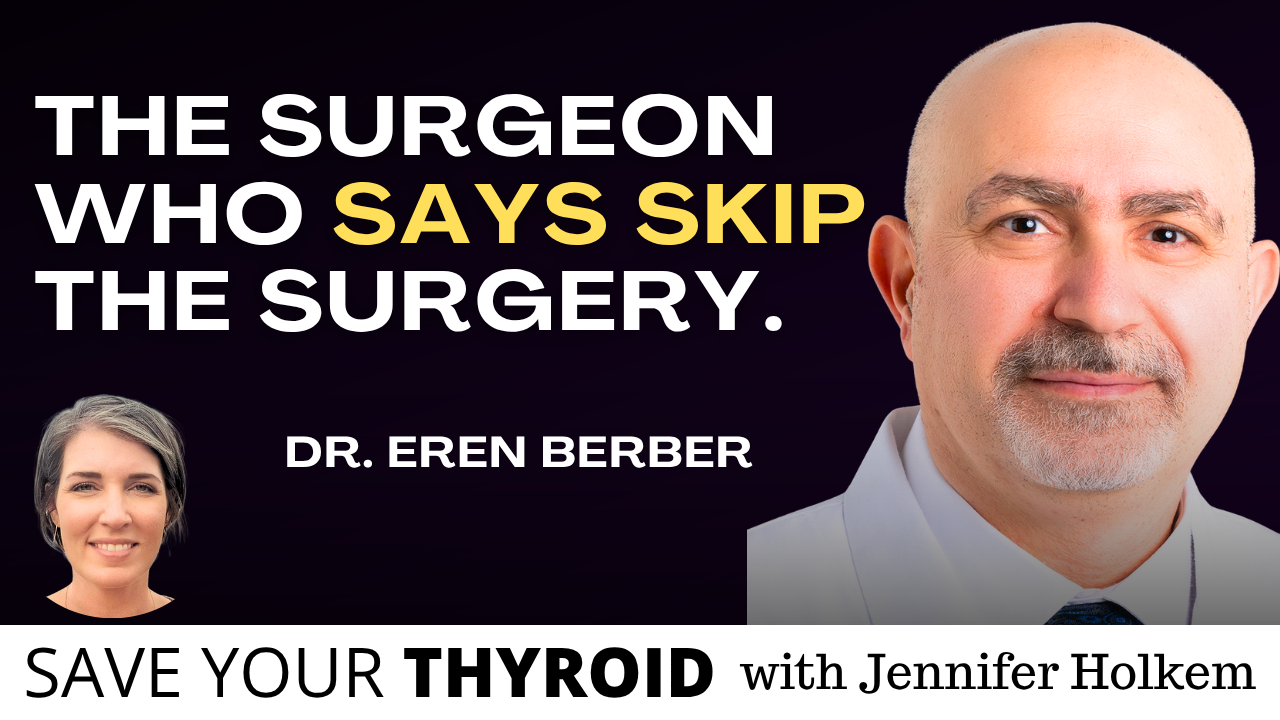
RFA, Robotic Surgery & the Future of Thyroid Care: What a Cleveland Clinic Pioneer Wants Every Patient to Know
Save Your Thyroid with Jennifer Holkem · Episode 121
When Dr. Eren Berber tells you that robotic thyroid surgery isn't always the better choice, it carries a different weight than when someone else says it.
He was one of the first surgeons in the United States to perform robotic thyroid surgery. He brought RFA to Ohio. He has authored more than 350 peer-reviewed papers. He is a Professor of Surgery and Director of Robotic Endocrine Surgery at Cleveland Clinic — one of the most accomplished thyroid specialists in the country.
And in Episode 121 of Save Your Thyroid with Jennifer Holkem, he sat down to give an unusually honest, comprehensive breakdown of every major thyroid treatment option available today.
Here's what he said.
On Robotic Surgery: The Honest Assessment
Patients ask Dr. Berber all the time: "Does the robot do better?"
His answer: not necessarily.
Robotic thyroid procedures require extraordinary surgeon experience — there are only a handful of surgeons in the entire country capable of performing them at a high level. And paradoxically, robotic surgery can actually be more invasive than conventional surgery. The transaxillary approach, for example, requires creating a surgical tunnel from the armpit to the neck — more pain, longer recovery, and the patient still needs lifelong thyroid hormone replacement.
"Overall, these procedures are not really leading to better outcomes than conventional surgery," Dr. Berber said. "I think their only benefit is that you don't have an incision in the neck."
He's not anti-robotic. He still performs it — for the right patients, specifically those with smaller nodules under four centimeters, cancer confined to the thyroid, and appropriate body anatomy. But if you're okay with a small scar, conventional surgery often gives the surgeon more flexibility to adapt if something unexpected comes up.
The bottom line: don't choose robotic surgery because you assume it's more advanced. Choose it because it's right for your specific situation.
On Ablation: From Skeptic to Believer
Dr. Berber didn't start out convinced that thyroid ablation worked.
"Honestly, I was a little bit skeptical initially," he admitted. "But seeing the results in my patients, I'm a big believer."
What changed his mind was four years of personally following every single ablation patient he treated. He wanted to know — does it actually work? The data he collected answered that question.
In his first 100 RFA patients at Cleveland Clinic, the success rate was over 90%. Less than 5% needed additional treatment. Less than 5% had complications. Hot nodules — those producing excess thyroid hormone — returned to normal thyroid function within approximately a month in nearly every case.
His current clinical pathway is straightforward: if a patient has a benign fine needle biopsy result and the nodule is causing symptoms, ablation is a strong candidate option. And increasingly, patients are bringing it up themselves before he even presents it as a choice.
For indeterminate nodules or cancer suspicion, he's clear: surgery remains the recommendation. The data supporting ablation for those situations is still limited. But for symptomatic benign nodules, the evidence is now strong enough that the ATA guidelines have incorporated ablation as a standard procedure for appropriate patients.
Treat Nodules Earlier — Don't Wait
One of the most important clinical insights Dr. Berber shared is one that many patients haven't heard before: the most dramatic RFA results happen with smaller nodules.
If a nodule is large when it's treated, it will shrink significantly — but it may not fully disappear. A remnant often remains. If a nodule is small when it's treated, it can disappear completely.
This raises a question worth asking your provider: if you're a young patient facing a lifetime of repeat ultrasounds and possible repeat biopsies for a growing nodule, why wait until it's large?
"Why not even start treating these nodules earlier?" Dr. Berber asked. "The nodule disappears and you're done with it."
Jen has said the same thing to her patient community for years. Her own nodule was between 65 and 75 milliliters when she was treated — large enough that it didn't fully disappear, though it reduced by 90%. Patients with smaller nodules at the time of treatment tend to see more complete resolution.
If your nodule is growing and you've been told to just watch it — that conversation is worth revisiting.
The Future: Non-Thermal Technologies and AI
Thyroid ablation technology is evolving faster than most patients realize.
Dr. Berber was attending the ISITES conference in Washington DC at the time of this recording — a gathering specifically focused on innovative endocrine surgery technologies. Among the topics being discussed: using nanopulse energy for thyroid ablation, applying ablation to small thyroid cancers in appropriate locations, AI integration into both surgery and ablation, and new dye-based technologies to better visualize and protect the parathyroid glands during surgery.
At Cleveland Clinic, a clinical trial evaluating nanopulse ablation is in the final stages of preparation. Nanopulse is a non-thermal technology — it doesn't use heat the way RFA does — and early experience is showing promise.
"All I can tell you is that the ablation technologies are evolving very, very rapidly," Dr. Berber said. "What we're using now is not going to be what we'll be using five years from now."
On Insurance Calling RFA Investigational
Thyroid RFA has been FDA cleared since 2018. A CPT billing code went into effect in January 2025. The ATA guidelines now formally include ablation as a standard procedure for appropriate patient pathologies.
As Jen put it in this episode: that excuse is on borrowed time.
Dr. Berber agreed. The CPT code has already made a meaningful difference — volumes have increased significantly since its introduction, and patients are having more success obtaining coverage.
If your insurance has denied RFA as investigational, you now have three things to cite: FDA clearance dating to 2018, an active billing code, and updated clinical guidelines. Push back.
How to Get a Second Opinion That Actually Matters
Dr. Berber's advice for patients who have been told they aren't a candidate for ablation: go directly to a physician who performs the procedure.
"Even in the same institutions, there are different levels of awareness and knowledge about this technology," he said. "The outcomes, the details, the indications — a lot of times they haven't been shared accurately."
His recommendation: don't rely on a referral from a physician who doesn't offer ablation to tell you whether you're a candidate. Find someone who does it and ask them yourself. And when you do, look into how many procedures they perform per year and whether their outcomes are published.
That last point is one Dr. Berber feels strongly about. Every procedure he performs is published in peer-reviewed journals. Patients can search his name on PubMed and review a decade of outcomes before they ever sit down with him.
"Having these outcomes transparently out there is pretty important — you already know what your surgeon is capable of. I think that has to be more widely adopted."
It's a reasonable standard. And one worth asking about when you evaluate any provider.
How to Reach Dr. Berber
To reach Dr. Berber at Cleveland Clinic, go to the Cleveland Clinic website and search his name directly — then contact his office. He emphasizes going to his office specifically rather than navigating the general institution referral process, which can result in patients being seen by providers who don't offer RFA.
Telehealth consultations are available for out-of-state patients. His team will gather your records and conduct an initial virtual visit to assess eligibility before arranging an in-person pre-procedural visit.
🔗 Dr. Eren Berber at Cleveland Clinic
If you found this helpful, please share it with someone who is navigating a thyroid nodule diagnosis. The more patients who know this information exists, the more physicians like Dr. Berber will be asked about it — and the faster this technology reaches the people who need it.
Find a physician, discover your options, and join our patient community at saveyourthyroid.org
When Ablation Isn't the Answer: A Surgeon Who Does Both Explains


 Goodpods