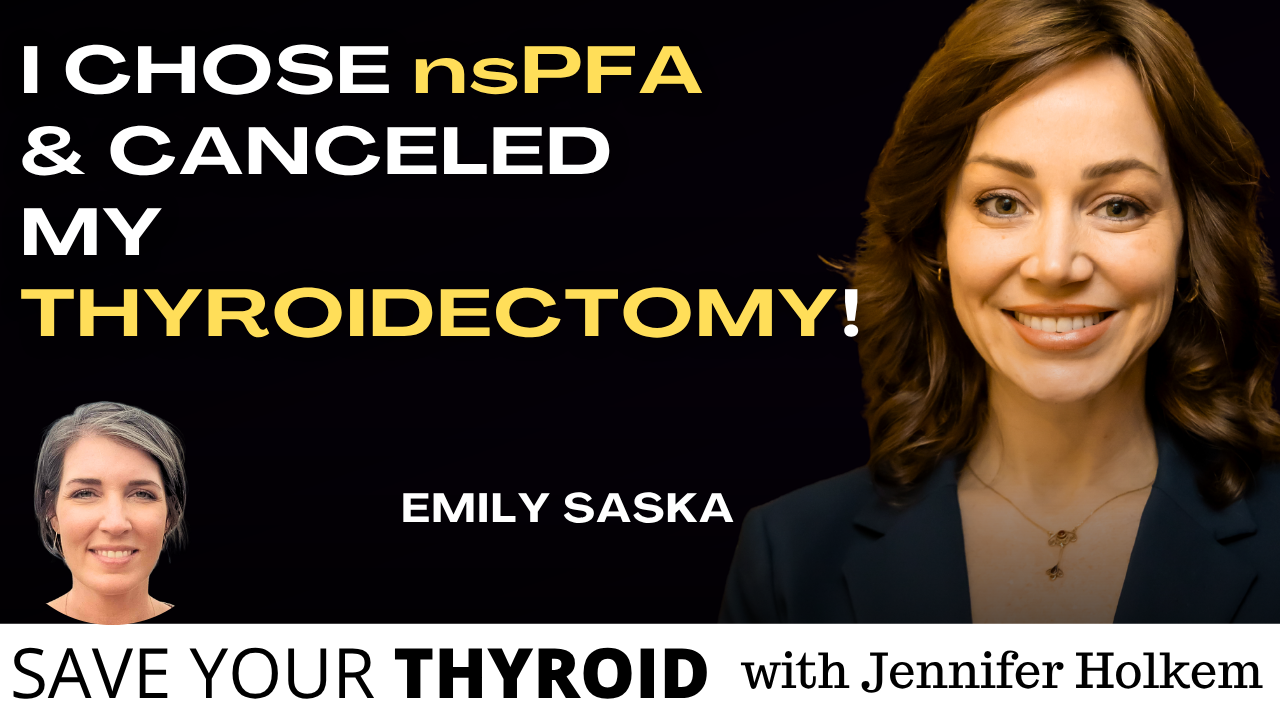
From Surgery Referral to 82% Nodule Shrinkage: Emily’s nsPFA Success Story
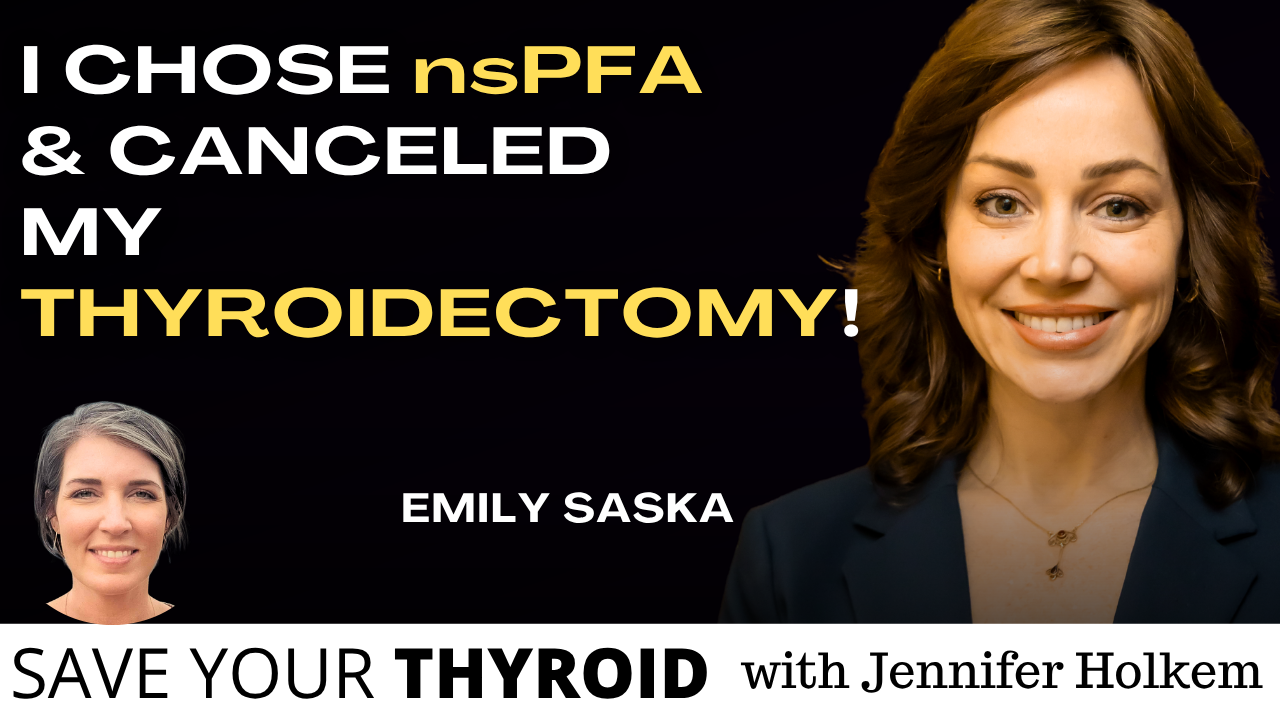
When Emily Saska went in for imaging on a "weird back thing" at age 37, she wasn’t expecting to be pulled off the ceiling by a radiologist. She was a healthy, fit lawyer and a busy mom of two. But the scan had picked up something unrelated: a significantly large nodule on her thyroid.
What followed was a medical whirlwind that many of my listeners know all too well. Within weeks, her nodule had grown from 3.2 cm to 3.8 cm. It was becoming visible, "angry," and increasingly uncomfortable. Her local endocrinologist in Baton Rouge gave her the standard recommendation: a referral to general surgery for a partial or full thyroidectomy.
Emily describes that moment as the "needle off the record." She was being told to remove a fully functioning, vital organ, despite all her bloodwork showing her thyroid was doing its job perfectly. The conversation about alternatives didn't exist in that office.
But Emily is a lawyer—she’s trained to look at the evidence. She went home, started "spiraling" in the way only a motivated patient can, and began her own deep dive into clinical case studies and patient communities.
Choosing the "God Thing" Over the Operating Room
While searching for a way out of the surgical path, Emily stumbled upon the Save Your Thyroid community and a name that kept appearing: Dr. Emad Kandil. As luck (or a "God thing," as Emily calls it) would have it, Dr. Kandil was based in New Orleans—just an hour away from her.
She didn't know the jargon. She didn't fully understand the science of thermal vs. non-thermal ablation. But she knew one thing: she had nothing to lose by trying to save her organ. She advocated for herself, secured a referral for a second opinion, and walked into Dr. Kandil’s office with a simple message: "You're smarter than me. Tell me what you think I should do."
The Birthday Present: What is nsPFA?
Dr. Kandil recommended a combination of ethanol ablation (for the cystic, fluid-filled parts of the nodule) and nanosecond pulsed field ablation (nsPFA) for the solid portions.
Unlike RFA or microwave ablation, which use heat to destroy tissue, nsPFA is a non-thermal technology. It uses ultra-short, high-voltage electric pulses to clear away the nodule cells without the risks associated with extreme temperatures near the delicate structures of the neck.
Emily scheduled the procedure for her 37th birthday. It was, as she says, her gift to herself.
A "Nothing Burger" Recovery
One of the biggest hurdles for patients considering ablation is the fear of the unknown. Emily’s experience demystifies that completely.
She arrived at the hospital at 6:30 AM, was under sedation by 8:00 AM, and was headed home by 11:00 AM. When she woke up, she didn’t find a surgical drain or a row of stitches. She found a single, tiny band-aid.
"I felt like I should be bandaged up or something. I felt like I needed a t-shirt that said, 'I've had weeks of consultations and biopsies, and all I got was this band-aid.'"
Aside from some mild hoarseness and a bit of neck soreness (mostly from the positioning during the procedure), Emily was back to her life immediately. In fact, four days after her thyroid ablation, she and her family flew to Puerto Rico for a vacation. No lengthy recovery, no lifelong hormone replacement—just a band-aid and a beach.
82% Smaller and Counting
The results of Emily’s "birthday gift" have been nothing short of a home run.
-
At 6 weeks: A 65% reduction in volume. The visible lump was gone.
-
At 7 months: An 82% reduction in size.
Most importantly, her thyroid function remains perfect. She saved the organ that regulates her heart, her brain, and her energy levels, all because she paused long enough to ask, "Is there another way?"
The Lesson: Trust Your Gut, Not Just the Referral
Emily’s story is a powerful reminder that while we should trust our doctors, we shouldn't trust them blindly. The "standard of care" is often years behind the latest technology.
Today, Emily is an advocate, refusing to "gatekeep" the success she found. She even went back to her original endocrinologist to show her the results, hoping to plant a seed for the next patient who walks in with a 4 cm nodule and a fear of surgery.
As I always say, you are your own best advocate. No one will fight for your thyroid harder than you will.
Ready to Learn More? Listen to Emily’s full story in the latest episode of the Save Your Thyroid with Jennifer Holkem podcast. We go into the details of her "angry" nodule, her experience with Dr. Kandil, and why she’s so glad she didn't follow that first referral to the operating room.
If you’ve been told surgery is your only option, visit saveyourthyroid.org to find a physician list and explore the non-surgical technologies that could save your thyroid, too.
When Ablation Isn't the Answer: A Surgeon Who Does Both Explains


 Goodpods