Amazon Music
 Apple Podcasts
 Audible
 Castbox
 Deezer
 iHeartRadio
 PocketCasts
 RSS Feed
 Spotify
 YouTube
 Youtube Music
  Goodpods
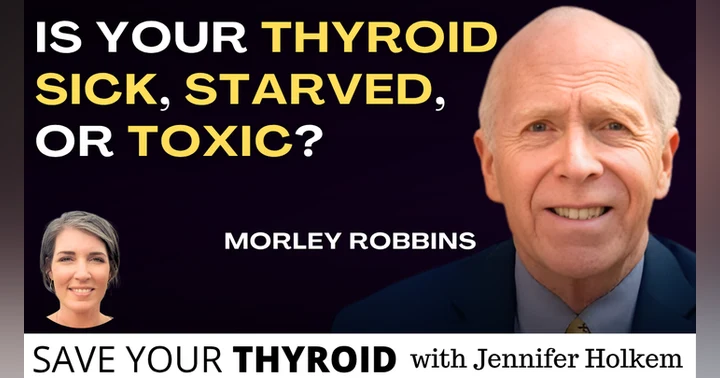
 Thyroid Nodules, Iron Toxicity & The Copper Connection w/ Morley Robbins
What if your thyroid isn't broken — it's simply starving for the minerals it needs to function?
That's the central question at the heart of this conversation with Morley Robbins, creator of the Root Cause Protocol and author of Cure Your Fatigue. Morley has spent nearly two decades reading thousands of peer-reviewed studies to piece together a puzzle that modern medicine has largely ignored — the complex interplay between minerals, mitochondria, and the thyroid gland.
In this episode, Morley and Jennifer explore the published research behind a paradigm-shifting idea: that copper deficiency and iron accumulation — not thyroid dysfunction itself — may be at the root of hypothyroidism, hyperthyroidism, and even thyroid nodule growth.
From the role of ceruloplasmin as the body's master antioxidant, to the reason your TSH may actually signal copper deficiency, to why zombie cells — iron-toxic cells that lose their ability to die — may be driving nodule formation, this conversation goes deep into the science that most physicians have never been taught.
Morley also walks through the practical stops and starts of the Root Cause Protocol — what to remove from your supplement routine, what to add, and why emotional stress may be sabotaging your mineral metabolism just as much as your diet.
In this episode:
Why copper is the general and iron is the foot soldier
How iron accumulation in the liver disrupts T4 to T3 conversion
Why your ferritin level may be misleading your doctor
The connection between iron toxicity and thyroid nodule growth
Why zombie cells can't die — and what that means for nodules
The stops and starts of the Root Cause Protocol
Find Morley Robbins: rcp123.org · Cure Your Fatigue available online
Are you struggling with thyroid nodules or hypothyroidism despite "normal" labs and a clean diet? It’s time to stop looking at the thyroid as the culprit and start looking at it as the victim of a mineral crisis.
In this episode of Save Your Thyroid, Jennifer Holkem sits down with Morley Robbins, the medical historian behind the Root Cause Protocol and author of Cu-RE Your Fatigue. Morley brings the "receipts"—thousands of peer-reviewed studies—to prove that what we’ve been told about iron and copper is often the exact opposite of biological reality.
We explore the revolutionary idea that thyroid nodules may actually be "zombie cells" that lack the copper-dependent energy to die, and why your "low ferritin" might actually be a sign of iron toxicity, not deficiency.
🕒 Episode Chapters:
00:00 | The Historian of Facts: Jennifer introduces Morley Robbins and the mission to question the standard of care with hard science.
05:15 | The "Confession": Jennifer shares her personal journey of "unlearning" and Morley explains how a frozen shoulder launched his mission.
12:40 | Why "Clean Eating" Isn't Enough: The Glyphosate Factor and why our organic food is "hollow."
18:22 | The 90/90 Rule: Why you can't fix a broken engine (mitochondria) by pressing the gas pedal (thyroid hormone) harder.
25:45 | The Iron Myth: Understanding the "Closed Loop" of iron recycling and why we are designed to hoard iron, not excrete it.
35:10 | Iron & Hypothyroidism: Reviewing the data (Edwards et al., 1983) on how iron accumulation causes the thyroid to fail.
42:30 | The Ferritin Trap: Is your "low ferritin" actually iron trapped in your tissues "rusting"?
52:15 | The "Zombie Cell" Theory: How copper deficiency prevents Apoptosis (cell death) and leads to thyroid nodules.
01:05:10 | The Proof in the Papers: Discussing the Frontiers in Endocrinology (2024) study linking iron levels to nodule risk.
01:15:40 | Actionable Solutions: The "Stops and Starts"—from ditching synthetic Vitamin C to embracing beef liver.
01:25:00 | Closing & Teaser: What’s coming in Part 2? A live "Full Monty" lab interpretation.
💡 Key Takeaways from This Episode:
The Copper "Doorman": Without bioavailable copper, iron cannot leave your tissues. It stays "stuck," creating oxidative stress (rust) in the thyroid gland.
Thyroid Nodules as Metabolic Failure: We discuss the study Aberrant Apoptosis in Thyroid Epithelial Cells, suggesting nodules are cells that simply didn't have the energy to "retire."
The Problem with Zinc & Synthetic C: How common supplements might be inadvertently tanking your copper levels and fueling thyroid dysfunction.
Watch the Jesse Chappus podcast episode with Morley that I mention in this episode:
https://www.youtube.com/watch?v=vYvXJRTlut4
Disclaimer: None of the statements made in this or any other video by Jennifer Holkem or "Its me Jen again" should be considered medical advice.
Support the channel:
PAYPAL👉https://www.paypal.com/paypalme/itsmejenagain
VENMO👉https://account.venmo.com/u/itsme_jenagain
Affiliate links:
TOUPS AND CO👉https://toupsandco.com/jen
RIVERSIDE👉https://www.riverside.fm/?via=itsmejenagain
VAN MAN👉https://vanman.shop/?ref=itsmejenagain
BON CHARGE👉https://us.boncharge.com/?rfsn=7843863.50b9fa&shpxid=4137e8a5-8199-46cb-b71c-0f86d29924ff
Resources:
👉Podcast: https://www.saveyourthyroidwithjen.com/
👉Patient site: https://www.saveyourthyroid.org/
👉Private FB group: https://www.facebook.com/groups/saveyourthyroidnonsurgical
👉Patient Navigation: https://www.saveyourthyroidwithjen.com/p/patient-navigation-services/
#ThyroidNodules #MorleyRobbins #RootCauseProtocol #IronToxicity #CopperConnection #ThyroidHealth #BioavailableCopper #SaveYourThyroid #MitochondrialHealth
Hosted on Acast. See acast.com/privacy for more information.
You're listening to Save Your Thyroid with Jennifer Holkem, the podcast where we believe that true patient advocacy begins with questioning the standard of care with hard science and published data.
If you've been in the thyroid community for any length of time, you know there are plenty of opinions on how to heal. But my guest today, Morley Robbins, deals in facts.
Morley is the creator of the Root Cause Protocol and the author of Cure Your Fatigue. While many know him as the challenger of the medical status quo, I see him primarily as a dedicated historian of medical literature. He has spent nearly two decades reading thousands of peer-reviewed studies to piece together a puzzle that modern medicine has largely fragmented — the complex interplay between minerals and mitochondria.
As someone who personally desires to understand the mechanism before I accept the solution, I deeply appreciate Morley's commitment to bringing receipts.
Today, we're going to look at the published research to answer a fundamental question: Is your thyroid actually broken or is it simply starving for the minerals it needs to function?
Let's get into it. Morley, it's an absolute honor to welcome you to the show.
MORLEY: Well, Jen, thank you so much for the opportunity. And I absolutely am enamored with your phrase, "dedicated historian of medical literature." I think I'm going to make arrangements to have that put on my tombstone. But no, it's been an amazing journey. I would never have predicted it. And every day is just an amazing point of discovery. And as we get into these conversations, I'll share what I'm learning. I'm absolutely amazed at what's out there. And you've certainly heard the expression, the more you know, the more you realize you don't know. The discovery process is phenomenal. And I'm just blessed to be able to be a part of it and be able to share it with people. So I'm very grateful.
JEN: Well, you have been in my recent discovery process. I personally am constantly doing research and learning and listening to podcasts. And so I want to kind of introduce you to my viewers by going to a concept in your book that's on page 117. And guys, if you haven't heard of this book, here it is — Cure Your Fatigue. And Morley, I told you in our phone call yesterday, I've marked and highlighted all throughout. It's an excellent read, highly recommended — and buy a pack of highlighters.
But on page 117, you talk about something that I thought was really relevant for the start of our conversation and how I discovered you, because you talk about how difficult it is to unlearn things. And those things that we've accepted as fact, because new information can often feel like a threat to our beliefs. And so my confession to you and to the audience is that when I first heard you, it was on a podcast you did with Jesse Chappas, which I'll link in the description. Excellent podcast. That's what happened to me. I was listening to you make these statements about vitamins that I had been taking and minerals and iron, and they all contradicted things that I believed or knew to be true. And so honestly, I was a little offended. I wanted to turn it off. I was like, I don't want to listen to this. He's not right.
And I resisted it initially, but I also was very curious and the curiosity was nagging at me. So I came back and I listened again and I wanted to understand where you were coming from. Then once I learned more that it was not your ideas that you were presenting, but that this was published data, I thought, I need to go a little bit further down the rabbit hole. And so I listened to several podcasts. I binge watched content that you had appeared on. And so that curiosity led me to buy your book. And it has now shifted my entire paradigm on this idea of what it is that you're talking about in your material.
So I felt like it was really important to bring you on and share that with the viewers. So many patients in my community are so focused on wanting to preserve their health. Patients that have thyroid nodules want to avoid surgery. They don't want to lose a gland that is vital to their health. And they want to figure out how can they fix their thyroid. And so the growing pains of unlearning was very uncomfortable.
You yourself also dealt with a very uncomfortable experience that you share in a lot of podcasts — your frozen shoulder. So can you take us back to the moment where you were a hospital executive and then a consultant and pulling your suitcase behind you with this painful frozen shoulder? How did you go from trusting the medical system to finding what you call the body's innate healer?
MORLEY: It's a great question. I've answered it a lot of different ways many times. I think it's important for the listeners to know that I'm a product of a very sickly family. My mom was an alcoholic with heart disease, a constant chain smoker. She went through probably two packs of cigarettes a day. My dad was a manic depressive with schizophrenia. And that's a fun household to grow up in. My sister became a nurse, so I was supposed to become a doctor. And that was the game plan until I got to college and discovered, wow, there's a lot of work involved. And that was not my style back then. I'm a very different person today than I was in my 20s.
So for the listeners trying to figure out, how old is that guy? He's 73, just a couple months ago. And I have more energy now than I did when I was 50. So I was like, I'm doing something right.
If you don't go to medical school, you go to business school. So I went to business school, got my MBA, and you learn to boss the doctors around. And that's what I did. I was pretty good at it. And I don't know that I ever trusted the system. I spent a lot of time growing up in hospitals because there were a lot of sick relatives. It wasn't just my mom and dad. And I was kind of fascinated by it. More than trusting it, I was fascinated by it. And I really, at a deep level, wanted to understand why is everyone so sick?
And as you note, I spent 12 years as a hospital executive, and then I decided I was going to be a consultant. And so for 20 years I'm pulling a suitcase behind my back as I'm going from city to city solving problems of hospitals trying to help them grow.
Along the way I developed what's called frozen shoulder and I couldn't pick my hand up above my waist. And it was very painful. I mean, I'd never experienced that kind of pain, and you can't sleep, so I'm losing sleep and I'm just in writhing pain. So I went to a health food store that I had gone to for 20 years. I lived north of Chicago for 25 years. I said, what have you got for frozen shoulder? And they said, you need to go see Dr. Liz. I said, I don't do witchcraft, because I was in the allopathic system.
And so they sold me some supplements. They did no good. And I came back a couple months later. The owner was there that day. And I went up to Lynn, I said, come on, you must have something stronger. And she looks me in the eye and she said, Morley, we love you. Go see Dr. Liz. I couldn't believe it.
So I went to see Dr. Liz. And just to bring the story to full circle, Dr. Liz is my wife now. And it was a very powerful encounter. She healed my shoulder. There's a pterygoid muscle in your jaw that when it gets tense, it locks up the shoulder. I didn't know that. And so she healed my shoulder by going into my mouth and putting pressure on that muscle, which was, at the beginning, more painful than the frozen shoulder. And then as she pressed more, as she met the tension in my muscle, my arm came up. It was like a miracle. Because I hadn't been able to do that for months.
And so we were having a chat about it. And she used a phrase I'd never heard in 32 years of working in a hospital. She talked about the innate healer. And I just looked at her and I said, I want to find out who that is. I was just so inspired by that phrase because I was thinking, well, there are millions of doctors around the world. Why do we have all these doctors if we have an innate healer, a healer within?
And so I've set out to research it. 12, 13 years later, I published the first edition of that book. And it talks about the three ring circus that runs life on the planet — copper, iron, oxygen. And copper and iron are the only metals that work with oxygen. That's a significant fact. And if they don't work well together, you're going to get what's called oxidative stress, which is the basis of all disease. Because when you have oxidative stress, you have what Douglas Wallace — a famous geneticist at Children's Hospital of Pennsylvania — calls cellular energy deficiency. Because if you can't convert oxygen into water to release the energy molecules, then you're going to have fatigue.
There's a Bible that's used in allopathic medicine called the Merck Manual. There are 20,000 conditions profiled in the Merck Manual. Guess what they all begin with? Oxidative stress.
And the way I think I was able to see it was that when I was in college, I worked in the mail room. And if you've ever been to a post office, you see hundreds of mailboxes. And they all have a different combination, or they require a different key to open them up. And that's the mindset of medicine — this condition requires this key to open it up so I can treat it. Well, that's not how it works on the other side of the mailbox. That's where I work. I worked on the work side, and I had access to everyone's mailbox. And that's how minerals work in the body. So it's just changing people's point of view.
That's really what we strive to do within the Root Cause Protocol — is just completely redefine the dynamic so that there's a real deep level of understanding that transcends the condition, and then they can begin to do the protocol and begin to heal themselves.
JEN: The mailbox analogy. I haven't heard you say that before in all the podcasts I've heard you on. I like that. That is a very interesting perspective. And I think it makes so much sense because I think innately we all understand that even though we're all different people and we have different genetics, we're all human beings and we all have very similar needs in terms of nutrition, light, sleep — all of these basic needs that we need met.
And it's so confusing now to know, what is it that we should do? That is the one question that I'm constantly asked by my patients in the community. What can I do for my thyroid that is in my control? Not what procedure, not what doctor should I see. They ask that too, but they want to know, what is it that I can do right now to help myself?
I have felt for almost seven years that I've been doing this — and I'm recording this in February — I have never felt comfortable really giving them any one particular line of advice. But I will say that I feel the most confident that I ever have that this is something that will help everyone, that I've ever had about anything.
MORLEY: We started out as the Magnesium Advocacy Group and then it evolved into the Root Cause Protocol. And when we started to really roll out the protocol, what surprised us the most, hands down, was the number of people who said, I don't need as much thyroid medication. I don't need any thyroid medication. And that really piqued my curiosity. So I said, well then, maybe the thyroid doesn't run the body the way they trained us to think.
So a lot of people want to know, how did you come upon all this knowledge? Well, I wasn't looking at mailboxes. I rejected the mailboxes. I basically, at one point, had a list of 32 areas where conventional medicine was wrong. Classic cholesterol causes heart disease — that was one of 32.
I had a really amazing experience talking with a consultant to the natural food industry. He said, you know, Morley, I'm constantly asked, what's new? What's new? And he said, what I've learned to ask now is, what's enduring? And when he asked that question, that really inspired me to go into the research to find out what is enduring.
And that's when I learned that oxygen wasn't always on the planet. Copper wasn't always on the planet. And copper is what saved life on the planet because when oxygen became a part of the atmosphere, it wiped out all of the anaerobic life. So copper is what enabled us to work with oxygen. And the reason why we're here, the reason why we're having this switched-on conversation with really cool technology, is that higher order thinking required more energy.
JEN: I want to just add this one side point before we move on. I've only been really implementing the things that I've learned from you over probably the last three, four months at the maximum. Over that period of time, I take less thyroid medicine than I did before that. I only needed to start taking thyroid medicine about two years ago when I started really going into perimenopause and my T3 function was low. I started taking a very, very low dose and that dose has gotten lower and less frequent. And so that's exciting to hear.
MORLEY: The T3 function was going down not because the thyroid wasn't working right, but because the liver wasn't working right. 90% of the conversion of T4 to T3 is with the triiodothyronine enzyme. And what disrupts that enzyme? Iron building in the liver because there's not enough copper in the diet.
That's a primal seesaw that people need to understand. Copper is the general and iron is the foot soldier. And the meme that runs the planet as it relates to medicine and healing is you're anemic and you're copper toxic. Well, the truth is just the opposite. We are drowning in iron because we don't have copper in our soil, in our food, and in our tissue.
They've known this since 1928. March at the University of Wisconsin, May at the University of Kentucky. But for almost 100 years now, we've known that this copper-iron thing is important. And if copper's down, iron's up. Then when the liver fills up with iron, then the heart's going to start to fill, and then it's going to go to the endocrine glands. Our adrenals blow out, our thyroid blows out, our gonads blow out. And people don't realize that what's really happening is just a misunderstanding about how the body works.
JEN: Well, we're going to talk about copper — this very, very important nutrient that pretty much everyone, I think you would say today, is deficient in. And I had no idea until I started listening to you and reading your book how important copper was. Because as you said, we're all told that we're copper toxic.
So, you know, I have premature graying. I'm 43 years old. I've been gray like this since I was in my mid-30s. And the first thing someone said to me was, well, maybe you have a copper deficiency. And when I started researching it — no, no, you don't want to supplement with copper because you'll be copper toxic. And nothing could be further from the truth unless you're someone who has that genetic disease called Wilson's disease.
So before we get into this really interesting deep dive on copper, I want to just give a quick disclaimer for the viewers because we are going to get into the science, but the information that we're going to share in this episode is for educational purposes only. It's not medical advice. Morley's interpretation of the literature often differs from the standard guidelines. So please don't stop taking any medications without consulting with your doctor. That being said, you need to know this information. It's vitally important. Share it with your doctor. I did just earlier this week and it was a wonderful conversation.
So let's get into the discussion on copper. A large portion of my listeners are extremely health conscious. Many of them eat a very good diet. They're seeking to move things out of their diet, out of their lifestyle that are bad for them or bad for their thyroid. In spite of this healthy diet, why are we still mineral depleted?
MORLEY: Wonderful question. You know, I was a biology major in college. We never talked about minerals. I don't remember any class that touched on minerals or mineral metabolism or how energy is really made inside the body. How is blood made? How is bone made? How are babies made? Those are four really important things, right? And they're not taught in medical school. How do I know that? Because they all require copper. You can't make blood, bone, or babies without copper.
Known since around 1932 was one of the first articles that talked about the deficiency of copper in the soil that was affecting the ruminant animals. It was affecting them in the Netherlands, Australia, Florida, many parts of the world.
What really drives the planet is a desire for money and power. And there's no money in healthy humans. It's a very simple model. After the first World War, there were a lot of munitions left over, which then went from being a munition to being a fertilizer. In a wonderful book by a biochemist, his name was Andre Voisin, he was French, grew up in Normandy. And in 1957, he wrote a wonderful book called Soil, Grass, Cancer. What he makes very clear is that NPK was used as a fertilizer, but it has a specific property — it blocks copper uptake in the root system of plants.
What is NPK exactly? Nitrogen, phosphorus, and potassium. And what they discovered back in the late 1800s is when you take produce and you burn it and then you study its ash, what gets consumed the most is nitrogen, phosphorus, and potassium. So they said, well, let's just focus on those three. There are over 90 minerals on the planet, but that's what they focused on.
So there's been recognition in nutrition circles since the 30s that copper is the number one nutrient deficiency on the farm. For almost 100 years we've known we've had a copper problem, which is going to affect the produce, which is going to affect the animals, which is going to affect the humans.
Then in 1941, in the UK, in Canada, in the US, they added back iron to refined flour — not organic iron, iron filings. It's documented in a book called Iron, The Most Toxic Metal by Jim Moon. And then in 1969, the FDA sought to increase the amount of iron in our food 300%. That inspired over 20 scientists from around the world to come to DC for the hearings with one question: What are you trying to do, kill people? And so in a magnanimous gesture, the FDA backed off and just increased it 50%. And that's been a cornerstone of food processing for 80 years now.
Then you begin to get into modern farming. The chemicals that are used now — people certainly have heard of glyphosate or Roundup. Well, that's the ninth most toxic chemical on the farm. And what glyphosate is really good at is it's a mineral chelator. Its original patent from the 50s was for chelating minerals out of industrial pipes.
And probably one of the most challenging chemicals that's been added is called tyrosinase inhibitors. What does tyrosinase inhibit? Well, the browning or the spoiling of the food. And what the Japanese discovered in the 60s is that anyone with black hair — Asians, Africans, Spaniards, Native American Indians — they need six times more copper in their diet. Six times.
And then we get to the pharmaceutical system. One of my heroes is a physician named Mildred Seeley. She got her medical degree in the 60s. And she was a big-form drug researcher. When she started doing her research, she discovered that every drug she was working on was causing magnesium deficiency in the subjects that they were being given to. So she quit her job. And then she spent the rest of her life devoted to teaching people about the importance of magnesium in the body.
So farming, food processing, and pharmaceuticals — those are three coordinates that have really challenged our physiology. And we don't know the foundational role that minerals play. They are the spark plugs. They are what bring enzymes to life. They are, in fact, what allow us to have life.
JEN: And if you're not super intentional, you're not going to get those minerals or vitamins from food alone. You're going to have to bring it back in in a supplemental form because the vast majority of the food we're eating today is hollow, especially the processed foods.
Once I learned about the iron filings, I went through and found all of the fortified grain items in my house. And I was like, well, I won't buy that again. I won't feed that to my kids again.
And you talk a lot in your book about the mitochondria. We're all taught in high school — everybody can say it — the mitochondria is the powerhouse of the cell. But we don't really understand what that even means. And you go on in your book to say that's not necessarily the case. So let's talk a little bit about mitochondria, why they're so important, why copper is so important to the mitochondria, and how they affect our thyroid specifically.
MORLEY: So it's useful to know that the mitochondria are also called purple bacteria. That's their origin. When you get into the mitochondria, people probably might have heard of what's called the electron transport chain. There's a point in what's called the electron transport chain where there's an enzyme that has a very fancy name called cytochrome C oxidase. And that means it's working with oxygen. That's the very place where oxygen is turned into two molecules of water to release the energy molecules. And that process of turning ADP into ATP requires copper. Wow, that's not taught anywhere.
And so what happens when we're under stress, the body needs energy. There are a whole series of enzymes called kinase enzymes. And what they do is they cleave off the last phosphate. And when that happens, the magnesium goes right into our urine. We talk about the magnesium burn rate when we're under stress. So the more stress you have in your world, the more magnesium loss you're going to have.
Now, if you go back to your high school biology class, you had a textbook with a picture of the cell with two or three mitochondria in it. What people didn't know is that that picture was drawn by Walt Disney. It has nothing to do with reality. The average cell has 500 mitochondria. Mast cells have a thousand mitochondria. Liver cells, 2,000 mitochondria. Kidney cells, 4,000. Heart cells, 10,000 mitochondria. Mature egg in a woman's body is designed to have 600,000 mitochondria. And under stress it goes down to 100,000.
Do you think possibly that might be behind PMS — I can't make enough energy for this egg that I'm producing? And then there are brain regions where the neuron, especially like in the substantia nigra, 2 million mitochondria.
Actually, when you really strip back what mitochondria are, they are smithies. And they're working with iron all day long, all night long. The mitochondria are recycling iron. They're recycling calcium. They're recycling amino acids. They're making neurotransmitters. They're doing so much stuff that we don't even have an awareness of. And it's been niched into this powerhouse role, which is really grossly undermining its function in the body.
And so the other part that I think is really important is the copper content of the mitochondria. When you look at a classical picture of a mitochondria, it's this bean-shaped organelle. And inside it is this really funky swimming pool. And in fact, when you look at it under an electron microscope, the fluid inside is sky blue. It's the same blue as that complex cytochrome C oxidase that's producing the water. And what's in that swimming pool is 50,000 atoms of copper.
And in 2005, Lyudmila Puchkova, a famous Russian scientist, discovered that copper is actually attached to a protein called ceruloplasmin, which people have never heard of. It's what runs our body, in my humble opinion. And it's found inside our mitochondria.
What is ceruloplasmin? It's one of the largest proteins in our body. To give people order of magnitude, insulin has 45 amino acids. Ceruloplasmin has 1,046. So it's 40 times bigger, and it has eight copper atoms inside it. There's no other protein in the body that has that size or that configuration with minerals. So it's the master antioxidant inside our body.
Everyone's been trained to think of glutathione as the master antioxidant. It's very important. But it's the master antioxidant in the cell. The master antioxidant inside the mitochondria is called melatonin. But the master antioxidant in our body is ceruloplasmin. And doctors know about it as it relates to Wilson's disease, but they don't know what it does.
So the part that people don't understand about copper is it has many properties, but it's the catalyst for creating energy and clearing exhaust. Very, very important.
And the way I explain that to people — many people know of the work of Bruce Lee, the famous martial artist. At a critical point in his life, his back got broken, and he couldn't continue with martial arts until he healed. But while he was healing, he created a whole new form of martial arts called Jeet Kune Do, which stands for offense-defense. And that's copper inside our body. It has this amazing intelligence to know what it needs to do both to create energy and clear exhaust.
And then in the world of thyroid management, they think of the thyroid hormone as the gas pedal. It's not. It's not a spark plug. It's not a catalyst like that. The T3 — the very important, active version of thyroid hormone — the T3 hormone, you can't make it if your liver's full of iron, if you're not taking copper.
And the thyroid hormone T3, the active form, hangs out in the mitochondria next to Complex IV. And there's a wonderful article by Jens Mittag from 2012 — he's a German endocrinologist. The T3 hormone is an oxygen sensor. It's sniffing to see if the oxygen is still O2 and that it hasn't been changed into superoxide, hydrogen peroxide, or the hydroxyl radical.
If the T3 senses that there isn't enough oxygen, if it's not being burned properly, it sends a signal back to the liver. The signal says, make more ceruloplasmin. We need more copper in this complex because we're not burning the oxygen cleanly.
And he puts modern endocrinology on its ear with that insight. And suddenly it makes sense why people were getting better and why they continue to get better by doing the protocol and not worrying about their numbers.
I mean, there's no other part of medicine that's more numbers driven than the thyroid. Everybody knows their TSH, but nobody knows about their regulatory hormone. Who knows about thyroid regulating hormone — TRH? And that's coming out of the hypothalamus, which is signaling to the pituitary, which is then signaling to the thyroid. But the important thing is that the thyroid regulating hormone is copper dependent. And if the hormone at the top doesn't have the copper, the hormone in the middle — TSH — is going to start screaming. And as soon as you have an elevated TSH, you know the person's copper deficient.
And a lot of people get confused by hypothyroidism versus hyperthyroidism. Well, hypo is lack of retinol, because in the process of making T4, it's got to be transcribed. In order for it to be transcribed, the thyroid receptor needs to marry up with what's called a nuclear receptor called RXR. So retinol gets broken down into hormones and nuclear receptors. And the thyroid receptor, if it's not married to the RXR, it can't be transcribed. So lack of retinol in the diet — it started with Eisenhower's heart attack in September of 1955. When they took cholesterol and retinol out of our diet, that's when thyroid issues really skyrocketed.
And then the other side of it is hyperthyroidism. When the thyroid is going a mile a second, it's copper depleted. It doesn't have any copper. All you've got to do is give it a little bit of copper and the thyroid calms down, knows exactly what to do.
JEN: Well, clearly so many parts of the process that you just so elegantly described depend on this copper and we don't have enough of it. So of course that's going to gum up the works and we're going to have problems.
I just want to make a side note. Most people who have hypothyroidism, the first thing that they notice on labs isn't that the thyroid numbers are low, but that their cholesterol is going up. And that's something you talk about in your book as being related to oxygen. All of this is connected.
MORLEY: They put the focal point on the butterfly hormone — the thyroid being the butterfly. They got everyone to believe that the thyroid runs the body, runs the metabolism. And it appears that way until you begin to go down to the level of minerals and how energy is actually made. And then the whole thing just begins to fall apart.
I'm not saying that the thyroid isn't important. It's very important. But the reason why the cholesterol is rising is if there isn't sufficient copper in the body — in the liver especially. And this goes back to 1973 when a famous cardiologist, Leslie Klevay, will be 93 in April. He made an assertion in 1973 that when the animal has copper deficiency, cholesterol will rise. And it makes perfect sense because it takes 11 molecules of oxygen to make one molecule of cholesterol. So what is cholesterol? It's an oxygen sink in a body that's struggling with copper.
JEN: So as we close that loop and go into the next topic, we're going to talk about iron and how this is something that's on a seesaw with copper. Let's talk about the iron myth — that we all are accumulating iron, not becoming anemic. Talk about the physiology and how that works.
MORLEY: So it's important for people to understand that iron can look low on a blood test, but be elevated inside the tissue. And to the average person, blood and tissue are the same, but they're not. They're completely different media. Because there is a process that we go through in our daily lives. We need to recycle iron — very, very important. Every second of every day, we have to turn over 2.5 million red blood cells. In the course of 24 hours, we have to replace 200 billion red blood cells.
It's very important that the amount of iron we need to support that is 25 milligrams of iron. But the part that no one knows or is not taught about is that 24 of those 25 milligrams come from a recycling system. Its fancy name is called the reticuloendothelial system — RES. It took me two years to figure out that meant recycling. 24 of the 25 are coming from the recycling system. One milligram is supposed to come through our mouth.
In 1937 and 1938, there were two famous scientists — McCanse and Widdowson were their names. They forged the standard for nutrition in the UK and then eventually in the whole world. And they were the ones that said, we only need one milligram of iron a day. So that's in two articles in 1937 and 1938. And then what happened three years later? Let's start adding iron filings. And the rest is history.
The thing is that there's a disconnect because people think that the blood test is an absolute measure of iron in the body. And it's not. What they will typically measure in a blood test are three factors: hemoglobin, ferritin level, and serum iron. And if any one of those three is down, oh, you've got anemia. And then they declare, let's really start amping up the iron.
But there are many different forms of anemia — B9 anemia, B12 anemia, hemolytic anemia, about 12 different forms. But the two most important are absolute iron deficiency anemia versus functional iron deficiency anemia. The absolute suggests that the person is completely empty of iron. And the functional says the recycling system is not working right. And what they've done is they've decided that anyone who has low iron numbers, they are absolutely iron deficient. There's no consideration given to the functional side.
In 1927, two famous scientists — Hans Krebs and Otto Warburg — were doing a famous study of birds. They bled them almost to the point of death to see how the body responds to no iron. And much to their shock, what happened in the pigeons was a threefold increase in copper enzymes. And in the geese, a sixfold increase in copper enzymes.
At that point they knew that copper was the general, iron was the foot soldier. Copper was in charge because the body was saying, let's express copper enzymes to restore iron homeostasis. And what did they do with that research? Swept it under the rug.
And a lot of confusion about copper and iron. The base of the confusion is not understanding the difference between absolute deficiency and relative deficiency. And when people are absolutely iron deficient, copper fills in their liver. Most people are copper deficient and their iron is filling up the liver.
Here's the difference between copper and iron in the blood: If iron looks low in the blood, it means it's high in the tissue. If copper looks high in the blood, it means it's low in the tissue. There's the seesaw. And that is a very important distinction for people to understand.
JEN: In your book on page 68, you actually list conditions that are scientifically linked to iron overload. And one of them was hypothyroidism. Can you speak to that?
MORLEY: There are articles. But I think what's important for people to know is there is a process of programmed cell death called apoptosis. What's evolving in the research now is a condition called ferroptosis — iron-directed cell death. And what we also know is if you want to stop ferroptosis, you need copper, you need glutathione peroxidase, or you need ceruloplasmin — the master antioxidant, which is copper dependent.
Now, as it relates to the thyroid, I think the most significant thing I can share — and I'm not a thyroid guy, I'm just fascinated by the gland — there are two forms of cancer where they've identified that there is no ceruloplasmin in the tissue: thyroid cancer and colon cancer. There's no ceruloplasmin. And there should be ceruloplasmin.
My theory of cancer is it's not a disease. There's such a thing as cancer metabolism, and it's anaerobic metabolism. When did we have anaerobic metabolism? Before copper was on the scene. And so what cancer represents is this very immature, very early life form of energy production.
And what's now discovered is that actually what's really behind the cancer is too much iron, too little retinol, and too many pathogens, especially parasites. And what are the parasites living on? Iron. And what did they first identify as the cause of cancer? In 1925 and 1926 — retinol deficiency caused cancer.
JEN: There was a study — Edwards et al., 1983 — men with hemochromatosis, this genetic disorder where the body loses its ability to shut off iron absorption, having iron overload, these men had an 80 times higher risk of thyroid dysfunction. So I feel like this is proof that when the iron is accumulating, the thyroid is failing.
MORLEY: For people to understand — hemochromatosis means that the person is a copper desert. The body essentially has no break on dealing with the iron. Well, who's the general? Copper's gone.
What's important for people to understand as it relates to genetics is you have genetics, you have epigenetics — the environment in which the genes find themselves in. But what rules epigenetics is energetics. And so if the energy is low, it's going to affect the environment, which is going to affect the genes.
JEN: I just want to touch on how many times you mentioned in the book how our epigenetics are so influenced by minerals. So if you're listening to this and you're like, what does that mean? It means that when you have minerals, you're going to be turning on good genes and you're going to be turning off bad genes. But when you don't have enough minerals — especially copper — you're turning off good genes and you're turning on bad genes.
So if we don't have enough copper, we're always going to have too much iron because it's a seesaw. Is that right?
MORLEY: Yes.
JEN: And then we didn't really talk about this much, but ferritin is something that a lot of thyroid patients are familiar with having low on their labs. You say that the ferritin is actually low because the iron is trapped in the tissues and that it's rusting, causing oxidative stress, because we don't have the copper to let it out. Am I understanding it right?
MORLEY: You got it right. Back in 2018, I was reading an article by a scientist named Douglas Kell. He wrote an article in 2009 called "Iron Behaving Badly." And if a scientist wants to make a real powerful statement, they'll have 200 footnotes. Well, Dr. Kell's article had 2,469 footnotes. So what he was telling the scientific and clinical community is you're not just wrong about iron, you're dead wrong.
And I got up the nerve to call him up. And I said, Dr. Kell, I'm really curious. What's the ideal ferritin for a human being? He looks right in the camera and he says, zero. And I went, what? He said, Morley, I want to make sure you understand this. He said, rising ferritin is not a sign of iron vitality. It is a clinical sign of organ pathophysiology.
And he said, that's where the confusion is. Is that they think that if the ferritin gets low, you need more iron. And the tragedy is, when you really want to understand something, you find out who are the world's authorities. And when you go back to their early literature, they're very clear about what ferritin is in the blood. It's empty shotgun shells. There's no iron in that ferritin in the blood. People don't know that.
And what is very clear in the literature, there are dozens of articles that talk about this: the ferritin blood test is completely irrelevant in a patient who has inflammation. And who are the most inflamed people on planet Earth? Pregnant women.
And the rate with which birthing practitioners are using a low ferritin blood test to justify an iron infusion is out of control all over the planet. I've had two clients, a week before they were to deliver, one on the East Coast, one on the West Coast, both got iron infusions. Both women almost died. Both babies almost died.
So the most succinct article on this is by famous copper researcher named Myra Fields. In 1990, she wrote a preeminent article on copper deficiency in pregnancy. If there's anyone in your circle of followers who is pregnant or planning to get pregnant, you need to read that article.
JEN: You say that unless you've bled out and you have no blood, you still have iron in your body. So we're not necessarily needing to supplement when we have a low ferritin. It's a distribution problem, not a supply problem.
MORLEY: Correct. No, it's very well said. And it does get stuck in the tissue because the copper's not there to move it.
JEN: So I just want to move now into this next part because this is going to be so relevant to our listeners. We're going to talk about apoptosis and nodules and what we're going to call zombie cells.
If you remember on page 39 of your book, you discuss how the mitochondria decide if a cell lives or dies. And I think that this is so interesting when I think about thyroid nodules, because thyroid nodules — not only do they tend to grow, with 70 to 80% of the population having thyroid nodules — once you have them, their tendency is to continue to grow. It's very uncommon for them to really just be stable or to decrease in size.
So let's talk about this process of apoptosis — regulated cell death that is decided by the mitochondria — and then the potential for that process to get stifled somehow.
MORLEY: So what I was thinking as I was going through the background research you had done, I just asked a very simple question about zombie cells. They're also called senescent cells. Zombie cells have 30 times more iron in them. And when we're talking about cancer cells, some studies say that there's as much as five times more iron in a breast cancer cell. I've seen it as high as 100 times. But the point is, 30 times more iron changes the intelligence of the cell. And it changes the ability to make energy.
What's hard to fathom is that there are two types of recycling. There's systemic recycling throughout our body, and then there's cellular recycling. So there's a system within a system.
What's absolutely amazing — I think this is one of the great unknowns in science — they don't know how iron delivers oxygen to the cell. Two scientists, Wittenberg and Wittenberg — husband and wife in 2007 — reached a point where they said, we just don't understand this. We don't understand the most important part of mitochondrial metabolism, where oxygen actually gets into the cell.
The fact of the matter is that the mitochondria like to do stuff. They need energy to do stuff. And as iron is delivering oxygen, it gets into the cell, it gets into the mitochondria, but it needs to be reformulated into heme groups and iron-sulfur clusters. And 95% of the iron in our body is attached to a heme group. And guess what? You can't make heme without copper. The first and the last of the eight enzymes required — both require copper.
Iron needs to be recycled through the mitochondria, through the cell, get back out into the recycling system to get back to the bone marrow so we can replace those 200 billion red blood cells every 24 hours. But it gets stuck. If it can't get out of the mitochondria because of a critical doorway called ABCB8, if it can't get out of the cell because of a breakdown in ferroportin, these are critical doorways that are allowing the egress of iron, and they're copper doormen running those doorways. And if copper's not there, then the iron builds up in the mitochondria, builds up in the cell.
And as it builds up in the mitochondria, there can be a 20%, 40%, 60%, 80%, 96% loss of energy production. So iron — we can't live without it, absolutely essential — needs to be properly regulated by the general.
And then within the cell, there's something called the labile iron pool. In the world of science, labile means reactive, highly reactive. And I think we should rename it the reactive iron pool. And then we've got the initials RIP — rest in peace — because as the RIP builds inside the cell, it will cause cell death.
Now what I'm intrigued by is there clearly is a signaling problem in the thyroid gland. There's a mechanism to trigger that apoptosis, and it's not getting through. And I think the signaling is being affected by the rise of iron. And the peptides that are supposed to be communicating can't get through. It's like having two cell phones with a bad connection. And that's basically what's happening inside an iron-toxic cell.
JEN: So I just Googled ferroptosis thyroid and it came up with gosh, 10 different papers — National Institute of Health, Science Direct, Frontiers, Vanderbilt, Nature, Endocrine, Diabetes — all about how ferroptosis and thyroid cancer, targeting ferroptosis, a novel insight into thyroid cancer.
I also want to read what you wrote on page 39 of your book, because when I read this, I went in and I highlighted it and I wrote a note underneath it — thyroid nodules. You said: "Mitochondria initiate apoptosis by releasing a chemical known as cytochrome C, which in turn activates caspase, one of the primary enzymes that are designed to destroy aging cells during the process of apoptosis. Apoptosis prevents aging or damaged cells from becoming cancer cells."
So basically if they can't release this chemical — the cytochrome C — and activate caspase, then they can't die. They lose their capacity to die. And so what I took from that is that if we don't have enough copper to make enough energy in the mitochondria, and we get all this iron stuck in the mitochondria, the cells can't die, so they become cancer. Is that a very reasonable conclusion?
MORLEY: That's a very reasonable conclusion. So it's mitochondrial dysfunction at the root.
JEN: I got two papers that I found when I was reading yesterday. One is "Aberrant Apoptosis in Thyroid Epithelial Cells from Goiter Nodules" — published in Endocrinology. A finding of this study was that cells taken from benign goiter nodules were resistant to apoptosis. Even when scientists tried to trigger the cell death signals, the nodule refused to die. So this is showing they're not dying when they should.
And then the other paper is "The Association Between Metal Element Levels and Thyroid Nodules" — published in Frontiers of Endocrinology just in 2024. The study found that iron levels were positively associated with the risk of developing thyroid nodules. And the idea is that the iron isn't inert — it's actually doing something to the tissue.
So I just think this is so interesting to look at it all in context. We've talked about how important copper is. We've talked about how our view of iron needs to be reframed. So the last thing I want to do before we close out this interview, Morley, is talk about some actionable solutions. There are stops and there are starts.
Two of the stops you mentioned — and I think this is kind of obvious based on what we've just said about how iron is overloading our system — is to stop taking iron supplements. Obviously, please don't use this as medical advice. If you're listening to this and you're taking iron supplements, you need to have a conversation with your doctor. But by taking iron, you're adding fuel to the fire.
And then also you touched on synthetic vitamin C or ascorbic acid. That protein, ceruloplasmin, when you have it in the presence of ascorbic acid, it releases its copper like diarrhea. Which when I read that I thought, holy cow. And I went through all my supplements and found several of them contained ascorbic acid and I didn't even realize it. So we need to take whole food vitamin C, not ascorbic acid. And then also zinc because it disrupts copper.
MORLEY: Exactly. You have to avoid zinc. So get zinc from your diet, not from your supplement bottle.
There are two things I would start before we get to the main protocol, which I think are really basic. First — I would invite those who are dealing with their thyroid issues to let go of this idea that the thyroid runs the body. It's a very important gland, just as the hypothalamus is an important part of our body, or the adrenals. The thyroid is the oxygen sensor that's keeping track of oxygen status. When the T3 realizes that there isn't adequate oxygen, it sends a signal to get more copper-dependent ceruloplasmin to bring more copper to the mitochondria so it can do its job, which is to activate the oxygen.
Second — when people get sick or don't feel well or have fatigue, they begin to think they're broken. Within the RCP, we spell fear differently — F-E-A-R, where you see the symbol for iron, Fe. And fear stands for "iron activates rust." And that's exactly what it does inside our body. When we're in chronic stress, when we're chronically worried about our thyroid, it activates a response in the body to trap the iron, put it into storage so it appears low on the blood test, which then invites the iron response.
What happens under chronic stress? Cortisol gets released. And it triggers the production of metallothionein, which is a metal binding protein. What does metallothionein like to bind up? Copper. So the body's not being malicious. The body's saying, well, you can't seem to handle your stress, so I'm going to take you offline.
One of the most important parts of the protocol is to do emotional release techniques, to release the understandable fear that something's not right. And what's the emotion that's attached to most thyroid conditions? Failure to speak up. A lot of people struggle with that emotional break.
And the reason why this is so important is that when you're in a state of fear, you're in sympathetic nervous system mode. You can't heal in the sympathetic nervous system. As long as you're pumping out all these stress hormones, you're not going to heal. So the importance of integrative processing technique or emotional freedom technique or Emotion Code or Body Code — these techniques are so important to help the individual release the fear that they're broken, and then the body can heal itself with the help of the protocol.
And then the only other one I would add — the importance of the cod liver oil, which we put priority emphasis on, because it has both vitamin A and D in the right ratio. What people don't realize is that when they're taking vitamin D supplements, they're preventing the uptake of vitamin A in their intestine. And most people don't know that retinol is what makes copper bioavailable.
JEN: I want to touch on really quickly another start you mentioned in the book — sources of copper, because we've talked about how important copper is and how hard it is for us to get it due to it being depleted from our food and our soils. Some rich sources of copper are bee pollen and grass-fed beef liver. I'll just say anecdotally that I've been taking grass-fed beef liver supplements for a few months now. And I feel better than I did before. And like I said, I've decreased my T3 medication.
And so I really, really appreciate everything you have shared with us today, Morley. This is something I think goes back to learning and teaching yourself and thinking for yourself. It's so important that we advocate for ourselves. Whether it comes to our nutrition, or when it comes to choosing a procedure as an alternative to thyroid surgery for a nodule, you have to be the one who takes the time to do the research, to understand it as best as you can, and to make a decision not based on fear, but based on knowledge, based on science, based on data.
Thank you so much today, Morley. We've learned that the thyroid is a victim oftentimes of mineral imbalance, not the culprit. We've learned that anemia might actually be iron recycling failure. And that nodules might just be cells that don't have the energy to retire.
So let's talk about how people can find this amazing book — Cure Your Fatigue.
MORLEY: Any online purveyor — Barnes & Noble — will have physical copies. You'll have to order it, but you'll have it within a couple of days. We have a website: rcp123.org. Within that website, you can go to the Resources tab and request a copy of the Starter Guide, which is a great resource. It's just 11 pages long, but it gives you the fundamentals — the stops and the starts. It answers a lot of questions in that document.
You can become a part of our community. We have an RCP community where we meet every other week. For those who want to dig deeper, we have an institute — it's a 16-week program where we train just under 1,000 people on how to understand the body's biology and physiology in a completely different way.
And if you want to speak to me personally, I'm happy to do it. My email address is just my first and last name at gmail.com. And I always give out my cell phone: 847-922-8061.
So thank you for the opportunity to have this exchange. I know it's going to lead to other conversations. It's been a real fun give and take about what's really behind the nodules and thyroid dysfunction.
I'm not satisfied yet with this nodule thing. I'm going to really dig in and find out what's the signal that's missing. Why is the apoptosis silenced? That's not normal. It's not natural. And I want to find out what the peptide is. There's a peptide that's not doing its job, and I want to know what that is. Because I think it's leading to a lot of actions that may not be necessary.
JEN: I can't wait to have you back on, Morley. Everyone stay tuned. You don't want to miss our next episode because Morley and I are going to go over some lab tests — something called the Full Monte Blood Panel. We're going to interpret that data on the show and show you exactly what changes when you implement the Root Cause Protocol. And we're going to talk about some of the things we touched on today with vitamin D.
So there's a lot more to unpack. Stay curious, keep asking questions, and join us on the next episode. Thanks so much, Morley.
MORLEY: You bet. Thank you.
---
That wraps up today's episode. If you found this valuable, please like, subscribe, and share it with someone who might benefit. You can find links to everything we discussed in the show notes below.
Find a physician, discover treatment options, and join our patient community at saveyourthyroid.org. To stay up to date on new episodes, resources, and expert insights, be sure to subscribe to my mailing list at saveyourthyroidwithjen.com.
There you can also find all podcast episodes and book a one-hour patient navigation consult for personalized guidance on your next steps.
As always, please remember this podcast is for informational purposes only and is not a substitute for professional medical advice. No endorsement is given or implied for any specific product, treatment, or physician mentioned. As always, consult with a qualified healthcare professional for your individual needs.
Thanks for listening and I'll see you next time.