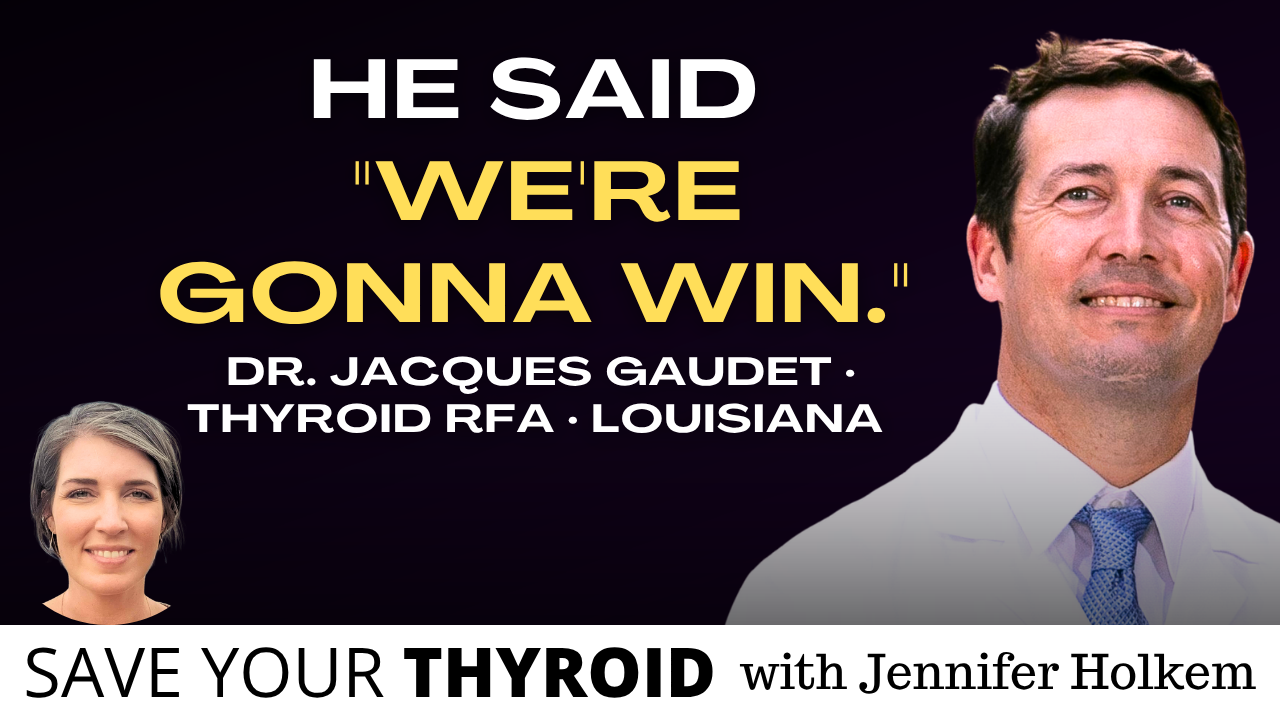
"We're Gonna Win." — Thyroid RFA in Louisiana with Dr. Jacques Gaudet | Save Your Thyroid
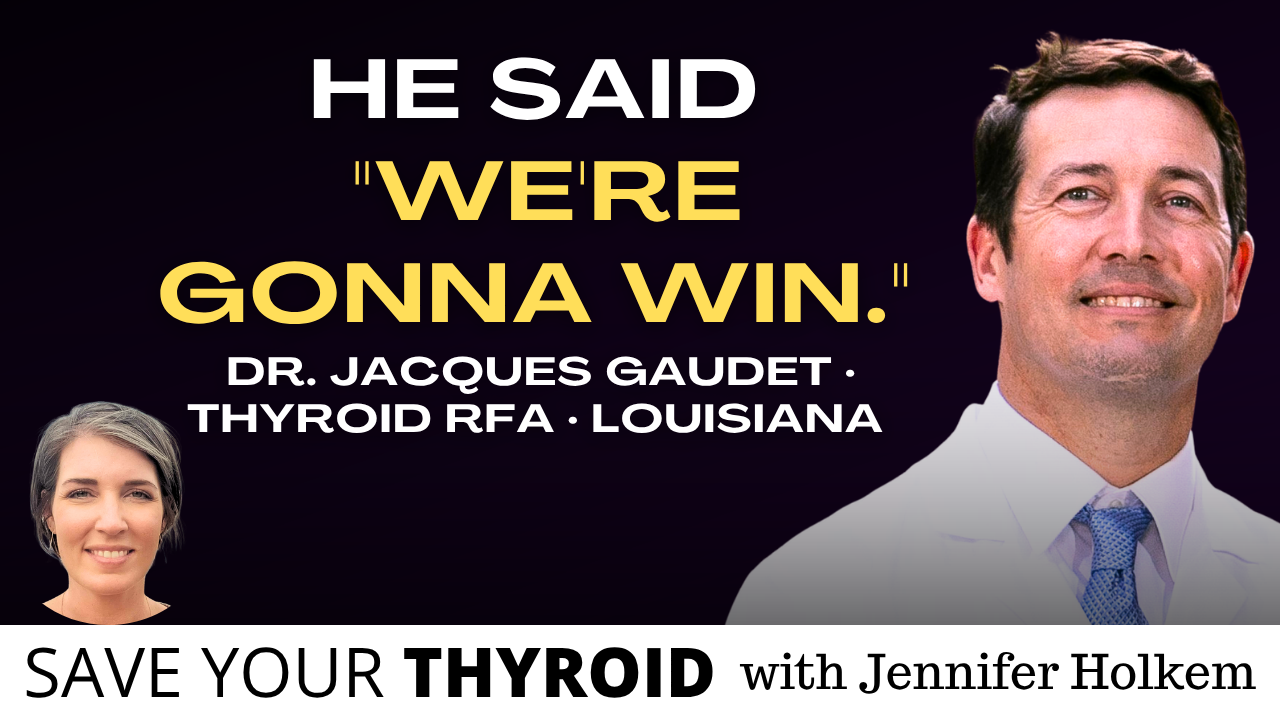
From the Operating Room to the Office: How One Surgeon is Bringing Non-Surgical Thyroid Care to the Bayou
When a patient is told they have a thyroid nodule, the immediate reaction is almost universally the same: panic. The mind instantly races to the worst-case scenarios, and for decades, the medical system offered a similarly dramatic solution: cut it out. For years, the standard of care for a suspicious or bothersome lump in the neck was a trip to the operating room, often resulting in the removal of half or all of the thyroid gland, leaving the patient dependent on lifelong hormone medication.
But medicine is evolving, and the push for less invasive options is gaining momentum—often driven by the very surgeons who spent their lives mastering the scalpel.
In a recent episode of the Save Your Thyroid with Jennifer Holkem podcast, I sat down with Dr. Jacques Gaudet, a board-certified Otolaryngologist and Head and Neck Surgeon at Southern ENT Associates. Dr. Gaudet serves a patient population scattered across Thibodaux, Raceland, and Houma, Louisiana. His story is a powerful look at what happens when a doctor refuses to accept that major surgery is the only answer for the person sitting in front of them.
A Foundation Forged in the Storm
To understand Dr. Gaudet’s approach to thyroid care, you have to look back at where his medical journey began: New Orleans, during the aftermath of Hurricane Katrina.
As a medical student and resident at LSU during that time, Dr. Gaudet found himself in a medical landscape that had been turned upside down. The traditional, stable hospital systems were fractured, and care was decentralized to satellite hospitals that lacked basic specialty services.
"We all knew that ultrasound-guided fine-needle aspiration of a thyroid nodule was step one, but getting that was in some ways almost impossible," he recalled.
Resource scarcity breeds innovation. Realizing his patients couldn't get the diagnostic care they needed, Dr. Gaudet decided he had to learn how to do it himself. He befriended general surgeons, radiologists, and ultrasound techs, absorbing everything he could about the technology. What started as a necessity born of a natural disaster turned into a lifelong passion for ultrasound-guided care—a skill that would eventually become the cornerstone of his practice.
The Surgeon Who Advocates for "Less"
Dr. Gaudet is a highly decorated surgeon. He was the recipient of the George G. Lyons Excellence in Otolaryngology Award and a three-time winner of the LSU ENT Resident Research Award. He has performed massive, complex cancer resections. Yet, when it comes to thyroid nodules, his philosophy is surprisingly conservative: less is more.
"Thyroid nodules are very common," Dr. Gaudet notes. "And with something that common, we should always lean towards less aggressive."
He views himself primarily as a staunch patient advocate. He shared a story about a skin cancer patient—a local shrimper who had just welcomed a new son and was terrified of a grim diagnosis. Dr. Gaudet’s response to him was simple: "We're gonna win." It’s an ethos he carries into his thyroid practice every day. Whether a nodule turns out to be nothing at all, or requires a complex intervention, his goal is to partner with the patient to find the path that preserves their health and their quality of life.
Bringing RFA to Southern Louisiana
Despite his drive to offer patients the best options, Dr. Gaudet didn't jump into new technology blindly. When he first heard whispers of Radiofrequency Ablation (RFA) for thyroid nodules—a procedure that uses a needle-like probe to heat and shrink a nodule from the inside out without surgery—he waited.
As a private practice physician in a smaller community, he needed hard data. He needed to know it was safe. By the time he attended the World Congress of Thyroid Cancer in 2019, the data was becoming undeniable. Once he saw the clinical proof, the hurdles vanished. He became the second physician in the entire state of Louisiana to offer Thyroid RFA.
For the 300,000 people living in the parishes his practice serves, this was a game-changer. Patients who previously had to travel to major city centers or out of state to save their thyroids now had a world-class option right in their own backyard.
What the Procedure is Actually Like
For many patients, the idea of an awake procedure on their neck sounds daunting. But the reality is surprisingly anti-climactic.
Because Dr. Gaudet is an expert sonographer—a skill honed since those post-Katrina days—he relies heavily on his own imaging. "You need to see it not just where you think the [RFA probe tip] is, you need to see the tip definitively," he explains.
The procedure takes place in the office, using the same ultrasound machine the patient is already familiar with. After some preoperative medication to calm the nerves and thorough local numbing, the ablation begins. Using his surgical knowledge of the neck's delicate anatomy—the trachea, carotid artery, and the recurrent laryngeal nerve—Dr. Gaudet safely navigates the probe.
Patients might hear a faint "popcorn" sound as the tissue is treated, but what surprises most of them is the lack of pain. Many report feeling nothing more than slight pressure, completely shocked when the procedure is over.
Redefining Success
One of the most important mindset shifts for patients undergoing RFA is understanding what success looks like. Unlike surgery, where the nodule is entirely removed in one day, RFA is a gradual process.
Dr. Gaudet explains that he looks for a 25%, 50%, or 75% reduction over a period of months. But the true measure of success isn't just the numbers on the ultrasound screen—it’s the quality of life. He often sees patients whose nodules shrink just 15% in the first month, yet their symptoms completely resolve. The cosmetic bulge vanishes. The choking sensation when swallowing disappears. They get their life back, and they get to keep their thyroid gland.
What You Need to Know Before Surgery
If you have a thyroid nodule and your doctor has recommended a total thyroidectomy, Dr. Gaudet’s advice is clear: ask why.
Are there suspicious nodules on both sides? Is there a massive goiter compressing your airway that can't be treated otherwise? If the answers aren't definitive, step back and evaluate.
"Do your homework," Dr. Gaudet advises. "Get a second opinion... Find a doctor you trust that does a fair amount of this."
A decade ago, surgery was often the only path. Today, the tide is shifting. Thanks to persistent patient advocates like Dr. Gaudet, patients have more options than ever to protect their bodies and preserve their thyroids.
You don't just have to watch and wait. And you don't automatically have to operate. But you have to get informed.
When Ablation Isn't the Answer: A Surgeon Who Does Both Explains


 Goodpods