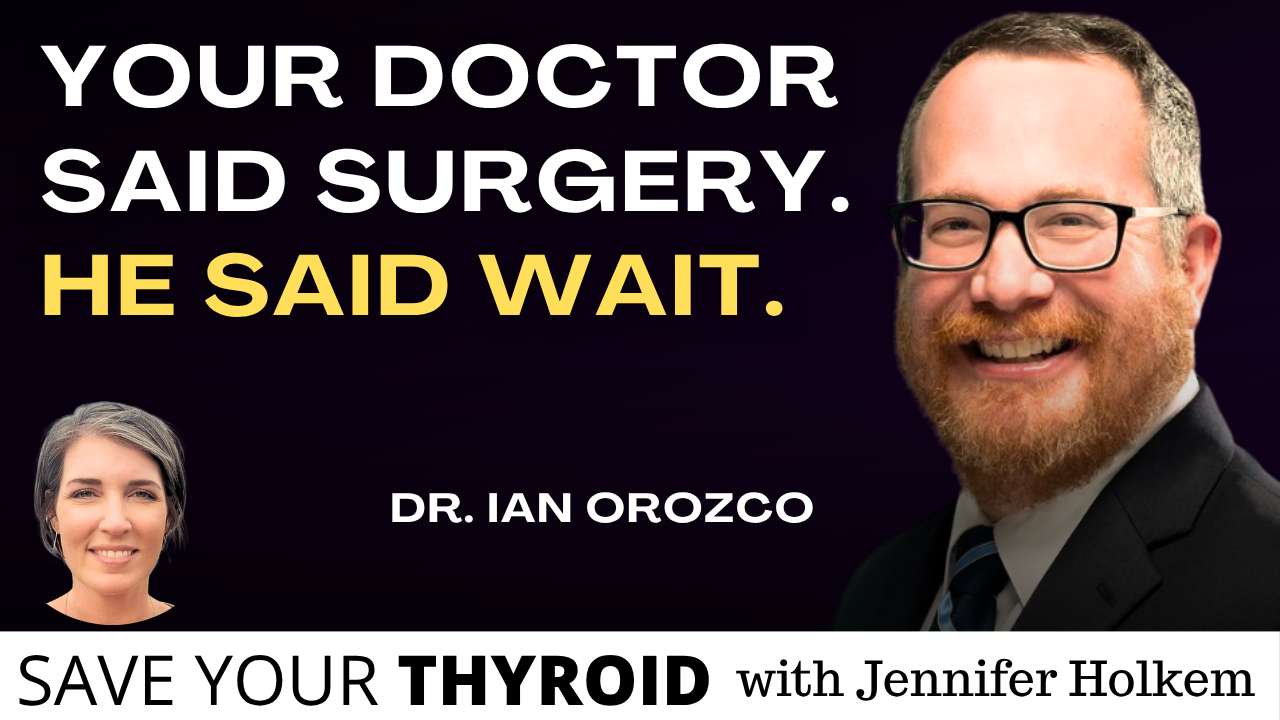
Stop Unnecessary Surgery: Dr. Ian Orozco Launches The NEW Thyroid Institute of Utah
Building a New Home for Thyroid Preservation: Dr. Ian Orozco’s Leap into Private Practice
For decades, the journey of a thyroid patient felt like a conveyor belt. You discover a nodule, you endure the anxiety of a biopsy, and if that lump is growing or causing symptoms, the referral is almost always the same: a consultation with a surgeon. The endocrinologist managed your hormones, and the surgeon managed the blade.
But a quiet revolution is happening in medicine, blurring the lines between these specialties. We are entering the era of the Interventional Endocrinologist—specialists who don't just diagnose and medicate, but actively treat and shrink nodules using minimally invasive technologies.
In the latest episode of the Save Your Thyroid with Jennifer Holkem podcast, I had the pleasure of sitting down with Dr. Ian Orozco. Based in Provo, Utah, Dr. Orozco is a board-certified endocrinologist and a regional pioneer in Radiofrequency Ablation (RFA). But we didn't just talk about the technology; we talked about a massive professional leap he just took to completely change how patients experience thyroid care.
Dr. Orozco has officially launched his own private clinic: The Thyroid Institute of Utah.
Breaking Away from the Bureaucracy For many physicians, working within a massive, multi-specialty hospital system is the safe route. But for Dr. Orozco, the red tape of traditional healthcare was getting in the way of patient care.
"I'm kind of living the dream right now," he shared during our interview. Separating from a larger hospital group allows him to build an environment from the ground up that caters exclusively to the modern, proactive thyroid patient.
This independence translates directly to patient access. In a traditional system, getting an appointment often requires a primary care referral, weeks of waiting, and navigating a labyrinth of hospital coordinators. At Dr. Orozco's new clinic, if a pregnant patient calls from the Salt Lake City airport in a panic about her thyroid, he can simply tell his staff to put her on the schedule and figure out the paperwork later. He even regularly coordinates "fly-in" weekends for out-of-state patients, allowing them to arrive on a Friday, have their RFA procedure on a Saturday, and fly home safely.
The Frustration with the Status Quo Despite the rapid advancement of non-surgical options like RFA, Dr. Orozco still sees the devastating effects of the medical community's slow adoption curve.
He recounted a recent consultation with a highly educated patient who had relocated from Boston. She had been seen at a top-tier medical institution for a benign, hyperfunctioning ("hot") nodule. It was the perfect size and location for RFA. Yet, the prestigious hospital only offered her two choices: radioactive iodine or surgical removal. RFA was never even brought up.
"I'm literally reading through her chart going, 'Please tell me she hasn't had surgery. Please tell me she hasn't had surgery,'" Dr. Orozco recalled. It’s a stark reminder that even in major medical hubs, patients are routinely fast-tracked to the operating room simply because their specific doctor doesn't perform thermal ablation.
The Best Part of the Day When you sit in a surgical consultation, the focus is often on the physical removal of the problem. But for an Interventional Endocrinologist like Dr. Orozco, the ultimate victory is functional preservation.
When asked about the most rewarding part of his job, he didn't point to the cosmetic results or the lack of a neck scar. Instead, he pointed to the prescription pad. When a patient comes in with a toxic, hyperfunctioning nodule that is actively suppressing their system, Dr. Orozco can use RFA to precisely target and ablate the malfunctioning tissue while leaving the healthy gland untouched.
"There isn't a whole lot in my office that makes me smile more... than when I can take someone's medication away and they don't have to take it anymore," he explained. He frequently tells these patients to take their anti-thyroid pill on the morning of their procedure, and then never take it again.
A One-Stop Shop for the Future The Thyroid Institute of Utah isn't just an RFA clinic; it is a vision for the future of comprehensive thyroidology.
Because he is no longer bound by a hospital's purchasing committees, Dr. Orozco is rapidly expanding his in-office toolkit. He is bringing back Medical Grade Ethanol Ablation to treat massive fluid-filled thyroid cysts. He is implementing advanced ultrasound elastography to measure the stiffness of nodules before treatment. He is even working on building his own in-office "hot lab" so he can offer radioactive iodine without sending patients away to a separate radiology center.
His goal is clear: outside of a direct need for surgery, he wants to handle every aspect of a patient's thyroid care under one roof, with the staff they already know and trust.
What You Need to Know If you take one thing away from Dr. Orozco’s story, let it be this: Surgery is not your only choice. If you are facing a thyroid nodule diagnosis, do not let the convenience of a surgeon's schedule dictate the rest of your life. Take the time to seek out a physician who understands the entire landscape of non-surgical options. Whether it requires a drive across town or a flight into Provo, Utah, finding an expert who will fight to keep your thyroid intact is a journey worth taking.
You can listen to my full interview with Dr. Ian Orozco here.
nsPFA: Zero Regrowth at 22 Months! The Durability Data Thyroid Patients Need


 Goodpods