Too Big for Thyroid RFA? This Nonsurgical Treatment Can Shrink Massive Goiters - Dr. Juan Camacho
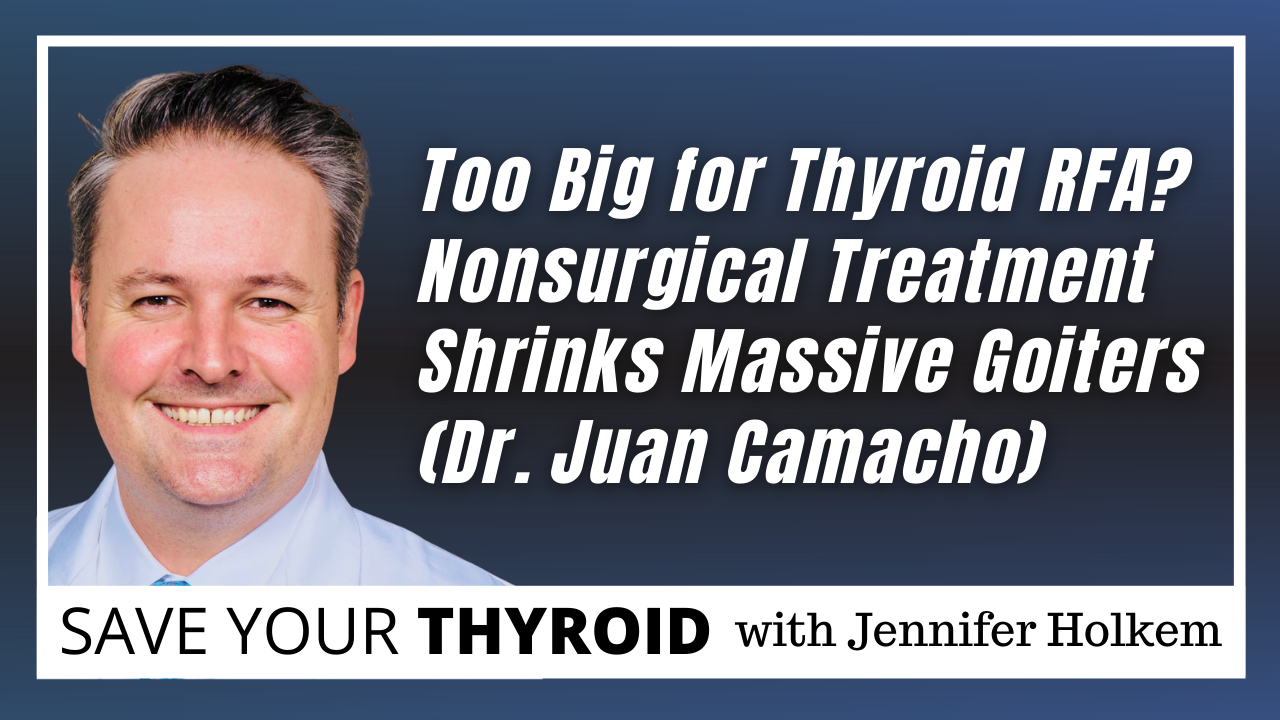
Beyond the Scalpel: How Pressure-Enabled Embolization is Shrinking Massive Goiters
For years, patients facing the diagnosis of a massive, compressive goiter were given a single, terrifying path forward.
When a thyroid grows so large that it dives deep into the chest cavity—sometimes even behind the heart or collapsing a lung—traditional surgery becomes a monumental undertaking. In the most severe cases, it requires a sternotomy: Cracking the chest bone. A highly invasive procedure with a grueling recovery.
Then came the ablation revolution. Radiofrequency ablation (RFA) and microwave ablation (MWA) changed the landscape of thyroid care, offering a way to treat nodules with just a needle and heat. But as incredible as these technologies are, they have a size limit. For massive goiters—those well over 20 milliliters—ablation often falls short, leaving patients right back where they started: facing the operating table.
But there is another way.
The "Heat Sink" Problem: Why Ablation Fails for Giants
To understand why a massive goiter can't just be ablated away, you have to understand a physical phenomenon called the "heat sink" effect.
As goiters grow, they become incredibly vascular. They demand more blood supply, creating a massive web of enlarged arteries to feed the rogue, multiplying cells. When a doctor tries to deposit heat into this highly vascular tissue using an ablation probe, that rushing blood acts like a coolant.
Dr. Juan Camacho, an interventional radiologist at the absolute forefront of thyroid treatment innovation, uses a brilliant analogy: Imagine having the Hoover Dam ready to unleash a torrent of water on top of a tiny campfire. The fire simply doesn't stand a chance. The blood flow steals the heat faster than the probe can deliver it, making traditional thermal ablation ineffective for these giant glands.
A Powerful Alternative: Pressure-Enabled TAE
Instead of trying to out-burn the blood supply, Thyroid Artery Embolization (TAE) takes the opposite approach: it cuts the blood supply off.
By threading a tiny catheter into the arteries feeding the thyroid and delivering microscopic particles to block the flow, TAE induces a controlled cell death. Deprived of blood, the overgrown tissue simply starves, dies off, and is naturally reabsorbed by the body.
But Dr. Camacho and his colleagues are taking this decades-old technique into the future with something called Pressure-Enabled Delivery (PED-TAE).
Using a specialized catheter equipped with a "smart valve" at the tip—which Dr. Camacho affectionately compares to an inverted umbrella or a tiny pet "cone of shame"—this device does two critical things. First, it creates a pressure vortex that forces the embolic particles much deeper into the thyroid tissue than a standard catheter ever could. Second, the umbrella catches any particles that try to wash backward.
This anti-reflux mechanism is vital. It drastically minimizes the already rare risk of non-target embolization (particles escaping to the brain and causing a stroke), making the procedure incredibly safe. Best of all? It can usually be done entirely through a small access point in the patient's wrist. No neck scars, no chest incisions, and you walk out of the hospital the same day.
The Remarkable Transformation
The results of this refined technique are nothing short of astounding. In Dr. Camacho’s recently published study evaluating 22 patients with complex, massive goiters, the data spoke volumes:
- 100% technical success.
- Zero neurovascular complications.
- A 73% median volume reduction in just six months.
To put that in perspective, the average thyroid volume in this study was 117 milliliters—nearly six times the size limit where standard ablation loses its effectiveness.
Furthermore, for those suffering from hyperthyroidism (an overactive thyroid caused by the goiter), 71% saw their hormone levels return completely to normal.
As Dr. Camacho points out, the goal isn't necessarily a 100% reduction in size. The goal is giving you your life back. A 73% reduction in a massive goiter means the pressure is gone. The breathing is restored. The swallowing is effortless again.
Setting a New Standard of Care
Because of these profound outcomes, Dr. Camacho is currently leading the PROTECT Registry, a multi-center research study across 10 renowned institutions nationwide, including the Mayo Clinic and UCSF.
What makes the PROTECT study so groundbreaking isn't just that it's proving the safety and efficacy of PED-TAE on a national scale. It's what they are measuring. Their primary outcome isn't just ultrasound measurements or blood tests—it is a validated, objective Quality of Life questionnaire. They are proving that success in thyroid care must be defined by how the patient actually feels.
What You Should Know If You're Facing Surgery
If you have been diagnosed with a massive, compressive goiter and are being pushed toward a sternotomy or a highly invasive total thyroidectomy, Dr. Camacho offers this vital piece of advice: Advocate for yourself. All medical practitioners carry some degree of inherent bias toward the treatments they know best. But you are in the driver's seat of your own health. Do not accept being boxed into a single option without exploring all of your alternatives. Demand to know what else is out there, and if your doctor isn't aware of techniques like TAE, seek out a consultation with an interventional radiologist who is.
You don't have to choose between a massive chest surgery and living in misery. The tools exist. The experts exist. You just have to know where to look.
Ready to Learn More?
Listen to the full conversation with Dr. Juan Camacho in the newest episode of the Save Your Thyroid with Jennifer Holkem podcast, where we dive deep into the science of the "heat sink" effect, the safety profile of PED-TAE, and exactly how the PROTECT study is expanding access for patients nationwide.
If you are currently facing a complex thyroid surgery recommendation and want to explore your options, visit the Save Your Thyroid patient community at saveyourthyroid.org, where you can connect with patients who have successfully navigated these alternative treatments.
To stay up to date on new episodes, research trials, and expert interviews, be sure to subscribe to the mailing list at saveyourthyroidwithjen.com.

From Thyroidectomy to TAE: How One Woman Avoided Surgery and Kept Her Thyroid