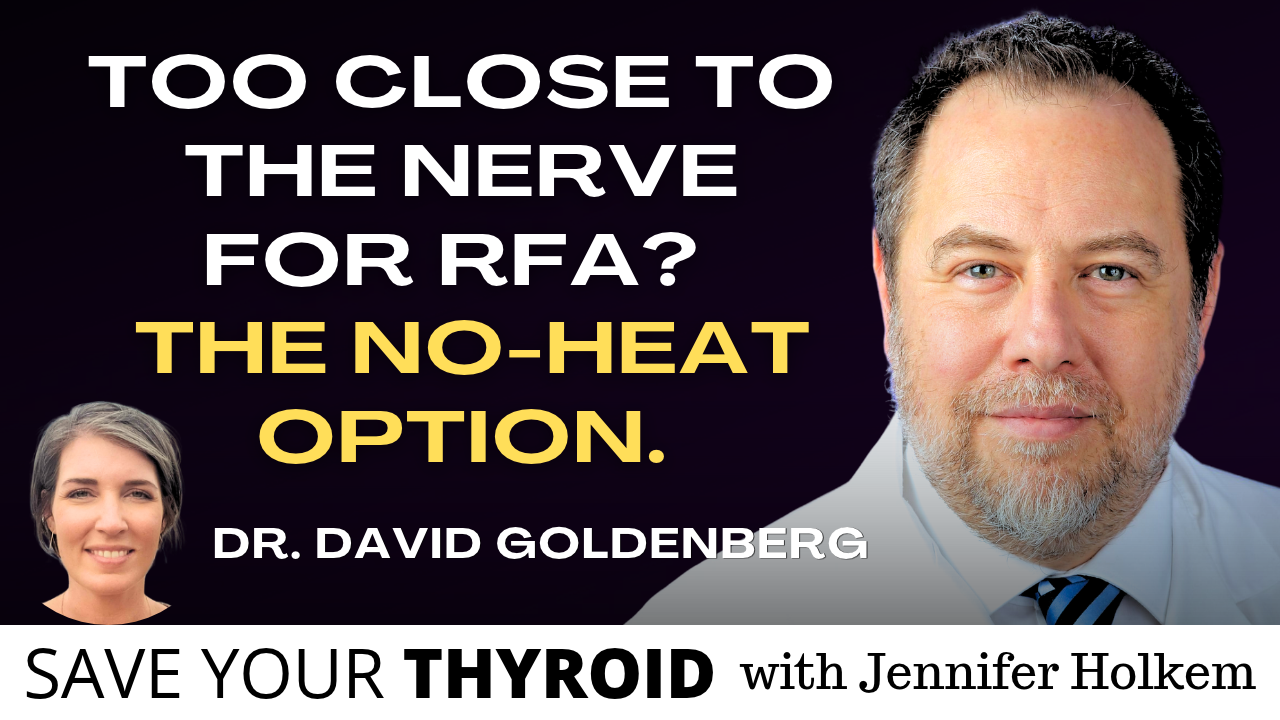
Nanopulse or RFA for Thyroid Nodules? A Surgeon Who Does Both Explains | Dr. David Goldenberg
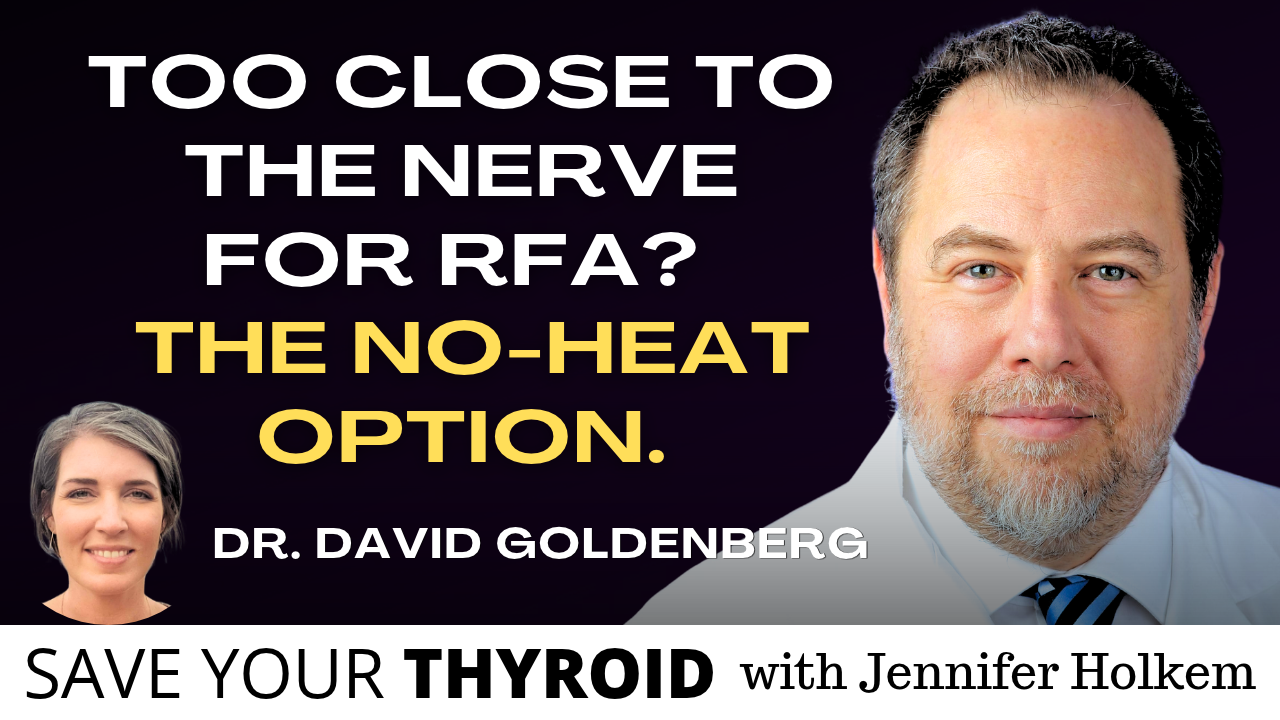
SAVE YOUR THYROID with Jennifer Holkem, episode 132
For years, one of the most common messages I’ve gotten from this community goes something like this: “I was told I’m not a candidate for RFA because my nodule is too close to the nerve.” Those patients were often left with only one option, which was surgery.
Nanosecond pulsed field ablation, or “nanopulse,” is starting to change that. It doesn’t use heat. Whenever a new technology arrives, the same questions follow. Is it better than RFA? Will it replace RFA? Is it right for me?
In Episode 132 of Save Your Thyroid with Jennifer Holkem, Dr. David Goldenberg comes back to the show to answer those questions. He is Chair of Otolaryngology–Head and Neck Surgery at Penn State Health and one of the few physicians in the U.S. who performs thyroid surgery, RFA, and nanopulse. He was trained at Johns Hopkins and has written more than 275 peer-reviewed articles, 40 book chapters, and eight books. He also leads Penn State’s thyroid ablation training course. And he has no interest in turning this into a competition.
Welcome back to Save Your Thyroid with Jennifer Holkem. This is the space where we bridge the gap between the standard of care and the future of medicine. My mission is to empower you with the knowledge you need to avoid unnecessary surgery and keep your thyroid intact for the long haul.
🎧 In today’s episode, we’re covering:
- What makes nanopulse different from RFA, and why that difference matters near the voice nerve
- The “danger triangle” and how nodule location shapes treatment decisions
- Why Dr. Goldenberg sees nanopulse as complementing RFA, not replacing it
- What the 22-month durability data shows, and what it doesn’t yet
- Why post-ablation ultrasounds get misread, and why TI-RADS doesn’t apply to treated nodules
- What the procedure is actually like, and why most nanopulse patients are asleep
- Cystic vs. toxic nodules: where each technology has performed best in his hands
- Where “dead” nodule tissue actually goes (this one changed how I understand my own nodule)
- Nanopulse for recurrent thyroid cancer in the lymph nodes
- Who is not a candidate for any ablation
- Insurance, availability, and the question every patient should ask
If you’ve been told your nodule is in a difficult location, or you’re trying to decide between RFA and nanopulse, this episode will help you walk into your next consultation with better questions.
Heat vs. No Heat: The Fundamental Difference
RFA works by generating heat to destroy nodule tissue. It’s effective and well studied. But heat travels, and in the thyroid you’re working within millimeters of the recurrent laryngeal nerve (which controls your voice and helps you swallow), the trachea, the esophagus, and the carotid artery.
Nanopulse takes a different approach. It delivers extremely short electrical pulses that disrupt the cells and trigger the body’s natural cell death process, without relying on thermal injury.
Dr. Goldenberg was quick to add that this doesn’t make RFA unsafe:
“That’s just not true. RFA in experienced hands is remarkably safe and remarkably effective… but it gives us another way of destroying tissue that is clinically important.”
The Danger Triangle
The classic case where heat carries more risk is a nodule that extends toward the back of the thyroid. Dr. Goldenberg calls that area the “danger triangle.” It sits between the nodule, the trachea, and the recurrent laryngeal nerve.
With RFA, that doesn’t necessarily rule a patient out, but it changes the approach. That might mean hydrodissection (injecting a fluid buffer between the nodule and critical structures), lower power settings, or intentionally leaving a small margin of untreated tissue. Nanopulse gives physicians more room to work in those areas.
“It doesn’t eliminate the need for experience and meticulous technique, because you can certainly hurt someone with all of these. The recurrent nerve is still the recurrent nerve, but it gives us a larger, what we like to call, therapeutic window of safety.”
Complement, Not Competition
This is the question I hear most from patients: is nanopulse going to replace RFA? Dr. Goldenberg’s answer was clear.
“I see nanopulse as complementing radiofrequency ablation. And I really would resist framing this as RFA versus nanopulse.”
He continues to treat patients with RFA and believe strongly in it, and some patients, he says, need RFA and not nanopulse.
“The future of thyroid ablation isn’t going to be one technology winning and one losing. It’s going to be physicians understanding all of these technologies well enough to help make the right selection together with the patient.”
Does It Last? The Durability Question
We talked through the 22-month data Professor Stefano Spiezia presented at NASIT. (If you missed that episode, it’s linked below.) The early results show substantial volume reduction, and they’re encouraging. But Dr. Goldenberg insisted on scientific discipline.
“RFA has years more of follow-up regarding a larger number of patients… Nanopulse just doesn’t have the depth of evidence yet. I would describe the durability as very encouraging but still maturing.”
That’s why he asks every ablation patient, RFA or nanopulse, to commit to an annual ultrasound. He says not one patient has hesitated.
A Warning About Follow-Up Ultrasounds
This part of the conversation hit a nerve for me, because it comes up in our community constantly. A patient has a successful ablation and is thrilled with the results. Then they go to a local imaging center where the sonographer isn’t familiar with ablation, sees the treatment changes, and upgrades the nodule’s TI-RADS score.
“TI-RADS is only for an untreated nodule.”
Treated nodules look different on ultrasound, and that’s expected. Size and volume reduction rate aren’t the same measurement. Dr. Goldenberg is publishing studies with radiology colleagues to help close this gap. In the meantime, if you travel for treatment, try to arrange follow-up with someone experienced in ablation. The physicians on the Save Your Thyroid physician finder perform their own ablations and ultrasounds.
What the Procedure Is Actually Like
From the outside, nanopulse and RFA look nearly identical: an ultrasound-guided needle procedure, done after local anesthesia, with the same careful mapping of critical structures. The difference is in the experience.
Most of Dr. Goldenberg’s RFA patients are awake. That’s intentional, because being able to talk during the procedure confirms the heat isn’t reaching the nerve. Most of his nanopulse patients are sedated. That’s not because it hurts. The electrical pulses cause muscle twitching.
“Although it’s not painful, people find it disconcerting.”
Having observed a nanopulse procedure myself, I can confirm that it really does look the same from the sidelines. The sedation is similar to what you’d have for a colonoscopy, a short nap you won’t remember.
Recovery is the same either way. You’ll need a driver, ice on your neck for 24 hours, and Tylenol or ibuprofen if needed, and most people are back to normal activity the next day.
Cystic vs. Toxic Nodules: What He’s Seeing So Far
Dr. Goldenberg has performed RFA for more than six years and nanopulse for almost one. His early observations:
“For a purely cystic nodule or a nodule where the vast majority of it is cystic, I still think that thermal ablation is king.”
“On the other hand, for toxic nodules, meaning nodules that are secreting thyroid hormone, I have been less than enthused with radiofrequency ablation. And I’m thrilled with nanopulse, giving the patient better results and quicker results.”
He was careful to frame these as lessons from his own practice, not hard rules. There are only about a dozen physicians in the U.S. performing nanopulse for thyroid, and he says they’re all still learning the nuances together.
“I’ve Had Three Patients Like That This Morning”
I asked whether he’d ever had a patient who would have gone straight to surgery in the past but was now a nanopulse candidate. His answer surprised me.
“I had two patients who came in thinking they need surgery and they’re going to get nanopulse ablation. And I had one patient who came for ablation who is going to be leaving with surgery, because that’s the right thing to do.”
That’s what a practice offering all three options looks like: surgery, ablation, and observation. He’s emphatic that observation counts as a real treatment option. He also doesn’t hesitate to say no when a patient insists on something he doesn’t believe is right for them.
“I don’t bully my patients into surgery, and I don’t let them bully me into doing things that I don’t believe are the moral and ethical and correct thing to do for them.”
My Learning Moment: It’s Not a Dead Zone
Dr. Goldenberg confirmed that nanopulse can treat tissue left behind after RFA. He’s done it. Most of the shrinkage from RFA happens within about a year, and nanopulse can work on what remains, just like any other thyroid tissue.
Then I asked whether he was treating live tissue or dead tissue when he went back in, and his answer changed how I understand my own nodule.
“The dead tissue is eaten up by macrophages and removed from the body… It’s not a dead zone.”
My nodule was 65–75 mL before RFA, and I have about 6 mL left. For years I pictured that remaining piece as a dead core. But the body clears away dead tissue, and that’s how the shrinkage happens. What’s left behind is live tissue.
Nanopulse for Recurrent Thyroid Cancer
This is the area Dr. Goldenberg says he’s most excited about. RFA and microwave ablation are already being used for recurrent thyroid cancer in the lymph nodes, and he’s beginning to explore nanopulse in carefully selected patients. That includes cases where surgery could cause significant harm, frail patients who might not survive surgery, and patients facing yet another operation who say no more.
“Reoperative thyroid surgery, trust me, can be very challenging. The tissue is scarred, and it’s near some very important things.”
He was also very clear about the limits:
“I want to emphasize this is not a replacement for appropriate thyroid cancer surgery or systemic treatment.”
In this setting, success is measured differently. The goal is local control: shrinking a lesion and stopping it from progressing, not necessarily a cure. Every case needs a team evaluation and a clear answer to the question of what treatment is trying to accomplish.
When the Answer Is No
Patients aren’t always good candidates for nanopulse, and most of the time, Dr. Goldenberg says, that’s because they’re not good candidates for any ablation. That includes nodules causing no symptoms, symptoms that the nodule can’t plausibly explain (often reflux instead), nodules extending below the breastbone, areas hidden behind bone, and diffuse goiters with no defined target.
“The question isn’t, can I just put an electrode in it? The question is, is ablation the appropriate treatment for this patient?”
His decision process runs in a specific order. He starts with the patient. Then he looks at the disease (benign, indeterminate, or malignant) and asks whether it needs treatment at all. Then the goal, then the anatomy, and only then the technology.
“My job is not to sell them a procedure. My job is to determine which treatment makes the most sense for whatever is ailing them.”
Insurance, Availability, and Training
Nanopulse has FDA clearance for soft tissue ablation, but adoption for thyroid is still early. Dr. Goldenberg points out that RFA went through the same path: early adopters, training programs, growing evidence, society involvement, and then broader adoption.
Insurance is following the same frustrating path RFA did. Coverage for nanopulse is inconsistent and can vary by insurer, indication, and even region within the same state.
“The clinical question of can we do it and the reimbursement question, will insurance cover it, are unfortunately not the same question.”
His advice is to discuss coverage directly with the treatment center before you commit.
For physicians already proficient in RFA, he says the transition isn’t hard, because the hardest skills aren’t specific to one device. He still recommends structured training: an RFA course plus proctoring with someone already performing nanopulse.
The Most Important Thing to Know Before Your Consultation
Don’t walk in asking for a specific technology.
“It’s like someone coming to me for surgery and saying, I want you cutting with this knife, but not that scissors.”
Start with a diagnosis. Find a physician who understands the full range of options, including observation, surgery, and minimally invasive treatments. Then ask them to walk you through their reasoning: why this option for me, and why not the others?
Key Takeaways from Episode 132:
- No heat. Nanopulse uses electrical pulses instead of heat, which matters most for nodules near the voice nerve.
- Complement, not competitor. Dr. Goldenberg uses both RFA and nanopulse, and some patients still need RFA.
- New candidates. Some patients told they can’t have RFA because of nodule location may qualify for nanopulse.
- Promising but early. The durability data is encouraging, but RFA has far more long-term evidence.
- Nodule type matters. In his experience, RFA works best for cystic nodules and nanopulse for toxic nodules.
- Recurrent thyroid cancer. He’s exploring nanopulse for carefully selected patients whose cancer has come back in the neck.
- Access is limited. Only about a dozen U.S. physicians offer it, and insurance coverage is inconsistent.
- Ask why, not for a device. Get a diagnosis first and see someone who offers every option, including observation and surgery.
For more on nonsurgical thyroid nodule treatments like RFA, microwave ablation, TAE, and nsPFA, be sure to subscribe!
Watch this episode on YouTube, or download for offline viewing on YouTube Music!
🔗https://youtu.be/KkQhoYJqba8?si=1uGNNUwiKlIS7f2U
Missed the durability episode? Watch Professor Stefano Spiezia break down the 22-month nsPFA data:
🔗 https://youtu.be/C149GI8iBnw
Connect with Dr. David Goldenberg at Penn State Health:
📞 717-531-6822. Ask about minimally invasive thyroid treatment or thyroid ablation.
Find a physician near you:
🔗 saveyourthyroid.org
Book a patient navigation consult:
🔗 saveyourthyroidwithjen.com/p/patient-navigation-services
Please consider supporting my work. Every donation is sincerely appreciated!
Venmo | Paypal
Disclaimer: None of the statements made in this or any other blog/video by “Its me Jen again” should be considered medical advice.
The goal of this podcast and blog: I seek to provide data, resources, and expert opinions on the topic of thyroid nodules, and make it accessible to patients. This material is meant to help patients understand what’s going on in their thyroid gland and what an important gland it is. If you can keep your thyroid intact, that’s going to help you live a longer, healthier life, and preserve your quality of life. Thanks for reading this far today! — Jen
Do You Really Need Thyroid Surgery? 3 Patient Cases from Weill Cornell Surgeons



 Goodpods